Prediction markets transform dispersed information into price signals by allowing users to trade shares tied to event outcomes. These prices are often interpreted as the market’s consensus probability of future events. While this mechanism has long existed in betting and financial derivatives, traditional platforms are often constrained by geography, limited transparency, and custodial risks.
With the rise of crypto-based prediction markets, the space has split into two distinct paths. One, represented by Polymarket, emphasizes on-chain transparency and global accessibility. The other, represented by Kalshi, prioritizes regulatory compliance and institutional participation. The contrast between these approaches is becoming central to whether prediction markets can enter mainstream finance.
Overview of Polymarket and Kalshi
At a high level, Polymarket and Kalshi embody two fundamentally different design philosophies.
Polymarket operates on blockchain infrastructure, using stablecoins for settlement. Users participate through wallets, and the platform does not custody funds. Trading and settlement are handled by smart contracts, resulting in high transparency and openness.
Kalshi, by contrast, is a CFTC-regulated event contracts exchange built on traditional financial infrastructure. Users must register accounts and complete identity verification. Funds are held by the platform, and trading and clearing occur within centralized systems, closely resembling traditional derivatives exchanges.
In essence, Polymarket emphasizes decentralization and openness, while Kalshi focuses on compliance and integration with the financial system.
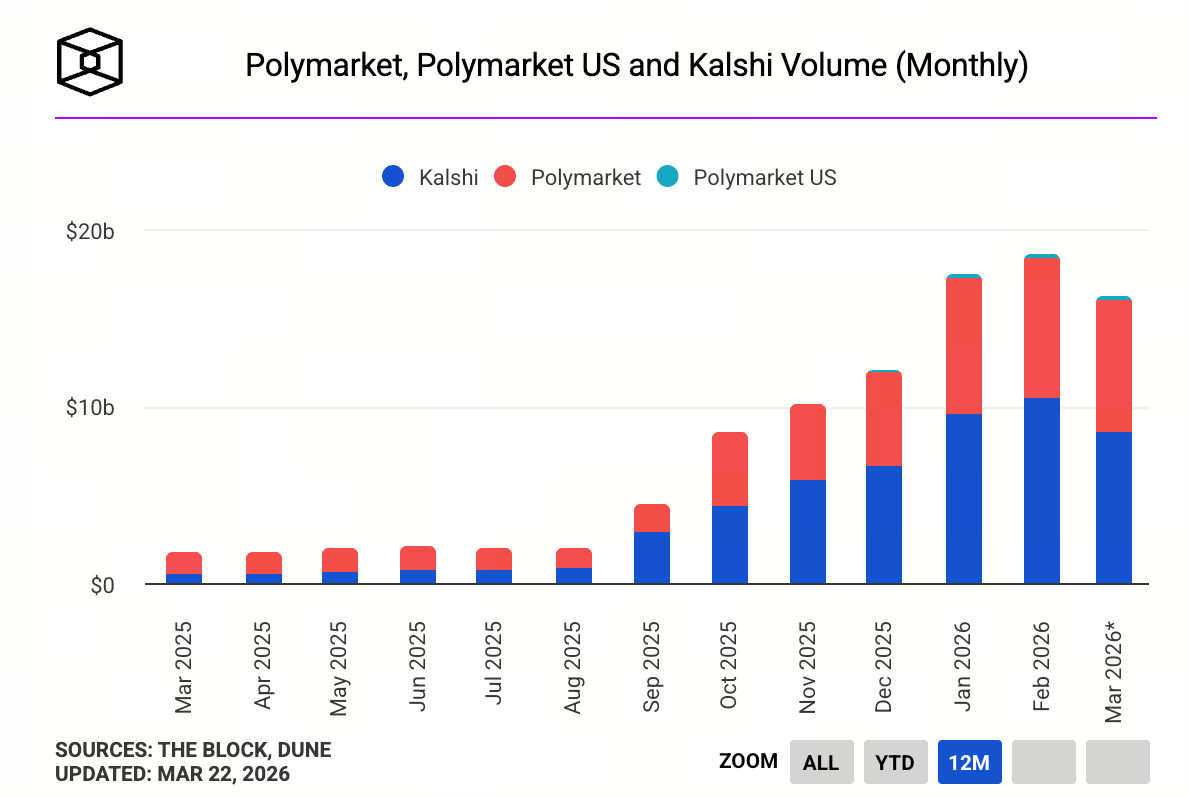
Source: The Block
What Are the Core Differences Between Polymarket and Kalshi?
The fundamental distinction is between a decentralized on-chain protocol and a regulated centralized exchange. Polymarket prioritizes global accessibility, while Kalshi prioritizes legal certainty.
This difference extends beyond technology into regulation, user base, and risk distribution.
| Dimension |
Polymarket |
Kalshi |
| Type |
Decentralized prediction market |
Regulated exchange |
| Technology |
Blockchain, smart contracts |
Centralized system |
| Regulation |
Uncertain |
CFTC-regulated |
| Assets |
USDC |
USD |
| Users |
Global |
Primarily US |
| Trading Hours |
7月24日 |
Fixed trading hours |
Differences in Trading Mechanisms and Architecture
From a trading perspective, Polymarket resembles a DeFi exchange, where prices are driven in real time by on-chain supply and demand. Kalshi, on the other hand, operates more like a traditional futures or options exchange, relying on centralized matching systems.
| Dimension |
Polymarket |
Kalshi |
| Architecture |
Blockchain, smart contracts |
Centralized system |
| Trading Mechanism |
On-chain order book or AMM |
Central matching engine |
| Settlement |
USDC stablecoin |
USD |
| Custody |
Non-custodial |
Platform custody |
| Trading Hours |
24/7 |
Fixed trading sessions |
Differences in Regulation and Asset Types
Regulation is the most critical differentiating factor.
Polymarket is globally accessible and allows flexible market creation. This enables rapid listing of new events and broader topic coverage, but also introduces uncertainty, especially across different jurisdictions.
Kalshi takes the opposite approach. All contracts must go through regulatory approval, making product design and listing more stringent. This reduces legal risk and makes the platform more appealing to institutional investors, but limits flexibility and slows innovation.
In short, Polymarket offers greater freedom, while Kalshi offers greater certainty.
Differences in User Experience and Access
The user journey also differs significantly.
Polymarket uses wallet-based access. Users can participate simply by connecting tools like MetaMask. This lowers entry barriers globally but requires familiarity with crypto assets.
Kalshi follows a traditional financial onboarding process. Users must create accounts and complete KYC verification, resulting in an experience closer to stock or futures trading platforms. While compliant, it is less flexible and less anonymous.
In simple terms, Polymarket’s barrier lies in technical familiarity, while Kalshi’s lies in regulatory requirements.
Use Cases: When to Choose Polymarket vs Kalshi
In practice, the two platforms serve different audiences and use cases.
Polymarket is better suited for crypto-native users who want to trade on global events, especially in areas like politics, crypto markets, or breaking news. Its 24/7 trading and non-custodial structure also appeal to active traders and strategy developers.
Kalshi is more suitable for users who require a regulated environment, such as US-based investors or institutions. Its products in macroeconomics, weather, and sports are more standardized and easier to integrate into traditional portfolios.
Risk Comparison: Polymarket vs Kalshi
Overall, Polymarket presents more distributed risks, including technical and regulatory uncertainty as well as market volatility. Kalshi’s risks are more concentrated at the platform level but are relatively controlled under regulatory oversight.
| Risk Type |
Polymarket |
Kalshi |
| Regulatory Risk |
High |
Low |
| Technical Risk |
Smart contract risk |
Low |
| Custody Risk |
Low, non-custodial |
Medium, platform custody |
| Liquidity Risk |
Lower in some markets |
More stable |
Conclusion
Polymarket and Kalshi represent two distinct directions for prediction markets. Polymarket is built on blockchain principles, emphasizing openness and innovation. Kalshi relies on regulatory frameworks, focusing on stability and institutional participation.
In the short term, both models are likely to coexist, serving different user groups. In the long run, whether prediction markets can become mainstream information infrastructure will depend on regulatory evolution, institutional adoption, and broader public understanding of probabilistic markets.
For individual users, the choice ultimately depends on location, risk tolerance, and intended use.
FAQs
What is the biggest difference between Polymarket and Kalshi? Polymarket is a decentralized on-chain platform, while Kalshi is a regulated centralized exchange.
Which platform is safer? From a regulatory standpoint, Kalshi is safer. From a fund control and transparency perspective, Polymarket offers advantages.
Why do prices differ between Polymarket and Kalshi? Differences in user base, liquidity, and regulatory constraints can lead to different probability pricing for the same event.
Can I use both Polymarket and Kalshi? Yes. Some traders even use price differences between the two as market signals.