Solana Mobile officially launched its native token, SKR, today (21st), marking a shift in its incentive model from the Saga phone’s “random wealth effect” to a more scalable and sustainable “mobile ecosystem economy” with the second-generation Seeker device.
This article presents a comprehensive analysis of SKR’s tokenomics and offers a neutral perspective on its long-term development, examining potential future challenges for Solana Mobile and how SKR, as a “launch lever,” could drive growth in its open platform’s application ecosystem.
SKR Is Now Claimable—How Is the Price Responding?
Solana Mobile opened SKR token claims today (21st). As the Solana ecosystem’s first native asset to deeply align the interests of mobile holders, developers, and protocol participants, SKR’s debut has captured significant market attention.
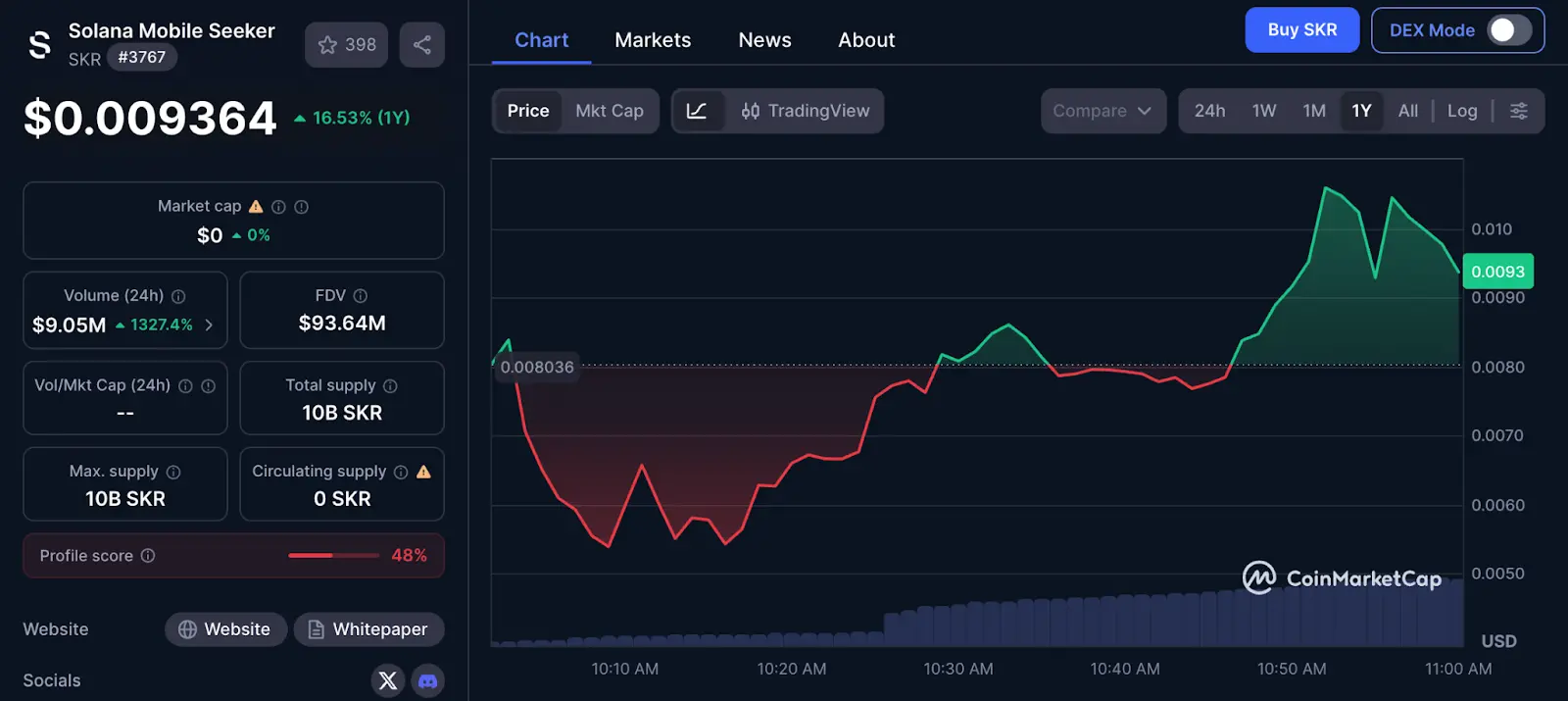
Data shows SKR traded between $0.006 and $0.01 in its first hour. At the current price of about $0.0095, entry-level Scout tier holders received an airdrop worth $47.5, while top-tier Sovereign holders received $7,125. Compared to the Seeker phone’s original presale cost of $450–$500, the highest return exceeded 14x.
As the first wave of liquidity hits the market, attention is shifting to the proportion of tokens staked by long-term holders, which will determine whether SKR can transition from short-term speculation to sustained governance momentum.
Solana Mobile’s Vision and the Mission of Seeker, Its Second-Generation Phone
Solana Mobile’s vision recognizes the current mobile network ecosystem is dominated by Apple and Google’s longstanding duopoly. These two platforms control app distribution, payment channels, and set the rules—contradicting Web3’s open ethos. Solana Mobile’s mission goes beyond hardware manufacturing; it aims to build a truly open, permissionless mobile platform.
The first-generation Saga phone’s explosive popularity was largely due to third-party projects (like BONK and other tokens) offering random airdrops. This “blind box” wealth effect drew attention but raised concerns about the sustainability of such incentives.
To convert fragmented traffic into long-term, predictable ecosystem growth, Solana Mobile launched the Seeker phone and the Seeker Season incentive program. Seeker is not just a hardware upgrade—it’s a gateway to the Solana Mobile ecosystem.
Since shipments began in August 2025, Seeker pre-orders have exceeded 150,000 units. Its competitive edge lies in transforming its incentive model: by introducing the native SKR token, Solana Mobile has institutionalized its rewards system, aiming for deeper alignment among users, developers, and the platform.
SKR Tokenomics and the TEEPIN Framework
Official disclosures set SKR’s initial total supply at 10 billion, using a linear decreasing inflation model to balance early growth and long-term stability. The first-year inflation rate is 10%, falling by 25% annually, and eventually stabilizing at 2%. Solana Mobile aims to build an “ecosystem flywheel” with SKR, powering the long-term development of decentralized mobile hardware and crypto applications.
In Seeker Season 1, nearly 2 billion SKR were allocated to ecosystem contributors—20% of total supply. After anti-sybil review, 100,908 users qualified for the airdrop.
User allocation tiers:
- Scout: 5,000 SKR
- Prospector: 10,000 SKR
- Vanguard: 40,000 SKR
- Luminary: 125,000 SKR
- Sovereign: 750,000 SKR
To incentivize early developers, 141 million SKR will be distributed to 188 developers who launched quality apps in the Seeker ecosystem, with each receiving 750,000 SKR.
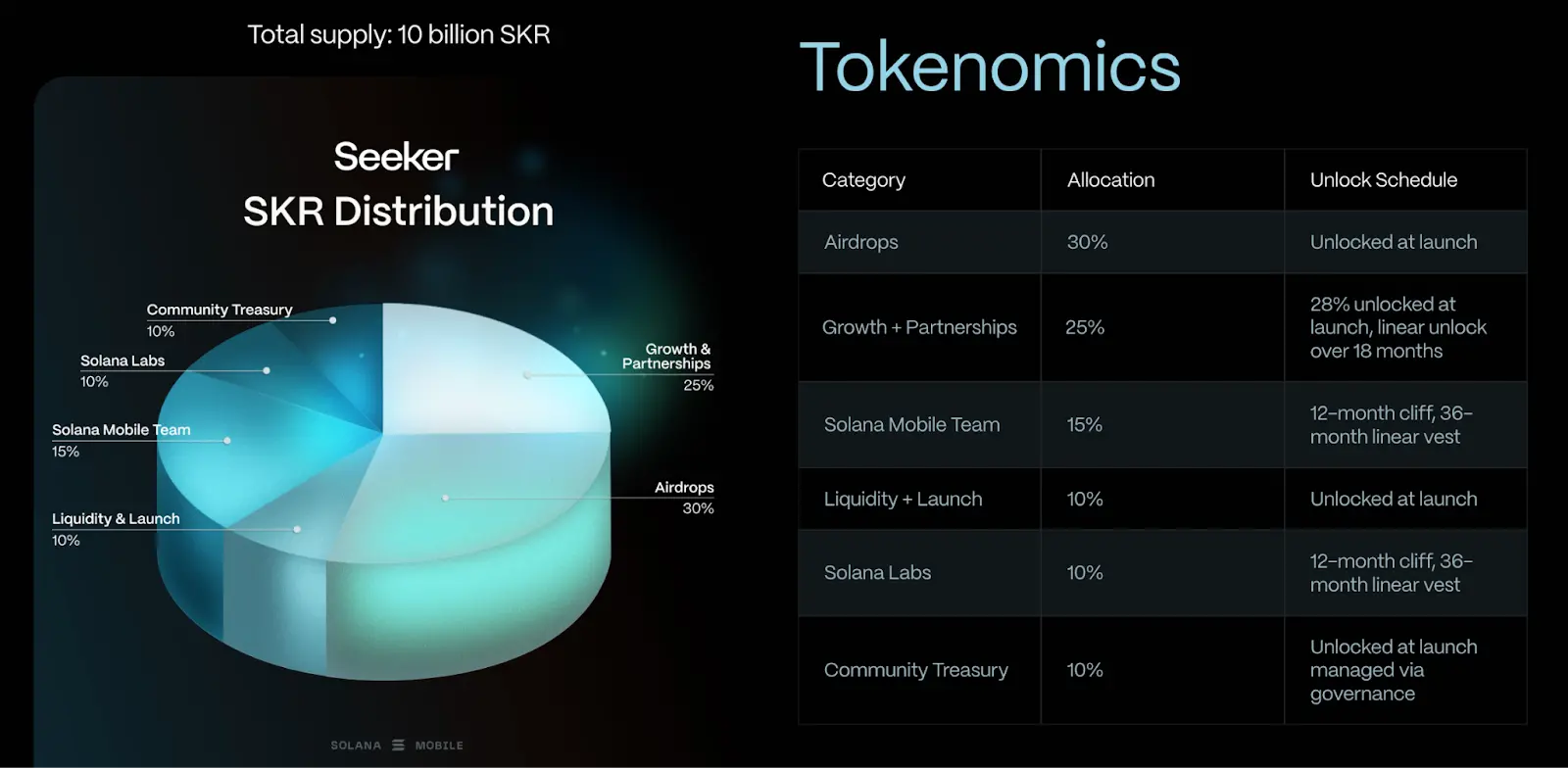
Tokenomics and vesting schedules for each allocation: Airdrop: 30% (unlocked at launch); Growth and partners: 25% (28% unlocked at launch, remainder unlocked linearly over 18 months); Team: 15% (locked for the first year, then unlocked linearly over 36 months); Liquidity and launch: 10% (unlocked at launch); Solana Labs: 10% (locked for the first year, then unlocked linearly over 36 months); Community treasury: 10% (unlocked at launch, governed by the community).
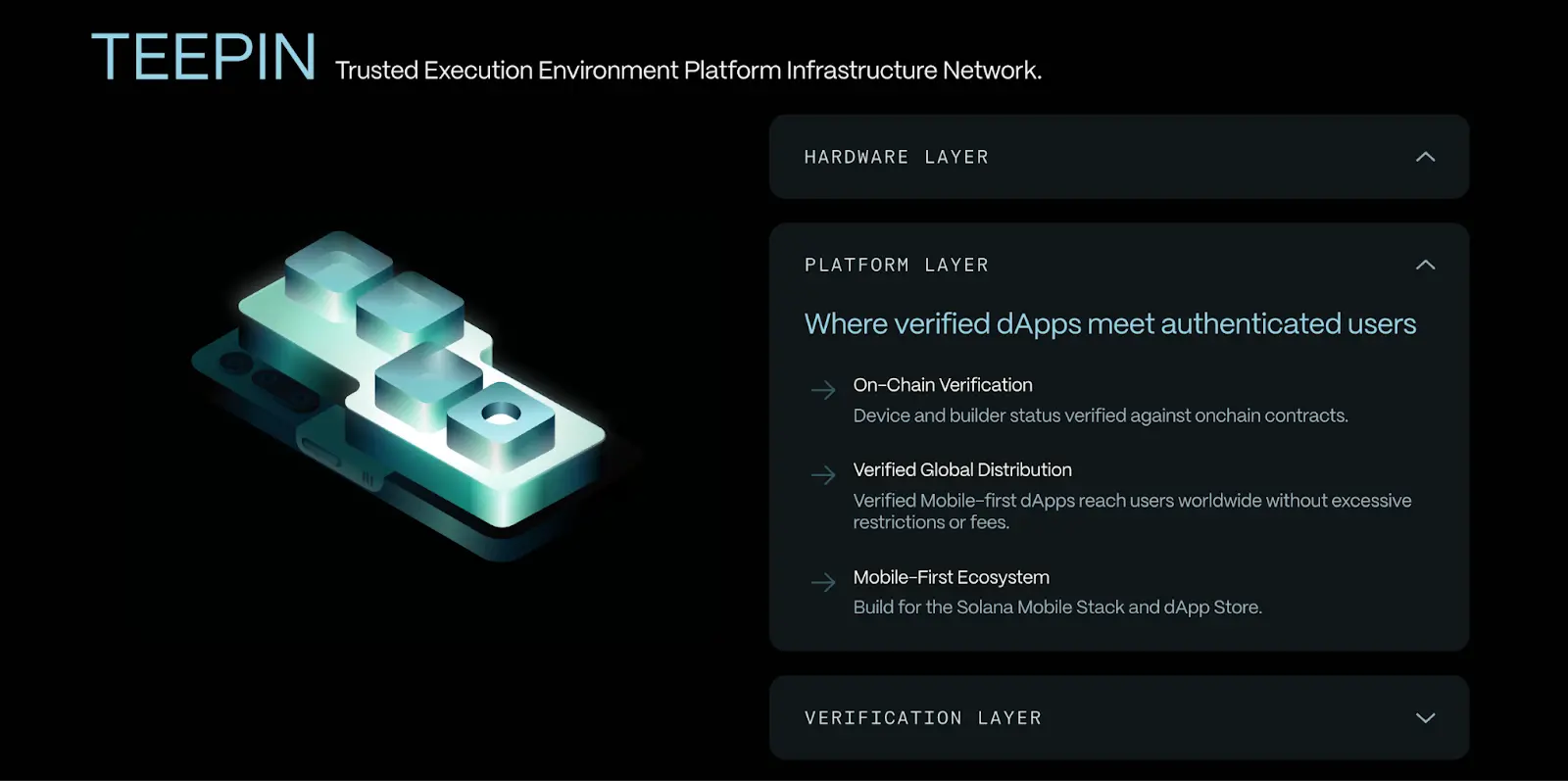
SKR’s core value lies in supporting TEEPIN (Trusted Execution Environment Platform Infrastructure Network).
Beginning in 2026, SKR holders can stake tokens to Guardians—operators responsible for platform security. Their duties include:
- Device identity verification: Ensuring hardware and software integrity.
- App store review: Evaluating decentralized app store submissions.
- Community standards enforcement: Upholding rules set by the community.
- Staking reward distribution: Staking SKR to Guardians allows participation in governance and earns network security rewards.
Teams including Anza, DoubleZero, Triton, Helius, and Jito have joined as the first Guardians. Solana Mobile notes that using multiple independent operators prevents any single company from controlling review or verification, laying the foundation for an open mobile platform.
SKR Airdrop, Staking, and Seeker Season 2 Outlook
With SKR’s official launch, eligible users can now claim tokens and participate in staking. After claiming, users can stake SKR directly in the Seed Vault wallet or through the official website to earn rewards. Staked SKR is settled and rewards are distributed every 48 hours.
Seeker Season 2 launched on the 9th of this month. The official announcement states that Season 2 will introduce more apps to the open platform and offer exclusive SKR incentive programs. Users simply need to keep using their Seeker phones, explore new apps, and participate in ecosystem activities to accumulate Season 2 participation data.
From Airdrop Incentives to Ecosystem Growth—Solana Mobile’s Marathon Is Just Beginning
The SKR token launch marks a major strategic shift for Solana Mobile. If the Saga phone’s success began with the surprise of “random airdrops,” the move from Saga to Seeker is Solana Mobile’s effort to transform that randomness into a more scalable, sustainable “mobile ecosystem economy.”
Despite SKR’s strong market attention, its long-term challenges remain. The current wealth effect has attracted over 150,000 seed users, but token rewards are a “launch lever,” not the ultimate goal of ecosystem development.
If Solana Mobile relies solely on token incentives, sustaining high user engagement long-term will be difficult. As early subsidies fade, can Solana Mobile foster truly “breakout” applications? Without apps that solve real user needs and drive strong retention, these 150,000 users could migrate to other ecosystems when the reward cycle ends.
In the fiercely competitive global smartphone market, Solana Mobile faces Apple iOS and Google Android, both with strong technical barriers and user retention. The advantages of an open platform, developer sovereignty, and censorship resistance do not guarantee mainstream user adoption. This is critical to whether Seeker can transition from a “crypto enthusiast’s gadget” to a “mainstream market tool.”
Delivering 150,000 Solana Mobile phones is only the starting point. The real challenge is whether the SKR-driven economic framework can cultivate an open application ecosystem capable of challenging industry giants.
Statement:
- This article is reprinted from [ChainCatcher]. Copyright belongs to the original author [Chloe]. If you have concerns about reprinting, please contact the Gate Learn team, who will handle your request according to relevant procedures.
- Disclaimer: The views and opinions expressed in this article are solely those of the author and do not constitute investment advice.
- Other language versions of this article are translated by the Gate Learn team. Do not copy, distribute, or plagiarize translated articles without mentioning Gate.







