As AI technology rapidly evolves, challenges such as compute centralization, data monopolies, and restricted access to models are becoming more prominent. Large tech companies now control the majority of AI models and computational resources, which forces developers and users to depend on closed platforms like Venice for AI services. In response, decentralized AI networks have emerged as a key area of exploration within the Web3 ecosystem. These networks aim to make AI capabilities more open, composable, and verifiable by leveraging open protocols and distributed infrastructure.
From a blockchain and digital asset perspective, the convergence of AI and Web3 is shaping a new technological paradigm. Through on-chain settlement, token incentives, and open compute networks, AI capabilities can be tokenized and integrated into decentralized economies. Venice’s architecture is a product of this trend, designed to build an open AI compute marketplace through its AI model network, privacy-preserving computation mechanisms, and on-chain incentive systems.
Overview of Venice and Decentralized AI Architecture
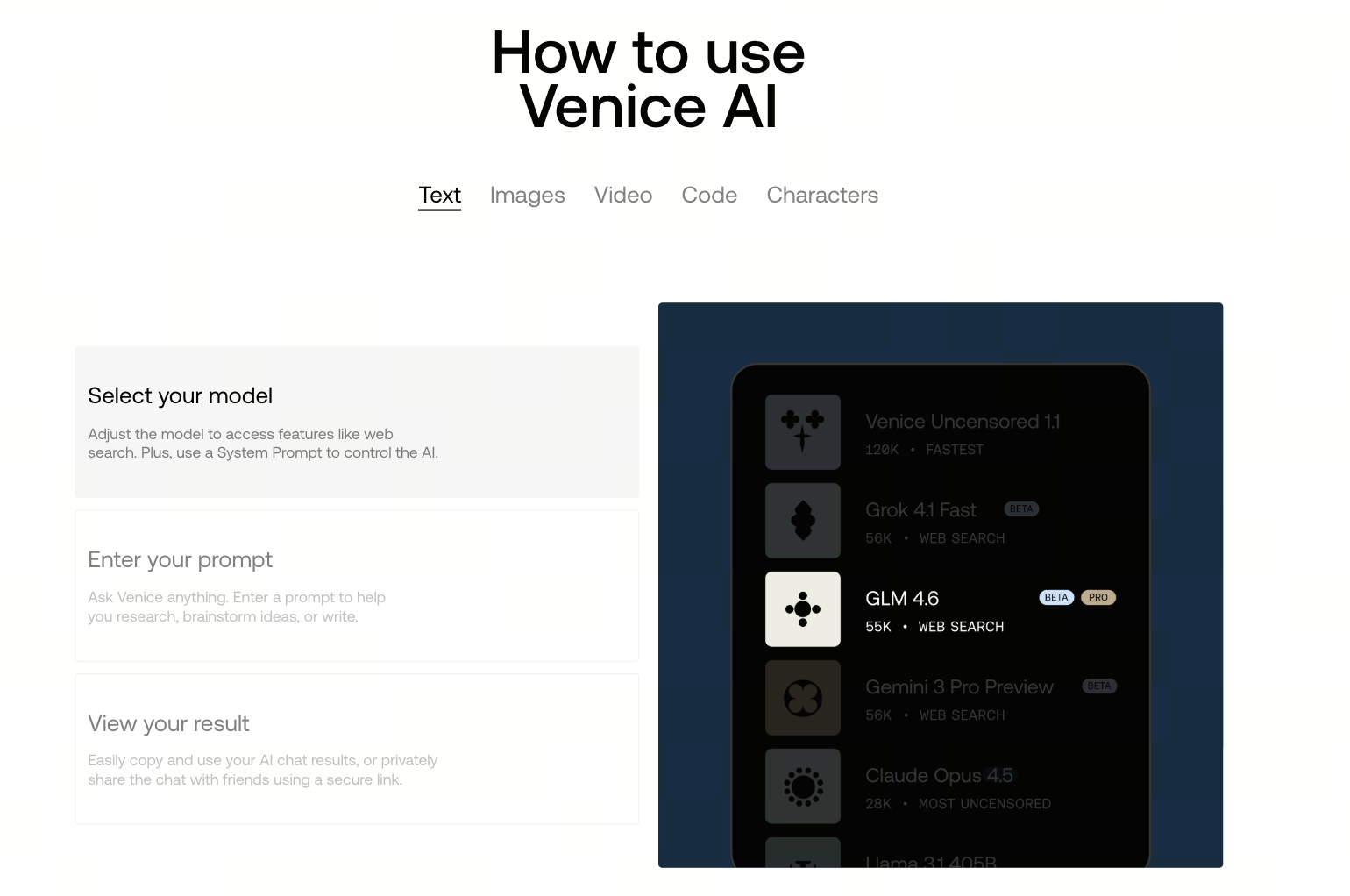 Image source: Venice Official Website
Venice’s central mission is to create a Decentralized AI Service Layer, enabling AI capabilities to be accessed and shared across an open network—much like blockchain infrastructure.
In traditional AI ecosystems, models typically run on centralized servers, and users access these models via APIs or subscription services. This model presents several issues:
- Data Privacy Risks: User data must often be uploaded to centralized servers for processing, meaning users lack full control over their own data.
- Platform Dependency: When a handful of companies control AI models, developers and application ecosystems are subject to platform rules and commercial strategies.
Venice addresses these problems by deploying AI inference nodes on a decentralized network, allowing model computation to occur on distributed infrastructure. Its architecture generally includes the following core layers:
- AI Inference Node Network: Distributed nodes that run AI models and provide inference capabilities.
- Privacy Computing and Data Isolation Mechanisms: Ensure that user data is not stored long-term or misused.
- Blockchain Settlement Layer: Records usage, processes payments, and incentivizes network participants.
This structure eliminates reliance on a single cloud provider, enabling resource sharing through an open network.
Venice’s platform logic can be understood as a combination of an AI model network and a blockchain settlement layer.
The AI model invocation process typically follows these steps:
Step 1: User Request Generation
Users or applications submit AI requests through the Venice interface—such as text generation, data analysis, or automation tasks.
Step 2: Task Distribution
The network protocol assigns tasks to available AI inference nodes, which may be operated by various participants.
Step 3: Model Execution
Nodes locally execute the AI models and return results.
Step 4: On-Chain Settlement
Invocation fees are settled via on-chain transactions and distributed to node operators according to protocol rules.
This model delivers several key benefits:
- Openness: Any developer can deploy AI services on the Venice network.
- Verifiability: Blockchain records ensure all AI activity is traceable.
- Resource Sharing: Compute and model resources can move freely across the network.
In essence, Venice is building a decentralized AI compute marketplace.
How Venice Uses AI to Enhance Protocol Security and Efficiency
Security and efficiency are core challenges in decentralized networks. Venice leverages AI to enhance platform performance on multiple fronts.
Intelligent Anomaly Detection
AI models can analyze network activity in real time, detecting:
- Unusual transaction patterns
- Bot attacks
- Malicious node behavior
Machine learning enables the platform to identify potential attacks and automatically deploy defensive measures.
Automated Resource Scheduling
AI optimizes compute resource allocation by:
- Dynamically assigning compute nodes based on demand
- Adjusting model inference priorities
- Optimizing network bandwidth usage
This approach significantly boosts AI inference efficiency.
Data Privacy Protection
Venice’s privacy architecture typically combines:
- Local computation
- Temporary data processing
- Data minimization principles
AI models process only the necessary data, reducing privacy risks.
As a result, AI is not just a core function of Venice—it is also a critical component of the platform’s governance and security framework.
Venice’s Role in Decentralized Finance (DeFi)
AI and DeFi are converging to shape the future of Web3, and Venice’s AI infrastructure can be leveraged across a range of DeFi scenarios.
Intelligent Trading Strategies
AI can analyze market data and generate trading strategies, including:
- Price trend forecasting
- Automated arbitrage strategies
- Risk management models
DeFi protocols can run these AI models on the Venice network.
Risk Monitoring and Liquidation Management
In lending protocols, AI can monitor collateral risk in real time:
- Detecting liquidation risk
- Predicting market volatility
- Automatically triggering risk alerts
This mechanism enhances the stability of DeFi protocols.
Automated Asset Management
AI agents can manage assets on behalf of users, for example:
- Automatic portfolio rebalancing
- Yield aggregation strategies
- Scanning for DeFi opportunities
In this model, AI is not just a tool—it becomes an on-chain economic participant.
Technical Comparison: Venice vs. Leading AI Protocols
The Web3 space now features several AI protocols, including:
- AI compute networks
- AI data marketplaces
- AI agent platforms
Venice stands out in several key areas:
Privacy-First Architecture
While many AI platforms still rely on centralized model services, Venice focuses on privacy protection and user data control.
Decentralized Compute Network
Venice more closely resembles a distributed AI inference network than a standalone AI service platform.
Web3-Native Design
Venice is designed for seamless integration with blockchain economies, featuring:
- On-chain settlement
- Token incentives
- Open protocol interfaces
This makes it easier to incorporate into the Web3 application ecosystem.
| Comparison Dimension |
Venice |
Centralized AI Platform |
Web3 AI Compute Network |
AI Agent Protocol |
| Architecture Model |
Decentralized AI inference network + privacy computing |
Centralized cloud server architecture |
Distributed compute network |
AI agent task execution network |
| Data Privacy |
Privacy-first design; user data processed locally when possible |
Data usually uploaded to platform servers |
Varies by protocol; some support privacy computing |
Data shared between agent and application |
| AI Model Execution |
Distributed nodes run AI inference models |
Models centrally deployed by platform |
Nodes provide compute for model execution |
Agents call external models for tasks |
| Settlement Mechanism |
On-chain settlement and token incentives |
Subscription or API billing |
On-chain settlement of compute costs |
Agent service fee settlement |
| Ecosystem Goal |
Build an open decentralized AI service network |
Provide commercial AI API services |
Provide AI training and inference compute |
Build an automated AI agent economy |
| Developer Openness |
Open protocol, accessible to Web3 apps |
Restricted by platform rules |
Open compute marketplace |
Developers can create agents |
| Web3 Integration |
Web3-native architecture |
Weak Web3 integration |
Emphasizes compute marketplace |
Focuses on AI automation economy |
| Typical Use Cases |
Privacy AI services, DeFi analytics, AI tools |
Text generation, image generation, AI SaaS |
AI model training, inference compute |
Automated trading, DAO agents, task automation |
Venice positions itself as a privacy-first decentralized AI service network, not simply an AI compute marketplace or agent protocol. Its goal is to deliver a callable, composable, and settleable AI infrastructure layer for the Web3 ecosystem.
The Evolution of Deep AI–Blockchain Integration
The convergence of AI and blockchain remains in its early stages, but several major trends are emerging.
AI Agent Economy
In the future Web3 ecosystem, AI agents may act as independent participants:
- Automatically executing trades
- Managing on-chain assets
- Participating in DAO governance
Decentralized Compute Networks
As demand for AI compute grows, distributed compute marketplaces may become foundational infrastructure.
Networks like Venice can enable global sharing of compute resources.
AI Model Tokenization
In the future, AI models may be tokenized, enabling:
- Model usage rights
- Data contribution rewards
- Compute provider earnings
This approach brings AI into the digital asset economy.
Conclusion
Venice represents a new exploratory direction for decentralized AI infrastructure. By integrating distributed compute networks, privacy mechanisms, and blockchain settlement systems, Venice aims to disrupt the traditional reliance of AI services on centralized cloud platforms. Technically, Venice’s core value lies in building an open AI compute network—enabling model invocation, resource sharing, and data processing in a decentralized environment. AI technology also plays a vital role in enhancing protocol security, optimizing resource allocation, and expanding DeFi and other Web3 application scenarios.
As AI and blockchain technologies continue to merge, future digital economies may feature increasingly complex intelligent networks. In this transition, decentralized AI platforms like Venice could become essential infrastructure connecting AI capabilities with the Web3 economy.







