From a market perspective, DeFi has moved beyond the era of liquidity mining and high-yield incentives into a new cycle centered on “real yield.” Yield models that rely purely on token emissions have proven difficult to sustain, while low-risk assets such as U.S. Treasuries are increasingly becoming a key allocation target for on-chain capital. Within this shift, the RWA sector represented by Ondo has rapidly gained traction, emerging as a critical bridge between traditional finance and the crypto ecosystem.
From an industry and technological standpoint, Ondo’s value lies not only in offering yield products, but in building a new kind of on-chain asset management infrastructure. By combining asset tokenization, yield tranching, compliant structures, and on-chain liquidity integration, Ondo makes traditional financial assets programmable and composable, providing a more stable and scalable source of yield for DeFi protocols, DAOs, and institutional capital.
What Is Ondo (ONDO)? Background and Development
 Source: Ondo official website
Ondo Finance is dedicated to bringing traditional financial assets onto the blockchain, gradually evolving into a DeFi infrastructure centered on on-chain asset management. Unlike early DeFi projects that focused heavily on liquidity mining and high-yield incentives, Ondo was designed from the outset with institutional-grade financial needs in mind, placing greater emphasis on compliance frameworks and risk segmentation.
Its development can be broadly divided into three stages:
-
Structured product phase: introduced fixed and floating yield tranches to segment and allocate risk
-
RWA transition phase: integrated real-world assets such as U.S. Treasuries and launched stable yield products like USDY
-
Infrastructure phase: built a full on-chain asset issuance and management system serving institutions and protocols
This trajectory reflects a broader shift in DeFi from “high risk, high return” experimentation toward stable yield and asset management.
How Ondo’s Core Architecture Enables Asset Management and Yield Distribution
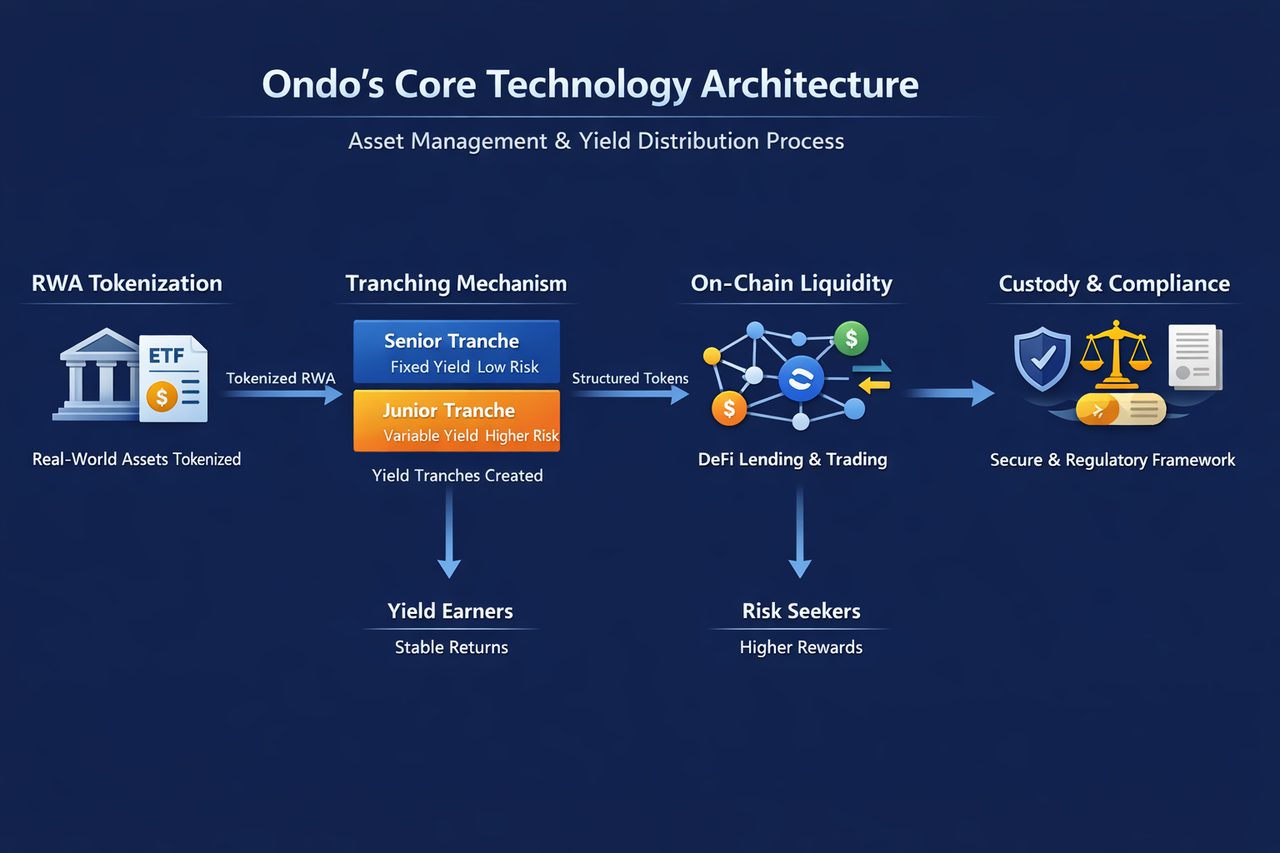
Ondo’s architecture is built around three core pillars: asset tokenization, yield tranching, and on-chain liquidity. Its key mechanisms include:
-
Asset Tokenization (RWA Tokenization)
Ondo wraps real-world assets, such as U.S. Treasury ETFs, into on-chain tokens that can be transferred and composed within blockchain ecosystems. This process typically involves custodians, compliance structures, and on-chain issuance protocols.
-
Yield Tranching Mechanism
Through structured financial design, Ondo splits the returns of a single asset into different risk layers:
This approach is similar to structured notes or tranche-based funds in traditional finance.
-
On-Chain Liquidity Integration
By integrating with major DeFi protocols, Ondo’s tokenized assets can be used in lending, trading, and other financial applications, improving overall capital efficiency.
-
Compliance and Custody Framework
Ondo adopts an off-chain custody plus on-chain representation model, ensuring that underlying assets are real and compliant with regulatory requirements. This is a key distinction from purely on-chain DeFi protocols.
Key Features of Ondo
Within today’s DeFi and RWA landscape, Ondo stands out for several defining characteristics:
-
Real yield sources: backed by low-risk assets such as U.S. Treasuries rather than token incentives
-
Risk segmentation: structured to meet varying investor risk preferences
-
Institution-friendly design: emphasizes compliance and transparency
-
High composability: assets can be integrated into other DeFi protocols
-
Cross-chain scalability: supports multi-chain deployment to expand liquidity
These features position Ondo as a foundational infrastructure layer within the growing RWA narrative.
ONDO Tokenomics and Distribution
ONDO serves as the governance token of the Ondo ecosystem, with key functions including:
-
Governance: participation in protocol parameters, product design, and treasury allocation
-
Incentives: used for ecosystem rewards and liquidity support
-
Value capture: may accrue value through future fee distribution mechanisms
Token allocation typically includes:
At present, ONDO primarily functions as a governance token, and its direct value capture from protocol revenue is still evolving.
Use Cases and Applications
Ondo’s primary use cases revolve around stable yield and asset allocation, with a focus on bringing real-world assets on-chain while improving capital efficiency.
For yield generation, users can hold Ondo’s RWA-backed assets, such as USDY, to earn returns similar to U.S. Treasuries. These yields are derived from real-world financial instruments, making them relatively stable.
Within DeFi, these assets can also be used as collateral in lending protocols, allowing users to unlock liquidity while continuing to earn yield.
For DAOs, Ondo provides a low-risk treasury management solution, helping organizations preserve and grow capital more sustainably.
Additionally, through its compliance framework, Ondo offers a gateway for traditional institutions to enter the crypto market, further bridging the gap between traditional finance and blockchain ecosystems.
Compared with traditional DeFi platforms, Ondo differs in several key ways:
| Dimension |
Traditional DeFi |
Ondo |
| Source of income |
Token incentives |
Returns from real-world assets |
| Risk structure |
Single |
Layered design |
| Client base |
Mainly retail investors |
Institutional and retail investors |
| Compliance |
Relatively weak |
Strong emphasis on compliance |
| Type of assets |
Crypto assets |
RWA and crypto assets |
Overall, Ondo operates more like an on-chain asset management firm than a purely decentralized financial protocol.
Risks to Consider When Using or Holding ONDO
Despite its strong narrative and infrastructure, Ondo carries several risks:
-
Compliance risk: RWA involves real-world assets and regulation, and policy changes may impact its model
-
Interest rate risk: returns are closely tied to U.S. Treasury yields, and falling rates may reduce attractiveness
-
Liquidity risk: some RWA assets still have limited on-chain liquidity
-
Smart contract risk: vulnerabilities or exploits may exist in on-chain protocols
-
Unclear value capture: the relationship between ONDO token value and protocol revenue is still developing
Future Outlook and Market Potential
From an industry perspective, the RWA sector in which Ondo operates has strong long-term potential:
-
Continued growth of RWA: more traditional assets are being brought on-chain
-
Accelerating institutional inflows: compliance requirements are driving infrastructure development
-
DeFi shifting toward stable yield: the market increasingly favors low-volatility assets
-
Cross-chain and global expansion: improving liquidity and accessibility of assets
Looking ahead, Ondo may expand into additional asset classes, such as corporate bonds and private credit, while introducing more sophisticated structured products and deeper integration with both CeFi and traditional finance.
Conclusion
Ondo (ONDO) represents a significant step in DeFi’s evolution from high-yield experimentation to asset management infrastructure. By bringing real-world assets on-chain and combining them with structured financial design and compliance frameworks, Ondo creates a system that balances yield stability with capital efficiency.
As RWA becomes a dominant narrative, Ondo is not just a product platform, but a key bridge between traditional finance and the crypto economy. Its long-term value, however, will depend on regulatory developments, asset expansion, and the continued evolution of its tokenomics.
FAQs
Q1: What does Ondo (ONDO) do? Ondo is a DeFi platform that brings real-world assets such as U.S. Treasuries onto the blockchain, offering stable yield products and asset management services.
Q2: What is the utility of the ONDO token? It is primarily used for governance, ecosystem incentives, and potential future value capture.
Q3: Where does Ondo’s yield come from? Primarily from interest generated by real-world assets like U.S. Treasuries, rather than token incentives.
Q4: Is Ondo safe? It uses compliant custody structures and on-chain mechanisms, but still carries smart contract and regulatory risks.
Q5: Who is Ondo suitable for? It is suitable for users seeking stable yield, asset allocation strategies, or institutional-grade participation in DeFi.







