In an increasingly competitive public blockchain landscape, performance is no longer measured solely by TPS figures but by the quality of architectural design. Sui introduces an object centric data model, defining assets as independent objects and avoiding global state locking. Combined with a parallel transaction execution mechanism and the separation of consensus and data layers, the network can maintain low latency and stability even under heavy load. At the same time, the Move programming language places asset security at its core, strengthening ownership rules and reducing smart contract vulnerabilities. This design gives Sui structural advantages in complex scenarios such as financial applications and blockchain games. Compared with major blockchains such as Ethereum and Solana, Sui represents an architecture reset approach to Layer 1 development. Its value lies not only in performance improvements but also in a systematic redesign of the underlying logic of blockchain systems.
To understand Sui's position in the Layer 1 ecosystem, several key dimensions can be examined. These include the project's origins and team background, the technical logic behind its object centric model and parallel execution mechanism, the design philosophy of the Move language for secure asset management, and the differences between Sui, Ethereum, and Solana in terms of execution models and scaling strategies. In addition, the tokenomics of the SUI token and the development of the Sui ecosystem provide an important foundation for evaluating the network's long term value and application potential.
Sui Network was founded in 2021 by Mysten Labs, a company established by former members of Meta's blockchain division. Several core team members previously worked on the Diem stablecoin project and participated in the development of the Move programming language.
The name “Sui” is derived from the Japanese word for “water,” symbolizing liquidity and adaptability. This naming reflects the project's design philosophy of building a blockchain network that is flexible, scalable, and capable of supporting a wide range of application scenarios.
After its mainnet officially launched in 2023, Sui quickly attracted attention from developers and investors, gradually forming a growing ecosystem.
Sui's performance advantages come from innovations in its underlying architecture rather than simple hardware optimization.
-
Object Centric Model
Sui adopts an object centric data model, where each asset is treated as an independent object with clearly defined attributes.
These objects have several key properties:
-
Clear ownership definition
-
Independent verification capability
-
Independent transferability
This design avoids global state locking, which significantly improves transaction processing efficiency.
-
Parallel Transaction Execution
Sui introduces an improved Byzantine broadcast mechanism that allows unrelated transactions to be processed simultaneously.
This architecture enables:
-
Synchronous parallel processing
-
No need to wait for global transaction ordering
-
Immediate generation of finality certificates
Compared with traditional serialized processing models, this design significantly increases throughput and reduces latency.
-
Separation Of Consensus And Data Layers
Sui separates data propagation from the consensus process, allowing the network to remain stable even under high load conditions. This modular architecture improves both scalability and security.
 (Source: sui/move)
Move Language: A Security First Smart Contract Foundation
Sui uses Move as its smart contract programming language. Move was originally designed by Meta's blockchain team for the Diem project and was specifically built for secure digital asset management.
The advantages of Move include:
-
Enforced asset ownership rules
-
Prevention of asset duplication or accidental destruction
-
Reduced risk of smart contract vulnerabilities
-
Support for composable and dynamic NFTs
Compared with languages such as Solidity or Rust, Move places stronger emphasis on asset security and strict logical design. This approach gives it structural advantages in complex environments such as financial applications and blockchain gaming.
Comparison Of SUI, Solana, And Ethereum
In the competition among Layer 1 public blockchains, Sui, Ethereum, and Solana represent three distinct technical approaches. Sui centers its design on an object oriented architecture and native parallel execution, allowing unrelated transactions to be processed simultaneously and improving scalability directly at the transaction model level. Ethereum continues to use an account based model with global ordering, addressing scalability mainly through its Layer 2 ecosystem while benefiting from a mature developer community and established standards. Solana relies primarily on a single chain high performance architecture combined with rapid transaction ordering, enabling high frequency interactions while maintaining relatively low transaction costs. The differences in execution models and scaling strategies among these networks illustrate the diverse directions currently shaping the evolution of public blockchain infrastructure.
| Comparison Category |
Sui |
Ethereum |
Solana |
| Execution Model |
Object oriented + parallel execution |
Account model + global ordering |
Account model + high speed pipeline |
| Transaction Processing |
Parallel confirmation for unrelated transactions |
Serialized processing |
High speed ordered processing |
| Smart Contract Language |
Move |
Solidity |
Rust |
| Scaling Strategy |
Native parallel architecture |
Relies on Layer 2 |
Main chain performance optimization |
| Gas Cost |
Low and predictable |
More volatile |
Relatively low |
| Security Design |
Strong asset ownership rules |
Mature ecosystem but contract risks exist |
Focus on performance optimization |
SUI Tokenomics
The maximum supply of SUI tokens is 10 billion, with a phased release schedule designed to reduce potential market impact.
Token Distribution
| Allocation Category |
Share |
| Community Reserve |
50% |
| Early Contributors |
20% |
| Investors |
14% |
| Mysten Labs |
10% |
| Community Access Programs |
6% |
 (Source: martianwallet/blog)
This distribution structure prioritizes community participation and ecosystem development. As of the fourth quarter of 2025, approximately 36.8%t of the total supply had entered circulation. Such a distribution model allows Sui to secure the network through a delegated proof of stake mechanism while supporting long term economic stability for the token.
Token Utility
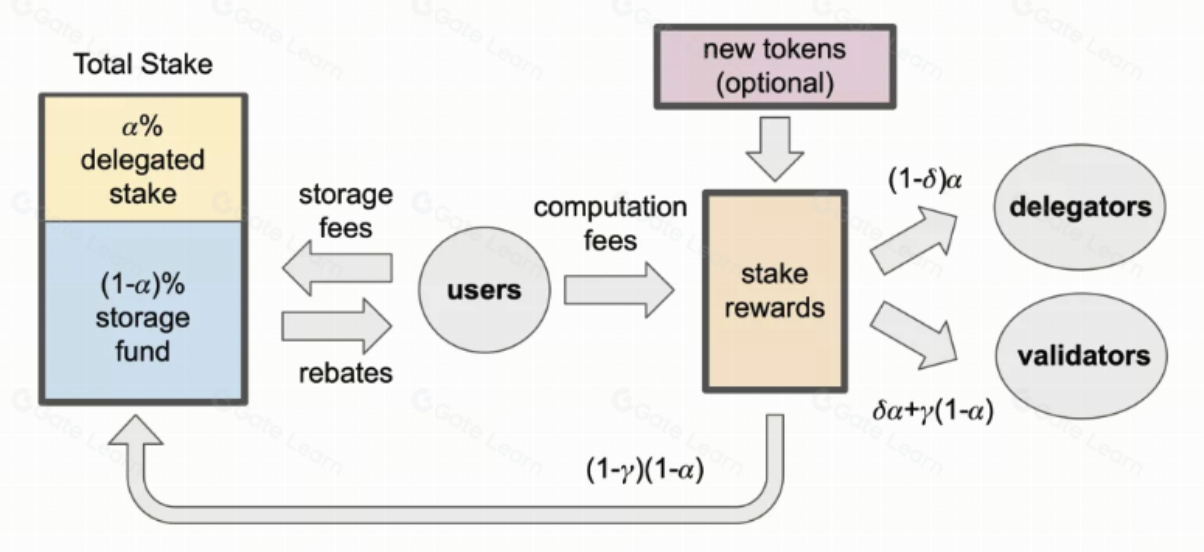
Since its launch, the native token SUI has served multiple core functions within the network and forms the foundation of its economic system.
-
Gas Fees: Used to pay transaction fees and the costs associated with interacting with decentralized applications on the network.
-
Staking Mechanism: Validators must stake SUI to participate in consensus and block validation. Token holders may also delegate their tokens to validators to earn staking rewards.
-
Governance Rights: SUI holders can participate in governance decisions by voting on key network parameters and protocol upgrades.
-
Incentives And Rewards: Validator block rewards and staking yields are distributed in SUI.
-
Medium Of Value Within The Ecosystem: As the foundational asset within the ecosystem, SUI functions both as a medium of exchange and a store of value.
 (Source: martianwallet/blog)
Through these mechanisms, SUI acts not only as transaction fuel but also as the central component supporting network security, governance participation, and the broader economic activity of the Sui ecosystem.
Recent Developments And Market Attention
In recent years, market attention toward Sui has largely focused on the continued expansion of its ecosystem and infrastructure capabilities. On the one hand, the growth of total value locked (TVL) on the network and the expansion of its DeFi ecosystem have become key indicators used to measure development momentum. On the other hand, the deployment of NFT projects and blockchain gaming applications is also testing the ability of Sui's high performance architecture to support complex and interactive environments.
At the same time, cross chain integrations, infrastructure improvements, security auditing mechanisms, and protocol level upgrades have become important dimensions for evaluating the network's long term competitiveness. As institutional interest in high performance Layer 1 blockchains continues to increase, Sui is gradually being viewed as a representative project with strong potential for architectural innovation within the competitive landscape.
From an ecosystem development perspective, Sui is advancing the Sui DeFi Moonshots Program, which provides financial incentives, technical collaboration, and security support to accelerate the innovation and deployment of high quality DeFi projects. In addition, eSui Dollar has been launched on Sui DeepBook, meaning that synthetic dollar assets have been integrated into the network's native liquidity infrastructure. This development expands the potential for margin trading and programmable financial strategies while further strengthening Sui's structural competitiveness within the on-chain financial ecosystem.
Conclusion
The value of Sui lies not only in its high performance capabilities but also in the redesign of its underlying architecture. Its object centric model, native parallel transaction execution, the security focused Move programming language, and a structured token economic system together form the foundation of the network.
In an increasingly competitive public blockchain environment, Sui represents an architecture reset approach to Layer 1 development. If Web3 moves toward large scale adoption, this architectural design philosophy may become one of its most important long term competitive advantages.
FAQ
-
What does the name Sui represent?
The name Sui originates from the Japanese word for “water,” symbolizing liquidity, flexibility, and adaptability. The concept reflects Sui's design philosophy of building a highly scalable and flexible blockchain network capable of supporting diverse Web3 application scenarios.
-
What are the technical advantages of Sui?
Sui's performance advantages come from its object centric architecture and parallel transaction execution model, which allow non conflicting transactions to be processed simultaneously. In addition, Sui uses the Move programming language, which emphasizes asset ownership rules and security mechanisms, reducing the risk of smart contract vulnerabilities. This design is particularly suitable for financial applications and blockchain games that require frequent interaction.
-
What is the purpose of the SUI token?
SUI is the native token of the Sui network, with a maximum supply of 10 billion tokens released gradually over time. Its primary uses include staking to maintain network security and earn rewards, paying gas fees for transactions and on-chain operations, and participating in governance voting. The token economy also includes a storage fee mechanism to manage on-chain data costs more efficiently.







