What Is Kadena?
Kadena is a blockchain platform that offers both public and permissioned (consortium) chain solutions, aiming to deliver high transaction throughput and developer-friendly features without compromising on security. Its native token, KDA, is used to pay network gas fees—the costs associated with executing transactions and smart contracts on-chain—and to incentivize miners who maintain network security.
What Are the Current Price, Market Cap, and Circulating Supply of Kadena (KDA)?
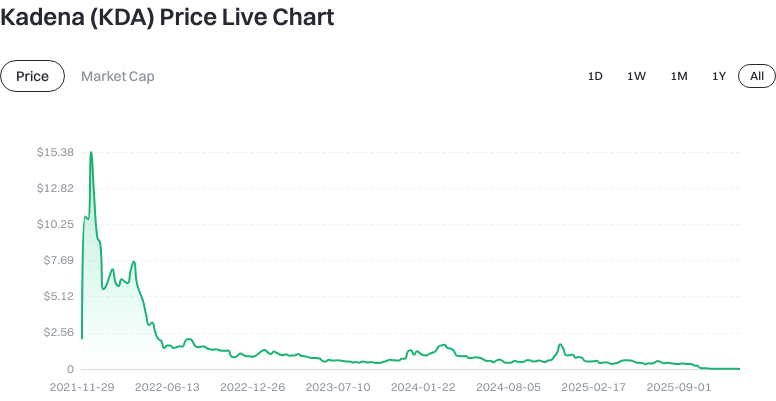
As of 2026-01-21, based on available data:
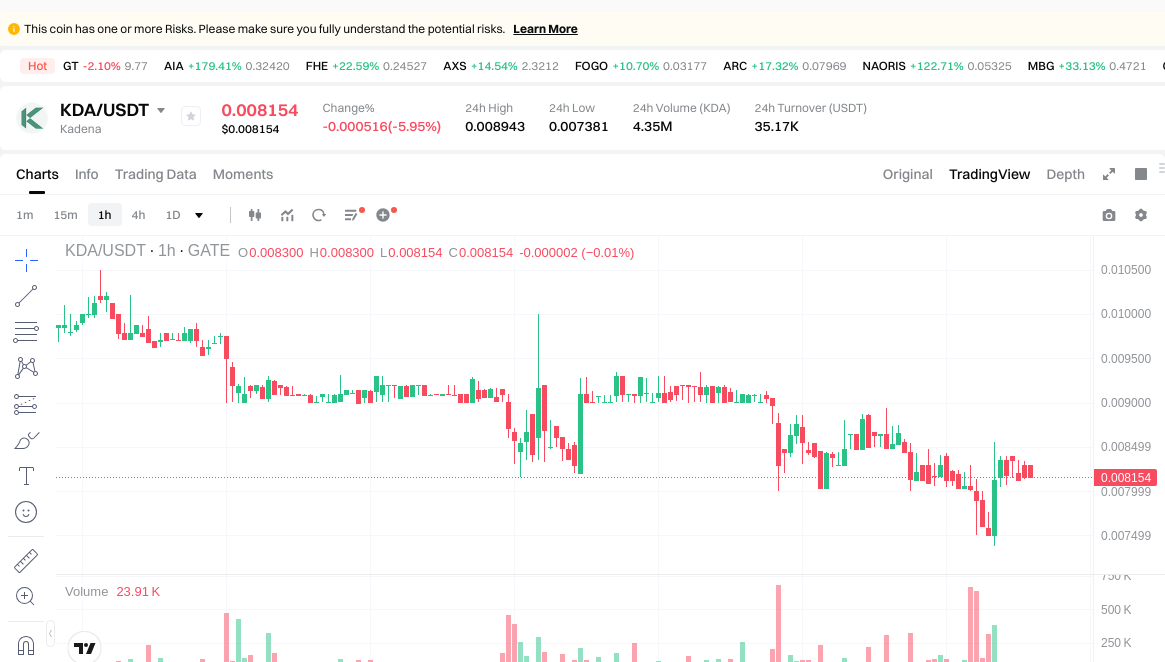
- Price: approximately $0.008300
- Circulating supply: about 338,586,083.5196 KDA
- Circulating market cap: around $2,810,264.49
- Max supply: 1,000,000,000 KDA
- Fully diluted market cap: approximately $2,810,264.49
- 24-hour trading volume: roughly $35,168.00
- Price change: 1 hour: ~0.01%, 24 hours: ~-2.38%, 7 days: ~-19.36%, 30 days: ~-28.15%
Click to view the latest KDA price updates
Market capitalization is calculated as price times circulating supply, providing a rough estimate of the project's size. Fully diluted market cap multiplies price by max supply, reflecting potential valuation after all tokens are unlocked.
Click to view KDA/USDT price
Figures may vary across platforms; always check the data update time and reference notes.
Who Created Kadena (KDA) and When?
Kadena was launched by a team with backgrounds in traditional finance and cryptography. After the mainnet went live in phases, the KDA token was officially issued on 2020-05-31. Public information indicates Kadena raised around $15 million from institutions such as SVAngel and CoinFund to support its core technology and ecosystem growth (source: project disclosures and early records, retrieved 2024-10). Kadena positions itself as enterprise-grade blockchain infrastructure compatible with both business and public use cases, focusing on security, performance, and composability.
How Does Kadena (KDA) Work?
Kadena utilizes a parallel Proof-of-Work (PoW) design, where multiple chains produce blocks simultaneously in a structured manner to boost throughput. In PoW consensus, miners compete by solving computational puzzles; the first to solve them earns block rewards and transaction fees, ensuring decentralized security.
The public chain leverages Chainweb—a parallel chain architecture—to scale performance without sacrificing PoW-level security. Its permissioned chain operates as a private network for institutional collaboration but can interoperate with the public chain for hybrid business models. The native smart contract language, Pact, emphasizes readability and formal verification, making it easier to audit contracts and manage permissions, thus reducing the risk of errors. KDA is used in the network for gas payments, miner incentives, and ecosystem settlements.
What Can Kadena (KDA) Be Used For?
On the public chain side, KDA pays for transfers and smart contract execution—serving as the essential “fuel” for DeFi, NFT, and on-chain settlement activities. In consortium chains, enterprises can migrate internal processes on-chain and interface securely with the public chain—enabling use cases such as supply chain management, clearing, and data sharing. For developers, KDA acts as the medium for contract calls and service payments, rewarding application nodes and infrastructure contributors.
What Wallets and Extensions Are Available in the Kadena (KDA) Ecosystem?
Users can manage their KDA assets via official or third-party wallets with features like account creation, transfers, contract interaction, and multisig support. The ecosystem includes block explorers for querying transactions and block status. Developers have access to Pact’s development and testing tools for building and auditing smart contracts. Always download wallets from official sources, verify addresses and network settings before use, and beware of phishing links.
What Are the Main Risks and Regulatory Considerations for Kadena (KDA)?
Technical risks: Parallel PoW architecture and cross-chain communication are complex; vulnerabilities in implementation or contracts could compromise asset or application security. Economic model: The issuance schedule of KDA, miner incentives, and long-term inflation can affect supply-demand dynamics and price trends. Liquidity risk: With a 24-hour trading volume of about $35.2k, limited order depth may lead to slippage and volatility.
Regulatory compliance: Definitions of crypto assets and compliance standards vary significantly by jurisdiction, potentially impacting token circulation and enterprise integration. Custody & operational risk: Private keys are the sole means of controlling assets; mnemonic phrases are key backups—if lost or leaked, funds may be unrecoverable. Exchange risk: Changes in platform maintenance, listing status, or withdrawal policies can affect trading and fund management. It is recommended to understand local regulations before participating and assess your own risk tolerance.
How Can I Buy and Safely Store Kadena (KDA) on Gate?
Step 1: Register & Complete KYC. Sign up at gate.com and complete identity verification along with security measures like Google Authenticator and withdrawal whitelist setup.
Step 2: Deposit or Purchase With Fiat. Fund your account with USDT or buy USDT via fiat channels (methods depend on platform availability), then confirm fees and settlement times.
Step 3: Search for Trading Pairs. Go to spot trading, search for “KDA,” verify token identifiers and network details, then select a suitable trading pair (e.g., KDA/USDT).
Step 4: Place an Order. Choose limit orders for price control or market orders for quick execution—but always pay attention to liquidity depth and potential slippage.
Step 5: Withdraw & Store Securely. For long-term holding, withdraw KDA to a self-custody wallet. Double-check the chain name and address format; test with a small amount before large transfers.
Step 6: Strengthen Security. Safely back up your mnemonic phrase and private key offline—never share them with anyone. For significant holdings, consider hardware wallets or multisig solutions; regularly review authorizations and device security.
How Is Kadena (KDA) Different From Ethereum?
Consensus & Scalability: Kadena uses parallel PoW to scale while maintaining PoW-grade security; Ethereum has transitioned to Proof-of-Stake (PoS) and relies on layer-2 networks and sharding for scalability.
Smart Contract Language: Kadena employs Pact for readable contracts with formal verification; Ethereum’s ecosystem centers on Solidity with more mature tools and libraries.
Fees & Performance: Kadena aims for high throughput and stable fees via parallel block production; Ethereum mainnet fees can be volatile under congestion but have been reduced by layer-2 solutions.
Ecosystem Maturity: Ethereum boasts a broader ecosystem with more applications and developers; Kadena is still growing—watch for further ecosystem expansion and tooling improvements. Each chain strikes different balances between security and scalability, catering to distinct use cases.
Summary of Kadena (KDA)
Kadena focuses on delivering secure and scalable blockchain infrastructure through parallel PoW consensus and Pact smart contracts—enabling both public chain and consortium chain deployments. KDA powers network gas payments and miner incentives, playing a key role in network operation and real-world adoption. Current metrics show that its market size and liquidity warrant continued observation; future progress will depend on ecosystem development, developer activity, and enterprise adoption. For newcomers, start with small amounts or test transfers; always follow official updates, secure your keys/mnemonics diligently, and choose appropriate wallets based on your investment horizon.
FAQ
No relation. In gaming contexts, KDA stands for Kill/Death/Assist statistics—a performance metric—while KDA coin is Kadena’s native blockchain token used for transaction fees and network governance. They simply share the same abbreviation but belong to entirely different fields.
What Are the Main Uses of KDA Coin?
KDA has two core functions:
- Paying transaction gas fees—users need KDA to transact on the Kadena network;
- Securing the network—staking KDA lets users become validator nodes eligible for rewards. Additionally, KDA serves as a primary asset within dApps and smart contracts across the ecosystem.
How Can Beginners Acquire KDA Coin?
The easiest way is to purchase it directly from regulated exchanges like Gate. You can buy KDA using fiat currency or by swapping other digital assets. After purchase, transfer your coins to a wallet you control or keep them on the exchange if preferred. Newcomers should start with small amounts to familiarize themselves with buying and transferring before scaling up.
Is KDA Coin Volatile? Is It Worth Holding Long-Term?
As a crypto asset, KDA’s price is highly volatile. Whether it’s worth holding depends on your outlook for the Kadena blockchain—research its fundamentals and broader market context before deciding. All investment decisions should be made according to your own risk tolerance; avoid blindly chasing highs or putting all funds into a single asset.
How Do I Choose a Wallet for KDA? Any Security Tips?
Kadena officially supports several wallets including Chainweaver and Zelcore. For self-custody wallets, carefully store your private key offline in a secure location; if using an exchange wallet, security is managed by the platform—but avoid storing large sums there long-term. Regardless of wallet type, enable two-factor authentication where possible and routinely monitor account activity.
Kadena (KDA) Key Terms Glossary
- Chainweb: Kadena’s multi-chain architecture that increases transaction throughput and network scalability via parallel chains.
- Pact: Kadena’s native smart contract language designed for secure, efficient on-chain application development.
- PoW (Proof of Work): The consensus mechanism used by Kadena where miners validate transactions by solving computational challenges.
- Gas Fees: Costs paid by users to execute transactions or smart contracts on Kadena.
- Cross-chain Interoperability: Kadena enables asset/data transfers between different chains within its ecosystem for enhanced liquidity.
Kadena (KDA) References & Further Reading