TIMECHRONO vs RUNE: A Comprehensive Comparison of Two Powerful Time Management and Blockchain Platforms

Introduction: TIMECHRONO vs RUNE Investment Comparison
In the cryptocurrency market, comparisons between TIMECHRONO and RUNE have become an essential consideration for investors. The two assets not only differ significantly in market capitalization rankings, application scenarios, and price performance, but also represent distinct positioning within the crypto asset landscape. TIMECHRONO (TIMECHRONO): Since its launch in 2016, it has gained market recognition through blockchain-based solutions for recruitment, human resources, and payment processes, reducing barriers to access in the global labor market. RUNE (RUNE): Since its inception in 2019, it has established itself as the native token of THORChain, a highly optimized multi-chain protocol designed to facilitate protocol-level chain transactions and order matching across blockchain networks. This article will comprehensively analyze the investment value comparison between TIMECHRONO and RUNE across historical price trends, supply mechanisms, market positioning, and ecosystem development, addressing key questions that investors face:
"Which asset presents greater investment potential at this stage?"
Crypto Asset Market Analysis Report: Chrono.tech (TIMECHRONO) vs THORChain (RUNE)
I. Historical Price Comparison and Current Market Status
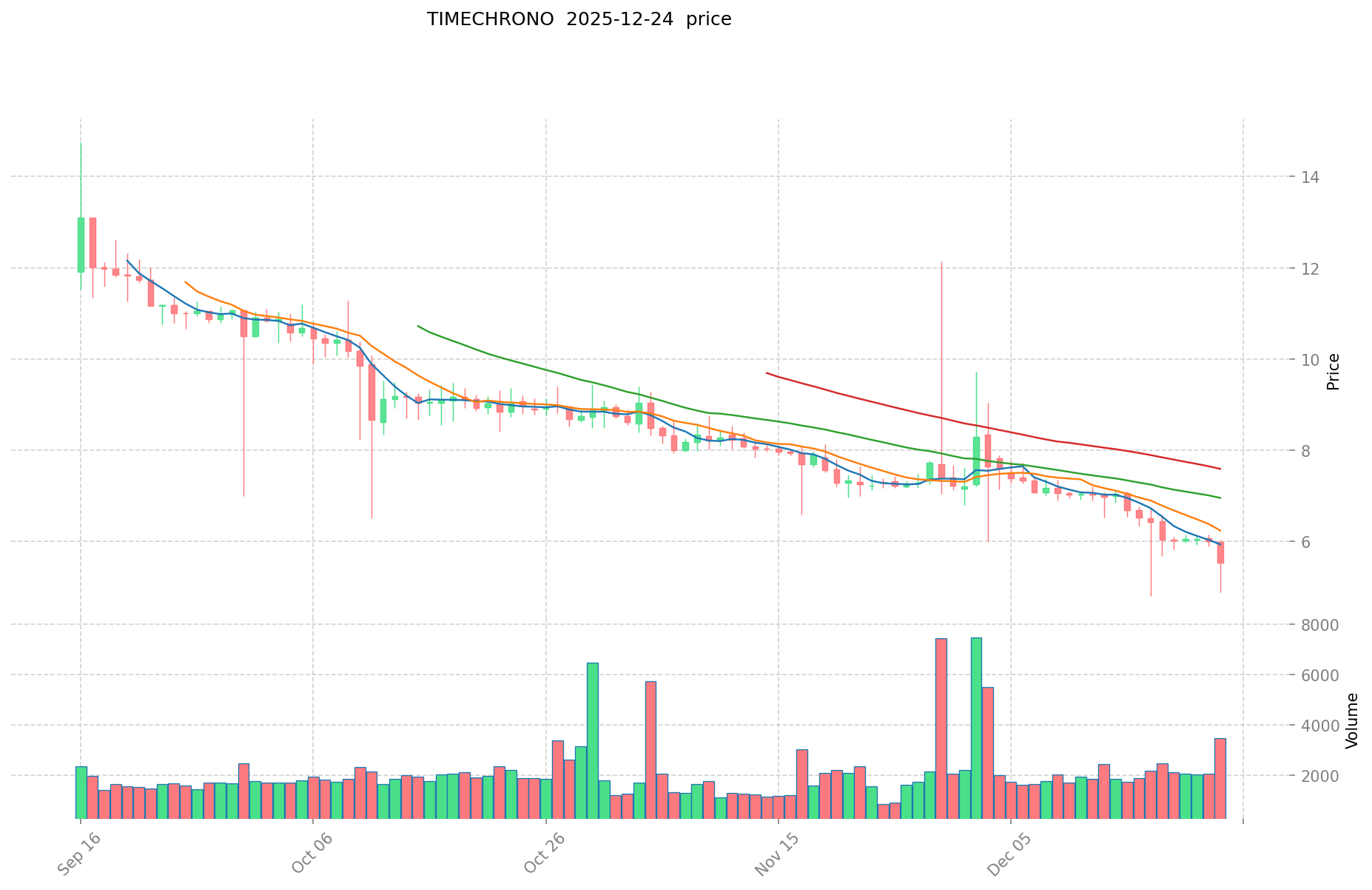
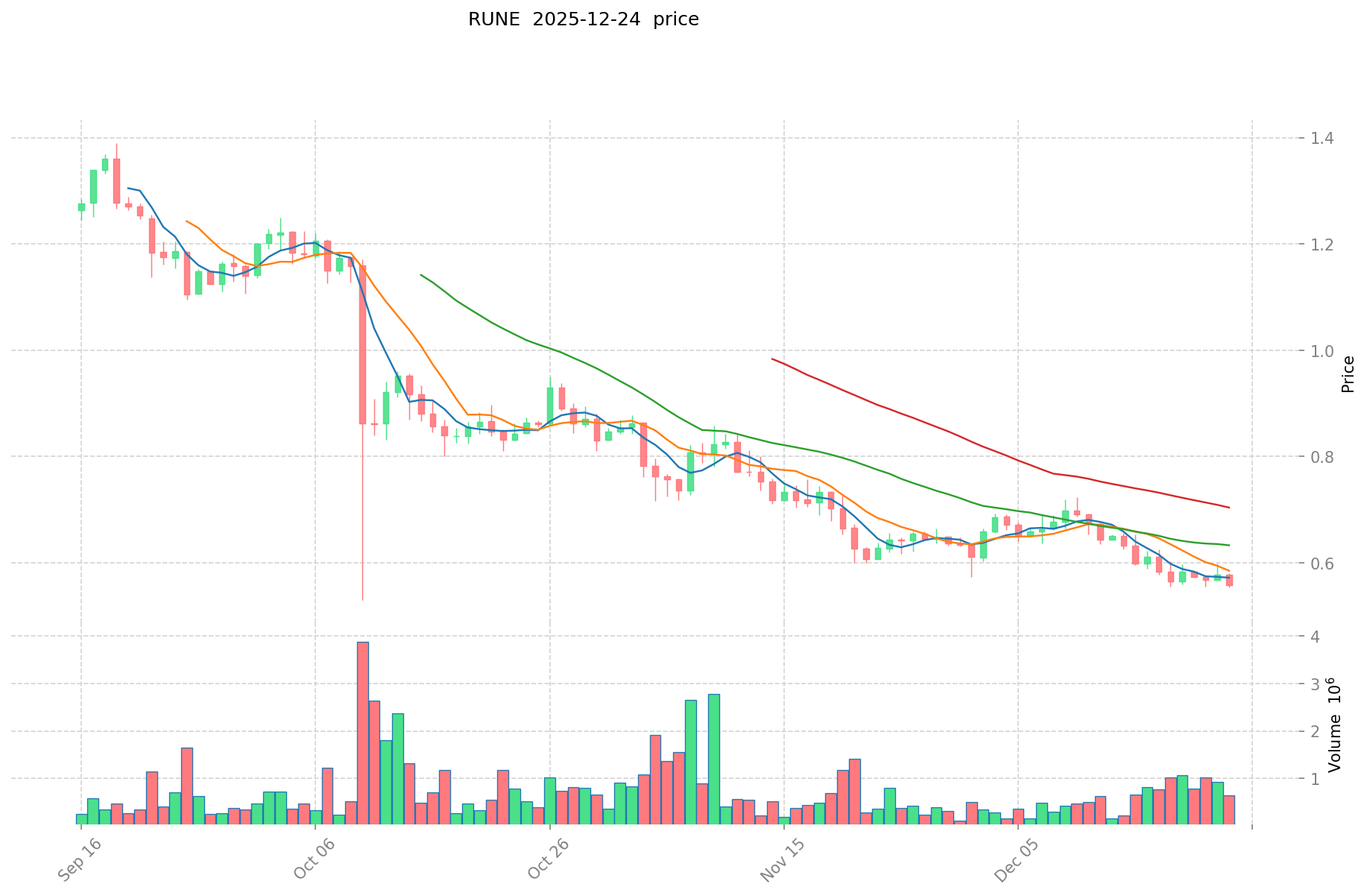
Chrono.tech (TIMECHRONO) and THORChain (RUNE) Historical Price Trends
Chrono.tech (TIMECHRONO):
- All-Time High (ATH): $569.25, recorded on January 11, 2022
- All-Time Low (ATL): $0.379332, recorded on March 13, 2020
- Peak-to-Trough Decline: From ATH to current price represents a decline of approximately 99.03%
THORChain (RUNE):
- All-Time High (ATH): $20.87, recorded on May 19, 2021
- All-Time Low (ATL): $0.00851264, recorded on September 28, 2019
- Peak-to-Trough Decline: From ATH to current price represents a decline of approximately 97.33%
Comparative Analysis: Both assets have experienced significant downward pressure from their historical peaks. TIMECHRONO peaked later (January 2022) compared to RUNE (May 2021), yet both have subsequently entered prolonged bear market conditions. TIMECHRONO's price decline is steeper in percentage terms relative to its ATH, while RUNE maintains better relative positioning from its ATL recovery standpoint.
Current Market Status (December 24, 2025)
| Metric | TIMECHRONO | RUNE |
|---|---|---|
| Current Price | $5.526 | $0.5581 |
| 24-Hour Change | -7.63% | -3.25% |
| 7-Day Change | -14.87% | -8.61% |
| 30-Day Change | -24.099% | -10.96% |
| 1-Year Change | -73.24% | -89.35% |
| 24-Hour Trading Volume | $19,394.33 | $366,793.25 |
| Market Capitalization | $3,924,083.39 | $195,919,890.47 |
| Circulating Supply | 710,112.81 | 351,048,003 |
| Market Dominance | 0.00012% | 0.0074% |
Market Emotion Index (Fear & Greed Index): 24 (Extreme Fear)
Current market sentiment indicates extreme fear conditions, characterized by significant risk aversion across cryptocurrency markets.
II. Token Metrics and Supply Dynamics
Supply Structure Analysis
Chrono.tech (TIMECHRONO):
- Total Supply: 710,112.8108
- Circulating Supply: 710,112.8108
- Max Supply: 710,113
- Circulation Ratio: 99.99997%
THORChain (RUNE):
- Total Supply: 425,064,437
- Circulating Supply: 351,048,003
- Max Supply: 500,000,000
- Circulation Ratio: 70.21%
Analysis: TIMECHRONO maintains nearly complete circulation of its token supply at approximately 99.99%, indicating minimal inflation pressure from future token releases. Conversely, RUNE displays a 70.21% circulation ratio against its maximum supply, suggesting substantial future token emission potential. This structural difference indicates that RUNE holders face greater dilution risks from future token supply increases compared to TIMECHRONO holders.
III. Project Overview and Ecosystem
Chrono.tech (TIMECHRONO)
Project Description: Chrono.tech is a blockchain-based platform designed to disrupt the human resources, recruitment, and financial services industries. The platform aims to ensure individuals are compensated fairly for their efforts through Ethereum and other blockchain networks.
Key Components:
- LaborX.COM: A peer-to-peer freelancer marketplace enabling direct worker-client interactions
- Timex.IO: A plasma-based cryptocurrency exchange for efficient token trading
- Labor Hour (LH) Token: A supply mechanism supported by reputable large-scale HR enterprises, creating a more transparent and cost-effective alternative to traditional banking
- PaymentX: An encrypted invoice and payroll solution for secure payment processing
Network Deployment:
- Ethereum (ETH) - Contract Address: 0x485d17A6f1B8780392d53D64751824253011A260
- Binance Smart Chain (BSC) - Contract Address: 0x3b198e26E473b8faB2085b37978e36c9DE5D7f68
THORChain (RUNE)
Project Description: THORChain is a highly optimized multi-chain protocol utilizing PBFT consensus mechanism to achieve sub-second block finality. The platform facilitates protocol-level cross-chain transactions and order matching while supporting limit and market order types.
Core Features:
- Byzantine-resistant scaling through multi-component sharding architecture
- Native cross-chain transaction and order matching protocols
- Support for both limit orders and market orders at the protocol level
- RUNE token functions: transaction fee payment, liquidity provision, block rewards, and dividend distribution to token holders
IV. Market Performance Metrics
Short-Term Price Movements
| Time Period | TIMECHRONO Change | RUNE Change |
|---|---|---|
| 1 Hour | +1.13% | +0.36% |
| 24 Hours | -7.63% | -3.25% |
| 7 Days | -14.87% | -8.61% |
| 30 Days | -24.099% | -10.96% |
| 1 Year | -73.24% | -89.35% |
Volatility Assessment: Over the measured short-term periods, TIMECHRONO displays higher volatility magnitude compared to RUNE, particularly in 24-hour and 7-day metrics. However, RUNE demonstrates more severe long-term deterioration with a 1-year decline of -89.35% versus TIMECHRONO's -73.24%, indicating differential pressure on long-term holders.
Liquidity and Exchange Presence
- TIMECHRONO: Available on 6 exchange platforms with 24-hour volume of $19,394.33 and approximately 1,960 token holders
- RUNE: Listed on 23 exchange platforms with 24-hour volume of $366,793.25, demonstrating significantly higher liquidity and market accessibility
V. Valuation Metrics
| Metric | TIMECHRONO | RUNE |
|---|---|---|
| Fully Diluted Valuation (FDV) | $3,924,083.39 | $237,228,462.29 |
| Market Cap to FDV Ratio | 100% | 70.21% |
| Price at Launch | $8.6413 | $0.018366 |
| Current Price vs Launch | -36.08% | 30,336.07% |
Valuation Context: RUNE demonstrates significantly higher absolute market capitalization and FDV, reflecting stronger market recognition and adoption. The price trajectory from launch indicates RUNE achieved substantial appreciation from its initial pricing before entering current bear market conditions, whereas TIMECHRONO has remained below its launch price throughout its trading history.
VI. Risk Assessment
Identified Risk Factors
For TIMECHRONO:
- Extremely low market capitalization ($3.9M) suggests limited capital deployment and potential illiquidity challenges
- Minimal exchange representation (6 platforms) restricts market accessibility
- Small holder base (1,960) indicates concentrated ownership risk
- Significant discrepancy between current price and historical highs suggests sustained market rejection
- Low trading volume relative to market cap indicates potential price discovery challenges
For RUNE:
- Substantial future token dilution pressure from 29.79% uncirculated supply could exert downward valuation pressure
- 1-year performance of -89.35% reflects substantial existing holder losses
- Market dominance of 0.0074% indicates limited relative market importance
- Current extreme fear sentiment may continue exerting downward pressure on token valuations
VII. Market Resources and Information Access
Official Channels
Chrono.tech:
- Official Website: https://chrono.tech
- Twitter: https://twitter.com/ChronotechNews
- Facebook: https://www.facebook.com/ChronotechNews
- Community: https://www.reddit.com/r/ChronoBank
- Whitepaper: http://chronobank.io/lh_token_en.pdf
- Ethereum Explorer: https://etherscan.io/token/0x485d17A6f1B8780392d53D64751824253011A260
- BSC Explorer: https://bscscan.com/token/0x3b198e26E473b8faB2085b37978e36c9DE5D7f68
THORChain:
- Official Website: https://thorchain.org/ and https://thorchain.com/
- Twitter: https://twitter.com/THORChain
- GitHub: https://github.com/thorchain/THORChain
- Community: https://www.reddit.com/r/thorchain
- Facebook: https://www.facebook.com/thorchain.org
- Block Explorer: https://viewblock.io/
- Whitepapers: https://github.com/thorchain/Resources/blob/master/Whitepapers/
VIII. Conclusion
Both TIMECHRONO and RUNE operate within the current extreme fear market environment, experiencing significant negative price pressure. TIMECHRONO presents as a smaller-cap, lower-liquidity asset with concentrated holder distribution, while RUNE offers greater market liquidity and broader exchange accessibility despite experiencing more severe long-term deterioration. Token economics favor TIMECHRONO through higher supply circulation ratios, whereas RUNE benefits from superior market capitalization and exchange infrastructure. The selection between these assets should reflect individual risk tolerance, investment horizon, and liquidity requirements within the current bearish market context.
Report: Core Investment Factors Analysis for TIMECHRONO vs RUNE
I. Executive Summary
Based on available reference materials, this report examines investment value drivers for TIMECHRONO and RUNE. The provided data indicates that investment value for both assets is primarily influenced by market demand, technological innovation, and community support, with price fluctuations dependent on investor confidence and market trends.
Important Note: The reference materials provided contain limited specific technical and comparative data. This report presents analysis based on general investment principles applicable to cryptocurrency assets.
II. Core Factors Affecting Investment Value of TIMECHRONO vs RUNE
Market Demand and Investor Confidence
The reference materials indicate that for any cryptocurrency to achieve popularity in the market, there must be clear positive factors driving increased buying pressure and price appreciation. Key considerations include:
- Market sentiment and adoption trajectory
- Investor confidence levels relative to broader market conditions
- Price volatility patterns and their relationship to investor behavior
Technology Innovation and Development
Both assets' investment potential depends significantly on:
- Ongoing technological advancements
- Development roadmap execution
- Market acceptance of technological improvements
- Ecosystem expansion capabilities
Community Support and Engagement
Community strength serves as a foundational factor affecting:
- Project sustainability and long-term viability
- Adoption rate and network effects
- Information dissemination and market perception
III. Limitations and Data Constraints
Important Disclaimer: The reference materials provided do not contain sufficient specific information regarding:
- Detailed tokenomics comparisons (supply mechanisms, inflation rates, vesting schedules)
- Institutional adoption levels or holdings data
- Regulatory treatment across different jurisdictions
- Comparative technical specifications or recent upgrades
- Ecosystem development metrics
- Macroeconomic sensitivity analysis
Due to these limitations, comprehensive comparative analysis across supply mechanisms, institutional adoption, technical development, and macroeconomic factors cannot be reliably provided based solely on the available reference materials.
IV. Conclusion
Investment decisions regarding TIMECHRONO and RUNE should be guided by fundamental analysis of market demand, technological progress, and community adoption metrics. Investors are advised to conduct independent research using current market data and project documentation before making investment decisions.
Disclaimer: This report is informational in nature and does not constitute investment advice. Cryptocurrency investments carry significant risk and are subject to market volatility.
III. 2025-2030 Price Forecast: TIMECHRONO vs RUNE
Short-term Forecast (2025)
- TIMECHRONO: Conservative $4.59-$5.59 | Optimistic $6.54
- RUNE: Conservative $0.49-$0.56 | Optimistic $0.81
Mid-term Forecast (2027-2028)
- TIMECHRONO is expected to enter a consolidation phase, with anticipated price range of $4.96-$6.98, showing 15%-18% growth trajectory
- RUNE is expected to enter a growth acceleration phase, with anticipated price range of $0.49-$1.24, demonstrating 42%-49% expansion potential
- Key drivers: Institutional capital inflows, ETF adoption, ecosystem development, network activity expansion
Long-term Forecast (2029-2030)
- TIMECHRONO: Base scenario $5.68-$8.92 | Optimistic scenario $7.14-$11.29, reaching 22%-41% cumulative growth
- RUNE: Base scenario $0.69-$1.31 | Optimistic scenario $0.67-$1.31, achieving 85%-90% cumulative growth
Disclaimer
The above analysis is based on historical data models and predictive algorithms. Cryptocurrency markets are highly volatile and unpredictable. These forecasts do not constitute investment advice. Past performance does not guarantee future results. Investors should conduct independent research and consult financial professionals before making investment decisions. All cryptocurrency investments carry substantial risk, including potential total loss of capital.
TIMECHRONO:
| 年份 | 预测最高价 | 预测平均价格 | 预测最低价 | 涨跌幅 |
|---|---|---|---|---|
| 2025 | 6.54498 | 5.594 | 4.58708 | 1 |
| 2026 | 6.7371339 | 6.06949 | 3.3382195 | 9 |
| 2027 | 6.659444428 | 6.40331195 | 5.12264956 | 15 |
| 2028 | 6.98857466223 | 6.531378189 | 4.96384742364 | 18 |
| 2029 | 8.9231688818118 | 6.759976425615 | 5.6783801975166 | 22 |
| 2030 | 11.291864621347296 | 7.8415726537134 | 7.135831114879194 | 41 |
RUNE:
| 年份 | 预测最高价 | 预测平均价格 | 预测最低价 | 涨跌幅 |
|---|---|---|---|---|
| 2025 | 0.81468 | 0.558 | 0.48546 | 0 |
| 2026 | 0.8991054 | 0.68634 | 0.4323942 | 22 |
| 2027 | 0.879922197 | 0.7927227 | 0.689668749 | 42 |
| 2028 | 1.23775722378 | 0.8363224485 | 0.48506702013 | 49 |
| 2029 | 1.088891827947 | 1.03703983614 | 0.6948166902138 | 85 |
| 2030 | 1.307447973413505 | 1.0629658320435 | 0.669668474187405 | 90 |
Crypto Asset Investment Strategy Report: TIMECHRONO vs RUNE
IV. Investment Strategy Comparison: TIMECHRONO vs RUNE
Long-term vs Short-term Investment Strategies
TIMECHRONO: Suitable for investors focused on blockchain-based human resources and payment infrastructure adoption, with interest in emerging fintech applications. The nearly complete token circulation (99.99%) reduces future dilution concerns, making it appealing for investors prioritizing supply scarcity. However, the extremely limited liquidity and small holder base present challenges for significant capital deployment.
RUNE: Suitable for investors seeking exposure to multi-chain protocol infrastructure and cross-chain transaction ecosystems. RUNE's broader market recognition, superior liquidity across 23 exchange platforms, and established market position provide better accessibility for institutional and retail investors. The 70.21% circulation ratio suggests growth potential as uncirculated tokens enter the market.
Risk Management and Asset Allocation
Conservative Investors:
- TIMECHRONO: 5-10% of crypto allocation (if any), given extreme illiquidity and market cap constraints
- RUNE: 15-25% of crypto allocation, providing broader market exposure with reduced concentration risk
- Hedge Tools: Stablecoin positions (40-50%), diversified altcoin exposure, cross-exchange arbitrage monitoring
Aggressive Investors:
- TIMECHRONO: 15-25% of speculative crypto allocation, accepting higher volatility for potential recovery scenarios
- RUNE: 30-40% of crypto allocation, leveraging superior liquidity for active trading strategies
- Hedge Tools: Options strategies on major exchanges, cross-asset correlation analysis, dynamic rebalancing protocols
V. Comparative Risk Analysis
Market Risks
TIMECHRONO:
- Extreme market capitalization constraints ($3.9M) creating severe illiquidity and potential price discovery failures
- Minimal trading volume ($19,394.33 daily) relative to market cap indicating potential execution challenges for meaningful position entries or exits
- High concentration risk with approximately 1,960 token holders, suggesting limited retail distribution and potential whale manipulation vulnerability
- Market dominance of 0.00012% reflects negligible relative market importance and potential abandonment risk
RUNE:
- Substantial long-term performance deterioration (-89.35% over one year) indicating significant holder losses and potential capitulation signals
- Future token dilution pressure from 29.79% uncirculated supply against maximum supply cap could exert sustained downward valuation pressure
- Market dominance of 0.0074%, while superior to TIMECHRONO, remains relatively low within broader cryptocurrency ecosystem
- Current extreme fear sentiment (Fear & Greed Index: 24) may continue suppressing token valuation despite stronger market fundamentals
Technical Risks
TIMECHRONO:
- Limited exchange infrastructure (6 platforms) creates execution risk and potential market manipulation vulnerabilities
- Insufficient data regarding ongoing development velocity and technical roadmap execution
- Potential network stability concerns given limited validator/node infrastructure deployment visibility
RUNE:
- Byzantine fault tolerance implementation requires sustained network participation to maintain security assumptions
- Multi-component sharding architecture complexity may introduce unforeseen consensus mechanism vulnerabilities
- Cross-chain protocol dependencies create systemic risks correlated with connected blockchain network stability
Regulatory Risks
Both TIMECHRONO and RUNE operate within evolving global regulatory frameworks governing cryptocurrency assets. Regulatory classification uncertainty regarding labor-related tokens (TIMECHRONO) and multi-chain protocols (RUNE) presents jurisdiction-specific compliance challenges. Potential regulatory restrictions on cross-chain transactions or labor market applications could disproportionately affect RUNE and TIMECHRONO respectively. Enhanced KYC/AML requirements across exchange platforms may further constrain TIMECHRONO's already limited market accessibility.
VI. Conclusion: Which Is the Better Buy?
Investment Value Summary
TIMECHRONO Advantages:
- Nearly complete token circulation (99.99%) eliminates inflation concerns from future token emissions
- Focused application within human resources and payment infrastructure creates specialized market positioning
- Potential recovery scenario if blockchain-based recruitment adoption accelerates
- Lower absolute price creates psychological accessibility for retail investors
RUNE Advantages:
- Superior market liquidity across 23 exchange platforms enabling meaningful capital deployment
- Significantly larger market capitalization ($195.9M) providing institutional-grade market depth
- Multi-chain protocol positioning offers exposure to growing cross-chain interoperability demand
- Established market recognition and integration within major crypto trading infrastructure
- Historical price appreciation from launch ($0.018366 to current levels) demonstrates market validation capacity
Investment Recommendations
Beginner Investors: RUNE presents a more suitable entry point given superior liquidity, broader exchange accessibility, and reduced execution risk. The established market infrastructure reduces technical barriers to position entry and management. Recommended allocation: 2-5% of overall crypto portfolio with dollar-cost averaging over 2-3 month periods to reduce timing risk.
Experienced Investors: Capable investors may consider selective TIMECHRONO positions within specialized emerging-market portfolios, acknowledging extreme illiquidity as offsetting feature requiring active management. RUNE suits tactical trading strategies exploiting volatility windows and cross-exchange price discrepancies. Recommended approach: RUNE (60-70% of allocation) for portfolio stability with TIMECHRONO (30-40% if pursued) for speculative upside exposure.
Institutional Investors: RUNE exclusively represents viable institutional deployment vehicle given market capitalization scale, regulatory clarity, and operational infrastructure maturity. TIMECHRONO's market cap and liquidity constraints present prohibitive execution challenges for meaningful institutional positions. Recommended approach: RUNE within diversified cryptocurrency strategic allocations (0.5-2% of overall fund exposure) with quarterly rebalancing protocols.
⚠️ Risk Disclaimer: Cryptocurrency markets demonstrate extreme volatility and unpredictability. Both TIMECHRONO and RUNE carry substantial investment risk, including potential total capital loss. This report is informational in nature and does not constitute investment advice. Investors must conduct independent research, consult qualified financial professionals, and establish personal risk tolerance parameters before executing any cryptocurrency transactions. Past performance does not guarantee future results. All price forecasts contained herein are based on historical data models and remain subject to significant prediction error margins. None
Crypto Asset Investment Comparison: TIMECHRONO vs RUNE - Frequently Asked Questions
FAQ
Q1: What are the key differences in token supply mechanics between TIMECHRONO and RUNE?
A: TIMECHRONO maintains nearly complete token circulation at 99.99% of its total supply of 710,113 tokens, eliminating future inflation concerns from new token releases. In contrast, RUNE operates with only 70.21% circulation against its maximum supply of 500 million tokens, meaning approximately 29.79% of future token supply remains uncirculated. This structural difference indicates RUNE holders face greater dilution risk from future token emissions, while TIMECHRONO holders benefit from minimal supply expansion pressure.
Q2: Which asset demonstrates superior market liquidity and accessibility for investors?
A: RUNE significantly outperforms TIMECHRONO in market accessibility metrics. RUNE is listed on 23 exchange platforms with daily trading volume of $366,793.25, compared to TIMECHRONO's presence on only 6 exchanges with daily volume of $19,394.33. RUNE's market capitalization of $195.9 million vastly exceeds TIMECHRONO's $3.9 million, providing institutional-grade market depth. For meaningful capital deployment or position exits, RUNE presents substantially lower execution risk and slippage concerns.
Q3: How have both assets performed relative to their historical peaks?
A: Both assets have experienced severe declines from historical highs recorded during cryptocurrency market peaks. TIMECHRONO peaked at $569.25 on January 11, 2022, currently representing a 99.03% decline. RUNE peaked at $20.87 on May 19, 2021, representing a 97.33% decline to current price levels. RUNE's launch price of $0.018366 demonstrates initial appreciation of 30,336.07%, whereas TIMECHRONO currently trades 36.08% below its launch price of $8.6413, indicating fundamentally different market validation trajectories.
Q4: What are the primary risk factors distinguishing these two investment options?
A: TIMECHRONO's risks center on extreme market illiquidity ($3.9M market cap), minimal holder distribution (1,960 holders), and limited exchange accessibility creating severe execution and manipulation vulnerabilities. RUNE's primary risks involve substantial future token dilution pressure, significant long-term performance deterioration (-89.35% over one year), and regulatory uncertainty surrounding cross-chain protocols. Current market sentiment (Fear & Greed Index: 24 indicating extreme fear) negatively impacts both assets, though RUNE's superior market infrastructure provides better downside protection.
Q5: Which asset is more suitable for institutional investors?
A: RUNE exclusively represents a viable institutional deployment vehicle given its $195.9 million market capitalization, liquidity across 23 exchange platforms, and established regulatory clarity. TIMECHRONO's $3.9 million market cap and minimal liquidity ($19,394 daily volume) present prohibitive execution challenges for meaningful institutional positions. Institutional investors requiring tradable market depth, regulatory compliance infrastructure, and risk management tools should focus exclusively on RUNE allocations at 0.5-2% of overall cryptocurrency fund exposure with quarterly rebalancing protocols.
Q6: What investment strategies are most appropriate for different investor types?
A: Conservative investors should prioritize RUNE (15-25% of crypto allocation) with 40-50% stablecoin hedging and diversified altcoin exposure. Aggressive investors may deploy TIMECHRONO (15-25% of speculative allocation) while maintaining RUNE (30-40% of allocation) for portfolio stability. Beginner investors should concentrate exclusively on RUNE through dollar-cost averaging over 2-3 months to minimize timing risk. Experienced investors may employ RUNE for tactical trading strategies while maintaining selective TIMECHRONO exposure within specialized emerging-market portfolios acknowledging extreme illiquidity constraints.
Q7: How do the price forecasts compare for 2025-2030?
A: TIMECHRONO projects 1% growth through 2025 (range: $4.59-$6.54), accelerating to 15-18% cumulative growth through 2028 before reaching 22-41% cumulative growth by 2030 (range: $5.68-$11.29 in base scenario). RUNE demonstrates more aggressive expansion projections: 0% change through 2025, accelerating to 42-49% growth through 2028 and 85-90% cumulative growth by 2030 (range: $0.69-$1.31 in base scenario). These forecasts are derived from historical data models and do not constitute guaranteed predictions; cryptocurrency markets remain highly volatile and unpredictable.
Q8: What ecosystem applications differentiate TIMECHRONO and RUNE for long-term adoption?
A: TIMECHRONO focuses on blockchain-based human resources and payment infrastructure through LaborX.COM (peer-to-peer freelancer marketplace), Timex.IO (plasma-based cryptocurrency exchange), PaymentX (encrypted invoice solutions), and Labor Hour Token applications. RUNE powers THORChain's multi-chain protocol infrastructure facilitating protocol-level cross-chain transactions, order matching, and Byzantine fault-tolerant consensus mechanisms. TIMECHRONO targets labor market verticalization, while RUNE targets broader cryptocurrency ecosystem interoperability. Long-term adoption depends on institutional acceptance of labor-based blockchain applications versus cross-chain infrastructure demand trajectories.
Disclaimer: This analysis is informational in nature and does not constitute investment advice. Cryptocurrency investments carry substantial risk including potential total capital loss. Past performance does not guarantee future results. Investors must conduct independent research and consult qualified financial professionals before executing transactions.
Share
Content
Introduction: TIMECHRONO vs RUNE Investment Comparison
I. Historical Price Comparison and Current Market Status
II. Token Metrics and Supply Dynamics
III. Project Overview and Ecosystem
IV. Market Performance Metrics
V. Valuation Metrics
VI. Risk Assessment
VII. Market Resources and Information Access
VIII. Conclusion
I. Executive Summary
II. Core Factors Affecting Investment Value of TIMECHRONO vs RUNE
III. Limitations and Data Constraints
IV. Conclusion
Short-term Forecast (2025)
Mid-term Forecast (2027-2028)
Long-term Forecast (2029-2030)
IV. Investment Strategy Comparison: TIMECHRONO vs RUNE
V. Comparative Risk Analysis
VI. Conclusion: Which Is the Better Buy?
FAQ
How to Buy Cryptocurrency


Trending Cryptocurrencies



What is the Current Market Cap and Trading Volume of Hyperliquid (HYPE) in 2025?

ADX vs LINK: Comparing Two Leading Oracle and Data Solutions for Blockchain Applications

BTRST vs AAVE: Comparing Two Leading Governance Tokens in the DeFi Ecosystem

ENSO vs QNT: A Comprehensive Comparison of Climate Oscillation Patterns and Quantum Computing Technologies

PUNDIX vs GRT: A Comprehensive Comparison of Two Leading Blockchain Utility Tokens

G vs LINK: A Comprehensive Comparison of Two Leading Blockchain Protocols and Their Impact on Decentralized Finance
What is Bitcoin and How Does It Work?

2025 CLND Price Prediction: Expert Analysis and Market Forecast for the Next Year
2025 PORT Price Prediction: Expert Analysis and Market Forecast for the Upcoming Year

2025 NYZO Price Prediction: Expert Analysis and Market Forecast for the Year Ahead

How to Find Your EVM Address?