Understanding the Evolution of Facebook's Digital Currency

What Is Facebook Libra (Diem)?
Introduction
The digital payments landscape presents significant opportunities as internet accessibility expands globally through affordable smartphones. Traditional financial services providers such as PayPal, Visa, and MasterCard dominate this space, while cryptocurrency projects also compete for market share. Facebook's entry into this sector was particularly notable given its massive user base. This existing network provided an unprecedented advantage for potential adoption of their proposed payment system, transforming how billions of people conduct financial transactions online.
What is Facebook Libra (Diem)?
Libra, later rebranded as Diem, represented Facebook's blockchain-based payment system first announced in 2019. The project was conceived by Morgan Beller, David Marcus, and Kevin Weil with the primary objective of providing financial services access to unbanked populations worldwide. The governance structure was managed by the Diem Association (formerly Libra Association), an independent membership organization based in Geneva, Switzerland. Understanding who stands behind Libra involves recognizing this association comprised diverse members from blockchain technology, payments, telecommunications, venture capital, and non-profit sectors. These members collectively oversaw governance decisions, operational management of the payment system, project development on the Libra blockchain, and grant distribution. Facebook's ambitious goal was to expand the association to 100 members, demonstrating the collaborative nature of who stands behind Libra's development and implementation.
Is Facebook's Libra a cryptocurrency?
While Libra utilized blockchain technology and cryptographic methods, it did not fully align with traditional cryptocurrency definitions. Standard cryptocurrencies typically possess certain characteristics that Libra lacked, making it more accurately classified as a digital currency rather than a true cryptocurrency. This distinction is important for understanding its technological foundation and operational framework, as it combined elements of blockchain innovation with more controlled, centralized features typical of traditional financial systems.
How will Facebook's Libra work?
The Diem Blockchain (formerly Libra Blockchain) operated as a permissioned blockchain, fundamentally distinguishing it from permissionless blockchains like Bitcoin or Ethereum. In permissionless systems, anyone with internet access can freely participate, transact, and build applications without restrictions. Conversely, Libra required explicit permission from network controllers, meaning applications had to obtain special access privileges to interact with the system. This permissioned structure eliminated the need for mining or staking mechanisms used by other blockchains. Instead, transaction validation relied on a predetermined set of validators who were members of the Libra Association—these validators represented another key element of who stands behind Libra's operational infrastructure. The white paper indicated a potential transition to a Proof of Stake (PoS) system, though the creators justified the initial permissioned approach by asserting that no existing permissionless system could adequately support billions of users conducting transactions simultaneously.
Is Facebook's Libra decentralized or centralized?
The blockchain community generally views permissioned blockchains as less decentralized compared to their permissionless counterparts, often resembling traditional corporate databases in structure and control. Libra lacked the censorship resistance characteristic of Bitcoin and other cryptocurrencies, as validator membership requirements within the Libra Association resulted in relative centralization. However, this controlled approach offered certain advantages. By vetting applications that interact with the distributed ledger, the system could more effectively exclude malicious actors and fraudulent schemes, potentially creating a safer environment for users while sacrificing some degree of decentralization.
The Libra payment system
The Diem payment system (formerly Libra payment system) supported multiple single-currency stablecoins pegged to major fiat currencies including USD, EUR, and GBP. These stablecoins derived their value from the Libra Reserve, which comprised cash, cash equivalents, and short-term government securities. Additionally, the system featured the Diem Dollar (formerly LBR), a multi-currency coin functioning as a composite of various stablecoins. This instrument operated as essentially a "stablecoin of stablecoins," backed by a diversified basket of assets designed to minimize volatility—a critical feature for any payment mechanism. Users stored their Libra cryptocurrency in Novi (formerly Calibra Wallet), a digital wallet designed for integration with Facebook's social media ecosystem, including Facebook Messenger and WhatsApp. The system enabled seamless conversion between fiat currencies and Facebook's coin. The open-source codebase, Diem Core, was written in Rust and included smart contract functionality through the Move programming language.
Will Facebook's Libra replace Bitcoin?
Libra and Bitcoin serve fundamentally different purposes and can coexist within the broader financial ecosystem. Bitcoin functions as a decentralized, censorship-resistant cryptocurrency, often utilized as a reserve asset or store of value. In contrast, Libra represented a more centralized model operating on a permissioned network, targeting different use cases within the digital payment landscape. Rather than competing directly, these systems address distinct market needs and user preferences, suggesting complementary rather than competitive relationships.
What is the future of Libra (Diem)?
Facebook encountered substantial criticism from central banks, lawmakers, and regulatory bodies following Libra's initial announcement. The project faced challenges in navigating complex regulatory landscapes and establishing necessary infrastructure components. While the company's massive user base provided significant potential for adoption, regulatory compliance and stakeholder acceptance remained critical factors. Ultimately, the question of who stands behind Libra—including Facebook (Meta), the Diem Association members, and various financial and technology partners—could not overcome the regulatory hurdles, and the project was discontinued. The assets and intellectual property were eventually sold, marking the end of Facebook's Libra initiative.
Conclusion
Facebook Libra (later Diem) represented an ambitious attempt to revolutionize digital payments through a permissioned blockchain system. Understanding who stands behind Libra reveals a complex consortium including Facebook (Meta), the Diem Association, and numerous partners from finance, technology, and telecommunications sectors. By leveraging Facebook's extensive social media network, the project aimed to provide financial services access to billions of unbanked individuals globally. Despite its innovative approach combining blockchain technology with traditional financial stability mechanisms through stablecoin backing, the project faced significant regulatory challenges and philosophical questions about centralization versus decentralization. While the initiative ultimately did not achieve its original vision due to regulatory obstacles, it sparked important discussions about the future of digital currencies, payment systems, and the role of major technology companies in financial services.
FAQ
Who is Libra?
Libra is a decentralized digital currency project designed to enable fast, secure, and low-cost global payments. It operates on blockchain technology and aims to provide financial access to unbanked populations worldwide through a stable, user-friendly cryptocurrency solution.
How is Libra different from Bitcoin?
Libra is a centralized digital currency backed by a consortium, while Bitcoin is fully decentralized. Libra focuses on global payments with stable value, whereas Bitcoin serves primarily as a store of value with price volatility.
Share
Content
How to Buy Cryptocurrency


Trending Cryptocurrencies



What Is x402? How the HTTP 402 Code Powers Instant Micropayments
JPMorgan Chase Stablecoin Market Projections: Enterprise Adoption in Web3

Cryptocurrency Platform Secures Regulatory Authorization in Brazil
Why the potential investment by the parent company of the Intercontinental Exchange, the New York Stock Exchange, in MoonPay is important for the adoption of Crypto Assets.
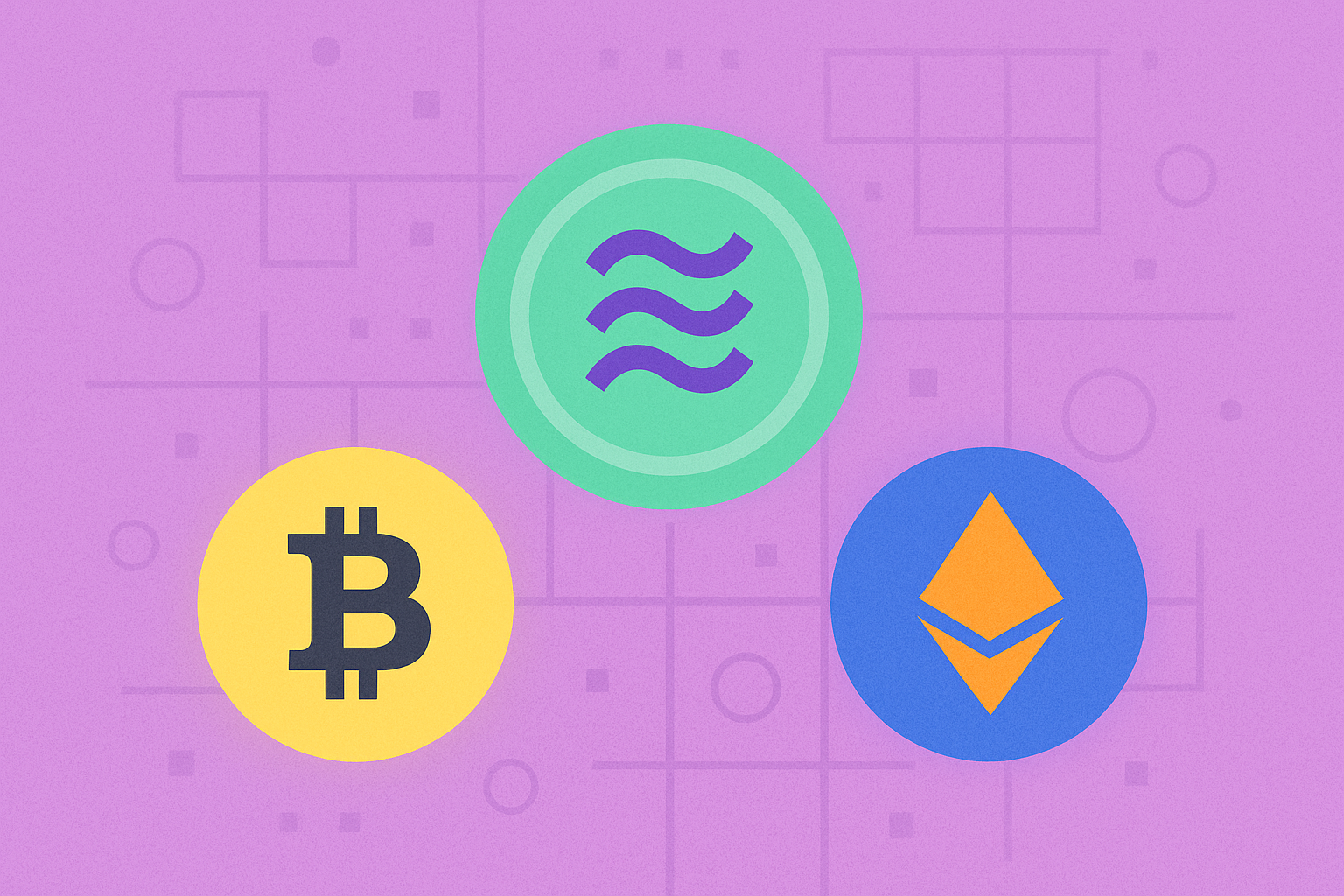
What is Facebook's Libra (Diem) currency?
Blockchain-Powered Music Royalty Distribution: Avalanche Drives the Digital Transformation
Understanding Bitcoin: Native SegWit vs. Taproot
The $9 Trillion XRP Claim: Fact or Fiction?

What is M2, and how does it impact the markets?
USD Tether
NFT là gì?