What is MVL: Understanding the Multi-Value Logic System in Modern Computing

2025-09-28 14:42:33
Altcoins
Blockchain
Crypto Ecosystem
DePIN
Web 3.0
Article Rating : 4
0 ratings
The article explores the Multi-Value Logic (MVL) system in modern computing and its transformative role in the mobility industry through blockchain technology. It highlights MVL's evolution, its decentralized architecture, and its substantial user base. The content addresses how MVL enhances transparency and efficiency in ride-hailing and electric vehicle sectors, catering to technologists and blockchain enthusiasts. Structured to provide a comprehensive understanding, the article covers MVL's origins, market impact, ecosystem applications, and potential challenges, presenting a detailed analysis for readers interested in blockchain-based mobility innovations. Key information includes participation methods through Gate.
What is MVL: Understanding the Multi-Value Logic System in Modern Computing

MVL's Positioning and Significance

In 2018, MVL Foundation introduced MVL (MVL), aiming to innovate the mobility industry using blockchain technologies.

As a blockchain-based mobility ecosystem, MVL plays a crucial role in ride-hailing, electric vehicles, and infrastructure sectors.

As of 2025, MVL has become an established player in the mobility blockchain space, with 220,000 drivers and 2.6 million passengers participating in its ecosystem. This article will analyze its technological architecture, market performance, and future potential.

Origins and Development History

Birth Background

MVL was created by the MVL Foundation in 2018, aiming to solve inefficiencies and lack of transparency in the traditional mobility industry.

It was born during the blockchain technology boom, with the goal of innovating the mobility sector through decentralized technologies.

MVL's launch brought new possibilities for ride-hailing services and electric vehicle infrastructure.

Important Milestones

  • 2018: Mainnet launch, introducing blockchain-based mobility services.
  • 2019: Launch of TADA, a ride-hailing service in Southeast Asia.
  • 2021: Introduction of ONiON, an electric vehicle and infrastructure business.
  • 2023: Ecosystem expansion, with over 600 vehicles participating in the network.

With support from the MVL Foundation and a team of over 300 employees worldwide, MVL continues to optimize its technology, security, and real-world applications.

How Does MVL Work?

Decentralized Control

MVL operates on a decentralized network of computers (nodes) spread across the globe, free from control by a single entity.

These nodes collaborate to validate transactions, ensuring system transparency and attack resistance, empowering users with greater autonomy and improving network resilience.

Blockchain Core

MVL's blockchain is a public, immutable digital ledger that records every transaction.

Transactions are grouped into blocks and linked through cryptographic hashes to form a secure chain.

Anyone can view the records, establishing trust without intermediaries.

MVL leverages blockchain technology to enhance transparency and efficiency in the mobility sector.

Ensuring Fairness

MVL uses a consensus mechanism to validate transactions and prevent fraudulent activities like double-spending.

Participants maintain network security through running nodes and validating transactions, and are rewarded with MVL tokens.

Its innovation includes integrating real-world mobility services with blockchain technology.

Secure Transactions

MVL uses public-private key encryption to protect transactions:

  • Private keys (like secret passwords) are used to sign transactions
  • Public keys (like account numbers) are used to verify ownership

This mechanism ensures fund security, while transactions maintain a level of pseudonymity.

Additional features include data sharing through DEPIN map and revenue sharing with token holders.

MVL's Market Performance

Circulation Overview

As of September 28, 2025, MVL has a circulating supply of 27,202,958,863.10265 tokens, with a total supply of 27,802,958,863.

Price Fluctuations

MVL reached its all-time high of $0.010655 on November 12, 2024. Its lowest price was $0.002524, recorded on September 28, 2025. These fluctuations reflect market sentiment, adoption trends, and external factors.

Click to view the current market price of MVL
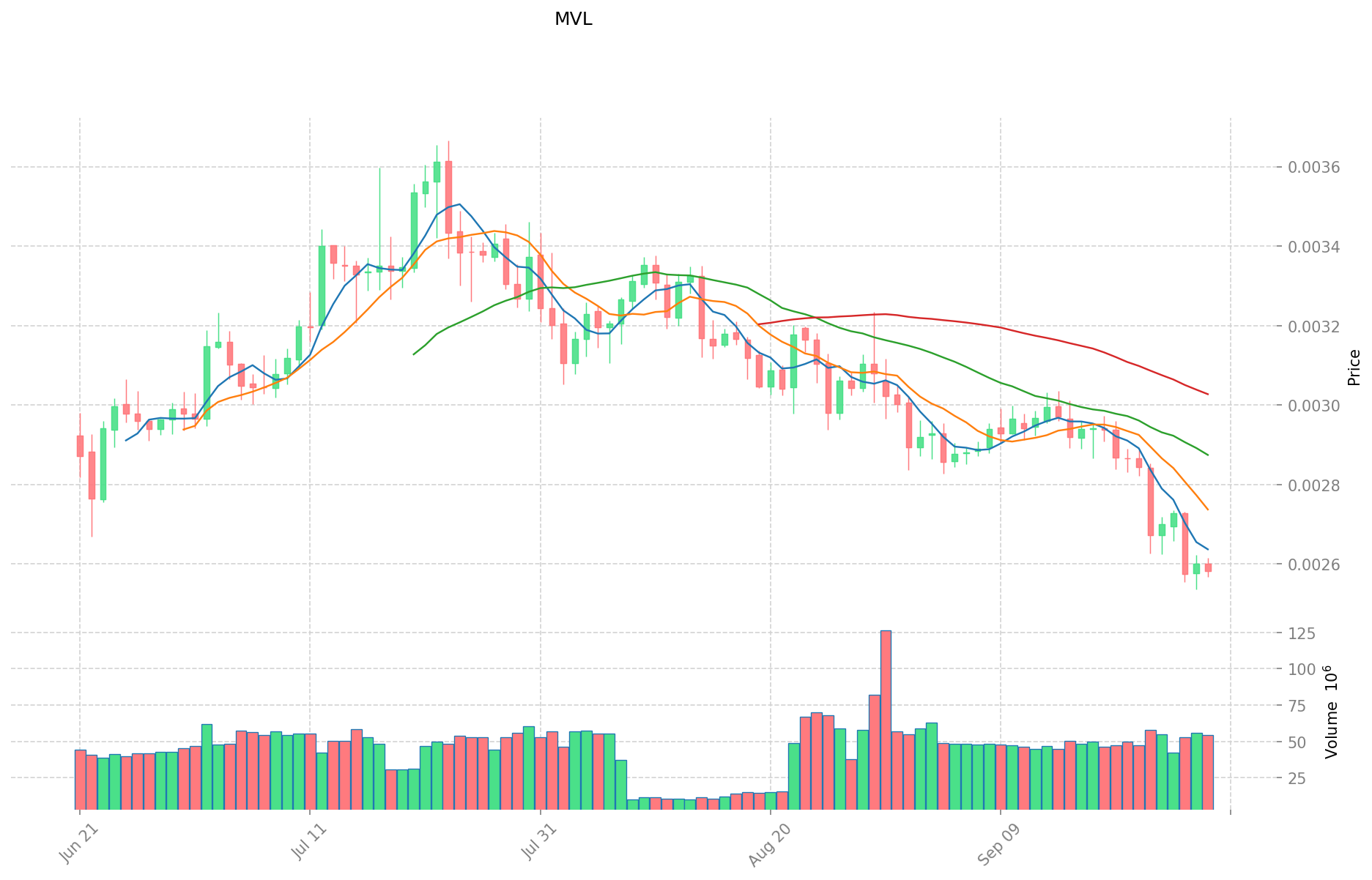
price-image

On-Chain Metrics

  • Daily Transaction Volume: $140,659.2817257 (indicating network activity)
  • Active Addresses: 11,698 (reflecting user engagement)

MVL Ecosystem Applications and Partnerships

Core Use Cases

MVL's ecosystem supports various applications:

  • Ride-hailing: TADA, providing on-demand transportation services.
  • Electric Vehicles: ONiON, driving innovation in sustainable mobility.

Strategic Collaborations

MVL has established partnerships with 220,000 drivers and 2.6 million passengers, enhancing its market presence. These partnerships provide a solid foundation for MVL's ecosystem expansion.

Controversies and Challenges

MVL faces the following challenges:

  • Market Competition: Competing with established ride-hailing services
  • Regulatory Risks: Potential regulations in the mobility sector
  • Adoption Barriers: Encouraging widespread use of blockchain in transportation

These issues have sparked discussions within the community and market, driving continuous innovation for MVL.

MVL Community and Social Media Atmosphere

Fan Enthusiasm

MVL's community is vibrant, with 220,000 drivers and 2.6 million passengers participating. On X platform, related posts and hashtags (like #MVL) often trend, with monthly post volumes reaching significant numbers. Price movements and new feature releases ignite community enthusiasm.

Social Media Sentiment

Sentiment on X shows a mix of opinions:

  • Supporters praise MVL's innovation in the mobility sector and blockchain integration.
  • Critics focus on challenges in market adoption and competition with traditional services.

Recent trends indicate growing interest in blockchain-based mobility solutions.

Hot Topics

X users actively discuss MVL's integration of blockchain in transportation, revenue sharing model, and DEPIN map data sharing, showcasing its transformative potential and the challenges of mainstream adoption.

More Information Sources for MVL

  • Official Website: Visit MVL official website for features, use cases, and latest updates.
  • Whitepaper: MVL whitepaper details its technical architecture, goals, and vision.
  • X Updates: On X platform, MVL uses @mvlchain actively, as of September 28, 2025, with posts covering technical upgrades, community events, and partnership news.

MVL Future Roadmap

  • Ecosystem Goals: Support expansion of TADA and ONiON services
  • Long-term Vision: Become a leading blockchain-based mobility infrastructure

How to Participate in MVL?

  1. Purchase Channels: Buy MVL on Gate.com
  2. Storage Solutions: Use secure wallets for storing MVL tokens
  3. Participate in Governance: Engage in community decisions through official channels
  4. Build the Ecosystem: Visit MVL GitHub to contribute code or develop applications

Summary

MVL is redefining the mobility industry through blockchain technology, offering innovative ride-hailing services and electric vehicle solutions. Its active community, rich resources, and strong market performance make it stand out in the cryptocurrency field. Despite facing challenges in market adoption and competition, MVL's innovative spirit and clear roadmap position it as a significant player in the future of decentralized mobility technology. Whether you're a newcomer or an experienced player, MVL is worth watching and participating in.

FAQ

How does MVL work?

MVL operates on blockchain, rewarding users for sharing mobility data. It uses tokens to incentivize participation in its ecosystem, connecting various transportation services.

What is the MVL short for?

MVL stands for Mass Vehicle Ledger, a blockchain-based ecosystem for the automotive and mobility industry.

How much does a MVL cost?

As of 2025, MVL's price fluctuates in the crypto market. It typically ranges from $0.50 to $2.00 per token, depending on market conditions and project developments.

What is MVL in finance?

MVL stands for Members' Voluntary Liquidation, a process to wind up a solvent company that has ceased trading. It's initiated by company members and legally ends the company's existence.

* The information is not intended to be and does not constitute financial advice or any other recommendation of any sort offered or endorsed by Gate.
Related Articles
How Active is the Community and Ecosystem of Akash Network (AKT) in 2025?

How Active is the Community and Ecosystem of Akash Network (AKT) in 2025?

The article explores the dynamic community and thriving ecosystem of Akash Network (AKT) in 2025, highlighting milestones such as 1 million social media followers and significant growth in daily on-chain transactions. It addresses how Akash's active engagement through events like competitions and meetups fosters community strength. Additionally, it discusses Akash's successful launch of 218 projects, including 51 focused on decentralized physical infrastructure networks (DePIN). Readers interested in the growth and impact of decentralized cloud computing solutions will find insights on Akash's market performance and community involvement.
2025-10-26 08:14:20
How Active is Pi Network's Community in 2025?

How Active is Pi Network's Community in 2025?

The article explores the dynamic growth of the Pi Network's community, focusing on its achievements such as reaching 13 million users, activating 400,000 nodes, and circulating 22 billion tokens. It addresses challenges in real-world adoption and utility while highlighting strategic goals like user expansion and ecosystem development through Pi Network Ventures. Targeted at crypto enthusiasts, developers, and potential investors, the article outlines the network's evolution post-mainnet launch, innovative mobile mining approach, and aims to attract more users to ensure long-term viability. Key metrics and comparisons emphasize scalability, decentralization, and user engagement.
2025-10-17 12:45:57
What is GEOD: Understanding the Global Environmental Observation Database and Its Impact on Climate Research

What is GEOD: Understanding the Global Environmental Observation Database and Its Impact on Climate Research

The article delves into the Global Environmental Observation Database (GEOD), highlighting its role in revolutionizing precise location services and space weather monitoring through GEODNET. By leveraging blockchain technology, GEODNET addresses the limitations of traditional GPS, offering centimeter-level positioning accuracy. The article explores its decentralized network structure, secure blockchain implementation, and real-world applications such as geospatial data and space weather monitoring. It targets industries requiring high-precision location data, discusses market performance including token circulation and prices, and examines community engagement. By outlining its historical milestones, current ecosystem, and future roadmap, the article positions GEODNET as a pivotal player in decentralized geospatial technology advancements.
2025-09-30 08:26:16
How Does FIL Compare to Its Competitors in Performance, Market Cap, and User Base?

How Does FIL Compare to Its Competitors in Performance, Market Cap, and User Base?

The article compares Filecoin (FIL) to its competitors in the decentralized storage market, focusing on performance metrics, market capitalization, and user base growth. Filecoin's competitive pricing, reliability, and integration with emerging technologies strengthen its market position, which is bolstered by impressive growth and partnerships. Additionally, its unique value propositions and practical utility are explored, highlighting FIL's advantage in addressing real-world storage needs. The content targets stakeholders in the blockchain and Web3 sectors, offering insights into FIL's strategic advantages and market leadership. Keywords include: Filecoin, decentralized storage, performance, market cap, user growth, utility.
2025-11-08 08:19:21
How Does HNT Compare to Its Competitors in Performance, Market Cap, and User Base?

How Does HNT Compare to Its Competitors in Performance, Market Cap, and User Base?

This article examines Helium Network's (HNT) performance within the decentralized wireless ecosystem, comparing key metrics like price, market cap, and user base against its competitors. It highlights Helium's strategic advantages, such as its unique tokenomics and substantial network growth, suggesting a strong position in the market despite certain challenges. The piece addresses the needs of investors and crypto enthusiasts seeking insight into HNT’s competitiveness and growth potential. The article is structured to outline performance comparisons, market share dynamics, and user base analysis, offering a comprehensive overview that emphasizes efficiency and readability. Key insights include Helium's expanding 5G infrastructure and its significant user engagement, with implications for the broader IoT and telecom markets.
2025-10-28 10:39:59
What is MSN: The Rise and Fall of Microsoft's Pioneering Online Service

What is MSN: The Rise and Fall of Microsoft's Pioneering Online Service

The article explores the rise and significance of Meson Network (MSN), a decentralized bandwidth marketplace launched in 2021. It discusses MSN's impact on the Web3 ecosystem, technical architecture, and market performance, highlighting the role it plays in efficient data transmission and decentralized infrastructure. Addressing inefficiencies in bandwidth distribution, it appeals to tech enthusiasts and industry professionals. Structured into sections on history, operation, market metrics, and community interaction, this article provides an insightful overview for readers seeking knowledge on decentralized technologies and Meson Network's future trajectory, tailored for easy scanning and comprehensive understanding.
2025-11-01 10:41:01
Recommended for You
How does RENDER token fund flow and exchange inflow impact price movements: a 2026 analysis

How does RENDER token fund flow and exchange inflow impact price movements: a 2026 analysis

This comprehensive analysis explores how RENDER token fund flows and exchange inflows directly drive price movements throughout 2026. The article examines four critical dimensions: futures open interest surge from $28.9M to $65.89M signaling bullish momentum, institutional accumulation patterns reflected in exchange outflows pushing prices to $2.36, market concentration across Gate and major platforms affecting price discovery, and on-chain activity spikes with 536 daily active addresses correlating with 83.8% weekly gains. Designed for traders, investors, and analysts, this guide decodes on-chain metrics, capital flow indicators, and market structure dynamics to predict RENDER price trends. By monitoring exchange inflows, holder distribution, and ecosystem transaction volume, readers gain actionable insights into how fundamental adoption metrics and speculative positioning collectively determine RENDER's valuation in the 2026 market cycle.
2026-01-08 10:32:35
What is KAS Kaspa coin market overview with $1.2B market cap and 27.07B circulating supply

What is KAS Kaspa coin market overview with $1.2B market cap and 27.07B circulating supply

Kaspa (KAS) establishes a solid market presence as the #37 ranked cryptocurrency with a $1.2 billion market cap and 27.07 billion circulating supply representing 93.3% of maximum tokens. The Layer-1 blockchain implements innovative BlockDAG technology with GHOSTDAG protocol, enabling parallel block processing and enhanced scalability compared to traditional blockchains. With $122.4 million in 24-hour trading volume across Gate and multiple major exchanges, KAS demonstrates healthy liquidity and market participation. The token exhibits modest price stability with -0.29% short-term fluctuation amid cautious market sentiment. Kaspa's thoughtfully engineered deflationary emission schedule projects inflation rates below Bitcoin by 2029, positioning it as a competitive Layer-1 solution for investors seeking technical innovation and long-term tokenomics sustainability.
2026-01-08 10:30:07
How does Kaspa (KAS) price volatility impact trading at $0.051 with $1.36 billion market cap?

How does Kaspa (KAS) price volatility impact trading at $0.051 with $1.36 billion market cap?

This article examines how Kaspa (KAS) price volatility at $0.051 impacts trading strategies within its $1.36 billion market cap environment. KAS demonstrates approximately 10% daily volatility, oscillating between $0.0455 and $0.05035, creating moderate risk opportunities for traders on Gate. The analysis identifies critical support at $0.045 and resistance at $0.119, providing structured frameworks for entry and exit decisions. Despite weak correlation with Bitcoin and Ethereum, KAS's mid-tier market capitalization creates unique trading dynamics where volume spikes and liquidation events generate outsized price swings. With typical daily volumes around $27 million, liquidity constraints amplify volatility during market contractions. Traders must implement disciplined risk management with 5-10% stop-loss strategies and position sizing discipline. Understanding these volatility patterns—from 24-hour fluctuations to technical levels—enables informed decision-making for day traders and swing traders navigating
2026-01-08 10:28:09
What are derivatives market signals for JASMY: funding rates, liquidations, and open interest explained
What are derivatives market signals for JASMY: funding rates, liquidations, and open interest explained

This article provides a comprehensive analysis of JASMY's derivatives market signals across three critical dimensions: funding rates, liquidations, and open interest. It explains how JASMY's 26% surge in open interest signals renewed trader confidence despite bearish technical patterns, indicating sophisticated accumulation at attractive entry points. The article reveals balanced long-short positioning through negative funding rates and symmetrical liquidation patterns, reducing cascading liquidation risks. With 24.5% price volatility creating significant risk-reward dynamics during JASMY's recovery phase, traders must understand how these signals interact. Designed for derivatives traders seeking actionable market intelligence, this guide decodes open interest dynamics, funding mechanisms, and liquidation cascades to optimize leverage strategies and anticipate volatility shifts across Gate and major perpetual futures exchanges.
2026-01-08 10:23:12
How does macroeconomic policy impact crypto prices: analyzing Fed policy, inflation data, and traditional market volatility effects on cryptocurrency
How does macroeconomic policy impact crypto prices: analyzing Fed policy, inflation data, and traditional market volatility effects on cryptocurrency

This comprehensive analysis examines how macroeconomic policy transmission mechanisms fundamentally shape cryptocurrency market dynamics. The article dissects Federal Reserve interest rate decisions and liquidity conditions as primary price drivers, demonstrating how rate cuts stimulate capital flows into Bitcoin and altcoins while rate hikes compress valuations. Monthly CPI releases emerge as critical market catalysts, triggering 50-100% trading volume spikes through immediate repricing of rate expectations. The piece further explores strengthening correlations between the S&P 500 and crypto assets, revealing 0.5-0.88 correlation ranges during risk-off periods, while highlighting asymmetric contagion effects across different cryptocurrencies. Institutional risk appetite and flow dynamics—including spot ETF inflows, stablecoin liquidity expansions, and exchange reserve fluctuations—function as primary determinants of directional crypto movements. Designed for traders, investors, and policy analysts, this guid
2026-01-08 10:20:31
What is Dogecoin market overview: DOGE price at $0.15, market cap $25.5B, and 24-hour trading volume explained

What is Dogecoin market overview: DOGE price at $0.15, market cap $25.5B, and 24-hour trading volume explained

This comprehensive Dogecoin market overview examines DOGE's significant position in the cryptocurrency ecosystem. Trading at $0.15 with a $25.5B market cap, Dogecoin ranks eighth globally, commanding 0.74% of total crypto market share. The article explores DOGE's 168.18B circulating supply under an inflationary model and demonstrates strong trading dynamics with daily volumes of $1.47B-$1.64B. Coverage spans major exchanges including Binance, Gate, Kraken, and KuCoin, ensuring robust liquidity for traders. Additionally, the emergence of the Grayscale Dogecoin Trust ETF provides institutional access. Ideal for investors and traders seeking to understand Dogecoin's market mechanics, liquidity conditions, and investment accessibility across traditional and cryptocurrency platforms.
2026-01-08 10:18:21
