Dragonfly’s 2026 Outlook: Crypto Enters a Phase of Concentration and Maturity
Bitcoin’s Dominance Is No Longer a One-Way Expansion
(Source: hosseeb)
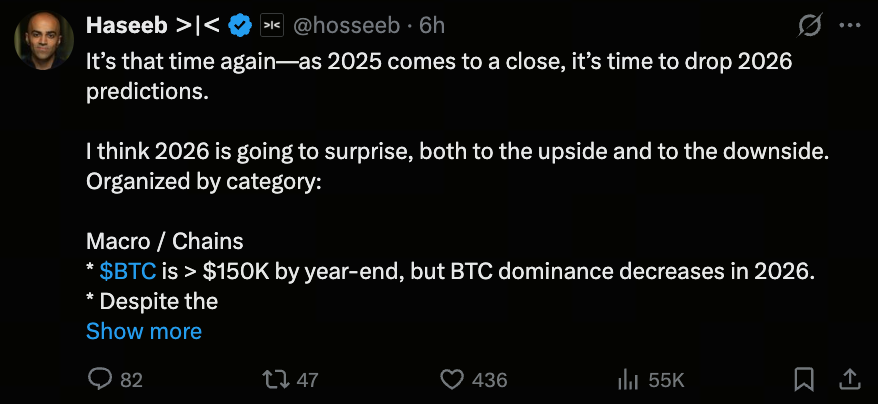
Haseeb projects that Bitcoin could reach $150,000 by the end of 2026, maintaining its position as the primary asset in the crypto market. However, record-high prices do not guarantee a corresponding increase in market dominance. As various blockchain ecosystems mature, capital allocation is becoming more diversified. Bitcoin’s market share may stabilize or even experience a structural decline.
Public Chain Competition Returns to Neutral Infrastructure
In the public chain sector, some new chains built around financial narratives or application-centric strategies may struggle to deliver on early market expectations. By contrast, Ethereum and Solana remain strong candidates for outperforming consensus. Their success stems from a consistent focus on neutral infrastructure, which continues to attract top developers and support the launch of critical applications.
Tech Giants Entering the Wallet Market Is Only a Matter of Time
Haseeb expects that by 2026, at least one major technology company will either launch its own crypto wallet or enter the market via acquisition. This development goes beyond expanding a single product line—it signals that mainstream tech industries now view crypto assets and on-chain identities as essential long-term strategic assets.
Perp DEX: Highly Concentrated Competitive Landscape
In the perpetual contract decentralized exchange (Perp DEX) space, competition will intensify rapidly. Ultimately, three leading platforms could control roughly 90% of the market. Other projects will be relegated to marginal niches, indicating that the derivatives sector has entered a mature phase dominated by top performers.
DeFi Investment Logic Undergoes Structural Shift
Haseeb highlights that equity-based investments will account for a much larger share in DeFi, potentially exceeding 20% of total investment by late 2026. This trend shows that capital markets are shifting focus from short-term token narratives to long-term value rooted in governance rights, cash flow, and corporate structure.
Stablecoin Supply Expands, US Dollar Remains Central
Stablecoin supply is expected to grow by approximately 60%. US dollar stablecoins will maintain near-total dominance, representing nearly 99% of the market. Although USDT will continue to play a pivotal role in liquidity, its market share may decrease slightly to around 55%, reflecting a gradual shift toward other US dollar stablecoin alternatives.
Regulatory Legislation Advances, But the Game Continues
Haseeb anticipates that the “Clarity” legislation will eventually be enacted. However, the passage of such bills will involve several rounds of political and industry negotiation. Regulatory implementation marks clearer rules, but uncertainty will persist in the short term.
Prediction Markets: Rapid Growth, Rapid Attrition
Prediction markets will continue to grow quickly in 2026, but will also face intense market attrition. Haseeb foresees around 90% of prediction market products exiting by year-end due to insufficient liquidity and weak demand.
AI and Crypto Integration Remains in Early Exploration
At the intersection of AI and crypto, real-world applications are still largely limited to software engineering and security. Most other use cases remain in proof-of-concept or prototype phases, with significant barriers to widespread adoption.
To learn more about Web3, click to register: https://www.gate.com/
Summary
Haseeb’s 2026 outlook presents a more mature and pragmatic vision of the crypto market. While price highs and technological innovation continue, the most significant changes are structural—capital concentration, infrastructure leadership, and a renewed focus on sustainable business models. For the crypto industry, 2026 may not only be a year of ongoing growth, but also a pivotal step toward long-term stability.
Share
Content
Bitcoin’s Dominance Is No Longer a One-Way Expansion
Public Chain Competition Returns to Neutral Infrastructure
Tech Giants Entering the Wallet Market Is Only a Matter of Time
Perp DEX: Highly Concentrated Competitive Landscape
DeFi Investment Logic Undergoes Structural Shift
Stablecoin Supply Expands, US Dollar Remains Central
Regulatory Legislation Advances, But the Game Continues
Prediction Markets: Rapid Growth, Rapid Attrition
AI and Crypto Integration Remains in Early Exploration
Summary


Related Articles

2025 BTC Price Prediction: BTC Trend Forecast Based on Technical and Macroeconomic Data

Flare Crypto Explained: What Is Flare Network and Why It Matters in 2025

How to Use a Crypto Whale Tracker: Top Tool Recommendation for 2025 to Follow Whale Moves

Pi Coin Transaction Guide: How to Transfer to Gate.com

What is N2: An AI-Driven Layer 2 Solution