Polymarket Confirms Exploit of Third-Party Verification Vulnerability, User Funds Stolen Sparks Risk Concerns
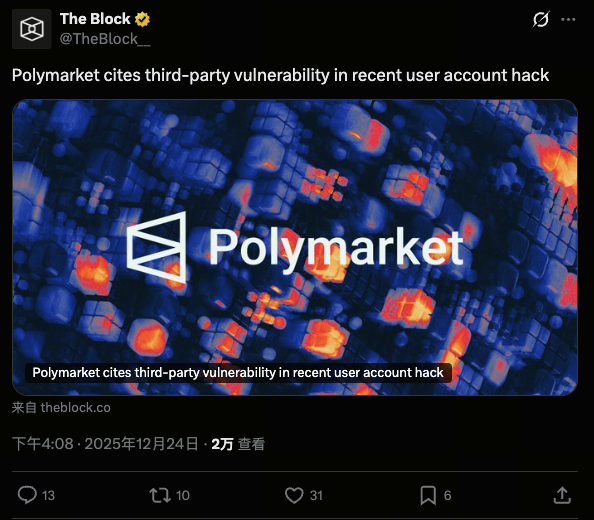
Image: https://x.com/TheBlock__/status/2003739551865475076
Polymarket Confirms Attack via Third-Party Authentication Vulnerability, User Funds Stolen
In late December 2025, Polymarket, a crypto prediction market platform, formally confirmed a security incident involving a third-party identity authentication service, resulting in the theft of certain user assets. The platform stressed that the breach did not originate from flaws in Polymarket’s core protocol or its smart contracts. Instead, attackers exploited vulnerabilities in a connected third-party authentication service, gaining control over affected user accounts and transferring funds.
Background and Official Statement
According to Polymarket’s official statement, the security breach occurred during user login and primarily impacted accounts registered or accessed through third-party authentication services, such as one-click email login. Several users reported that, despite enabling two-factor authentication (2FA), their account balances were emptied within minutes.
Polymarket subsequently confirmed that the vulnerability had been patched and stated there is no indication of ongoing attack risk. The platform clarified that its core market mechanisms, smart contracts, and settlement systems were not affected; the breach was due to a security flaw in the external identity verification process.
Attack Method and Potential Vulnerability Mechanism
Industry analysis and public information indicate this was not a typical phishing attack or a result of users disclosing private keys. Attackers likely exploited weaknesses in the third-party authentication process, bypassing standard login verification to gain wallet control linked to user accounts, even though users did not click malicious links or reveal email credentials.
Once control was obtained, attackers rapidly moved assets to external addresses, using transaction splitting and chain obfuscation to conceal fund flows and cause real losses.
Polymarket has not yet disclosed technical details about the vulnerability or the third-party provider involved. However, industry consensus suggests that authentication solutions outsourcing key management or account authorization to third parties can introduce systemic risks if those components are compromised.
User Feedback and Community Response
After the incident surfaced, users shared their experiences across community platforms and social media. One user reported logging back into Polymarket after receiving an abnormal login alert, only to find their balance nearly wiped out. Another user stated they had not engaged in any risky actions, only used email login with 2FA enabled, yet their assets were transferred out in a short time.
These cases quickly sparked community debate. Many users began re-examining the trade-off between “convenient login” and “asset security” on Web3 platforms. Some argued the incident revealed how efforts to optimize user experience in decentralized applications can inadvertently expose vulnerabilities in security boundaries.
Polymarket’s Response and Current Status
After confirming the breach, Polymarket reported that it immediately patched the vulnerability and proactively contacted affected users. The platform emphasized that no new suspicious activity has been observed and the system remains secure.
The official statement also confirmed that core smart contracts and market logic were not impacted. As a result, users employing self-custody wallets or logging in without third-party authentication were not exposed to this attack vector.
To date, Polymarket has not disclosed the exact number of affected users or the total scale of financial losses.
Industry Perspective: Why Third-Party Authentication Is a High-Risk Factor
From a broader industry viewpoint, this event underscores the structural risks Web3 platforms face when relying on third-party identity authentication services. Convenient email logins and social account authorizations lower the entry barrier but introduce new attack surfaces.
In Web2, OAuth and social login systems have long faced security challenges. In Web3, these authentication processes are often directly tied to wallet creation, key management, or transaction authorization. Any vulnerability can lead to direct asset losses, not just data breaches.
Security Lessons and User Protection Recommendations
The Polymarket incident offers several key security takeaways for crypto asset holders:
- Use third-party authentication services cautiously. Prioritize self-custody wallets and independent key management solutions.
- Implement multi-layered protection, such as hardware wallets and independent authenticators.
- For platforms used infrequently, promptly transfer assets to personal control addresses.
- Monitor official project updates, security alerts, and community feedback to respond quickly to potential risks.
Conclusion
In summary, the Polymarket security incident did not compromise the safety of its core protocol, but it clearly exposed the potential systemic risks of third-party identity authentication in the Web3 ecosystem. As the crypto industry continues to pursue user growth and enhanced experiences, striking the right balance between usability and asset security will remain a persistent challenge for all platforms.
Share
Content
Polymarket has confirmed a breach caused by a third-party authentication vulnerability, leading to the theft of funds from certain users.
Incident Background and Official Statement
Attack Methodology and Underlying Vulnerability Mechanism
User Feedback and Community Response
Polymarket's Response and Current Status
Industry Perspective: Why Third-Party Authentication Is a High-Risk Vector
Security Takeaways and User Protection Recommendations
Conclusion


Related Articles
2025 BTC Price Prediction: BTC Trend Forecast Based on Technical and Macroeconomic Data
Flare Crypto Explained: What Is Flare Network and Why It Matters in 2025
How to Use a Crypto Whale Tracker: Top Tool Recommendation for 2025 to Follow Whale Moves

Pi Coin Transaction Guide: How to Transfer to Gate.com

What is N2: An AI-Driven Layer 2 Solution