


is crypto real
What Is Cryptocurrency?
Cryptocurrency is a form of digital currency that operates on a blockchain network.
It relies on a public blockchain to record every transaction, allowing anyone to verify the ledger without trusting a single centralized authority. A blockchain functions like a public ledger, where all entries are accessible and, once recorded, are nearly impossible to alter, minimizing the risk of fraud.
Users manage their assets using a "wallet." A wallet is not an app that stores coins, but rather a tool for safeguarding your private key. The private key acts like the key to a safe—whoever holds it controls the assets, so it must be securely backed up.
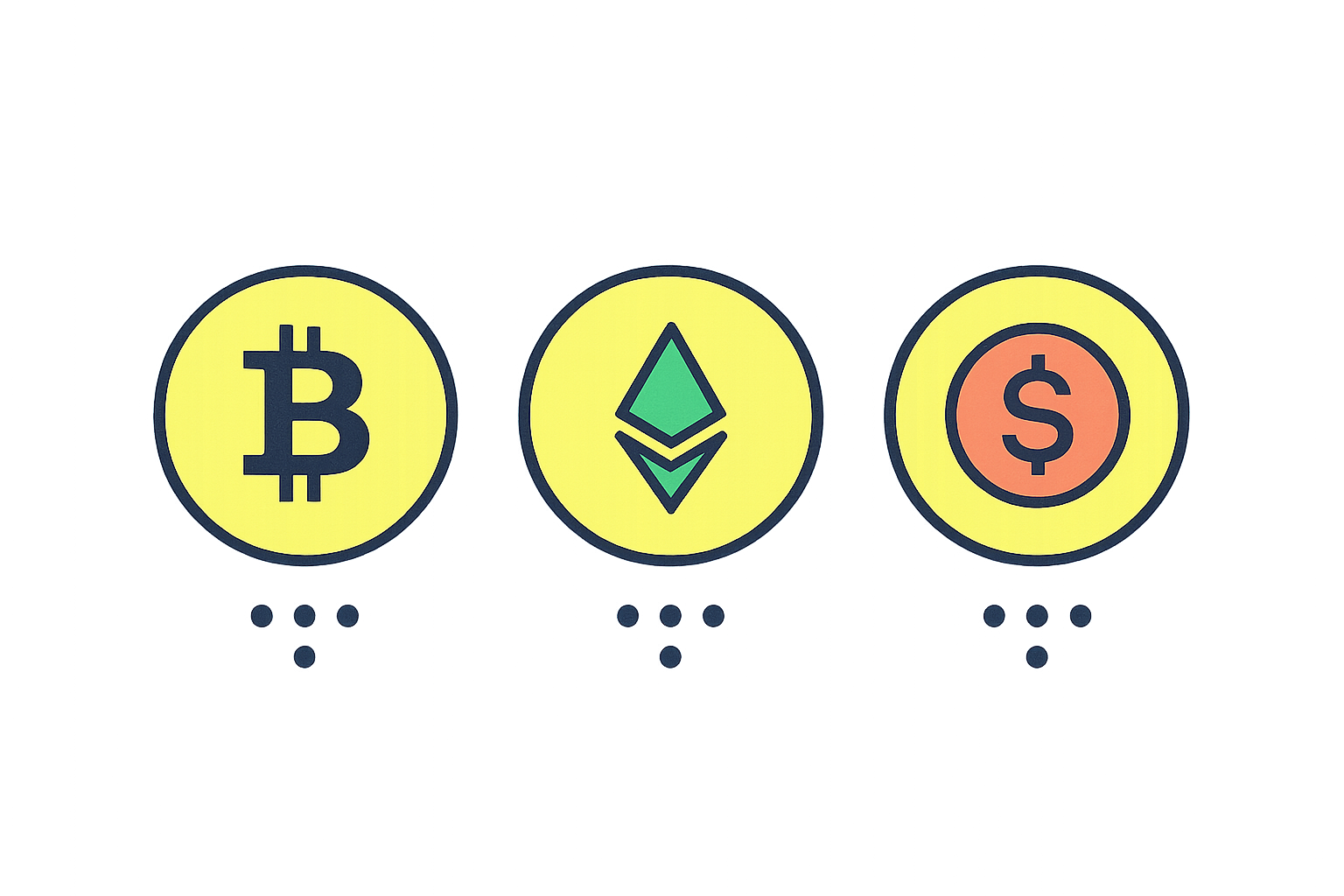
With cryptocurrency, you can transfer value globally without a bank account, as network participants collectively maintain the security of the ledger. Popular types include Bitcoin, Ether (ETH), and stablecoins—cryptocurrencies pegged to fiat currencies like the US dollar for greater price stability.
How Does Cryptocurrency Work?
Cryptocurrency transactions are recorded on a public ledger and verified collectively by network participants.
When you initiate a transfer, your transaction is bundled into a "block," which is then validated and added to the ledger by "validators" or "miners." To prevent spam and ensure network health, each transaction incurs a small fee known as "gas."
An address works like your account number for receiving funds, while the private key grants spending authority. Anyone can send crypto to your address, but only you can access it with your private key. To enhance security, networks typically require multiple "confirmations" to ensure the block containing your transaction is stable.
A typical process might involve: buying Bitcoin (BTC) with stablecoin USDT on an exchange, withdrawing it to your personal wallet; on-chain records will show funds moving from the exchange's address to yours, and after several confirmations, your assets are credited. You can verify these transactions anytime.
What Are the Main Use Cases of Cryptocurrency in Web3?
Cryptocurrency serves as both a means of payment and a unit of account for various on-chain assets.
- Trading: On exchanges like Gate, cryptocurrencies facilitate order matching and settlement. For instance, USDT trading pairs dominate spot markets, allowing users to enter and exit positions conveniently while minimizing friction between fiat and blockchain transactions.
- DeFi (Decentralized Finance): You can deposit assets into lending protocols to earn interest or provide liquidity to decentralized exchanges (DEXes), earning a share of trading fees. Providing liquidity means adding your funds to an automated market-making pool so others can swap tokens—fees are distributed proportionally.
- NFTs and Creator Economy: Many NFTs are priced in ETH, with purchases and resales executed transparently on-chain.
- Blockchain Gaming: In-game tokens are used for assets and rights. Users often enter games with stablecoins and convert earned tokens back to mainstream assets when exiting.
How Do You Buy Cryptocurrency?
You can purchase cryptocurrency through regulated exchanges and transfer it to your self-custody wallet for safekeeping.
- Register on Gate and complete KYC: Setting up an account and verifying your identity improves compliance and raises transaction limits.
- Choose your deposit method: You can buy USDT directly with a bank card via "fiat purchase," or deposit through platform-supported OTC merchants. Always choose reputable vendors.
- Place an order in the spot market: For example, buy BTC or ETH with USDT by selecting the appropriate trading pair (e.g., BTC/USDT), then choose limit or market order based on your needs. Once filled, assets are visible in your funding account.
- Withdraw to a self-custody wallet: Create a wallet and securely back up your recovery phrase. Then withdraw from Gate to your wallet address—test with a small amount first, then larger sums once confirmed. Ensure network selection and fees are set correctly.
- Be aware of risks and fees: Watch for price volatility, withdrawal and network fees, account and wallet security; beware of phishing links and impersonators, and always enable two-factor authentication for critical actions.
What Are the Latest Trends and Data in Cryptocurrency?
Over the past year, total market capitalization, stablecoin supply, and on-chain activity have all shown sustained growth, with Bitcoin maintaining a dominant share.
- Market Cap Performance: Throughout 2025, global crypto market cap ranged mostly between $2 trillion and $3 trillion USD; in H2 2025, it hovered between $2.2 trillion and $2.6 trillion (based on public market aggregation).
- Market Structure: Bitcoin’s share of total crypto market cap has generally remained between 45%–55%, reflecting continued demand for its "store of value" qualities.
- Stablecoin Supply and Usage: As of end-2025, total issuance of major stablecoins (USDT, USDC, etc.) exceeded $150 billion USD, with USDT accounting for 70%–75%. Stablecoin pairs make up over 70% of spot trading volume on major exchanges; on Gate, USDT pairs are consistently the primary trading channel.
- On-Chain Activity: In H2 2025, Bitcoin daily transactions ranged from 300,000 to 700,000; Ethereum mainnet handled 800,000 to 1.2 million daily transactions, boosted by DeFi settlements and L2 scaling solutions.
- Regulatory Progress: Over the past year, several countries have clarified exchange licensing and stablecoin regulatory frameworks, strengthening compliance gateways and risk control tools for more secure trading and custody experiences.
How Does Cryptocurrency Differ from Fiat Currency?
There are clear distinctions in issuance method, accounting systems, volatility, and acceptance.
- Issuance: Fiat currencies are issued by central banks and accounted for by commercial banks; cryptocurrencies operate via network protocols enforced by code and participants. For example, Bitcoin’s supply cap of 21 million is hard-coded.
- Settlement: Fiat transfers rely on banks and clearing houses—cross-border payments may take days. Cryptocurrencies settle on-chain globally within minutes but require network fees.
- Price Stability: Fiat offers stable value suited for everyday pricing; most cryptocurrencies are more volatile. However, stablecoins are pegged to fiat and serve as entry/exit ramps and settlement instruments.
- Acceptance & Compliance: Fiat is widely accepted and legally protected; cryptocurrency acceptance varies by jurisdiction and use case as regulatory frameworks evolve.
Common Misconceptions About Cryptocurrency
Most misconceptions revolve around equating crypto with scams or underestimating private key management risks.
- "Crypto is illegal": In fact, many countries have clear rules for compliant trading and taxation. Illegality pertains to fraud or money laundering—not the technology itself.
- "Blockchain is unhackable": While blockchain records are hard to alter, wallets can still be compromised. Common risks include phishing sites, fake apps, and private key leaks—always enable two-factor authentication and securely back up recovery phrases offline.
- "Guaranteed profits": Crypto prices are highly volatile; on-chain investing involves smart contract bugs or liquidation risks. Manage risk exposure wisely—set take-profit/stop-loss levels and diversify platforms/assets.
- "Decentralized means anonymous": All blockchain activity is public and traceable—compliance tools make tracking possible. Never assume anonymity absolves you from legal or regulatory obligations.
In summary: cryptocurrency represents real technology and digital asset classes. To participate safely in this new financial network, use reliable tools, enter via compliant platforms, understand risks/data, and apply best practices.
Key Terms
- Blockchain: A distributed ledger technology secured by cryptography that ensures transaction records are immutable and transparent.
- Decentralization: The absence of central authority—network participants collectively maintain system operation and security.
- Wallet: A tool for storing and managing cryptocurrency private keys, enabling sending/receiving digital assets.
- Consensus Mechanism: The protocol rules by which network nodes agree on the current state of the ledger.
- Mining: The process where participants use computational power to validate transactions and create new blocks in exchange for rewards.
- Smart Contract: Self-executing code that automates transactions when preset conditions are met without intermediaries.
FAQ
Does cryptocurrency have real value or is it just hype?
Cryptocurrencies have genuine economic value, but their value foundation differs from traditional assets. Leading coins like Bitcoin and Ethereum derive value from millions of global users acknowledging their worth—much like gold’s value arises from scarcity and consensus rather than utility alone. However, speculation does exist; assess each project’s fundamentals carefully.
Could cryptocurrency suddenly crash completely?
Crypto markets are much more volatile than traditional finance—prices can swing dramatically. The risk of a complete collapse depends on the asset: Bitcoin is considered relatively lower-risk due to its robust network base; small-cap coins carry higher risk. Only invest what you can afford to lose, avoid leverage or borrowing to buy crypto, and educate yourself to minimize scam risks.
Why do so many people believe cryptocurrency is real?
There are three core reasons for crypto’s broad acceptance: it enables peer-to-peer value transfer without intermediaries; growing adoption by enterprises (such as Tesla or MicroStrategy) boosts trust; and blockchain’s open-source transparency allows anyone to verify authenticity. Together these factors reinforce market consensus.
What determines cryptocurrency prices? Can they be manipulated?
Crypto prices are driven by supply-demand dynamics, market sentiment, policy news, and technology developments. Large-cap coins (like BTC) have deep liquidity making full manipulation difficult; smaller coins may be more susceptible to price control by large holders (“whales”). Stick to reputable exchanges like Gate for transparent trade data—and avoid low-quality coins or scams.
Is holding cryptocurrency safe? Can hackers steal my assets?
Cryptocurrencies themselves are protected by advanced cryptography—making them technically hard to hack. Security depends on how you store them: regulated platforms like Gate offer relative safety; if you self-custody private keys, backup procedures are critical. Unsafe wallets or phishing links expose you to theft risk. Beginners should start with trusted exchanges before managing their own assets.
Further Reading
- https://disb.dc.gov/page/you-invest-crypto-know-risks
- https://www.kaspersky.com/resource-center/definitions/what-is-cryptocurrency
- https://en.wikipedia.org/wiki/Cryptocurrency
- https://consumer.ftc.gov/articles/what-know-about-cryptocurrency-scams
- https://www.fidelity.com/learning-center/trading-investing/crypto/crypto-vs-cash
- https://www.schwab.com/learn/story/cryptocurrencies-what-are-they
- https://www.rba.gov.au/education/resources/explainers/cryptocurrencies.html
- https://www.coursera.org/articles/how-does-cryptocurrency-work
Related Articles

The Future of Cross-Chain Bridges: Full-Chain Interoperability Becomes Inevitable, Liquidity Bridges Will Decline

Solana Need L2s And Appchains?
