


As of June 2026, the global wealth management industry is undergoing a profound structural transformation. In the past, a nearly insurmountable divide separated crypto assets from traditional wealth management—the former operated on-chain, while the latter functioned within the fiat system, lacking any systematic connection mechanism. For high-net-worth individuals holding digital assets, this fragmentation meant splintered asset allocation, inefficient liquidity, and missed cross-market opportunities.
Against this backdrop, Gate has officially launched Gate Wealth, a comprehensive private banking-grade service for ultra-high-net-worth individuals and institutional investors worldwide, bridging Web3 and traditional finance. This service system integrates digital assets, fiat systems, and real-world assets (RWA), aiming to build a cross-cycle, multi-asset-class global wealth management infrastructure. From the shifting landscape of global wealth management, the structural limitations of traditional private banks, and the core competencies of the next-generation wealth management system, we systematically analyze the industry trend represented by Gate Wealth.

What Is Changing in Global Wealth Management?
Understanding the industry significance of Gate Wealth first requires an examination of the fundamentals of global wealth management.
The global high-net-worth population continues to expand. According to Altrata's 2026 World Ultra Wealth Report, as of the end of 2025, the number of ultra-high-net-worth individuals (UHNWIs) with a net worth exceeding $30 million reached 556,850 worldwide, a year-over-year increase of 14.4%—the fastest growth rate since 2017. The total wealth of this group hit $63.8 trillion, up 14.3% from the previous year. The report forecasts that by 2030, the global UHNWI population will grow to 746,570, an increase of approximately 190,000 from 2025. Regionally, the United States leads with 206,880 UHNWIs, mainland China ranks second with 55,490, and Germany third with 28,330.
On a broader scale, nearly 60 million high-net-worth individuals worldwide (with investable assets exceeding $1 million) hold approximately $226.47 trillion in assets. These figures indicate that the potential market for global wealth management services continues to expand rapidly.
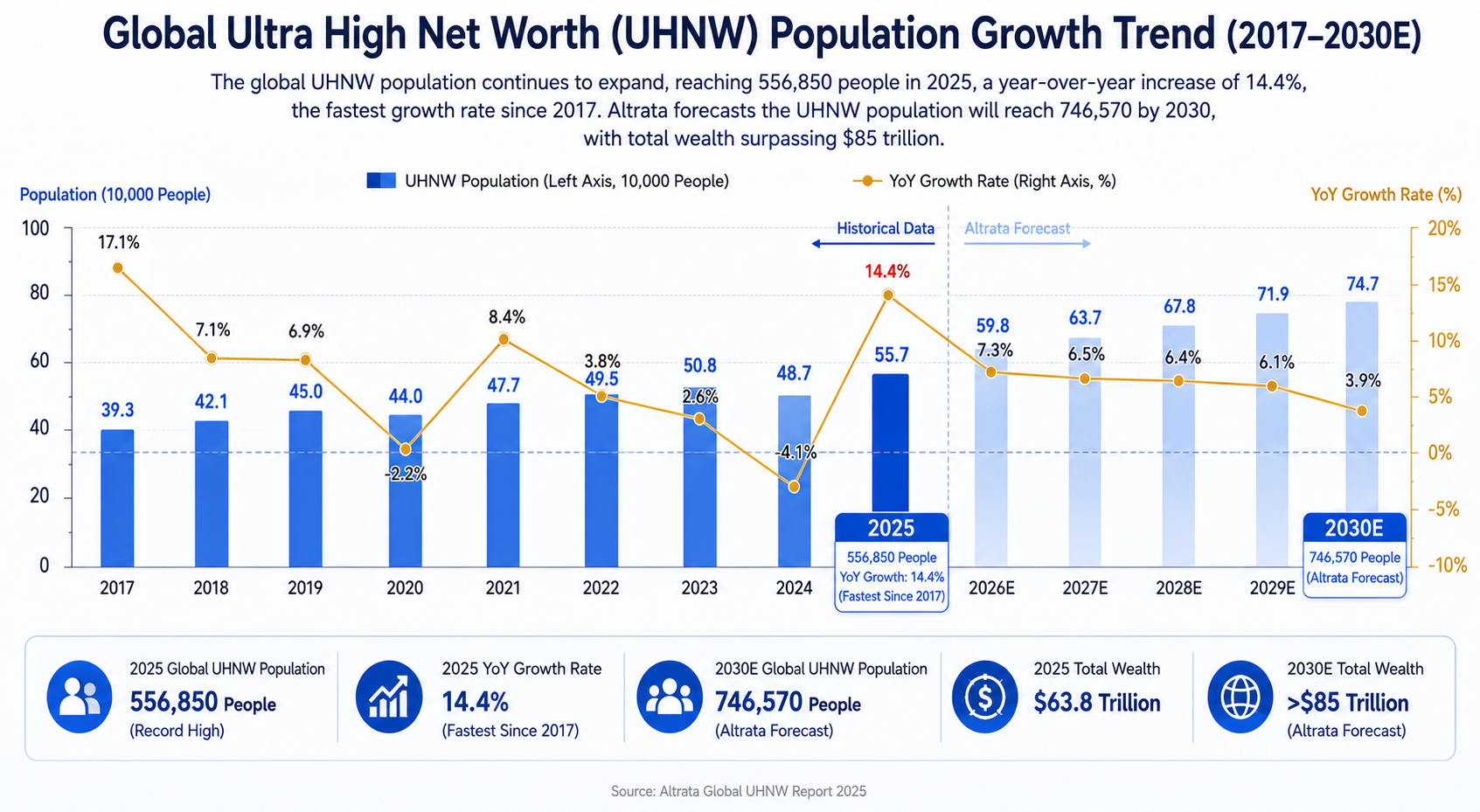
Global UHNWI Growth Trend (2017–2030E)
Digital assets are becoming an allocation option for high-net-worth individuals. This trend has evolved from an early fringe experiment into a systematic asset allocation behavior. A survey of 270 high-net-worth individuals in Asia showed that 87% of respondents already hold digital assets. A KPMG survey revealed that 58% of Hong Kong family offices and high-net-worth individuals have invested in virtual assets. Although most allocation ratios remain low—60% of respondents have virtual assets comprising less than 5% of their portfolios—54% indicated they intend to allocate 5% to 30% of their assets to this category.
Family offices are becoming a key force in digital asset allocation. According to BNY Mellon research, 74% of ultra-high-net-worth family offices have already invested or are considering investing in crypto assets, a 21-percentage-point increase from the previous year. Multiple institutional sources note that Bitcoin and Ethereum remain the primary entry points for family offices, largely due to the ongoing improvement of custody, security, compliance, and trading infrastructure, which helps compensate for the lack of in-house crypto expertise in family offices. The investment logic of family offices has shifted from "crypto experimenters" to "organized allocators."
The RWA (Real World Assets) market is experiencing explosive growth. The scale of on-chain tokenized RWAs has surged from approximately $5.4 billion at the start of 2025 to between $26.4 billion and $34 billion as of June 2026—a more than fivefold increase in just 15 months. A report from Castle Labs indicates that the current RWA market size has reached $28.2 billion, with a peak of $31.8 billion. Tokenized U.S. Treasuries and money market funds remain the largest category, at around $17 billion, accounting for nearly 60% of the entire RWA market. Bernstein analysts have characterized 2026 as the inaugural year of a tokenization "super cycle," while McKinsey predicts that the tokenized asset market (excluding stablecoins and CBDCs) will reach approximately $2 trillion by 2030. These data points collectively indicate that the on-chain migration of real-world assets is accelerating from the proof-of-concept stage into a phase of large-scale adoption.
From these fundamental data, a clear conclusion emerges: the volume of global wealth is growing, high-net-worth individuals' acceptance of digital assets is rising, and the tokenization of RWAs is opening a channel between traditional and digital assets. These three forces converge to reshape the underlying logic of the wealth management industry.
Why Can Traditional Private Banks Not Easily Serve Web3 Investors?
Despite these clearly defined trends, traditional private banking systems face multiple structural constraints when serving high-net-worth clients holding digital assets.
First, they cannot effectively manage on-chain assets. The IT architecture and custody systems of traditional private banks are built on centralized databases, creating a fundamental incompatibility with the address systems and smart contract logic of public blockchains. On-chain assets held by clients—whether major crypto assets, DeFi positions, or NFTs—cannot be integrated into the traditional private bank's asset management system for a unified view and real-time monitoring. This "data silo" forces clients to constantly toggle between traditional bank accounts and on-chain wallets, making it nearly impossible to establish a holistic perspective on asset allocation.
Second, there is a disconnect between fiat and crypto assets. Traditional private banks can offer asset allocation advice and execution for fiat-denominated assets, but they lack the trading, custody, and yield management capabilities for crypto assets. Clients who need to manage both asset classes often must engage separately with a traditional private bank and a crypto exchange, leading to significant disparities in information, liquidity, and execution efficiency. This fragmentation not only increases operational costs but also hinders the effective implementation of cross-asset allocation strategies.
Third, cross-market liquidity is insufficient. The asset allocation needs of high-net-worth clients frequently span multiple markets, currencies, and asset classes. Traditional private banks have well-established liquidity networks for global fiat assets but lack deep liquidity support in the crypto space. Without institutional-grade OTC channels and market maker networks, large purchases or sales of crypto assets would face significant slippage costs and execution risks.
Fourth, the asset allocation framework is fragmented. Traditional private banks' asset allocation models are designed around conventional asset classes like equities, bonds, private equity, and real estate, lacking a systematic methodology to incorporate crypto assets as an independent asset class. In core toolchains—such as risk factor analysis, correlation modeling, and portfolio optimization—crypto assets are often simplistically categorized as "alternative investments" or excluded altogether.
The common thread running through these structural limitations is clear: the market needs a global wealth management platform capable of unifying the management of crypto and traditional assets. This is not a replacement for traditional private banks but an extension of existing service capabilities—bringing on-chain assets within the private banking service boundary while introducing traditional finance's allocation framework and risk management systems into the digital asset space.
Core Capabilities of the Next-Generation Wealth Management System
Based on the analysis above, a next-generation wealth management system capable of serving both Web3 investors and traditional high-net-worth individuals must possess the following core capabilities:
Multi-asset allocation capability. This is not simply a list of asset classes but the establishment of a unified allocation framework and risk model that allows crypto assets, RWAs, and traditional financial assets to undergo portfolio optimization and dynamic rebalancing under the same methodology. The allocation framework must cover the full spectrum from liquidity management to long-term capital appreciation and be capable of systematic adjustments in response to macroeconomic cycles.
RWA integration capability. With the rapid expansion of tokenized U.S. Treasuries, tokenized equities, and tokenized commodities, the next-generation wealth management system must have the ability to incorporate these compliant on-chain assets into allocation portfolios. This involves not only asset selection and evaluation but also systematic operational capabilities such as subscription and redemption mechanisms, income distribution, and tax treatment.
Global liquidity network. Cross-market allocation of large assets requires deep liquidity support. This includes efficient conversion channels between fiat and crypto assets, multi-currency multi-asset trade execution capabilities, and institutional-grade OTC block trading networks. The depth and breadth of the liquidity network directly determine the execution efficiency of large-scale asset allocation.
Staking and financing capabilities. Digital asset holders often face the classic dilemma of "hold versus utilize." The next-generation wealth management system must provide mechanisms to unlock liquidity without selling core assets, including crypto asset-backed lending and structured financing tools. This enables clients to maintain asset exposure while obtaining operational funds or the ability to allocate to other asset classes.
Trust and structured investment vehicles. Wealth management for ultra-high-net-worth clients involves not only asset allocation but also asset protection, tax planning, and wealth succession. Trust structures, offshore arrangements, and structured investment vehicles are standard at this service tier and must be systematically integrated with the management and succession needs of digital assets.
Gate Wealth: The Infrastructure Connecting Web3 and Traditional Finance
On June 24, 2026, Gate officially launched Gate Wealth, establishing a global wealth management and private banking service system. From a product design perspective, Gate Wealth's architecture directly addresses the industry needs discussed above, with its core features manifested at the following levels:
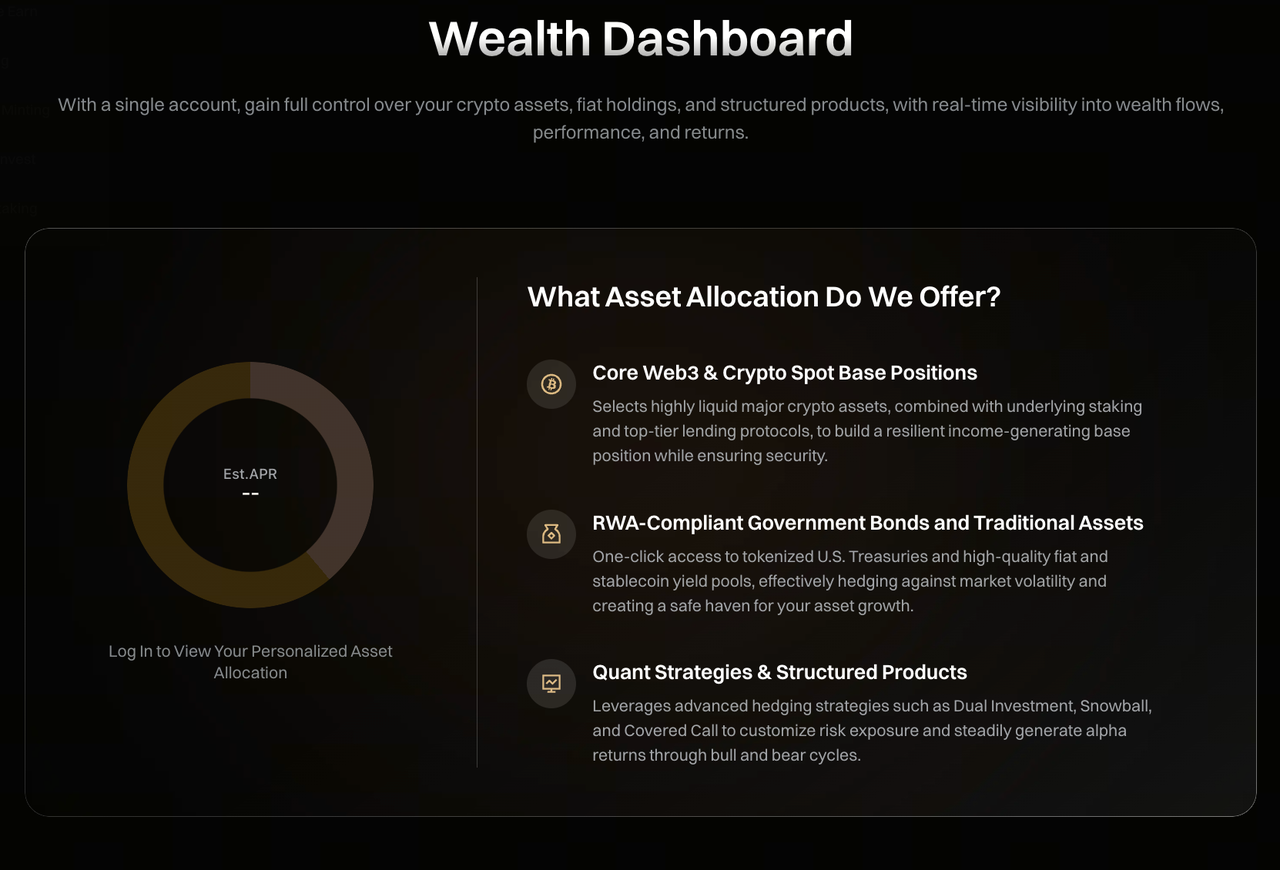
Source: Gate Wealth
Breadth of asset coverage. Gate Wealth's asset allocation system spans crypto assets, RWAs and compliant yield assets (including tokenized U.S. Treasuries and stablecoin yield products), global equity markets (including S&P 500 ETFs, Nasdaq 100 ETFs, etc.), bonds and fixed income, structured financial products (including dual-currency and options-based strategies), as well as IPO and primary market investment opportunities. This asset coverage enables clients to unify crypto assets, fiat assets, and structured financial products within a single system, achieving holistic allocation and real-time management.
Three core capability pillars. Gate Wealth's capability design rests on three pillars: First, security and compliance—supported by a multi-jurisdictional compliance framework, trust and asset management systems, and a transparent Proof of Reserves (PoR) mechanism to provide foundational security for client assets. Second, around-the-clock dedicated service—a service network consisting of professional account managers and research teams providing 7x24 global response, supporting large trade execution, asset transfers, and customized investment needs. Third, global liquidity and execution network—leveraging connectivity with traditional banking systems and global digital asset liquidity networks to achieve efficient cross-asset conversion and deep liquidity support.
Institutional-grade credentials and compliance framework. Gate entities have obtained Digital Asset Service Provider (CASP) and relevant financial institution authorizations in Malta, covering major European Economic Area markets through the EU passporting mechanism. Additionally, Gate has registered as a digital currency service provider in Australia, secured a Virtual Asset Service Provider (VASP) license and related trading business authorization in Dubai, and obtained digital asset business approvals in the Bahamas. This multi-jurisdictional compliance framework provides foundational support for Gate Wealth's global operations.
Extension of private banking services. Beyond core asset allocation capabilities, Gate Wealth extends its services to family wealth succession and cross-generational planning. Through trust structure design, it optimizes asset structures and achieves risk isolation. Combined with cross-border tax planning and compliance advisory services, it provides clients with long-term asset allocation solutions across jurisdictions. This positioning aligns closely with the wealth succession and long-term planning needs of the global ultra-high-net-worth population.
From an industry evolution perspective, the launch of Gate Wealth marks the upgrade of crypto wealth management from "exchange ancillary services" to "an independent private banking-grade service system." Previously, wealth management services in the crypto industry were mostly attached to exchanges, existing in the form of VIP client benefits or wealth management products, lacking systematic asset allocation frameworks, institutional-grade compliance structures, and cross-cycle service capabilities. Gate Wealth seeks to introduce the service standards of traditional private banking—including dedicated client managers, investment research support, trust structures, tax planning, and cross-border allocation—into the digital asset space, while embedding the native capabilities of crypto assets—on-chain transparency, smart contract automation, and global accessibility—into traditional wealth management service processes.
Conclusion
The global wealth management industry is undergoing a paradigm shift from "asset class segmentation" to "unified allocation framework." The demand for digital asset allocation among high-net-worth individuals, the explosive growth of the RWA market, and the accelerated push toward tokenization by traditional financial institutions are all driving this transformation. In this context, comprehensive wealth management platforms capable of managing both crypto and traditional assets and connecting the on-chain world with the fiat system are evolving from "differentiated options" into "industry infrastructure."
The launch of Gate Wealth is a concrete manifestation of this trend. By integrating crypto assets, RWAs, global equities, bonds, and structured products, building a multi-jurisdictional compliance framework and global liquidity network, and offering full life-cycle services from asset allocation to wealth succession, Gate Wealth aims to provide a unified global wealth management infrastructure for high-net-worth individuals and institutional clients worldwide. As the global financial system accelerates toward digitization and institutionalization, such comprehensive service platforms bridging Web3 and traditional finance are poised to occupy a central position in the next-generation wealth management ecosystem.
FAQ
Q1: What is the core difference between Gate Wealth and traditional private banks?
Traditional private banks cannot manage on-chain assets, creating a disconnect between fiat and crypto asset systems. Gate Wealth integrates crypto assets, RWAs, global equities, bonds, and other diversified assets on a single platform. Clients can execute, manage, and allocate across asset classes without switching between multiple platforms.
Q2: What asset classes does Gate Wealth support?
Gate Wealth covers crypto assets (BTC, ETH, and other mainstream digital assets), RWAs and compliant yield assets (tokenized U.S. Treasuries, stablecoin yield products), global equity markets (S&P 500 ETFs, Nasdaq 100 ETFs, etc.), bonds and fixed income, as well as structured financial products and IPO primary market opportunities.
Q3: How does Gate Wealth ensure the security of client assets?
Gate Wealth provides asset security through a multi-jurisdictional compliance framework, trust and asset management systems, and a transparent Proof of Reserves (PoR) mechanism. Gate entities have obtained relevant financial and virtual asset service licenses and authorizations in multiple jurisdictions, including Malta, Dubai, Australia, and the Bahamas.
Q4: Who can apply for Gate Wealth services?
Gate Wealth offers private banking-grade wealth management services to ultra-high-net-worth individuals and institutional investors worldwide. For specific eligibility criteria and application procedures, please visit the wealth management page on the Gate website.
Q5: Does Gate Wealth support wealth succession and tax planning?
Yes. Gate Wealth extends its services to family wealth succession and cross-generational planning. Through trust structure design, it optimizes asset structures and achieves risk isolation. Combined with cross-border tax planning and compliance advisory services, it provides clients with life-cycle wealth management solutions.


