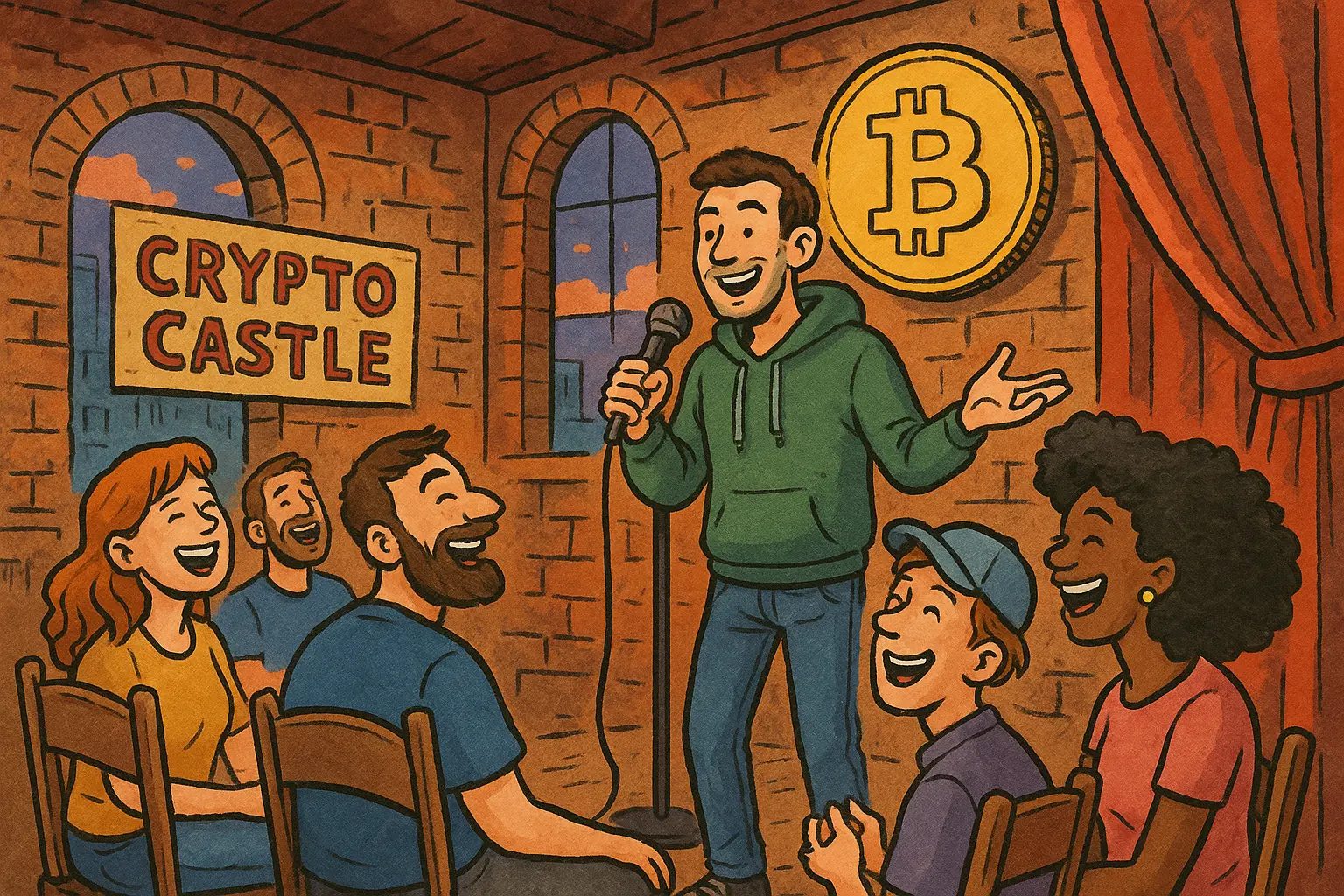
Actor and comedian Viv Ford created the YouTube sitcom “Crypto Castle,” set back in 2015 when Bitcoin was only $250, and a group of early adopters with dreams believed they were changing the world.
Show Overview: A House Full of Early Bitcoin Adopters
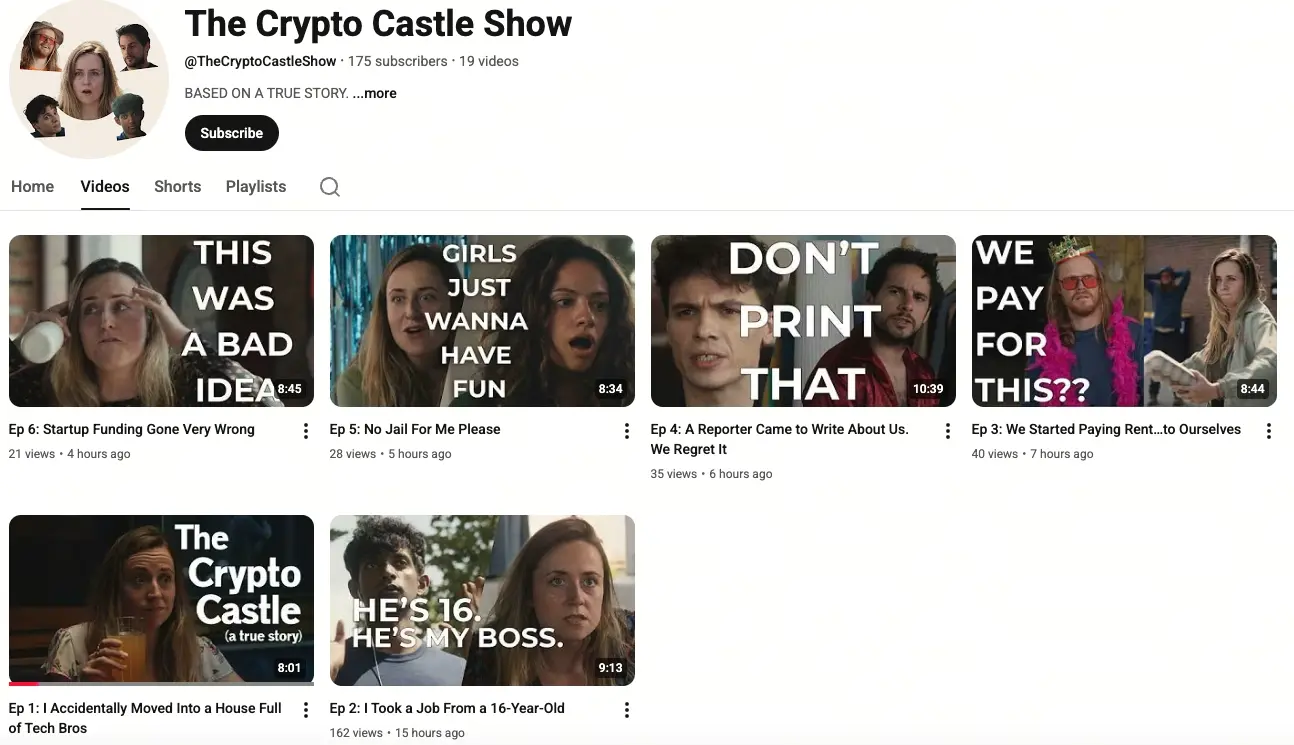 (Source: YouTube)
“Crypto Castle” is based on Viv Ford’s personal experience, starring Vivian—a young woman in her twenties wandering on the fringes of San Francisco’s tech boom in the mid-2010s, eventually sharing an apartment with four Bitcoin brothers.
The main cast represents typical characters from the early crypto community:
Garrett: “The loudest in the room,” a typical early coin trader
Trent: A crypto idealist aspiring to be a nation builder
Ray: A teenage genius, a technical early adopter
Pierre: A mysterious Frenchman with an unclear background and motives
The opening credits feature a unique design—showing a complete Bitcoin price chart with an arrow pointing to the show’s timeline, which is during a dip in Bitcoin’s price curve. From the start, viewers understand that these idealistic early adopters are caught in a wave that will change the world, yet they are unaware of the future— including Bitcoin hard forks, Mt. Gox collapse, and Ethereum’s rise.
Viv Ford’s Motivation: Why Crypto Culture Needs Its Own “Silicon Valley”
Viv Ford posed a long-standing question: “Why isn’t there a lighthearted, humorous TV series that resonates and tells the story of this crazy world? Why isn’t there a crypto-themed show like ‘Silicon Valley’?” To her, cryptocurrencies have long been portrayed in mainstream media as either tools for crime or elements of a sci-fi future—no one has truly explored the idealistic, somewhat humorous subculture of early crypto.
Ford’s core interest isn’t the technology itself but the people who believe they are writing history: “I really want to understand what its subculture was like before it went mainstream and everyone started making money from it.”
The “Regrettable Evolution” of Crypto Subculture
Ford’s observations on the evolution of crypto culture form a deep theme in “Crypto Castle.” She notes that many of the earliest Bitcoin participants have quietly exited.
Her interpretation is thought-provoking: “I think the reason might be that these people are more fans of subculture than of cryptocurrency itself—they’re passionate about finding something before it becomes mainstream. So they’ve been dedicated to seeking that out.”
As these pioneers leave, “the development of this culture is regrettable; it seems to be left with only the question of ‘how to make money,’” she laments. “As the industry tries to mature and be taken more seriously, I think, ‘Wait, this is a joke.’ Can we go back to the past, to when it was just a silly joke?”
Frequently Asked Questions
Is “Crypto Castle” based on real events?
According to Viv Ford, the show’s story framework is based on her personal experiences with the early Bitcoin community in the mid-2010s. She has mentioned multiple times in interviews her firsthand observations of that era, including the idealism of early adopters, the subcultural traits of the community, and the cultural shifts following market expansion. The show is a sitcom; some details may be dramatized, but the overall background and thematic spirit are autobiographical.
Where can I watch “Crypto Castle”?
The show is available for free on YouTube and is one of the few original comedy works centered on crypto subculture. Ford aims to break the stereotype that cryptocurrencies only appear in serious crime movies or investment discussions, restoring it as a vibrant, humorous subcultural story.
Why are there more and more crypto-themed TV shows now?
Netflix announced this month that it is producing a romantic comedy “One Attempt Remaining” with a crypto theme. Analysts believe that with the institutionalization of Bitcoin ETFs and the accelerated mainstream adoption of cryptocurrencies, public perception has shifted from “mysterious/illegal” to “a cultural phenomenon worth taking seriously.” Entertainment creators are reevaluating the storytelling potential of cryptocurrencies as a backdrop for entertainment.
Aviso legal: La información de esta página puede proceder de terceros y no representa los puntos de vista ni las opiniones de Gate. El contenido que aparece en esta página es solo para fines informativos y no constituye ningún tipo de asesoramiento financiero, de inversión o legal. Gate no garantiza la exactitud ni la integridad de la información y no se hace responsable de ninguna pérdida derivada del uso de esta información. Las inversiones en activos virtuales conllevan riesgos elevados y están sujetas a una volatilidad significativa de los precios. Podrías perder todo el capital invertido. Asegúrate de entender completamente los riesgos asociados y toma decisiones prudentes de acuerdo con tu situación financiera y tu tolerancia al riesgo. Para obtener más información, consulta el
Aviso legal.
Artículos relacionados
Hanbalonwang venderá todas las participaciones de SAT1 y compensará a los usuarios con 35 ETH antes de salir
Según Odaily, Hanbalonwang anunció el 9 de mayo que venderá todas sus participaciones en SAT1 y distribuirá el producto entre los usuarios afectados como compensación antes de salir del mercado. El operador afirmó que su inversión inicial fue de 565 ETH y que actualmente tiene un valor de 543 ETH. Planea asignar 35 ETH desde las SAT1 s
GateNewshace2h
La cuota de mercado de Ethereum DeFi cae al 54%, 9,5 puntos menos desde principios de 2025
De acuerdo con CryptoSlate, la participación de Ethereum en el valor total bloqueado (TVL) de DeFi ha caído desde el 63,5% al inicio de 2025 hasta aproximadamente el 54% al 7 de mayo, situándose cerca de su nivel más bajo en un año. Las blockchains competidoras han ganado dominio en segmentos específicos: Solana mantiene el 6,66% del DeFi TVL, BNB
GateNewshace3h
Los ETF de spot de Bitcoin registraron una salida neta de 146 millones de dólares; FBTC fue el mayor emisor de salidas en un solo día.
De acuerdo con los datos de SoSoValue, el 8 de mayo, hora del Este de EE. UU., los ETF de spot de Bitcoin en EE. UU. registraron una salida neta total de 146 millones de dólares, siendo Fidelity (FBTC) el mayor emisor de salidas netas del día, con una salida neta de 97,6041 millones de dólares; el mismo día, los ETF spot de Ethereum registraron una entrada neta de 3,57 millones de dólares. Flujo de fondos de los ETF spot de Bitcoin del 8 de mayo (Fuente: SoSoValue) Según los datos de SoSoValue,
MarketWhisperhace3h
Bitcoin se dispara a 65.000 dólares, sube 2,7% en el día; Ethereum alcanza 1.900 dólares, sube 3%
Bitcoin se disparó hasta los 65.000 dólares hoy, ganando más de un 2,7% intradía, mientras Ethereum subió hasta los 1.900 dólares con ganancias superiores al 3%. Las acciones relacionadas con cripto también repuntaron en las operaciones fuera de horario, con Microstrategy (MSTR) al alza de casi un 2% y Miner Corp (BMNR) de casi un 3%.
GateNewshace4h
La ballena de Ethereum Garrett Jin transfiere 78.077 ETH, mientras los fondos institucionales salen al mismo tiempo
De acuerdo con los datos públicos on-chain, el 8 de mayo, una ballena de Ethereum identificada como Garrett Jin transfirió a Binance 78.077 ETH (aprox. 178 millones de dólares); el mismo día, el fondo iShares Ethereum Trust (ETHA) de BlackRock y el fondo FETH de Fidelity enviaron en total 35.394 ETH a los exchanges (aprox. 80,7 millones de dólares). Detalles de las transferencias on-chain de Garrett Jin De acuerdo con los datos públicos on-chain, la dirección con la marca #BitcoinOG1011 (ex CEO
MarketWhisperhace5h


