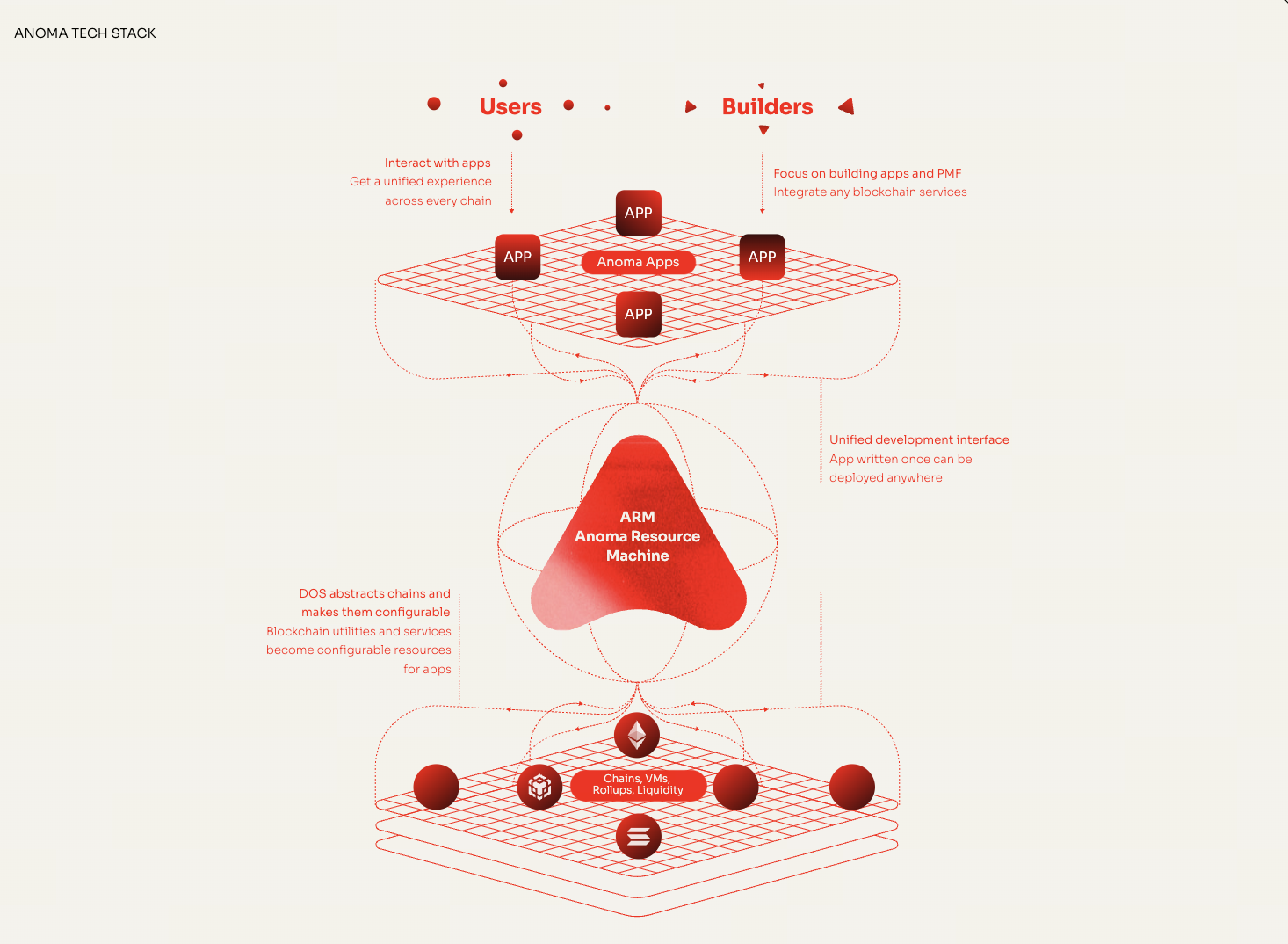
Unlike traditional blockchains, where users sign transactions step by step, manually pick bridges, and route, the Intent-Centric paradigm treats "the desired state" as its foundational primitive: users declare goals and constraints, and the system handles counterparty discovery, path computation, and multi-chain execution. Anoma designs intents as universal, composable, and detached from any single dApp, enabling DeFi matching, privacy payments, NFT trading, quadratic funding, and more to be expressed under one architecture—without each building its own centralized order book or Web2 middleware.
From the lens of blockchain infrastructure evolution, Anoma represents a leap from "programmable settlement" to "full-stack decentralized applications." The settlement layer still relies on existing chain security, but counterparty discovery and solving are now embedded into the protocol layer. Its technical differentiation comes from Ferveo threshold decryption, Taiga's composable privacy execution environment, and multi-chain atomic commits driven by Chimera Chain and Heterogeneous Paxos. Below, we walk through the architecture module by module: how it works, how it scales, cross-chain and privacy designs, and an objective look at the track's challenges and future.
What Is Intent-Centric Architecture?
In Anoma, an intent is a user's expression of preference over system state—it can be a complete state transition (e.g., Alice sends Bob USDT) or a partial constraint for a solver to fill in (e.g., "pay a bounty based on Berlin's temperature"). At the architecture level, intents are opaque byte strings; the application layer defines asset and business semantics.
Intent-centric architecture can be roughly split into three generations:
| Generation |
Characteristics |
Limitations |
| First |
Single-app intents (e.g., some DEX aggregators) |
Not composable, narrow scope |
| Second |
Cross-chain intents + permissioned solvers |
Solving layer often centralized |
| Third (Anoma) |
Universal intents + decentralized gossip + permissioned solver competition |
High engineering and governance complexity |
Anoma contrasts declarative (state what you want) with EVM's imperative (state how to do it). The early "Intent Machine" (IM) concept has matured into ARM (Abstract Resource Machine) in 2024–2025, modeling state changes as resource creation and consumption, with intents validated by ARM rules.
The DOS (Decentralized Operating System) is layered into: Application Layer (Anoma App + SDK), Network Layer (Intent Gossip/Interpool + Solver), and Settlement Layer (protocol adapters per chain + optional Fractal Instance). Starting in September 2025, the mainnet rollout prioritized XAN and governance on Ethereum, with ARM gradually extending to Base, Arbitrum, and BNB Chain via an EVM Protocol Adapter.
How Does the Solver Network Work?
The Solver Network is the execution engine of the Intent-Centric architecture, handling NP-search tasks that centralized relayers, market makers, or sequencers usually perform.
Typical flow:
- Creation: Users sign an intent through an app interface, optionally attaching a conditional fee payable only upon successful settlement.
- Broadcast: The client sends the intent to Intent Gossip nodes (the network layer, also called Interpool)—a decentralized P2P gossip network with no single matching engine.
- Listening & Matching: Solvers run permissionlessly, subscribing to all or a subset of intents, searching for composable subsets within the known intent pool and chain states.
- Transaction Construction: Multiple intents are combined into a complete state transition (transaction) that satisfies ARM and settlement layer rules. Under the declarative model, the submitter only needs to guarantee the final state is correct, without trusting intermediate proxy contract paths.
- Settlement: Submitted to the underlying chain for confirmation via a Protocol Adapter or Fractal Instance.
Solvers can specialize (e.g., stablecoin routing, ZK proof services) or be general-purpose. Economically, when intents carry fees or spreads exist, competition drives better execution. Gossip nodes and the final solver can share intent fees; the consensus layer collects ordering fees. Future mainnet phases may introduce XAN staking and slashing to deter malicious or lazy behavior (subject to official upgrades).
Unlike scenario-specific intents like CoW Protocol or UniswapX, Anoma emphasizes generalized intents: any application can define its own intent format, with applications providing validity predicates and solver algorithms.
How Fractal Consensus Improves Scalability
A Fractal Instance is an independent deployment unit of Anoma's consensus and execution protocol, combining:
- Security domain: Users trust a specific set of validators forming a Byzantine-fault-tolerant quorum.
- Concurrency domain: Only orders transactions within that instance.
- Data availability domain: Externally queryable state fragments.
Each Fractal Instance is sovereign—it doesn't depend on other instances to keep running. Validator sets can overlap, enabling multi-chain atomic settlement. Instances can customize Sybil resistance (PoS, PoA, etc.), gas pricing, and local governance, achieving "homogeneous architecture, heterogeneous security."
Typhon is Anoma's production-grade consensus and execution engine, blending Narwhal (a DAG-based mempool for higher propagation throughput), Heterogeneous Paxos (atomic commits across heterogeneous chain quorums), and concurrent execution partitions. A key innovation is separating ordering from execution validity: solver "solution attempts" can be ordered first via consensus, then validated by ARM for the final state—enabling parallel intent processing and breaking the single-threaded EVM ordering bottleneck.
On GitHub, Anoma node code already integrates Narwhal + Bullshark and other modules, showing ongoing iteration. Production specs and audits remain authoritative. Early instances ran on Tendermint; the long-term roadmap replaces it with Typhon to power Chimera Chain.
The scalability logic: horizontally, add Fractal Instances to distribute load and customize rules; vertically, use local instances (even on-demand consensus between devices) for low-latency scenarios while staying interoperable with global instances.
How Anoma Achieves Cross-Chain State Unification
Anoma advocates for bridgeless interoperability: avoiding the custody and contract risks of traditional bridge lock-and-wrap, and instead relying on intents + atomic settlement + validator overlap.
Path One: Multi-Chain Protocol Adapter (already live)
ARM is deployed on EVM chains as Protocol Adapters (PAs) in forms like Solidity, coexisting with existing VMs. Apps built once can settle on Ethereum, Base, Arbitrum, and other chains with deployed PAs. Users express cross-chain goals with a single intent; solvers handle execution on each chain. This is the main form of the 2025–2026 mainnet rollout.
Path Two: Chimera Chain + Heterogeneous Paxos (research/roadmap)
Chimera Chain is a logical chain spanning state partitions of multiple base chains. Transactions are submitted as atomic bundles—either all commit or none. Heterogeneous Paxos, given an honest overlap in validator sets, aims for single-round consensus to commit across multiple chains atomically, outperforming two-phase bridge locking. More overlap means stronger atomicity; less overlap may degrade atomicity, requiring explicit application-layer handling.
Path Three: Inter-Fractal Instance Messages
Typhon handles asynchronous messages between Fractal Instances and synchronous (atomic) messaging within Chimera; semantics are interpreted by upper-layer applications like Taiga.
For users, cross-chain "state unification" means a single app, a single intent interaction—underlying state updates are distributed across chains but consistency is guaranteed by solvers and consensus. It's not merging all chains into one global ledger, but achieving logical unification with physical distribution at the coordination layer.
How Privacy and Zero-Knowledge Technology Are Integrated
Public mempool intents face MEV and front-running risks. Anoma uses a multi-layer privacy approach:
(1) Ferveo Threshold Decryption
A distributed public key based on DKG; users submit encrypted intents, and after consensus ordering, validators decrypt with a ≥2/3 node quorum before execution. Ferveo is non-interactive, reducing extra game-theoretic assumptions. Used for mempool privacy, fair ordering, and censorship resistance.
(2) Taiga Composable Privacy
A unified execution environment where transparent, shielded, and private intents coexist in the same app—privacy is user-optional, not a chain-wide binary choice. This contrasts with dApps that support only transparency or only mixing.
(3) Resource-Level ZK
ARM models privacy as a resource attribute: validity predicates can require ZK ownership proofs without revealing the holder. The sister project Namada uses multi-asset shielded pools like MASP on mainnet, validating the Resource Machine concept. Anoma DOS provides private rails for ERC-20 and others on EVM chains via PAs (e.g., AnomaPay on BNB Chain public test with ZK payments, proof times ~15 seconds—subject to the actual version).
(4) Batch Processing & Logical Clocks
The data availability domain supports batch decryption of encrypted intents; solvers compete for optimal solutions after the batch opens, balancing privacy with composability.
Privacy and compliance can be balanced through selective disclosure: Swiss-style confidentiality plus audit-needed data sharing—serving institutional payments and RWA scenarios.
How Anoma Differs from Traditional Blockchain Architectures
| Dimension |
Traditional L1 (e.g., Ethereum) |
Modular Blockchain |
Anoma DOS |
| Basic unit |
Transaction |
Module composition |
Intent + Resource |
| Stack focus |
Single-chain state machine |
DA/execution/consensus split |
Full-stack dApp (discovery + solving + settlement) |
| Cross-chain |
Bridges, messaging protocols |
Each layer interoperates independently |
PA + Chimera atomic bundles |
| Counterparty discovery |
On-chain AMM or off-chain order book |
Relies on upper-layer apps |
Native gossip + solver |
| Privacy |
Primarily chain-level transparency |
Optional L2 privacy |
Resource-level programmable privacy |
| Developer model |
Deploy per chain |
Choose stack and combine |
Build once, configure resources across chains |
Anoma is not an L1 competitor to Ethereum on throughput. It's a coordination and abstraction layer above it; settlement security is still anchored to underlying chains. Its argument: Web3 needs an application-layer operating system, not more homogeneous infrastructure.
What Challenges Does the Intent-Based Track Face?
- (1) Solver Trust & Quality: A decentralized solver market with too few participants could lead to poor execution, opaque fees, or "soft centralization" misaligned with user interests.
- (2) Standards & Fragmentation: UniswapX, CoW, Across, Essential, and others each define their own intent formats—no universal standard yet, interoperability relies on adaptation layers.
- (3) MEV & Privacy Trade-offs: Fully public intents are easily extracted; fully encrypted intents increase decryption and proof costs, harming latency and UX.
- (4) Cross-Chain Atomicity Conditions: The Chimera approach depends on validator overlap; real multi-chain ecosystems have divergent validator sets, so atomic guarantees don't hold everywhere.
- (5) Engineering Complexity: Toolchains like ARM, Typhon, PA, and Juvix are still maturing; developer cognitive load is higher than a single EVM.
- (6) Regulation & Compliance: Privacy payments and cross-border stablecoin routing face jurisdictional differences; institutional adoption requires auditable design.
- (7) Phased Mainnet: After September 2025, XAN, governance, and some PAs are live, but full Typhon mainnet and solver staking are still rolling out—there's a potential gap between expectations and delivery.
Future Directions of Anoma Technology
The official and open-source roadmap highlights include:
- PA coverage expansion: Moving from Ethereum L2s toward non-EVM chains like Solana and Bitcoin.
- Typhon + Chimera production: Achieving research-stage single-round multi-chain atomic commits.
- Solver economy refinement: Transparent staking, slashing, and fee markets.
- Deep Taiga + ARM integration: Composable privacy as a default dApp capability.
- Anoma App SDK & Portal: Lowering the barrier for building intent applications, aggregating governance, payments, and app discovery.
- Benchmark apps like AnomaPay: Running private payments, agent proxy payments, institutional treasuries, etc., to validate DOS value.
The long-term vision: users express goals as naturally as with a Web2 app, with chains, bridges, and routing invisible. Developers write Web3 apps like writing Windows apps—no redeployment for each new chain.
Summary
Anoma's technical architecture is built on the Intent-Centric paradigm, with ARM + Solver Network + Fractal/Typhon consensus as its backbone. It connects to the real multi-chain world via Protocol Adapters and builds privacy through Ferveo, Taiga, and ZK. The operational logic: intents propagate through Interpool → solvers compete to solve them → atomic settlement on the settlement layer. Scalability comes from horizontally splitting Fractal Instances; cross-chain comes from vertically connecting PAs and Chimera atomic bundles.
As of 2026, DOS is deployed on multiple EVM chains, with XAN and governance running. Full capabilities are being released in phases. Competition in the Intent track is intensifying. Anoma's differentiation lies in its combination of universal intents + OS-level abstraction + bridgeless interoperability research. To assess its technical success, track verifiable metrics like intent volume, active solver count, PA-covered chains, and privacy app retention—not just narrative hype.







