As ChatGPT has driven rapid growth across the AI industry, AI Crypto has also become an important sector in the crypto market. More blockchain projects are building ecosystems around AI models, AI Agents, GPU computing power, and decentralized machine learning, aiming to secure a meaningful position in the future competition for AI infrastructure.
Against this backdrop, Artificial Superintelligence Alliance (ASI), Bittensor, and Render have become some of the most closely watched AI Crypto projects in the market. However, although all three are associated with the AI narrative, their technical paths and ecosystem positioning are quite different. Artificial Superintelligence Alliance places more emphasis on AI Agents and open AGI networks, Bittensor focuses on decentralized machine learning, while Render mainly provides GPU computing power and AI compute resources.
What Are the Core Positioning Differences Between ASI, Bittensor, and Render?
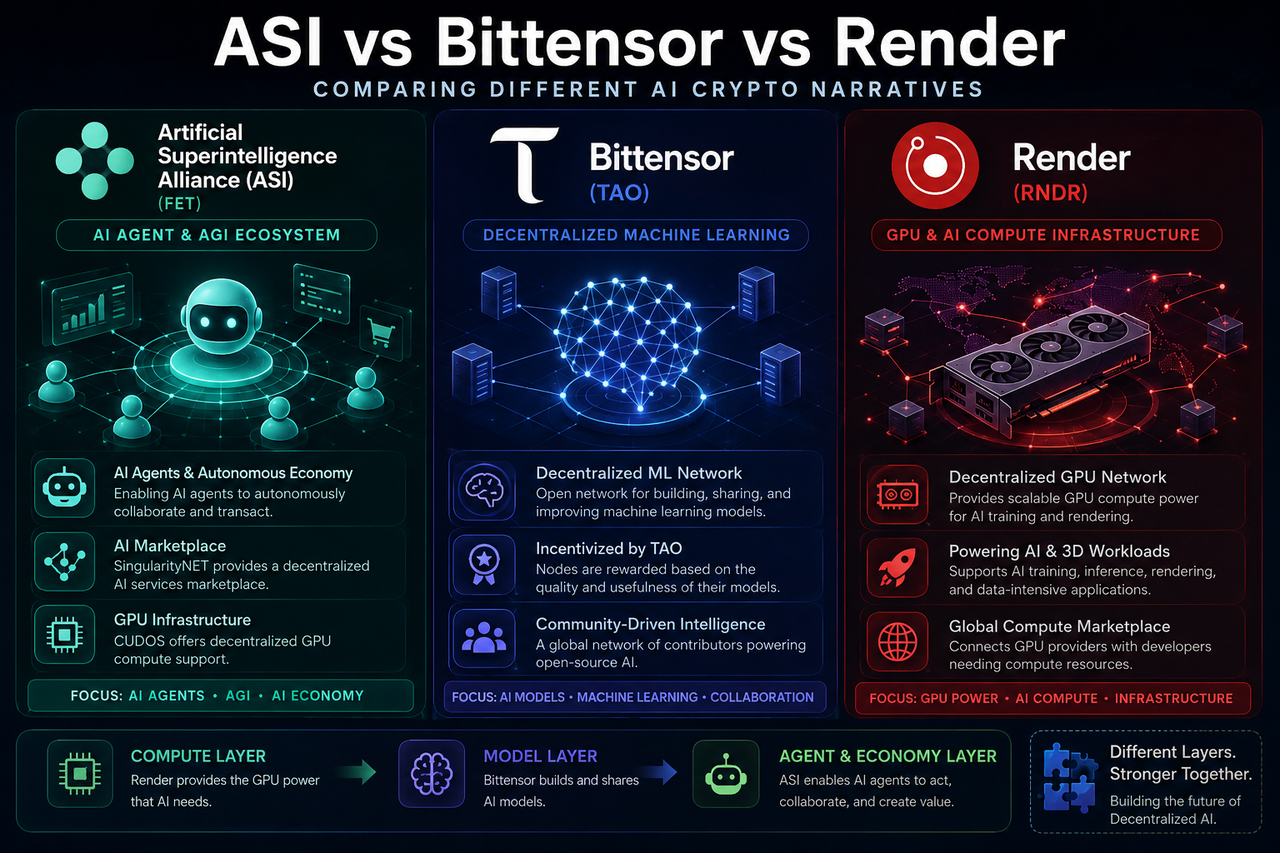
From the perspective of overall ecosystem structure, ASI, Bittensor, and Render correspond respectively to AI Agent networks, AI model networks, and AI computing networks.
ASI is jointly formed by Fetch.ai, SingularityNET, and CUDOS, with the goal of building open AGI infrastructure. Fetch.ai is responsible for the AI Agent network, SingularityNET provides the AI Marketplace, and CUDOS supplies GPU computing support. As a result, ASI is more oriented toward the AI Economy and an ecosystem for AI automation and collaboration.
Bittensor’s core direction is decentralized machine learning. It aims to use blockchain networks to build an open AI model collaboration system, allowing developers to share AI models and training capabilities while using the TAO incentive mechanism to drive network development.
By contrast, Render is more focused on GPU computing resources. As demand for AI model training and inference grows rapidly, GPUs have become one of the most critical foundational resources in the AI industry. Render aims to provide developers with more open computing capabilities through a distributed GPU network.
The table below shows the differences among the three more clearly:
| Project |
Artificial Superintelligence Alliance (FET) |
Bittensor (TAO) |
Render (RNDR) |
| Core Direction |
AI Agents and AGI ecosystem |
Decentralized machine learning |
GPU computing network |
| Main Positioning |
AI Economy infrastructure |
AI model collaboration network |
AI Compute Infrastructure |
| Core Technology |
AI Agents, Agentverse |
Subnets, machine learning network |
Distributed GPUs |
| Representative Narrative |
AI Agent / AGI |
Decentralized AI models |
AI computing power |
| Ecosystem Features |
Comprehensive AI network |
Model driven ecosystem |
Compute driven ecosystem |
| Application Direction |
AI automation and collaboration |
AI model training |
AI inference and rendering |
| Representative Token |
FET |
TAO |
RNDR |
What Are ASI’s Key Features?
ASI’s biggest feature lies in its focus on AI Agents and the Autonomous Economy. It envisions a future where AI is not merely a tool, but a digital intelligent agent capable of autonomously executing tasks, collaborating automatically, and completing transactions.
For that reason, ASI is more concerned with how AI collaborates and how AI can form an open economic network.
Compared with traditional AI projects that focus only on model training, ASI integrates AI Agents, an AI Marketplace, and GPU computing resources, forming a relatively complete Web3 AI infrastructure stack.
This model has also given ASI strong market attention within the AGI and AI Agent narratives.
What Is the Core Logic of Bittensor?
Bittensor places greater emphasis on AI models themselves.
Its core goal is to build a decentralized machine learning network where developers around the world can jointly train AI models and share AI capabilities.
In the Bittensor network, different nodes provide AI inference and model capabilities, while the system distributes TAO rewards based on model quality. This means developers can earn rewards by contributing high quality AI models, creating an open AI collaboration ecosystem.
As a result, Bittensor is closer to an AI Model Network than an AI Agent network.
Compared with ASI, Bittensor focuses more on how AI is trained, rather than how AI automatically executes tasks.
Why Is Render Considered an AI Infrastructure Project?
Render’s core value mainly comes from GPU computing power.
At present, the AI industry is highly dependent on GPUs. Whether for model training or AI inference, large amounts of computing resources are required. However, most GPU resources are still concentrated in the hands of large technology companies and centralized cloud platforms.
Render aims to provide developers with more open AI computing resources through a distributed GPU network.
Originally, Render was mainly used for graphics rendering and 3D computing. As the AI industry has expanded rapidly, however, its GPU network has gradually become an important part of AI Compute Infrastructure.
For this reason, Render is more aligned with the AI compute layer than with the AI Agent or AI model layers.
How Do ASI, Bittensor, and Render Differ Within the AI Crypto Ecosystem?
From the perspective of AI infrastructure, ASI, Bittensor, and Render actually sit at different layers of the ecosystem.
-
Render is closer to the underlying GPU computing network, providing computing resources for AI.
-
Bittensor is closer to the AI model layer, with its focus on building an open machine learning network.
-
ASI is closer to the AI Agent and AI Economy layer, with the goal of building an AI network capable of autonomous collaboration.
Therefore, these three types of projects are not necessarily in direct competition. In the future, they may even form complementary ecosystems.
For example, Render could provide GPU computing power, Bittensor could provide AI models, and ASI could provide AI Agents and automated collaboration. This structure is also more consistent with the likely development logic of future AI infrastructure.
Why Does AI Crypto Have Different Technical Paths?
The AI industry itself contains multiple infrastructure layers.
These include GPU computing power, AI models, data resources, AI Agents, and the AI application layer. As a result, different AI Crypto projects choose different entry points.
Some projects focus on computing resources, some focus on AI models, while others pay more attention to AI Agents and automated collaboration networks.
This is why AI Crypto does not follow a single unified path, but is gradually forming a complete ecosystem structure.
What Challenges Do ASI, Bittensor, and Render Face?
Although the AI Crypto market is growing rapidly, the entire industry is still at an early stage.
The main challenge for ASI is the large scale implementation of AI Agent networks, along with the long term development of open AGI.
For Bittensor, the difficulty lies in continuously building a high quality machine learning network and helping ordinary users better understand its ecosystem.
Render’s challenges come more from competition in the GPU market and resource cost pressures caused by the rapidly changing AI computing industry.
At the same time, these projects also need to face competitive pressure from traditional AI giants such as OpenAI and Google DeepMind.
What Is the Future Development Direction of AI Crypto?
Future AI infrastructure is likely to form a multi layer ecosystem structure.
GPU networks will provide computing resources, machine learning networks will train AI models, and AI Agent networks will execute tasks and enable automated collaboration.
From this perspective:
-
Render is closer to the AI compute layer
-
Bittensor is closer to the AI model layer
-
ASI is closer to the AI Agent and AI Economy layer
Conclusion
ASI, Bittensor, and Render are among the representative projects in today’s AI Crypto market, but their technical paths and ecosystem positioning are clearly different.
ASI focuses more on AI Agents and open AGI networks, Bittensor specializes in decentralized machine learning, while Render mainly provides GPU computing power and AI compute resources.
FAQs
What Is Bittensor’s Core Function?
Bittensor is a decentralized machine learning network that allows developers to share AI models and training capabilities.
Why Is Render Part of AI Crypto?
Render provides GPU computing resources, and AI model training and inference are highly dependent on GPU computing.
What Is the Difference Between ASI and Bittensor?
ASI focuses more on AI Agents and automated collaboration, while Bittensor focuses more on AI model training and machine learning networks.
What Is Render Mainly Used For?
Render mainly provides GPU computing power, AI inference resources, and high performance computing networks.
How Will the Future Trend of AI Crypto Develop?
In the future, AI Crypto may continue expanding around AI Agents, GPU computing power, decentralized AI models, and open AGI ecosystems.