ATS (Alltoscan Token) is the native Utility token of the Alltoscan multichain Web3 infrastructure, deployed on BNB Chain (BEP-20), with a maximum supply of 100 million tokens. It serves unified Gas settlement, ecosystem incentives, staking rewards, and future governance participation. Within the Alltoscan product suite, ATS functions not only as a medium of exchange but also as a "value hub" that binds the multichain block explorer, Wats Wallet, and cross-chain DeFi scenarios into a single economic system.
As multiple chains develop in parallel, users often need to prepare native Gas separately for each chain, while developers and operators face the issue of fragmented data interfaces. Infrastructure projects lacking clear token utility struggle to build sustained usage feedback and community stickiness. ATS aims to directly link on-chain queries, wallet interactions, and token demand through a "pay multichain fees only with ATS" mechanism, Gas fee pool burning (targeting a supply cap reduction to approximately 30 million tokens), and a phased unlocking distribution design, providing a measurable growth lever for the multichain ecosystem.
From the perspective of blockchain infrastructure evolution, ATS embodies the typical Web3 economic path of "tool usage frequency → fee accumulation → supply contraction/ecosystem reinvestment." The following sections sequentially analyze ATS's core functions, distribution and incentives, governance role, connection with on-chain data services, value-influencing factors, community growth model, investment risks, and long-term potential, helping readers build a comprehensive understanding of the Alltoscan tokenomics model.
ATS Token Core Functions and Uses
ATS serves four core functions within the Alltoscan ecosystem:
- Unified Multichain Gas Medium
The project states that when users perform cross-chain swaps, transfers, or DApp interactions, they only need to hold ATS as the fee token, while the system handles settlement with each chain's native Gas in the background, thereby reducing the operational overhead of "preparing tokens for each chain." This design directly aligns with Alltoscan's "New Age DeFi Solutions" positioning—encapsulating complex Gas management within the infrastructure layer.
- Infrastructure Usage Fee
Multichain block explorer queries, API calls (including potential enterprise-level data services), advanced wallet features, and similar functions can all use ATS as the payment or deduction unit, forming the basis of a dual B2C and B2B revenue model.
- Staking and Liquidity Incentives
20% of the token allocation is designated for the staking pool, used to reward long-term holders, validator node partners, or liquidity providers (specific rules subject to official announcements), enhancing ecosystem participation depth.
- Ecosystem Collaboration and Value Capture
Collaborations with nearly 40 partners including BNB Chain, Avalanche, Polygon, and Floki bring exposure to ATS use cases. Wats Wallet sets ATS as the sole fee token, converging "chain querying + chain using" into a single asset.
Supplementary Mechanism: Deflationary Burning
ATS entering the Gas fee pool will be burned according to plan until the maximum supply is reduced to approximately 30 million tokens. According to publicly available page information, the burn pool has already accumulated a certain amount of ATS (such as Burn Pool data shown on the official website), reflecting the supply contraction logic of "more usage → more burning."
ATS Token Distribution and Incentive Mechanism
ATS has a total supply of 100,000,000 tokens, with allocation balanced among team building, market expansion, liquidity, and community incentives:
| Category |
Ratio |
Unlock Mechanism (Summary) |
| Team |
10% |
15-month lockup after TGE, then quarterly linear release over 3 years |
| Public Sale |
20% |
10% unlocked at TGE, remaining 90% released quarterly over 6 months |
| Treasury |
10% |
Linear unlock over 4 years |
| Liquidity |
10% |
Fully unlocked at TGE |
| Staking |
20% |
0 at TGE, linear unlock over 1 year |
| Marketing |
10% |
Linear unlock over 3 years |
| Ecosystem |
20% |
Linear unlock over 4 years |
How the Incentive Mechanism Drives Growth:
- Early Liquidity: The liquidity share released at TGE supports listings on exchanges like Gate, reducing trading friction.
- Staking Lock-up: The staking pool with linear release over 1 year encourages long-term holding and smooths selling pressure.
- Ecosystem Fund: The ecosystem share unlocking over 4 years can be used for developer grants, chain integration subsidies, hackathons, and joint marketing with partners.
- Marketing Budget: Coordinating with events such as Black Friday and the BNB Greenfield testnet launch to boost brand awareness and wallet downloads.
- Burning Feedback: Multichain transaction fees flow back into the burn pool, creating a dynamic balance with market cap and circulating supply.
Objectively, team and ecosystem shares account for 30%, with longer unlock periods favorable for sustained project operations. However, investors should refer to the Token Unlocks calendar to assess the impact of periodic supply increases on price.
ATS Role in Ecosystem Governance
Currently, ATS's governance attributes remain primarily "planning + utility-driven," and a fully on-chain DAO structure has not yet been established. However, its governance potential is reflected in:
- Parameter and Fee Governance (Potential)
In the future, ATS holders could vote on multichain fee rates, burning ratios, priority for new chain listings, API pricing tiers, and more, linking token holders to infrastructure revenue.
- Ecosystem Resource Allocation
The expenditure direction of the Treasury (10%) and Ecosystem Pool (20%)—such as funding open-source block explorers, rewarding early Wats Wallet users, and subsidizing Rollup data indexing—can be made transparent through community proposal mechanisms.
- Partner Access
Multichain ecosystem expansion relies on external chains and projects connecting. ATS staking or payment thresholds can serve as an economic filter for the "chain listing" process, reducing resource occupation by low-quality networks.
- Synergy with BNB Chain Ecosystem
As a BEP-20 token, ATS can leverage BNB Chain's toolchain, Greenfield storage scenarios, and BNB ecosystem traffic to obtain underlying public-chain support in governance and resource alignment.
Governance effectiveness depends on voting participation rates, auditability of smart contracts, and team execution transparency. When researching ATS, one should distinguish between "white paper governance narrative" and "live on-chain voting contracts."
How ATS Connects On-Chain Data with Web3 Services
Alltoscan uses the multichain block explorer as a data hub and ATS as the settlement layer, forming a "data → tools → payment" closed loop:
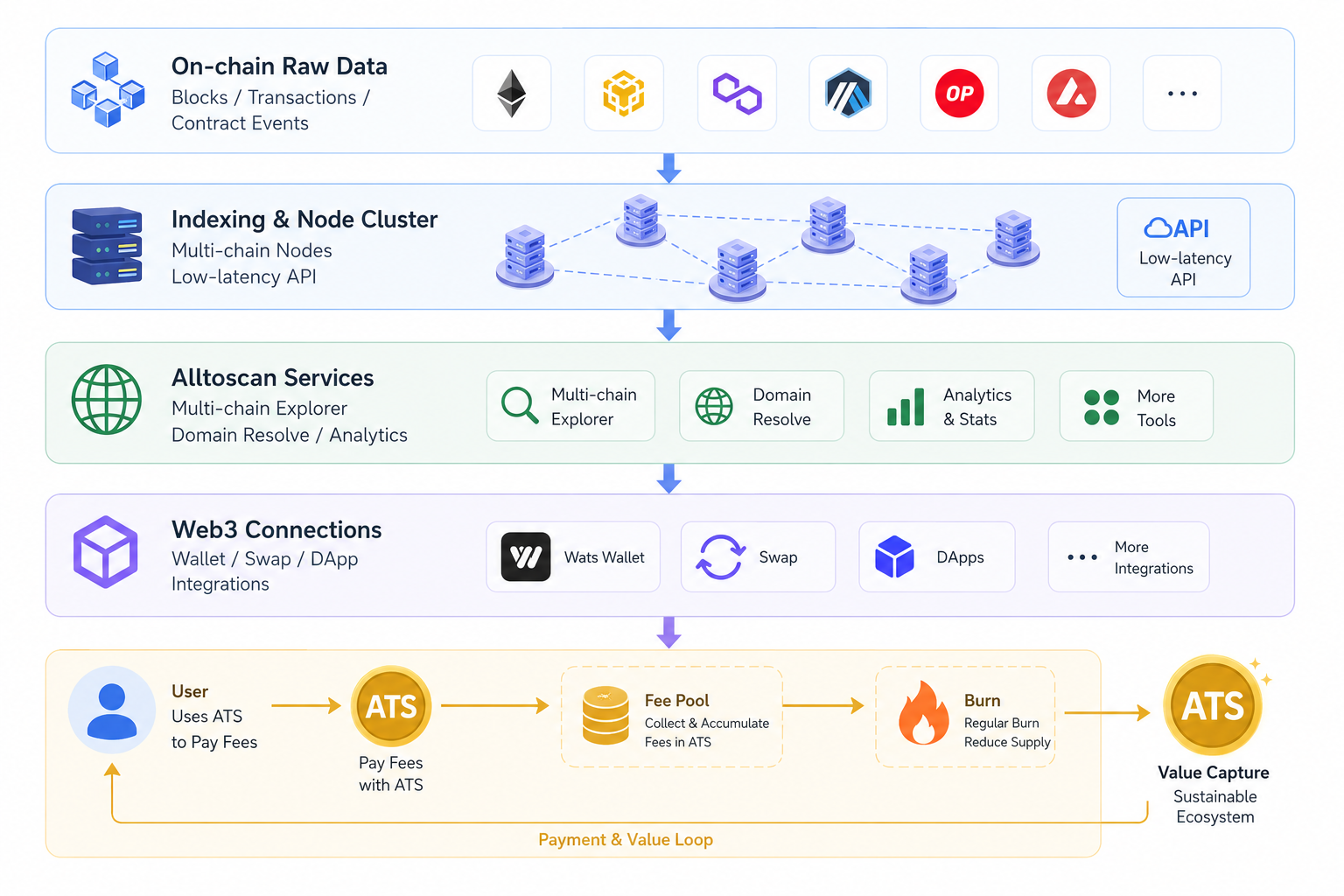
Specific connection methods:
- Data Readability: The explorer standardizes heterogeneous chain data, enabling developers to build risk control, tax, and research tools using a unified API. ATS can serve as the unit for API subscriptions or pay-per-use billing.
- L2/Rollup Transparency: The project emphasizes compatibility with various Rollups, making it easy for users to review L2 transactions and batches, increasing trust among research institutions and projects.
- Web3 Domains: Collaborations with initiatives like Unstoppable Domains replace address hashes with human-readable domain names, improving transfer experience and indirectly increasing wallet and explorer traffic.
- Wallet as Entry Point: Wats Wallet supports 70+ chains and displays tens of millions of assets. With ATS as the only fee token, it naturally guides users from "querying on-chain records" to "initiating on-chain operations."
- Open Source Plan: Open-sourcing the block explorer can reduce third-party trust costs and expand the developer network for ATS settlement scenarios.
The growth logic of this model is: data services increase stickiness → wallets and DeFi increase transaction frequency → ATS fees and burning increase → ecosystem fund reinvests in data and products.
Main Factors Influencing ATS Token Value
Demand-Side Factors:
| Factor |
Description |
| Multichain Transaction Activity |
The greater the usage of Wats Wallet and planned Swap, the higher the demand for ATS fees |
| Burning Progress |
Fee pool burning reduces circulating supply, affecting long-term scarcity expectations |
| Staking Participation Rate |
Higher lock-up ratios can reduce immediate market selling pressure |
| Partner Expansion |
New chain integrations and brand collaborations like La Liga bring user growth |
| API / Enterprise Clients |
If on-chain data commercialization is realized, stable B2B demand will form |
Supply-Side Factors:
- Periodic selling pressure from phased unlocks (team, ecosystem, marketing)
- Liquidity pool depth and exchange distribution
- Actual on-chain burning speed of reducing max supply from 100 million to 30 million tokens
Market and Macro Factors:
- As of May 2026, ATS has a market cap of approximately 69.56 million CNY (CoinMarketCap rank ~#989), with a circulating supply of about 74.95 million tokens. Compared to its April 2024 all-time high (approximately CNY 16.99), there is still significant drawdown potential, and price volatility is significantly affected by overall market sentiment.
- There are approximately 37,400 holder addresses; distribution and whale behavior also affect short-term prices.
Value assessment should combine "actual on-chain burning data + product daily active users + unlock calendar," rather than looking only at white paper ratio allocations.
Alltoscan Community Growth and Incentive Model
Alltoscan's community strategy is "partner traffic generation + activity virality + product retention":
- Ecosystem Partnership Network
Joint promotion with nearly 40 partners including BNB Chain, Avalanche, Polygon, and Floki, leveraging public chain and Meme community traffic to onboard explorer and wallet users.
- Product and Event Operations
Black Friday promotions, BNB Greenfield testnet release, URL upgrade announcements, etc., maintain social media (X, Telegram, Medium) activity.
- Wats Wallet Growth Flywheel
Non-custodial design, NFC physical cards, AES256 encryption, and biometric authentication attract security-conscious multichain users. Unified ATS fees reduce cognitive burden for newcomers, facilitating word-of-mouth spread.
- Developer and Open Source Community
The open-source multichain explorer plan attracts builders to contribute index and frontend modules. Community contributors can receive ecosystem fund grants (subject to official plan progress).
Community health depends not only on follower count but also on verifiable metrics such as GitHub activity, wallet downloads, daily explorer queries, and on-chain ATS burning records.
Risks to Consider When Investing in ATS
- Price Volatility Risk: ATS has experienced wide price swings between historical highs and lows. Liquidity is concentrated on a few CEXs, and significant slippage may occur during sharp declines.
- Unlock Selling Pressure: Team, ecosystem, and marketing shares are released over years. Investors need to track Token Unlocks to avoid concentrated unlock windows.
- Product Delivery Risk: Unified Gas, Swap platform, and open-source explorer depend on continuous development. Delays will weaken the token demand narrative.
- Competition Risk: Etherscan Blockscan, OKLink, Blockscout, and others have already established mindshare in the multichain data market. Alltoscan must maintain data accuracy and low latency.
- Regulatory and Compliance Risk: Multichain wallets and cross-border payments may face KYC/AML requirements in various countries, affecting feature scope.
- Security and Phishing Risk: Fake wallets and fake contract addresses are common industry risks. Investors must verify the BSC contract: 0x75D8BB7fBd4782a134211dc350Ba5c715197B81d.
- Information Transparency Risk: Limited personal disclosure from the founding team, with relatively high decision-making centralization.
Disclaimer: The above content is for research reference only and does not constitute any investment advice. Crypto assets are high-risk; please make independent judgments.
Long-Term Development Potential of the ATS Ecosystem
Growth Levers:
- The multichain user base continues to expand, creating a real demand for a "single Gas token + unified data entry."
- If burning deflation grows in tandem with transaction volume, it may form a supply contraction expectation in the long term, supporting ATS's store of value narrative.
- The Wats Wallet + Swap closed loop can increase fee capture rate, enhancing token utility rather than pure speculation.
- BNB Chain ecosystem and capital/resource support from partners like DWF Labs aid in cold start and liquidity maintenance.
- Commercialization of on-chain data APIs has ToB expansion potential; ATS can serve as settlement and staking collateral.
Potential Bottlenecks:
- The infrastructure track has a strong Matthew effect, requiring continuous investment in nodes, indexing, and branding.
- Token market cap is still small relative to leading projects; more milestones (open source release, major client signings, governance launch) are needed to validate the model.
If Alltoscan can build a reputation in data quality, wallet security, and fee experience, ATS has the opportunity to upgrade from "ecosystem fuel" to an "infrastructure equity-type token." Conversely, if usage scenarios stagnate, the token may deviate from fundamentals over the long term.
Summary
The ATS tokenomics model is utility-oriented: through multichain unified Gas, fee burning, staking, and ecosystem fund allocation, it incorporates user behavior, developer collaboration, and supply management into a single framework. Allocation balances team long-term incentives (10% long lockup) with community growth (20% staking + 20% ecosystem). Its fundraising history includes milestones such as a presale of approximately 3 million USDT.
The key to driving Alltoscan's multichain ecosystem growth lies in whether a positive cycle of "data services → wallet and DeFi usage → ATS consumption and burning → ecosystem reinvestment" can be formed. On the value side, both demand (transaction volume, staking, partners) and supply (unlocks, burning, liquidity) need to be observed.







