As Web3 gradually moves from a single-chain structure into a multichain ecosystem, different blockchains are forming their own application and liquidity networks. Ethereum, Solana, Layer2, Cosmos, and Avalanche are all growing rapidly, yet these ecosystems often lack native communication between chains.
Early cross-chain bridges mainly solved the problem of asset migration, such as transferring tokens from Ethereum to other blockchains. But as cross-chain DeFi, chain abstraction wallets, omnichain games, and multichain governance have emerged, the market has begun to need more advanced cross-chain capabilities.
Developers no longer need only “cross-chain transfers.” They increasingly want different blockchains to exchange data directly, call smart contracts, and synchronize states. As a result, cross-chain messaging protocols have gradually become an important part of Web3 infrastructure.
What Is Axelar?
Axelar is a decentralized cross-chain interoperability network that enables message and asset communication between different blockchains through an independent PoS validator network.
Axelar’s core capability is General Message Passing (GMP), which allows developers to call smart contracts directly across different blockchains. Compared with traditional bridging protocols, Axelar places greater emphasis on “cross-chain application logic execution.”
Its network is mainly composed of Axelar Network, Gateways, and validators, and it provides cross-chain infrastructure for developers through a unified API.
From an architectural perspective, Axelar is closer to a “cross-chain layer.”
What Is Wormhole?
Wormhole is a cross-chain messaging and bridging protocol that was initially used mainly for asset bridging between Ethereum and Solana.
As its ecosystem has expanded, Wormhole has gradually developed into a cross-chain protocol that supports multichain messaging. Its core architecture is the Guardian Network, where multiple Guardian nodes jointly verify cross-chain messages.
When a cross-chain event occurs on the source chain, Guardians generate signed attestations, which are then verified and executed on the destination chain.
Today, Wormhole supports multiple major blockchain ecosystems and is widely used for cross-chain bridging, NFT migration, and omnichain applications.
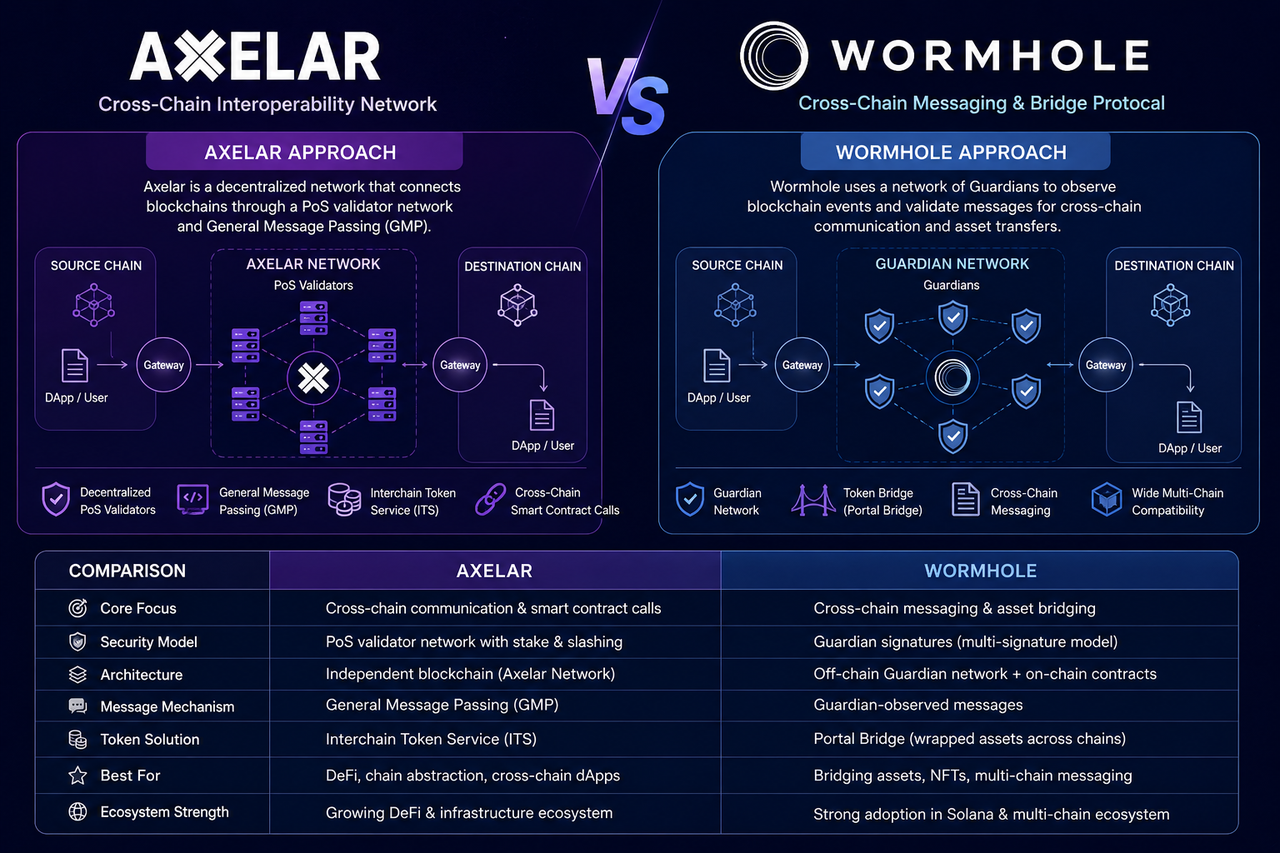
Key Differences Between Axelar and Wormhole
| Comparison Dimension |
Axelar |
Wormhole |
| Core positioning |
Decentralized cross-chain communication network |
Cross-chain bridging and messaging network |
| Core mechanism |
General Message Passing (GMP) |
Guardian Message Verification |
| Validation method |
PoS validator network |
Guardian Network |
| Security model |
Staking and consensus mechanism |
Multi-node signature verification |
| Independent chain |
Yes, Axelar Network |
No independent main chain |
| Core advantage |
Cross-chain smart contract calls |
Multichain bridging and message compatibility |
| Main direction |
Chain abstraction and cross-chain communication |
Bridging and omnichain messaging |
| Cross-chain token solution |
ITS |
Portal Bridge |
| Suitable scenarios |
Cross-chain DeFi, chain abstraction |
NFTs, GameFi, asset bridging |
| Architecture |
Closer to a cross-chain layer |
Closer to a messaging relay network |
How Do Axelar and Wormhole Differ in Their Validation Mechanisms?
The validation mechanism is one of the biggest differences between the two protocols.
Axelar uses an independent PoS validator network to maintain cross-chain security. Validators need to stake AXL tokens and confirm the authenticity of cross-chain messages through a consensus mechanism.
This design makes Axelar closer to a blockchain network, with a security model similar to that of a PoS public chain.
Wormhole, by contrast, uses the Guardian Network. Guardians monitor cross-chain events on different blockchains and jointly generate validation signatures. Once enough signatures are collected, the destination chain can execute the message.
Put simply, Axelar leans more toward “chain-level consensus validation,” while Wormhole leans more toward “multi-node signature validation.”
How Are Axelar and Wormhole Different in Cross-Chain Messaging Architecture?
Axelar’s cross-chain communication mainly revolves around GMP, focusing on cross-chain smart contract calls and interchain application logic execution.
Developers can use GMP to send complex messages between different blockchains and trigger smart contract functions on the destination chain. As a result, Axelar is better suited to cross-chain DeFi, chain abstraction, and multichain application coordination.
Wormhole places more emphasis on message transmission and bridging compatibility. Its message structure is relatively general and can support cross-chain transfers of tokens, NFTs, and arbitrary data.
From a design perspective, Axelar is more like a “cross-chain communication network,” while Wormhole is more like a “cross-chain message relay layer.”
How Do Axelar and Wormhole Differ in Their Security Models?
The security model is one of the most important competitive points for cross-chain protocols.
Axelar’s security comes from its PoS validator network. Validators need to stake AXL and face slashing risks, so network security is closely tied to economic incentives.
Wormhole’s security depends on its Guardian set. If a majority of nodes in the Guardian Network were attacked or colluded maliciously, cross-chain validation security could theoretically be affected.
Because cross-chain protocols often involve large amounts of on-chain assets, security mechanisms remain a major focus across the industry.
How Do Axelar and Wormhole Differ in Ecosystem Direction?
Axelar leans more toward cross-chain infrastructure and chain abstraction.
Its ecosystem focus includes GMP, ITS (Interchain Token Service), cross-chain gas abstraction, and multichain DeFi communication. An ecosystem has already formed around Axelar, including Squid and multichain liquidity protocols.
Wormhole has stronger influence in cross-chain bridging, NFTs, and the Solana ecosystem. Many omnichain NFT, GameFi, and asset bridging projects use Wormhole for cross-chain communication.
Although both protocols are cross-chain interoperability networks, their ecosystem priorities are clearly different.
Which Is More Suitable for Chain Abstraction, Axelar or Wormhole?
The goal of chain abstraction is to let users interact without needing to notice the underlying blockchain.
Axelar has done more work in this direction. Its GMP and cross-chain gas services can help developers hide cross-chain complexity, so users do not need to switch networks frequently.
Wormhole can also support omnichain applications, but its focus is more on cross-chain messaging compatibility and bridging scalability.
Based on current ecosystem development, Axelar has a clearer position in chain abstraction infrastructure.
What Use Cases Are Axelar and Wormhole Best Suited For?
Axelar is better suited to scenarios that require complex cross-chain logic and a unified communication layer, such as cross-chain DeFi, chain abstraction wallets, interchain governance, and multichain application coordination.
Wormhole is better suited to cross-chain bridging, NFT migration, omnichain games, and multichain message synchronization.
As the Web3 multichain ecosystem continues to develop, the two protocols may also become complementary at different application layers.
Conclusion
Axelar and Wormhole are both important cross-chain protocols in the Web3 multichain ecosystem, but they follow different technical paths and security models.
Axelar builds a unified cross-chain communication layer through its PoS validator network and GMP, placing greater emphasis on interchain smart contract calls and chain abstraction capabilities. Wormhole provides cross-chain bridging and messaging capabilities through the Guardian Network, and has strong ecosystem influence in multichain bridging and omnichain applications.
FAQs
What Is the Biggest Difference Between Axelar and Wormhole?
Axelar uses a PoS validator network, while Wormhole uses the Guardian Network for cross-chain message validation.
What Is the Difference Between GMP and Wormhole’s Messaging Mechanism?
GMP places more emphasis on cross-chain smart contract calls, while Wormhole places more emphasis on general messaging and bridging compatibility.
Is Wormhole a Cross-Chain Bridge?
Yes. Wormhole was initially used mainly for cross-chain bridging, then gradually expanded into a messaging protocol.
Is Axelar More Suitable for Chain Abstraction?
Based on current development, Axelar has done more work in chain abstraction and unified cross-chain communication.
Does Wormhole Support Cross-Chain NFTs?
Yes. Wormhole is widely used in cross-chain NFT and omnichain gaming scenarios.
Do Axelar and Wormhole Support Cross-Chain Smart Contract Calls?
Yes. Both can support cross-chain messaging and smart contract interaction to varying degrees.







