The key distinction between c8ntinuum, LayerZero, Axelar, and traditional cross-chain bridges centers on their cross-chain trust models. c8ntinuum leverages on-chain zk light client verification of source chain consensus, LayerZero utilizes decentralized verifier networks (DVN) for off-chain attestation, Axelar depends on independent validator set consensus, and traditional bridges primarily rely on PoA or multisig committee attestation. This fundamental difference directly correlates with the bridgeless architecture and state verification pathways promoted by c8ntinuum (CTM).
Cross-chain solutions are categorized by “who validates message authenticity.” Whether verification occurs on-chain or off-chain determines the necessity of additional privileged third parties. The verification model also impacts wrapped token structure and liquidity distribution: c8ntinuum’s horizontal topology and protocol treasury differ from LayerZero OApp, Axelar Gateway, and traditional lock-mint pools in asset mapping. The CTM generation process and CTM tokenomics reinforce the value cycle and infrastructure integration from the token perspective.
What is c8ntinuum’s cross-chain methodology?
c8ntinuum treats interoperability as authenticated communication between replicated state machines, avoiding additional bridge contracts or committees as trust anchors. The protocol generates zero-knowledge proofs of source chain consensus via zk-light-rollup, and the target chain verifies zk-SNARK to trigger lock-and-release or mint-and-burn. Relayers only transmit block headers. The bridgeless horizontal topology aggregates proofs recursively across N chains, reducing complexity from O(N²) to O(N). For chains without smart contracts, QTSS (FROST threshold signature) is used, offering lower security than pure zk. IBC precompiles and Solana-aware verification support heterogeneous VMs, while the Infrastructure layer enables B2B cross-chain messaging for any chain.
What is the LayerZero / DVN solution?
LayerZero adopts an OApp + Endpoint architecture: the source chain Endpoint sends cross-chain message packets, and the target chain Endpoint executes them. Message validity isn’t verified by target chain consensus of the source chain, but relies on external DVN attestation. Security depends on the DVN honesty threshold—only after sufficient DVN signatures does the target chain accept the message. DVNs may be self-hosted or third-party, with flexible configuration, but off-chain verification means lower trust than on-chain state proofs. Asset bridging typically results in separate wrapped versions on each chain.
What is the Axelar consensus verification solution?
Axelar operates as an independent validator consensus network: validators run Axelar chain consensus, voting to confirm GMP and asset transfers. External chains interact via Gateway, and after validator attestation, the target chain executes mint or release. Unlike LayerZero’s modular DVN, Axelar ties validator economic security to AXL staking. The trust assumption is a majority of honest validators and Gateway contract security, introducing a third-party verification layer distinct from source and target chain consensus.
Trust Gradient: PoA → MPC → Consensus Verification → State Verification
Cross-chain solutions can be organized by verification method along a trust gradient, from maximum reliance on privileged third parties to convergence on source chain consensus and cryptographic proof:
| Gradient Level |
Example Solution |
Verification Method |
Main Trust Assumption |
| PoA / Multisig |
Traditional bridge |
Committee attestation |
Honest multisig holders |
| MPC / Threshold Signature |
Partial custody bridge, QTSS |
Threshold signature |
No collusion among key shards |
| Consensus Verification |
Axelar, select protocols |
Independent validator voting |
Honest validator majority |
| State Verification |
c8ntinuum zk light client |
On-chain zk proof of source chain state |
Source chain consensus + ZK reliability |
Higher gradient levels align security assumptions more closely with source chain consensus and proof system reliability, minimizing privileged third parties. LayerZero DVN sits between consensus verification and MPC; traditional PoA bridges, with small committees, have a history of frequent attacks.
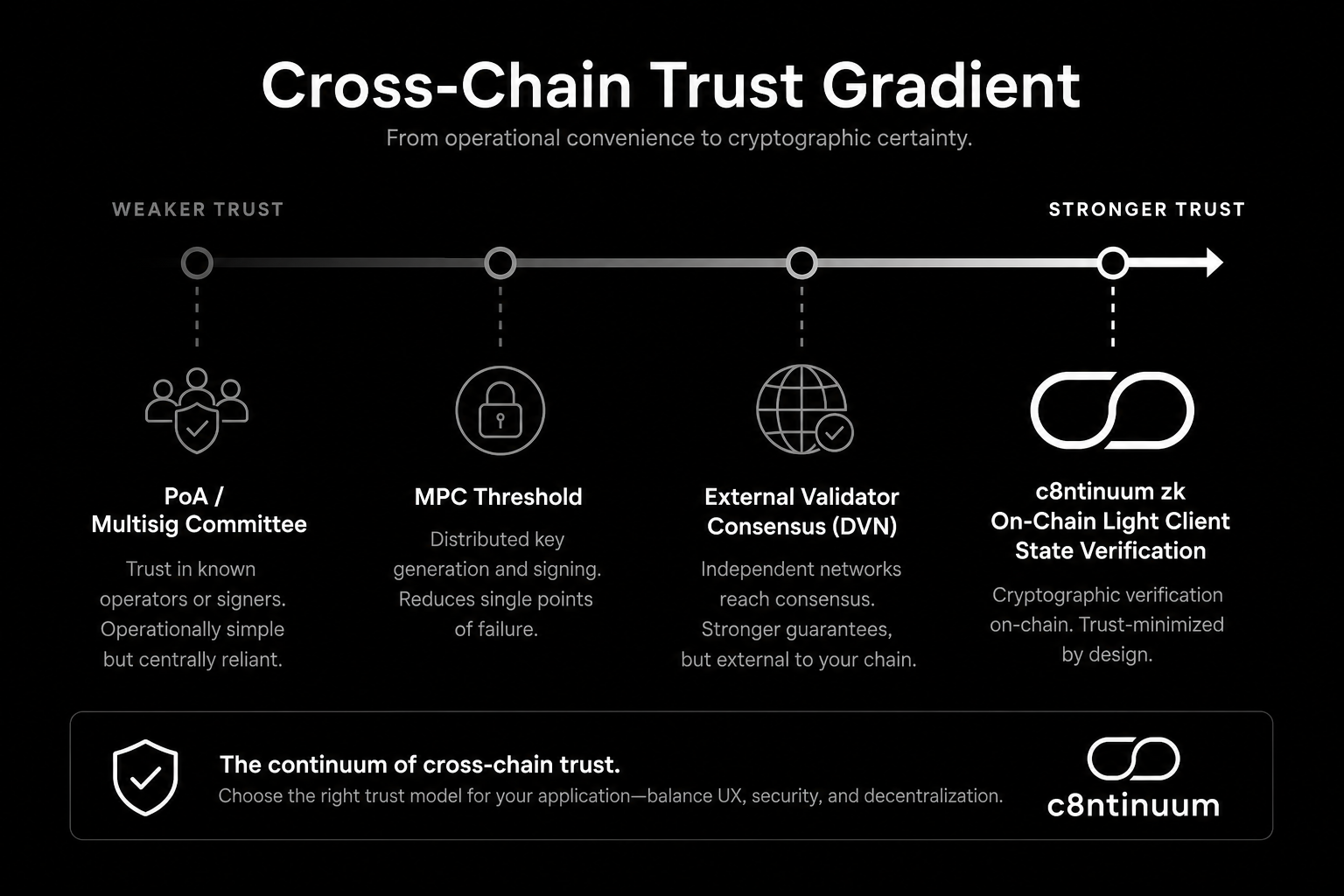 Figure 1. Cross-chain trust gradient: progression from PoA/multisig, MPC threshold signature, consensus verification, to c8ntinuum on-chain state verification.
zk Light Client and Bridgeless Architecture in Context
zk light client and bridgeless architecture are central to c8ntinuum’s comparative positioning. zk light client refers to verifying zero-knowledge proofs of source chain consensus state transitions within target chain contracts—entirely on-chain, eliminating reliance on off-chain attestation. Bridgeless architecture means no extra bridge contracts as trust anchors; state proofs directly trigger asset lock-release or mint-burn.
LayerZero and Axelar do not follow the zk light client route: LayerZero depends on DVN off-chain signatures, Axelar on validator off-chain consensus. Traditional bridges store committee multisig on-chain, but the committee remains a privileged third party. On-chain zk verification and off-chain attestation differ fundamentally in security models. c8ntinuum aggregates proofs independently for each chain rollup, avoiding Hub-Spoke single-point bridges. QTSS provides FROST threshold signature for chains without smart contracts, coexisting with pure zk paths.
Comparative Table: Verification Method, Trust Assumption, Bridging Topology, Liquidity Impact
| Comparison Dimension |
c8ntinuum |
LayerZero |
Axelar |
Traditional Bridge |
| Verification Method |
On-chain zk light client state proof |
External DVN attestation |
Validator consensus + Gateway |
PoA / multisig committee |
| Trust Assumption |
Source chain consensus + ZK reliability |
DVN honesty threshold |
Axelar validator honest majority |
Bridge operator / multisig holders |
| Bridging Topology |
Bridgeless, horizontal O(N) |
OApp + Endpoint mesh |
Gateway hub |
Lock-mint pool / custody contract |
| Liquidity Impact |
Protocol treasury + horizontal mapping |
Independent wrapped assets per chain |
Axelar wrapped assets dispersed |
Fragmented wrapped tokens, de-pegging risk |
| Heterogeneous VM Support |
IBC precompile, Solana-aware verification |
OApp adaptation required |
Cosmos + EVM Gateway |
Usually custom per chain |
This table compares four key dimensions: c8ntinuum emphasizes on-chain cryptographic proof and bridgeless structure; LayerZero offers modular DVN flexibility; Axelar connects heterogeneous chains via validator set; traditional bridges are simple but carry the heaviest committee trust. Most solutions generate distinct wrapped versions across chains, increasing de-pegging and fragmentation risk.
| Scenario Focus |
Key Verification Risks |
| Large asset transfers |
Committee/DVN collusion or key leakage |
| High-frequency messaging |
Off-chain attestation delays, DVN configuration |
| Heterogeneous VM interoperability |
Light client/precompile coverage for non-EVM chains |
| Long-term wrapped asset holding |
Wrapped token de-pegging, bridge contract upgrades |
This second table adds scenario context: users should prioritize specific risk points for each protocol and use case, rather than relying solely on brand or ecosystem scale.
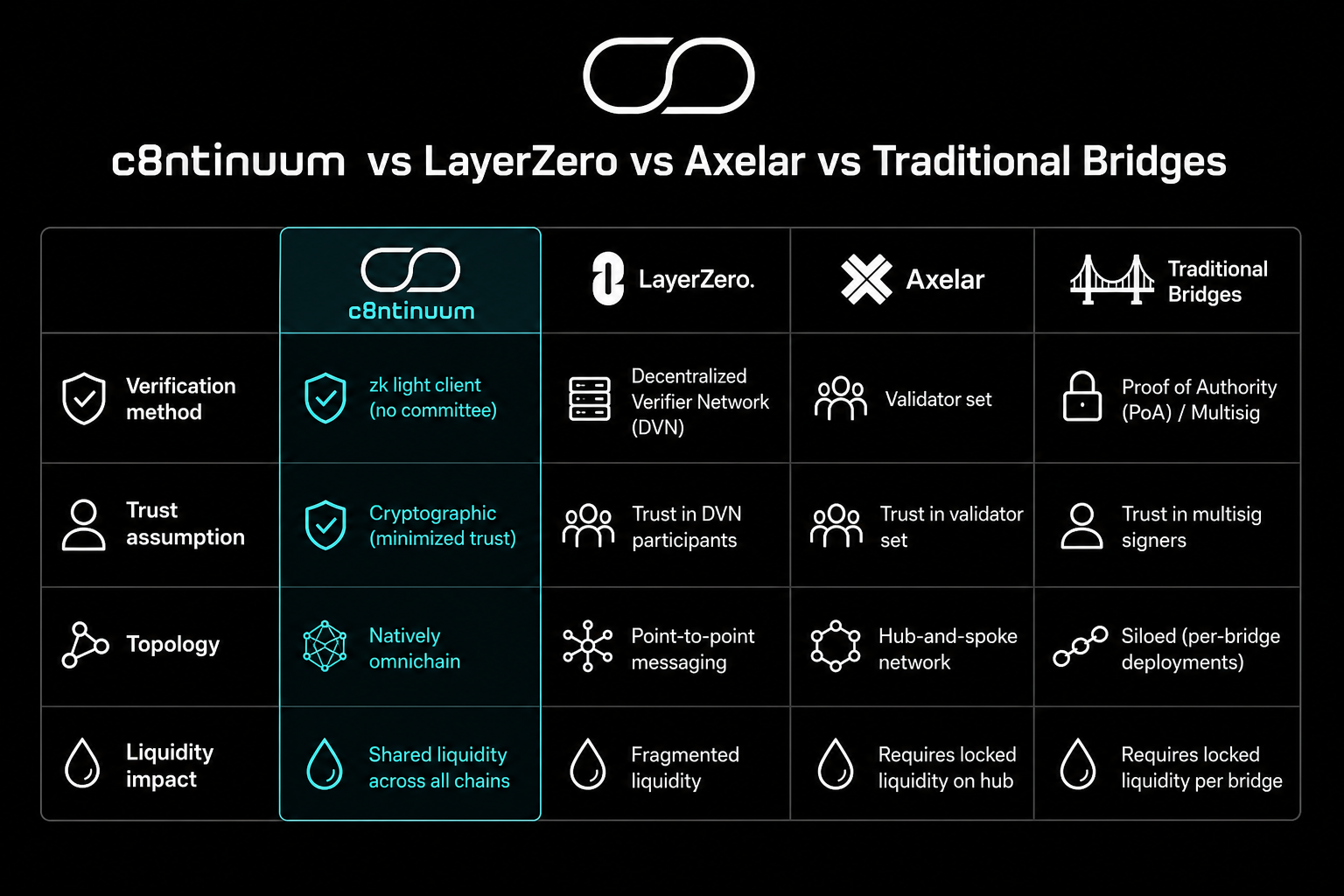 Figure 2. Comparison of c8ntinuum, LayerZero, Axelar, and traditional bridges across verification method, trust assumption, topology, and liquidity dimensions.
What are the limitations of comparison?
Horizontal comparison has structural limitations: protocols evolve rapidly, DVN composition, validator scale, and zk circuit versions may change. c8ntinuum’s QTSS path is less secure than pure zk and should not be oversimplified as “all protocol equals state verification.” Actual security depends on contract audits, Relayer incentives, and governance authority. zk proofs incur computational costs, DVN and validator consensus have off-chain latency. Wrapped asset liquidity and ecosystem integration affect user experience but don’t alter underlying verification logic. Verification gradient and ecosystem maturity should be evaluated separately.
Summary
The distinction among c8ntinuum, LayerZero, Axelar, and traditional bridges is rooted in their cross-chain trust models: c8ntinuum uses on-chain zk light client state verification and a bridgeless horizontal topology; LayerZero relies on modular DVN off-chain attestation; Axelar depends on independent validator consensus and Gateway; traditional bridges mostly rely on PoA or multisig committees. Each has unique characteristics in verification gradient, bridging structure, and liquidity impact. Selection should be based on scenario-specific security assumptions and asset mapping requirements, not simple advantage/disadvantage categorization.
FAQ
What are the differences between c8ntinuum and LayerZero?
The primary distinction lies in verification location and trust assumption: LayerZero depends on external DVN for off-chain attestation of cross-chain messages, with the target chain Endpoint executing after sufficient DVN signatures. c8ntinuum uses zk light client in the target chain contract to verify source chain consensus state proof, without DVN as a trust anchor. Bridging topology and wrapped asset formats also differ.
How does c8ntinuum differ from Axelar?
Axelar relies on an independent validator set to vote and confirm GMP and asset transfers, with trust based on honest validator majority. c8ntinuum converges security assumption to source chain consensus and zero-knowledge proof systems, performing on-chain state verification rather than third-party validator chain attestation. Axelar connects heterogeneous chains via Gateway hub, while c8ntinuum emphasizes bridgeless horizontal topology and protocol treasury.
How does c8ntinuum differ from traditional bridges?
Traditional bridges mainly rely on PoA or multisig committee attestation, with small committees and flexible upgrades but the highest trust assumption and frequent attack history. c8ntinuum does not use committee bridges as trust anchors, instead verifying source chain state on-chain via zk light client. For chains without smart contracts, QTSS threshold signature is used, offering security between MPC and pure zk.
How does c8ntinuum achieve cross-chain interoperability?
c8ntinuum generates zero-knowledge proofs of source chain consensus in zk-light-rollup, and the target chain contract verifies zk-SNARK before triggering lock-and-release or mint-and-burn. Relayers transmit block headers, and horizontal topology aggregates proofs across chains. IBC precompile and Solana-aware verification support heterogeneous VMs. The Infrastructure layer enables B2B cross-chain messaging for external chains.
What trust models exist for cross-chain bridges?
Common models include: PoA/multisig committee attestation (traditional bridges), MPC threshold signature (partial custody solutions), independent validator consensus (Axelar), external DVN attestation (LayerZero), and on-chain zk light client state verification (c8ntinuum). The gradient ranges from maximum reliance on privileged third parties to convergence on source chain consensus and cryptographic proof.
What are the limitations when comparing cross-chain solutions?
Protocols evolve rapidly, with DVN composition, validator scale, and contract versions subject to change. c8ntinuum’s QTSS path is less secure than pure zk. Actual risk depends on contract audits, Relayer incentives, and governance authority. Performance and ecosystem integration should be evaluated separately from the verification model—solutions should not be judged by a single dimension.







