Canton and Hyperledger Fabric are both widely used in enterprise and institutional blockchain settings, so they are often compared with each other. Although both emphasize permission management, privacy protection, and institutional collaboration, they differ significantly in their underlying architecture, interoperability logic, and financial positioning.
As blockchain adoption expands into banking, payments, supply chains, and digital assets, enterprises are increasingly focused on how to collaborate on-chain while maintaining privacy and compliance. Hyperledger Fabric represents an earlier direction in consortium blockchain development, while Canton places greater emphasis on synchronized finance across institutions and interoperability between networks. This difference also makes the two better suited to different types of business scenarios.
A Brief Overview of Canton and Hyperledger Fabric
Canton is a privacy focused blockchain network designed for institutional financial markets. Through Daml smart contracts and the Global Synchronizer, it enables data synchronization, asset coordination, and atomic settlement across multiple systems.
Hyperledger Fabric is an enterprise grade consortium blockchain framework promoted by the Linux Foundation and originally developed with contributions from organizations such as IBM. Fabric aims to provide enterprises with a controllable, permissioned, and modular distributed ledger environment, allowing multiple organizations to share data and execute unified business processes.
What Are the Network Architecture Differences Between Canton and Hyperledger Fabric?
One of the core differences between Canton and Fabric lies in their network architecture.
Fabric is closer to the traditional consortium chain model. Multiple organizations jointly maintain a permissioned network and use Channels to isolate data and support business collaboration. This structure improves privacy and control, but different Channels usually lack a unified synchronization mechanism, which limits cross system collaboration.
By contrast, Canton places more emphasis on cross network synchronization. Its Global Synchronizer can coordinate state consistency across multiple independent applications and subnetworks, allowing different institutions to share a unified transaction order and transaction state.
This means Fabric is better suited to enterprise consortia with fixed members, while Canton is better suited to dynamic financial networks involving multiple institutions.
How Do Canton and Fabric Differ in Their Privacy Mechanisms?
Fabric’s privacy mainly relies on Channels and permission management. Organizations can only access data within the Channels they belong to, which allows different business activities to remain isolated from each other.
This model works well for enterprise collaboration, but it can create data synchronization challenges in complex financial networks. Multiple Channels often mean multiple isolated data spaces, so cross system collaboration requires additional coordination.
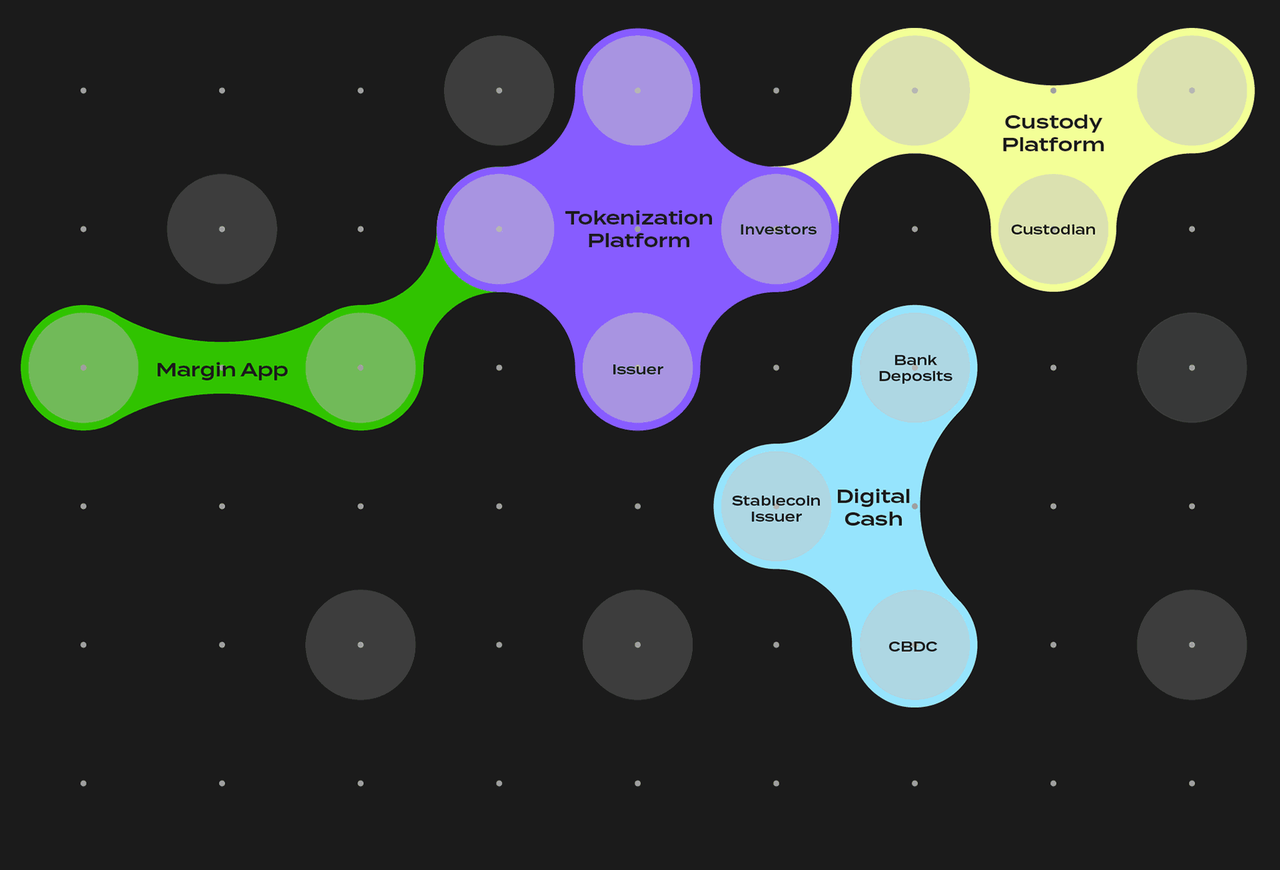
Canton, on the other hand, uses Sub Transaction Privacy. Different participants in a transaction can only see the data relevant to them and do not gain access to the full transaction content.
In this sense, Fabric is more like “isolating data by organization,” while Canton is more like “sharing state while displaying content according to permissions.” This difference makes Canton better suited to financial scenarios that require multiparty collaboration while strictly controlling data visibility.
What Is the Difference Between Canton and Hyperledger Fabric Smart Contract Models?
Fabric uses Chaincode as its smart contract mechanism, with developers typically writing business logic in Go, Java, or Node.js. Its focus is on executing enterprise processes and managing consortium chain business workflows.
By comparison, Canton uses the Daml smart contract language. Daml is designed not only for code execution, but also for modeling multiparty financial agreements and managing permissions.
For example, in complex financial transactions, Daml can define which participants have viewing rights, which institutions can perform asset operations, and how assets move through their lifecycle.
As a result, Chaincode is more oriented toward enterprise application logic, while Daml is more focused on financial contracts and institutional asset management.
Differences Between Canton and Fabric in Interoperability
Interoperability is one of the biggest differences between the two.
Fabric was originally designed for collaboration within enterprise consortia, so its architecture focuses on data sharing within a single network rather than real time synchronization across multiple networks. When different Fabric networks need to work together, additional bridges or middleware systems are usually required.
Canton was designed from the beginning with multi network coordination in mind. Its synchronized finance architecture allows multiple systems to share a unified state and supports atomic asset settlement.
This means Canton’s interoperability is not simply about whether assets can move across chains, but whether different systems can see consistent outcomes at the same time.
For financial markets, this synchronization capability is especially important, because institutional transactions often involve multiple participants and complex clearing processes.
Which Scenarios Are Better Suited to Canton?
Canton is better suited to financial scenarios that require cross institutional collaboration and real time settlement.
For example, in digital bond issuance, RWA, institutional payments, and cross border clearing, different participants usually need to share part of the state while still protecting sensitive data. In these cases, Canton’s synchronized finance architecture and sub transaction privacy mechanism can provide higher collaboration efficiency.
In addition, institutional DeFi and on-chain financial infrastructure are placing increasing importance on atomic settlement and cross system synchronization, which is one of Canton’s key areas of focus.
Which Scenarios Are Better Suited to Hyperledger Fabric?
Fabric is better suited to data sharing and business collaboration within enterprise consortia.
For example, in supply chain management, trade finance, logistics tracking, and enterprise process coordination, participants are usually relatively fixed and care more about permission control, process auditability, and consortium governance.
Because Fabric has a strong modular structure, many traditional enterprises can integrate it more easily with existing IT systems. This is also one of the main reasons Fabric has long been widely used in enterprise blockchain projects.
Canton vs Hyperledger Fabric Comparison Table
| Comparison Dimension |
Canton |
Hyperledger Fabric |
| Network Type |
Synchronized financial network |
Enterprise consortium chain |
| Main Positioning |
Institutional finance |
Enterprise collaboration |
| Privacy Mechanism |
Sub transaction privacy |
Channel based permission isolation |
| Smart Contracts |
Daml |
Chaincode |
| Interoperability |
Native support |
Limited |
| Settlement Method |
Atomic settlement |
Standard transaction processing |
| Typical Scenarios |
RWA, payments, digital securities |
Supply chains, enterprise consortia |
| Data Sharing Method |
Permissioned shared state |
Channel isolation |
Conclusion
Canton and Hyperledger Fabric are both institutional grade blockchain infrastructure solutions, but they represent two different development paths.
Fabric places greater emphasis on data sharing and permission management within enterprise consortia, making it suitable for supply chains, enterprise collaboration, and consortium blockchain scenarios. Its core goal is to help multiple organizations share ledgers and business processes in a controlled environment.
Canton, by contrast, places greater emphasis on synchronized finance, cross network collaboration, and atomic settlement, making it more suitable for RWA, digital securities, and institutional financial infrastructure.
As blockchain gradually expands from single enterprise systems to cross institutional financial networks, interoperability and synchronization are becoming increasingly important. Under this trend, Canton and Fabric are likely to continue serving different types of institutional blockchain needs.
FAQs
Are Canton and Hyperledger Fabric Both Consortium Chains?
Both have permissioned and institutional collaboration features, but Canton emphasizes cross network synchronization and financial interoperability, while Fabric is closer to a traditional consortium chain structure.
Why Does Canton Emphasize Interoperability More Than Fabric?
Because Canton’s core goal is to support multi institution financial collaboration, not just data sharing within a single consortium.
Can Fabric Support Cross Chain Use Cases?
Yes, it can be achieved through additional solutions, but its underlying architecture was not specifically designed for cross chain synchronization.
What Is the Difference Between Daml and Chaincode?
Daml is better suited to financial agreement modeling and permission control, while Chaincode is better suited to developing general enterprise business logic.
Is Canton Suitable for Supply Chain Scenarios?
Yes, but its main advantages are more concentrated in financial infrastructure and asset synchronization.
Is Fabric Suitable for RWA?
It can be used for some consortium based RWA scenarios, but Canton has stronger advantages in cross institutional synchronization and atomic settlement.







