The fundamental differences between Espresso Network, centralized sequencers, and Astria-style shared sequencing solutions center on who provides transaction confirmation, whether multiple Rollups share a unified order, and how execution sovereignty and Data Availability (DA) are separated. Espresso Network (ESP) serves as a shared settlement and finality layer for multichain ecosystems. Centralized sequencers operate for a single Layer 2 (L2) or Rollup. Astria exemplifies a modular sequencing design that separates ordering from execution. While all three address the question of transaction sequencing, their trust boundaries and interoperability capabilities differ.

What Role Does Espresso Network Play in Sequencing?
Espresso Network delivers decentralized, verifiable finality for transaction ordering. Each application or chain maintains its own execution environment and local sequencing logic, then submits sorted transaction flows to Espresso. The network achieves consensus via HotShot, aggregating validators to produce a standardized, immutable order record.
Espresso does not replace execution engines in each environment. Execution is replayed deterministically by Rollup or application nodes based on the finalized order. For cross-environment collaboration, zero-knowledge proofs and similar techniques allow other chains to verify finality on Espresso without replaying the full source logic. HotShot consensus defines the strength of confirmation and censorship resistance. ESP staking and protocol fees incentivize validators and underpin network security. Data availability is managed through mechanisms like verifiable information distribution (VID), ensuring blocks aren't finalized until a sufficient share is recoverable. Thus, Espresso functions as a “shared settlement/shared finality layer”: sequencing outcomes are broadly verifiable, while execution and compliance remain under each environment’s control.
What Is a Centralized Sequencer? What Efficiencies and Risks Does It Present?
A centralized sequencer is the operational model for most early-stage Rollups: a single operator receives user transactions, determines the packaging order, and quickly provides soft confirmation. “Confirmation” in the UI typically reflects operator commitment, not multi-party consensus finality.
Efficiency stems from a streamlined path: single-node decisions yield low latency and superior throughput compared to multi-node consensus. Risks are concentrated—the operator can censor, delay, or prioritize transactions; outages halt block production; maximum extractable value (MEV) strategies are controlled unilaterally. When each Rollup manages its own sequencer, cross-chain interactions rely on bridges or messaging protocols, lacking standardized shared order. Centralized sequencers are not inherently flawed; they trade operational trust for speed and engineering simplicity. Evaluations must distinguish between soft confirmation and robust finality.
How Does Astria-Style Shared Sequencing Differ?
Astria represents shared sequencing networks: multiple Rollups outsource transactions to a decentralized sequencer set, separating sequencing from execution. It emphasizes “lazy sequencing”—consensus only establishes order for data like (rollup_id, tx_bytes), without executing state transitions. Rollup nodes execute according to the committed order.
Astria designs typically use CometBFT (Tendermint family) for consensus. DA is often managed by external modules (e.g., Celestia), offering DA selection flexibility. Multiple Rollups sharing sequencers target atomic composability across Rollups. Like Espresso, Astria falls under “outsourced sequencing,” but confirmation and DA bundling differ: Espresso prioritizes HotShot shared finality and cross-environment verifiable settlement; Astria focuses on streamlined sequencing middleware and modular DA. Both reduce single-operator censorship and downtime via multi-node consensus but introduce shared infrastructure dependencies.
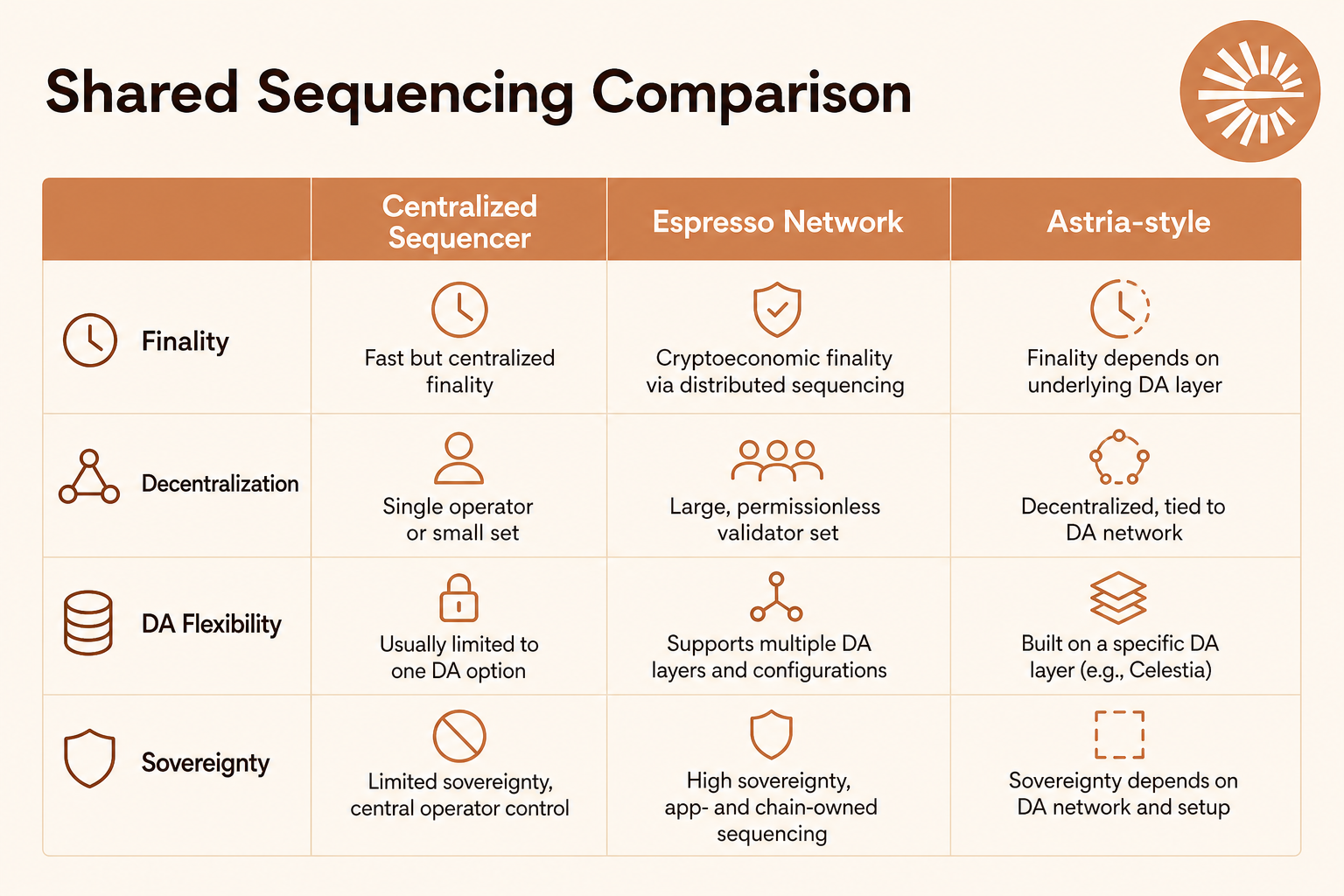 Figure 1. Comparison of confirmation, sovereignty, and DA among Espresso, centralized sequencers, and Astria-style shared sequencing.
Comparison Table: Confirmation Speed, Decentralization, Sovereignty, DA Flexibility
| Dimension |
Centralized Sequencer |
Espresso Network |
Astria-Style Shared Sequencing |
| Confirmation type |
Operator soft confirmation |
HotShot multi-party finality |
CometBFT consensus confirmation plus optional soft confirmation |
| Decentralization |
Single operator |
PoS validator set |
Shared sequencer node set |
| Execution sovereignty |
Rollup self-execution and sequencing |
Execution remains in each environment, order finalized by shared layer |
Lazy sequencing, execution wholly managed by Rollup |
| DA flexibility |
Often tied to L1 or other DA via Rollup stack |
VID/Espresso DA path within network |
Typically connects to independent DA (e.g., Celestia) |
| Cross-Rollup order |
Not shared by default |
Shared finality enables cross-environment verification |
Design emphasizes shared order and atomic composability |
| Typical trade-off |
Low latency, concentrated trust |
Verifiable confirmation, relies on shared settlement layer |
Strong modularity, requires coordination between sequencing and DA boundaries |
Note: Confirmation speed must be assessed alongside confirmation strength. Centralized models usually offer soft confirmation first; Espresso and Astria-style solutions use consensus for verifiable ordering, with perceived latency depending on integration. All three retain execution sovereignty, but sequencing trust varies: single operator, Espresso validators, or Astria sequencer network. DA flexibility reflects modularity—external connections enhance pluggability; built-in paths are tightly linked to finality.
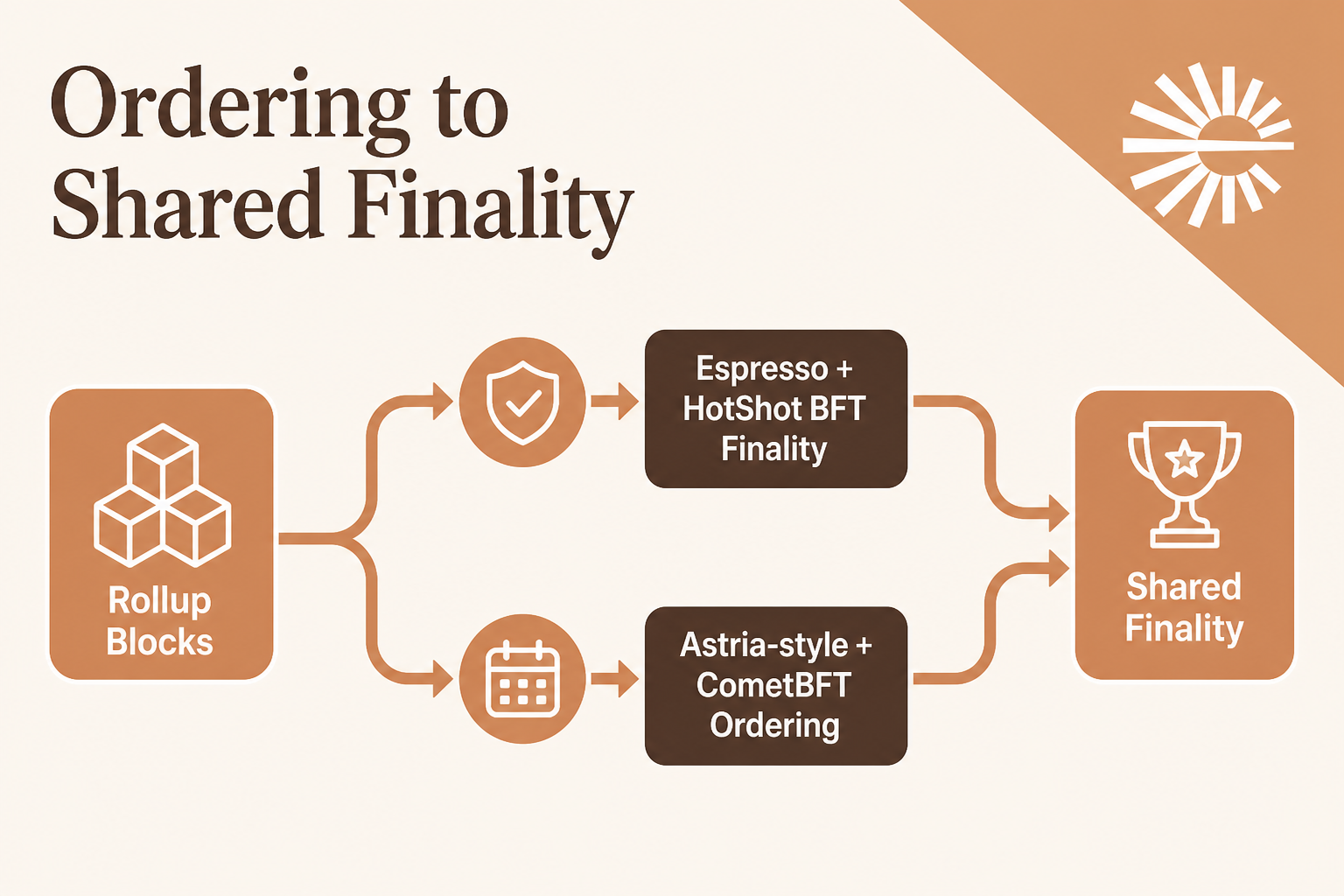 Figure 2. Typical path from application-side sequencing to shared sequencing layer, DA, and cross-Rollup verification.
What Differentiates Cross-Rollup Composability?
Cross-Rollup composability hinges on whether chains share a standardized order and whether others can efficiently verify finalized order. Centralized sequencers keep chains independent; cross-chain relies on asynchronous messaging or bridges, with atomicity dictated by bridge design.
Shared sequencing aims for multiple Rollup transactions to enter unified consensus, allowing observers to interpret relative order based on block commitments, reducing contention. Second-level confirmation flow clarifies user feedback versus cross-environment verifiable finality. Espresso combines shared finality and zero-knowledge proofs, enabling target environments to verify source state without full replay. Astria emphasizes atomic composability within the same sequencing height. Neither solution automatically bridges assets—composability requires application-layer protocol implementation.
| Composability element |
Centralized Sequencer |
Shared Sequencing (Espresso/Astria-Style) |
| Shared standardized order |
Usually absent |
Present (multiple Rollups in same layer) |
| Cross-chain verification |
Depends on external bridge/message |
Can leverage shared commitment and proof |
| Atomicity source |
Application/bridge design |
Sequencing layer order plus application orchestration |
| Fault domain |
Each chain’s sequencer is independent |
Shared sequencing layer is a common dependency |
Shared order narrows disputes over transaction precedence but shifts some availability and censorship resistance to the shared layer. Centralized models isolate fault domains better, but incur higher interoperability costs. These are engineering boundaries, not absolute winners.
What Are the Limitations and Common Misconceptions in Comparison?
Misconception 1: Equating “shared sequencing” with “loss of Rollup sovereignty.” Execution and compliance remain local; only sequencing consensus and, in some designs, settlement verifiability are outsourced. Misconception 2: Judging superiority based solely on latency—soft confirmation and consensus finality differ in strength. Misconception 3: Assuming cross-chain assets automatically settle atomically; shared sequencing only provides order and verifiable commitments.
Limitations: Centralized models concentrate single-point risk; shared sequencing reduces censorship but introduces shared layer dependency, validator concentration, and integration complexity. Espresso requires understanding HotShot, staking, and proof assumptions; Astria-style solutions demand evaluation of sequencing consensus and external DA. Ignoring confirmation strength, fault domain, and sovereignty boundaries leads to biased conclusions.
Summary
Espresso, centralized sequencers, and Astria-style solutions all solve the problem of transaction ordering but differ in trust models and interoperability. Centralized sequencers trade single operators for low-latency soft confirmation. Espresso leverages HotShot shared finality and verifiable settlement for multi-environment coordination. Astria emphasizes composability with lazy sequencing and modular DA. Effective comparisons should focus on confirmation strength, decentralization, execution sovereignty, DA boundaries, and cross-Rollup composability—not on generic claims of superiority.
FAQ
What Is Espresso Network?
Espresso Network is a shared settlement and finality infrastructure for multichain scenarios. Applications or Rollups retain their own execution environments; HotShot consensus provides multi-party finality for transaction ordering, and proof enables other environments to verify confirmations.
What Is the Difference Between Shared Sequencers and Centralized Sequencers?
Centralized sequencers are operated by a single entity for one Rollup, determining order and providing soft confirmation. Shared sequencers use multi-node consensus to offer a standardized order for multiple Rollups. The former has lower latency and concentrated trust; the latter reduces single-point censorship and downtime but introduces shared layer dependency.
How Do Espresso and Astria Differ?
Both are outsourced, shareable sequencing approaches, but differ in engine and module boundaries. Espresso uses HotShot for shared finality and emphasizes cross-environment verifiable settlement. Astria uses CometBFT for lazy sequencing, leaves execution to Rollups, and DA is often external. Comparisons should focus on confirmation, DA, and composability, not a single performance figure.
How Does Espresso Improve Cross-Chain Confirmation Speed?
Espresso’s shared finality enables multiple environments to coordinate states using the same final confirmation record. Coupled with zero-knowledge proofs, it reduces reliance on full replay and trusted intermediaries. Faster cross-chain confirmation results from efficient verification, not from eliminating local execution or bridging logic.
What Are the Risks of Using Espresso?
Risks include validator set and staking security assumptions, shared settlement layer availability, client and proof verification integration complexity, and continued dependence on correct application-layer protocols for cross-environment messaging. These are infrastructure and integration risks, distinct from censorship and downtime risks associated with single-operator sequencing.







