Ethena Explained: Synthetic Dollar USDe and the Future of Web3 Stablecoins

Beginner
Quick Reads
Last Updated 2026-03-29 15:26:54
Reading Time: 1m
Ethena’s primary advantages are its decentralized and transparent nature. Rather than depending on traditional financial institutions, Ethena maintains stability by actively leveraging on-chain assets and derivative hedging.

What is Ethena?

Ethena is a decentralized finance (DeFi) protocol built on the Ethereum blockchain. Its core innovation is USDe, a synthetic dollar stablecoin that isn’t backed by fiat but instead maintains its US dollar peg via a delta-hedging strategy utilizing crypto assets and derivatives. Ethena also offers sUSDe, a yield-generating dollar-denominated deposit tool that combines stability with passive income potential.

How Ethena Works: Core Mechanisms

  1. USDe: Synthetic Dollar Mechanics
    USDe employs a delta-hedging strategy, using assets like Bitcoin, Ethereum, and Solana as collateral while simultaneously taking offsetting positions in perpetual or futures contracts. This approach stabilizes value and generates yield. USDe also leverages a mint-redeem arbitrage mechanism to help maintain its peg.
  2. sUSDe: The Internet Bond Savings Tool
    Ethena introduces the concept of an Internet Bond, combining staking rewards and futures basis income to create an opportunity to earn yield in US dollars for liquidity providers.

Ethena’s Competitive Edge

Ethena’s main strength is its creation of a truly crypto-native dollar stablecoin. USDe operates independently of centralized entities, relying solely on transparent, on-chain assets and derivative-based hedging for stability. Meanwhile, sUSDe delivers compelling passive returns. With rapid growth in total value locked (TVL) and expanding partnerships, Ethena is building a highly promising DeFi stablecoin ecosystem.

2025 Outlook

  1. Market Price and Sentiment
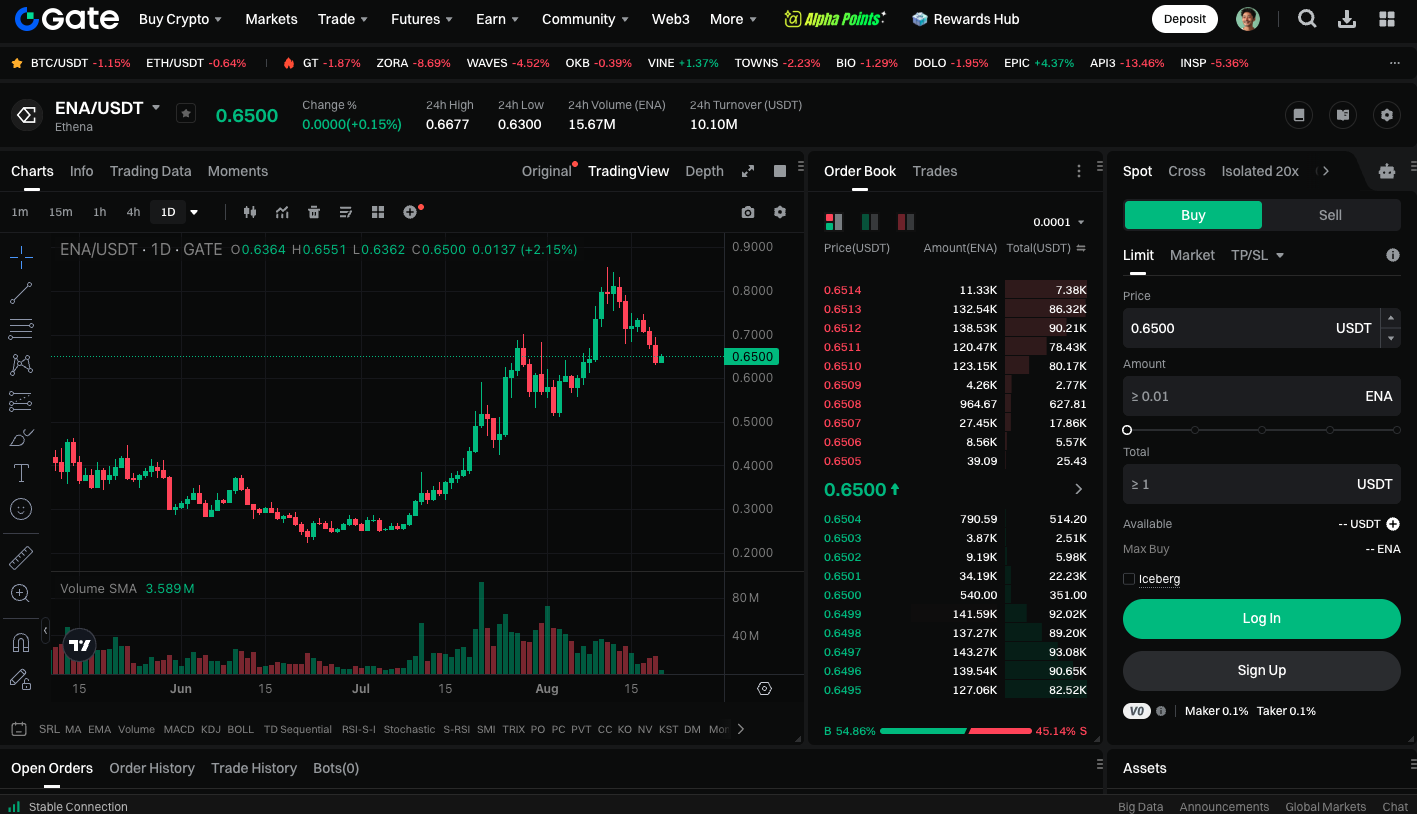
    ENA has shown strong recent performance, with a spot price above $0.65 at the time of writing. The market is focused on whether it can break through the $1.40 resistance level.
  2. Rising Stablecoin Status
    USDe has climbed to the world’s third-largest stablecoin by market cap, with its total value locked (TVL) exceeding $10 billion—shows the ecosystem’s scale and growing acceptance.
  3. Compliance and Institutional Partnerships
    Ethena has partnered with Anchorage Digital to issue the compliant stablecoin USDtb on a regulated platform, integrating with the traditional financial system and boosting Ethena Protocol’s credibility and institutional trust.

Challenges and Risks

Ethena faces notable risks. USDe’s high yields, which once reached 60%, have fallen below 5%, reflecting declining arbitrage opportunities. If perpetual contract funding rates turn negative, the delta-hedging model could break down. This would risk the stability of the stablecoin. Since part of Ethena’s liquidity is derived from liquid staking tokens (LSTs), any depegging events there could also expose the protocol to risk.

Future Trends

Looking ahead, Ethena plans to deepen institutional partnerships and strengthen its regulatory position. For example, leveraging Anchorage Digital’s platform to introduce USDtb to traditional financial infrastructure could drive higher trust and adoption. As a decentralized dollar alternative, USDe has the potential to become a major player in the DeFi stablecoin arena, particularly in the yield-bearing sector. If Ethena maintains stability and achieves wide adoption across CeFi and Web3, it could set a new standard for secure and appealing digital currency infrastructure.

ENA/USDT Spot Trading

ENA is gaining traction among younger investors in the spot market. Paired with USDT, ENA enables users to capture value. It also offers arbitrage opportunities within the Ethena ecosystem. Spot trading offers flexible entry and exit points. It also allows easy participation in governance and liquidity provision.

You can start trading ENA spot now: https://www.gate.com/trade/ENA_USDT
Summary

Ethena brings a new, crypto-native perspective to the stablecoin market with its innovative pricing and yield models. USDe and sUSDe are designed to meet the needs of DeFi and Web3 investors, while offering a different approach to digital money. Although arbitrage and strategy risks remain, Ethena’s ongoing progress with compliance and transparency could drive robust growth after 2025, establishing itself as a key player in the DeFi stablecoin sector.

Author: Allen
Disclaimer
* The information is not intended to be and does not constitute financial advice or any other recommendation of any sort offered or endorsed by Gate.
* This article may not be reproduced, transmitted or copied without referencing Gate. Contravention is an infringement of Copyright Act and may be subject to legal action.

Related Articles

AI-Native Settlement Layers: How United Stables Is Building the Next Financial Rail
Beginner

AI-Native Settlement Layers: How United Stables Is Building the Next Financial Rail

Stablecoins were originally designed as dollar substitutes within exchanges, primarily used for asset pricing and trade settlement. As on-chain financial ecosystems have matured, their role has expanded beyond simple payments to include collateral assets, cross-chain liquidity mediums, and unified settlement units. In particular, as AI systems and automated agents begin to participate directly in economic activity, demand has risen sharply for programmable value units capable of instant settlement. This shift is pushing stablecoins toward the role of foundational financial infrastructure.
2026-03-25 03:16:17
The ve(3,3) Flywheel Explained: How AERO Tokenomics Powers Aerodrome’s DeFi Economy
Beginner

The ve(3,3) Flywheel Explained: How AERO Tokenomics Powers Aerodrome’s DeFi Economy

In the competition for DeFi liquidity, high-inflation mining alone is no longer enough to build lasting advantages. Aerodrome applies the ve(3,3) economic model to redesign token emissions, voting mechanisms, and revenue distribution, creating a liquidity flywheel centered on governance and cash flow. This article examines AERO tokenomics, the veAERO locking mechanism, and protocol revenue models to explain how Aerodrome builds a sustainable DeFi economic system.
2026-03-25 06:41:58
Aerodrome Tokenomics: How ve(3,3) Powers Base's Most Profitable DEX
Beginner

Aerodrome Tokenomics: How ve(3,3) Powers Base's Most Profitable DEX

AERO is the native token of Aerodrome Finance, a core decentralized exchange and liquidity protocol in the Base ecosystem. It is primarily used for liquidity incentives and ecosystem operations. veAERO is a governance NFT that users receive by locking AERO, representing both voting power and the right to share protocol revenue. Through a dual track structure of AERO as a utility token and veAERO as a governance credential, Aerodrome separates liquidity usage value from long term governance power, allowing participants to act as liquidity providers, governance decision makers, and revenue sharers within the same system.
2026-03-25 06:40:31
How is the price of PAXG determined? Pegging mechanism, trading depth, and influencing factors
Beginner

How is the price of PAXG determined? Pegging mechanism, trading depth, and influencing factors

PAXG (Pax Gold) is a tokenized asset backed by physical gold reserves, launched by fintech firm Paxos and issued as an ERC-20 token on the Ethereum blockchain. The core concept is to digitally represent real-world gold assets, allowing investors to hold and trade gold via the blockchain network. Because each PAXG token corresponds to a specific quantity of physical gold, its price is theoretically expected to closely track the global gold market.
2026-03-24 19:11:40
How Does PAXG Work? In-Depth Overview of the Physical Gold Tokenization Mechanism
Beginner

How Does PAXG Work? In-Depth Overview of the Physical Gold Tokenization Mechanism

PAXG (Pax Gold) is a tokenized asset backed by physical gold, issued by the fintech company Paxos and traded on the Ethereum blockchain as an ERC-20 token. The core concept is to tokenize physical gold on-chain, with each PAXG token representing ownership of a certain amount of gold. This structure enables investors to hold and trade gold in the form of a digital asset.
2026-03-24 19:12:51
Hybrid Collateral Stablecoins: Inside United Stables' Stability and Yield Architecture
Beginner

Hybrid Collateral Stablecoins: Inside United Stables' Stability and Yield Architecture

In the early stages of the crypto market, traditional stablecoins mainly relied on single-reserve or single-collateral models. Their primary focus was price stability and payment convenience, which allowed them to become foundational tools for on-chain trading and capital flows. As the market has entered a more mature financial phase, however, this structure has begun to reveal limitations, including high concentration risk and the difficulty of balancing liquidity with yield. These constraints have driven the evolution toward multi-layer collateral and portfolio-based designs, such as the dual-layer hybrid collateral architecture proposed by United Stables, which seeks to redefine the underlying logic of stable assets.
2026-03-25 03:17:39





