As the blockchain industry develops, the transparency of public on-chain data has gradually exposed privacy issues. User wallet addresses, asset sizes, and fund flows can often be tracked and analyzed over long periods, creating risks for personal payments, business activity, and on-chain financial use cases. Privacy coins have therefore become an important segment of the crypto market. Their core goal is to reduce the likelihood that transaction behavior can be externally traced while still preserving blockchain verifiability.
In the privacy coin sector, Firo, Monero, and Zcash are three of the most representative projects. Monero has long been seen as a major name in anonymous payments. Zcash helped bring zk-SNARKs zero-knowledge proofs into blockchain applications. Firo, meanwhile, explores a privacy model that does not require a trusted setup through Lelantus Spark and its anonymity pool structure.
What Are Firo, Monero, and Zcash?
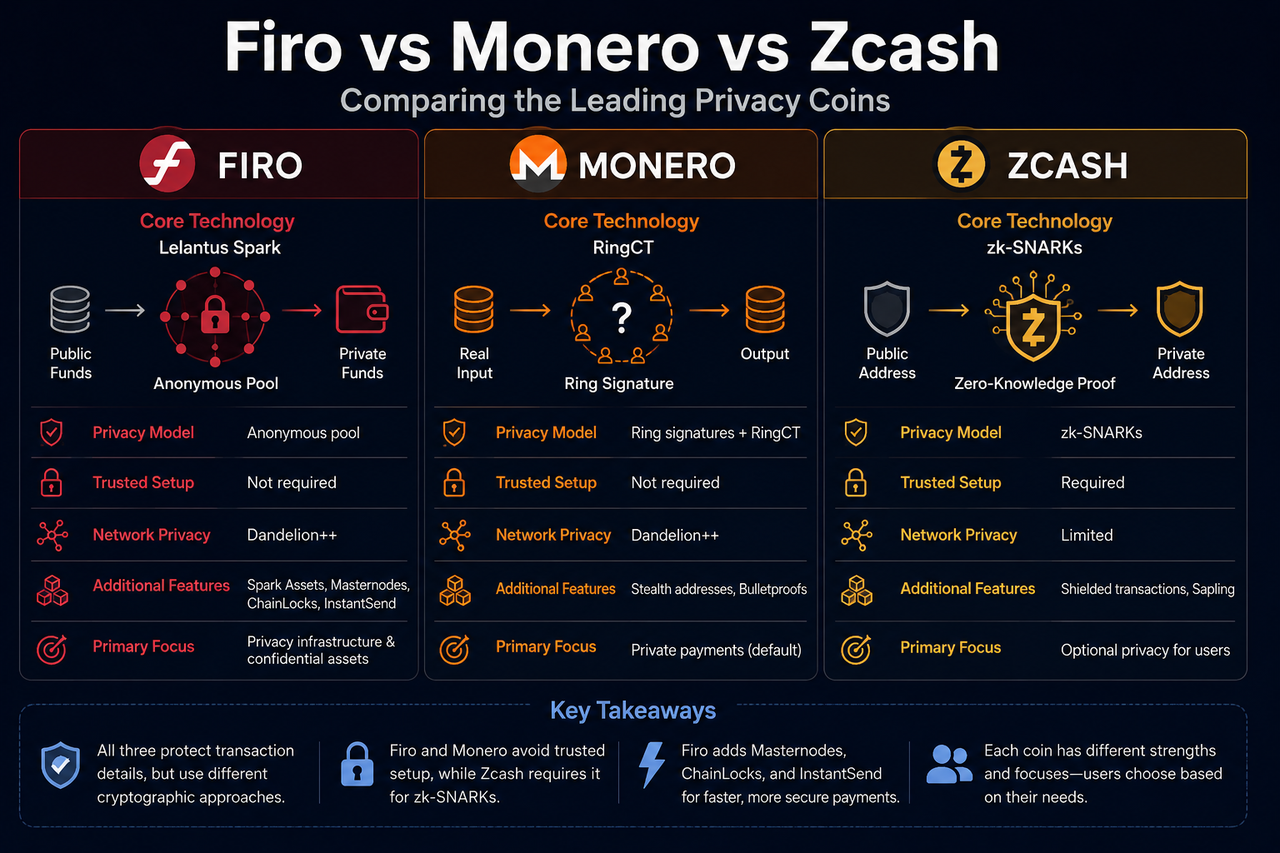
Firo, Monero, and Zcash are all privacy coins, but they follow different technical paths.
Firo’s core protocol is Lelantus Spark, which focuses on hiding transaction senders, recipients, and amounts through anonymity pools and zero-knowledge proofs. The project was first launched under the name Zcoin and has gradually expanded from anonymous payments into confidential assets and private stablecoins.
Monero (XMR) has long focused on anonymous payment use cases. Its default privacy mechanisms include RingCT, ring signatures, and stealth addresses. Compared with “optional privacy” models, Monero’s anonymity features are usually enabled by default, giving it a relatively stable overall anonymity set.
Zcash (ZEC) was one of the first projects to apply zk-SNARKs zero-knowledge proofs to blockchain. Its privacy feature is optional, allowing users to switch between transparent transactions and shielded transactions.
What Are the Core Technical Differences Between Firo, Monero, and Zcash?
The biggest differences among the three lie in their anonymity mechanisms and cryptographic structures.
| Project |
Firo |
Monero |
Zcash |
| Core Protocol |
Lelantus Spark |
RingCT |
zk-SNARKs |
| Privacy Structure |
Anonymity pool |
Ring signatures |
Zero-knowledge proofs |
| Default Privacy |
Partially default |
Default |
Optional |
| Trusted Setup |
Not required |
Not required |
Required |
| Network-Layer Privacy |
Dandelion++ |
Dandelion++ |
Partially supported |
Firo uses an anonymity pool structure, mixing user assets into a shared anonymity set to break the link between inputs and outputs. Its focus is on avoiding a trusted setup while further expanding into confidential asset use cases such as Spark Assets.
Monero uses RingCT and ring signatures to hide the real transaction input, making it difficult for outside observers to identify the actual sender. Because its privacy features are enabled by default, Monero is generally considered to have a strong and consistent anonymity structure.
Zcash relies more heavily on zk-SNARKs zero-knowledge proofs, using advanced cryptography to hide transaction information. Compared with the other two, Zcash has a more complex cryptographic design, but its anonymous transactions are not enabled by default.
Why Does Trusted Setup Matter?
Trusted setup is one of the most frequently discussed issues in privacy protocols.
Some zk-SNARKs protocols need to generate specific parameters during the initialization phase. If that process were maliciously controlled, it could theoretically affect system security. For this reason, trusted setup is viewed as a potential trust issue in zero-knowledge proof protocols.
One of the design goals of both Firo and Monero is to avoid trusted setup. Firo’s Lelantus Spark and Monero’s RingCT do not require a trusted initialization process, which gives them a stronger emphasis on a “minimal trust model.”
Although Zcash has long relied on trusted setup, its community has reduced the risk through multi-party generation ceremonies.
How Do Firo, Monero, and Zcash Differ in Network-Layer Privacy?
In addition to on-chain anonymity, network-layer privacy is also important.
Even when transaction amounts and addresses are hidden, an IP address may still be exposed when nodes broadcast transactions. If an attacker can analyze the transaction propagation path, there may still be an opportunity to trace the source of user activity.
Firo and Monero both use Dandelion++ to improve the transaction broadcast structure. This mechanism divides transaction propagation into multiple phases, reducing the risk that the transaction origin can be identified.
By comparison, Zcash focuses more on on-chain zero-knowledge proofs, and its network-layer privacy capabilities are relatively weaker.
How Do the Use Cases of Firo, Monero, and Zcash Differ?
Although all three are privacy coins, their ecosystem development directions are not exactly the same.
Firo places greater emphasis on private financial infrastructure. Its focus is not limited to anonymous payments, but also includes Spark Assets, private stablecoins, and confidential asset issuance. The project aims to build an on-chain system that supports multi-asset privacy.
Monero is positioned more like anonymous digital cash. Its long-term focus is on improving anonymous payment capabilities while maintaining a default privacy structure.
Zcash follows a more cryptography-driven privacy technology path, and its zk-SNARKs structure is widely viewed as an important practical example in the field of zero-knowledge proofs.
What Challenges Do Privacy Coins Face?
Although privacy protocols have significant technical value, the development of privacy coins still faces real-world challenges.
The first is regulation. Because privacy coins involve anonymous transactions, they may face stricter regulatory treatment in some regions.
The second is exchange compatibility. Some centralized exchanges may restrict deposits, withdrawals, or trading functions for privacy coins.
In addition, privacy protocols are usually more complex than ordinary blockchain structures, so the barrier for ordinary users to understand and use them is also relatively higher.
Conclusion
Firo, Monero, and Zcash are all important representatives of the privacy coin sector, but their technical paths differ clearly.
Monero emphasizes default anonymous payments and ring signature structures. Zcash focuses on zk-SNARKs zero-knowledge proofs. Firo, through Lelantus Spark, anonymity pools, and Dandelion++, explores private financial infrastructure that does not require a trusted setup.
FAQs
What Is the Biggest Difference Between Firo and Monero?
Monero mainly relies on RingCT and ring signatures, while Firo uses Lelantus Spark and an anonymity pool structure.
Why Does Zcash Require a Trusted Setup?
Because its zk-SNARKs protocol requires an initialization parameter generation process.
Which Privacy Coin Has the Strongest Anonymity?
Different protocols use different privacy models, so it is difficult to define one as having the absolute “strongest anonymity.”
Does Firo Support Network-Layer Privacy?
Yes. Firo uses Dandelion++ to reduce the risk of IP addresses being traced.
Does Firo Support Confidential Assets?
Yes. Firo’s Spark Assets framework can be used for private stablecoins and anonymous digital assets.







