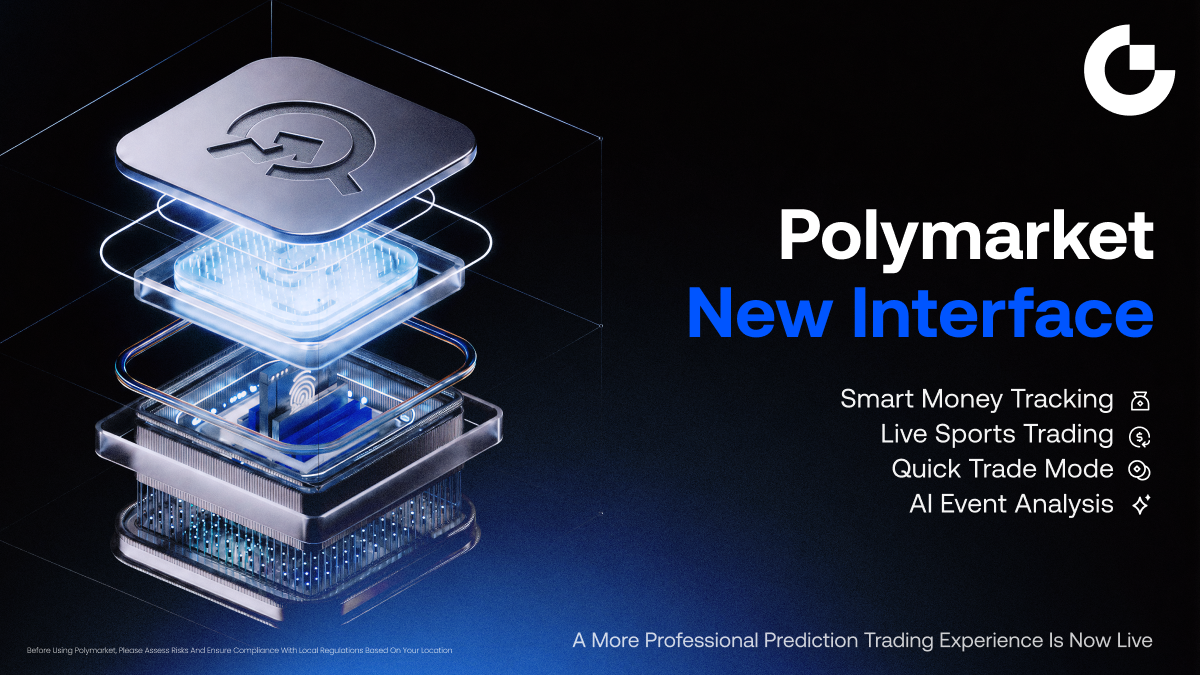
Prediction markets are transforming from a simple game of guessing outcomes into a new type of information-driven marketplace. Whether it's the U.S. presidential election, crypto ETFs, macroeconomic data, or major sports and social events, a growing number of users are leveraging these markets to express opinions, manage risk, and even execute short-term trades. As both user counts and capital inflows surge, the core competitive edge has shifted—profitability now depends less on simply being "right" and more on understanding market structure, capital flows, and trading dynamics.
Against this backdrop, "Smart Money" has emerged as one of the most closely watched concepts in prediction markets.
Gate recently rolled out a major upgrade to its Prediction Market, systematically enhancing smart money identification, whale tracking, AI analysis, and real-time trading features, all integrated into Gate App v8.19. The goal is clear: evolve prediction markets from simple event betting into a data-driven, strategy-oriented professional trading environment.
What Does "Smart Money" Mean in Prediction Markets?
In traditional finance, "smart money" refers to capital groups with strong long-term profitability, high information processing efficiency, and disciplined trading habits.
In prediction markets, however, the concept takes on added significance. These markets trade in "probabilities"—different users assign different prices to event outcomes, and those prices fluctuate constantly based on sentiment, news, capital flows, and odds adjustments. Certain traders consistently achieve high win rates in this dynamic environment, making their position changes, pace of position increase, and exit timing closely monitored by the market.
That's why many users focus on:
- Which accounts are consistently profitable
- Which traders position themselves ahead of major events
- Where whale capital is flowing
- Whether market moves are driven by top players
In effect, prediction markets are developing the same "on-chain smart money tracking" logic seen in crypto derivatives markets.
Gate's latest upgrade productizes this observation framework.
Why Smart Money Is Becoming a Key Metric
Prediction markets differ from traditional trading in one crucial way: their information density is extreme. A single game result, an economic data release, or a policy announcement can rapidly reprice the market. Ordinary users often struggle to process this flood of information, so traders who consistently generate stable returns naturally become reference points for everyone else.
One of the core changes in Gate's upgraded leaderboard is a clearer identification system for smart money.
Beyond PnL and volume, the new system introduces several user tags, including:
- Smart Money
- Shark
- Whale
- High-Activity Trader
Crucially, "Smart Money" emphasizes long-term stable profitability over short-term explosive gains. Users can now see not just "who made the most" but "who consistently makes money over time."
This dimension is far closer to genuine trading skill than focusing on a single high-return account.
From Leaderboards to Position Curves: Prediction Markets Go Data-Driven
Another major upgrade is the dramatic increase in trading behavior transparency.
Gate now offers:
- PnL curve display
- Historical trade record viewing
- Position change tracking
- Top holdings module
- Multi-dimensional sorting and filtering
Users can now visually study the behavior patterns of different traders.
For example:
- Does a particular Smart Money trader specialize in sports markets?
- Does a certain whale prefer macroeconomic events?
- Do certain accounts consistently position themselves ahead of hot topics?
- Was a market anomaly driven by concentrated capital?
This data doesn't provide direct "answers," but it helps users understand market structure much faster.
As prediction markets become more financialized, "studying capital behavior" is itself becoming a new trading approach.
Why Whale Positions Matter
Whale behavior significantly impacts odds and sentiment in prediction markets, especially in illiquid event markets where large, concentrated bets can quickly shift price ranges and expectations.
Gate's new "Top Holdings" module lets users see:
- Who holds the largest positions
- How the long/short structure is distributed
- What direction large capital is betting on
- Which events are attracting high-net-worth participants
For short-term traders, this information is vital. Many prediction markets are less about "trading the final outcome" and more about "trading expectation changes." An event may never happen, but if market probability rises, the price can move well in advance.
So tracking whale behavior is often more critical than waiting for results.
As prediction markets cover more events, the information burden on users grows rapidly.
Especially in:
- Macro events
- Political elections
- Crypto policy
- Sports events
- Breaking news
Market shifts often outpace an ordinary user's ability to process information.
Gate's upgrade introduces AI analysis for structured event interpretation, including:
- Core event summary
- Key influencing factors
- Latest developments
- Key points to watch next
The core value isn't to "replace judgment" but to lower the cost of filtering information. In high-frequency event markets, time is a trading advantage. Those who can process information faster—and understand market sentiment and capital direction sooner—gain a clear edge.
Why Sports Prediction Markets Are Becoming Real-Time Trading
Sports is another key focus of this upgrade. Traditional sports betting is largely "pre-match wagers," but prediction markets are moving toward real-time trading.
For example:
- Odds change during the match
- Users adjust positions based on live scores
- Markets create short-term volatility around different phases
- High-frequency trading is increasing
Gate's new system supports:
- LIVE real-time event display
- Synchronized score and time updates
- Multi-phase aggregation for the same match
- Express trade and pop-up order placement
- Market orders and limit orders
These features show prediction markets evolving into "event-driven trading markets," not just guessing games.
What the Gate-Polymarket Integration Means
Gate's prediction market is now deeply integrated with the Polymarket ecosystem.
Users can conveniently access popular prediction markets through the Gate App, using the platform's data analysis, trading tools, and capital behavior observation for decision-making.
Looking ahead, several trends are clear:
- Stronger data analysis capabilities
- Higher-frequency event trading
- More professional traders entering the space
- Increased AI-assisted decision-making
- Deeper integration with on-chain liquidity
The "Smart Money" system is a key indicator that prediction markets are becoming more professional.
Does Following Smart Money Guarantee Profits?
It's important to note that "Smart Money" is not infallible.
Even consistently profitable traders can suffer losses due to:
- Misjudging information
- Shifts in market sentiment
- Liquidity risk
- Black swan events
- The inherent unpredictability of sports
Moreover, many smart money strategies include:
- Hedging
- Phased position building
- Multi-market arbitrage
- Risk management portfolios
If ordinary users simply copy a single position without understanding the full strategy, they may still face high risk.
Thus, smart money is best used as a "market observation tool," not a simple copy-trading signal.
Prediction Markets Enter the "Strategy Era"
In recent years, prediction markets have been driven largely by hot events.
But as user scale grows, liquidity deepens, and professional players enter, the industry is entering a new phase:
From "betting on outcomes" to "researching the market."
- Who can understand capital behavior faster?
- Who can process information more effectively?
- Who can identify changes in market expectations more accurately?
These skills are becoming more important than simply guessing right.
Gate's upgrade around smart money, whale tracking, AI analysis, and real-time trading reflects this shift—from a simple tool to a professional, data-driven trading ecosystem.
In the future, prediction markets may no longer be just "betting platforms." They will become vital information fields for observing market sentiment, capital behavior, and social expectations.







