gStocks tokenized securities offer real stock reserve anchoring and order book trading convenience, but they still involve market, liquidity, regulatory, and operational risks. Understanding the gStocks tokenized securities product mechanism is only the first step—users must independently establish a framework to assess risk and compliance boundaries.
Common misconceptions, Gate service availability limitations, pre-position checklists, and risk sources at both the mechanism and execution levels should be evaluated separately. The focus here is on the risk mechanisms themselves, not on short-term market judgments.
What Are the Main Risks When Using gStocks?
Market Risk: gStocks prices are tied to the underlying stocks. Price swings in the underlying asset directly impact the tokenized unit's value. The 1:1 anchoring solves asset mapping but does not remove price volatility.
Liquidity Risk: Order book depth varies by asset and time. Insufficient buy or sell orders can lead to increased slippage, partial fills, or long wait times for execution. Popular assets generally offer better liquidity, while less popular ones require careful assessment.
Regulatory Risk: The Gate User Agreement may restrict or prohibit services in certain regions. Product terms, fees, and feature availability are subject to change. Planned features such as bidirectional conversion and multi-chain expansion are governed by their actual launch status.
Operational Risk: Errors like selecting the wrong asset code, misunderstanding order types, inputting incorrect quantities or prices, or failing to review positions post-trade can result in unexpected exposure or losses.
| Risk Type |
Typical Trigger Scenario |
Mitigation Approach |
| Market Risk |
Sharp drop in underlying stock |
Position management, diversification |
| Liquidity Risk |
Large market orders during low depth |
Limit orders, batch trading, monitor depth |
| Regulatory Risk |
Regional restrictions, term changes |
Read agreements and announcements |
| Operational Risk |
Mixed codes, parameter errors |
Order checklist, post-trade review |
This table summarizes four risk categories and basic mitigation strategies. Mitigation does not equal elimination; users must make independent decisions based on their own circumstances.
What Are Common Misconceptions About 1:1 Anchoring?
Misconception: Anchoring means no risk. gStocks 1:1 anchoring and conversion ensures circulating tokens match real stock reserves, but underlying stock prices can still fall, causing gStocks market value to fluctuate. Anchoring is an asset mapping mechanism, not a price stabilization mechanism.
Misconception: Anchoring allows free real stock conversion at any time. Bidirectional conversion is a planned feature; actual launch status, processing time, and exceptions are governed by Gate announcements. Planned features should not be assumed as available.
Misconception: All gStocks reserves are interchangeable. Each gStocks token is tied to a specific underlying stock, and reserves are segregated by asset type. Holding TSLAG versus other gStocks means distinct reserves and risk profiles.
Misconception: Anchoring replaces fundamental analysis. Transparency in reserves answers “what does the token represent,” but not “is the underlying asset worth holding.” Fundamentals, industry cycles, and corporate governance still require independent research.
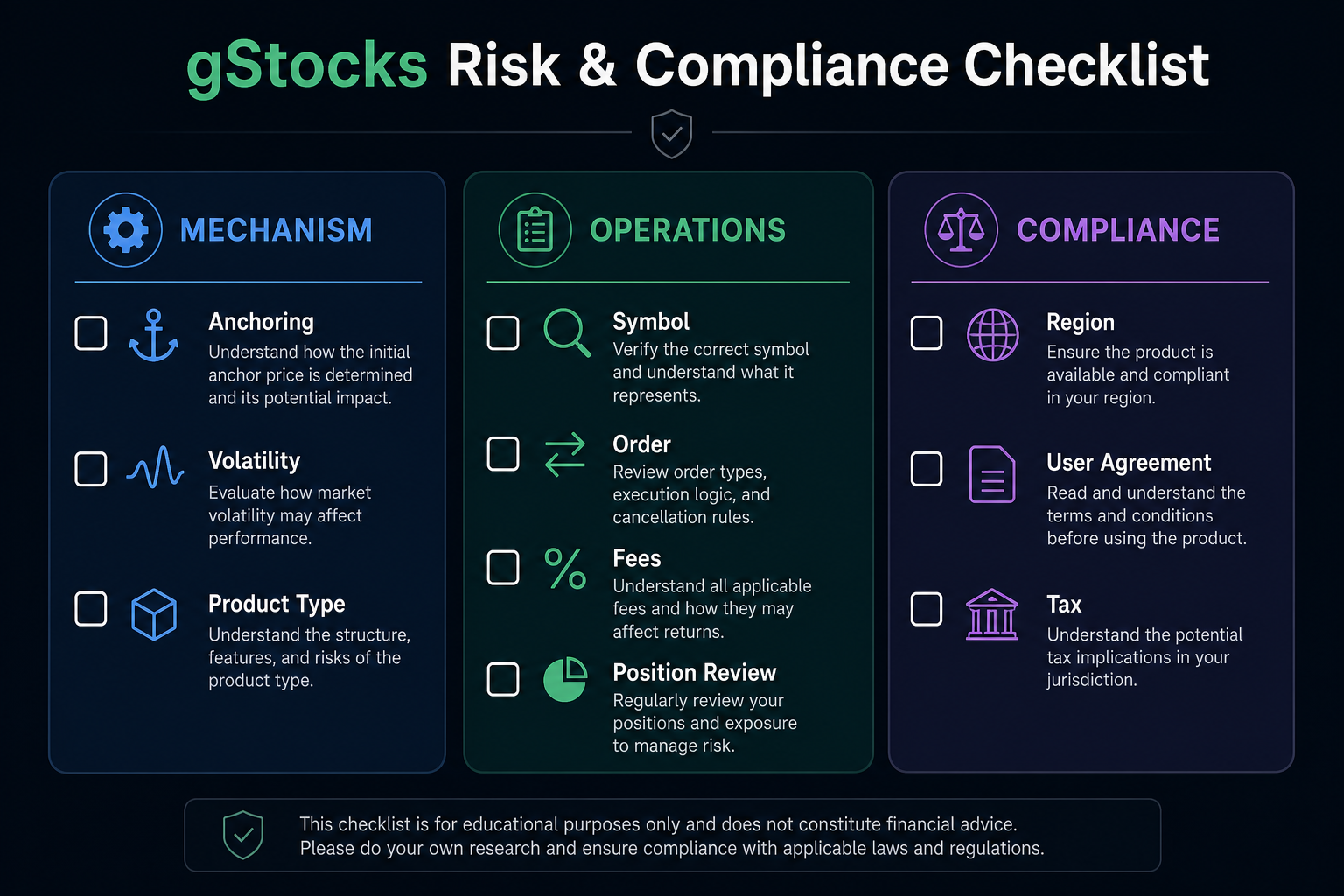
Figure 1. gStocks risk and compliance boundary checklist: mechanism, operation, and regional availability.
What Are the Compliance and Service Availability Boundaries?
The Gate User Agreement specifies that the platform may restrict or prohibit all or part of its services in certain regions. gStocks, as a Gate tokenized stock product, are subject to this framework. Users must verify whether their jurisdiction is eligible for service and whether specific identity verification or disclosure is required.
Compliance boundaries also include whether the product is permitted for retail users under local regulations; tax obligations (such as dividends or capital gains) are the user's responsibility and should be discussed with a professional advisor; anti-money laundering (AML) and know your customer (KYC) requirements may affect account features and limits.
Service availability is determined by Gate’s latest User Agreement, risk alerts, and official announcements—not by third-party interpretations. If your account indicates regional restrictions or unavailable features, the platform’s official guidance takes precedence.
What Are the Rights and Responsibilities for Tokenized Holdings?
gStocks tokenized holdings do not automatically confer all the rights of traditional stock ownership. Dividends may be settled automatically, but governance rights such as voting, shareholder meeting participation, and tender offer responses depend on Gate product details and underlying asset rules.
On responsibilities: Users must safeguard account credentials, enable two-factor authentication (2FA), and beware of phishing and fraudulent websites. The platform discloses reserve principles, and users monitor their holdings via account reconciliation; losses caused by operational mistakes or account theft are handled according to the User Agreement.
See gStocks vs Traditional Stocks vs CFD for a comparison of rights between gStocks and registered stocks, preventing tokenized positions from being mistaken for full shareholder status.
What Should You Check Before Trading?
Mechanism Checklist: Do you understand 1:1 anchoring? Are you aware that anchoring does not eliminate price volatility? Can you distinguish gStocks from CFDs and traditional stocks?
Operational Checklist: Is your account KYC complete and regionally eligible? Is your available USDT balance sufficient? Are asset codes and names accurate? Have you confirmed order types and estimated fees? Did you review your position after execution?
Compliance Checklist: Have you read the User Agreement and risk alerts? Is gStocks usage allowed in your region? Are you familiar with local tax and reporting obligations?
| Checklist Stage |
Key Questions |
Reference Resources |
| Mechanism |
Anchoring, conversion, dividend rules |
Pillar, Anchoring Mechanism Cluster |
| Operation |
Funds, codes, orders, review |
Trading Process Cluster |
| Compliance |
Region, agreement, taxes |
User Agreement, Announcements |
Repeat these checklists before every position increase or when trying new features. The Gate gStocks trading process covers operational details; mechanism and compliance boundaries require separate review.
Summary
gStocks risk and compliance boundaries include market volatility, liquidity variation, regulatory constraints, operational errors, and regional availability. Features like 1:1 anchoring, unified account management, and automatic dividends enhance user experience and asset mapping, but do not remove risk. Completing mechanism, operation, and compliance checklists before trading helps prevent mistaking product advantages for risk-free guarantees and ensures tokenized securities are used within regulatory guidelines.
FAQ
In Which Regions Is gStocks Unavailable?
The Gate User Agreement may restrict or prohibit all or part of its services in certain regions. The specific list is determined by Gate’s latest User Agreement, risk alerts, and official announcements; users must check before using.
Does 1:1 Anchoring Mean No Losses?
No. Anchoring ensures tokens match real stock reserves, but if the underlying stock price declines, gStocks market value will fluctuate. Anchoring solves asset mapping, not market risk elimination.
What Rights Do gStocks Holders Have? Is It the Same as Buying Stocks Directly?
Dividends may be settled automatically, but full governance rights like voting depend on product terms. Rights may differ from traditional registered stocks; review product details and gStocks vs Traditional Stocks vs CFD for comparison.
What Is Most Important to Confirm Before Trading gStocks?
Key points: anchoring and product mechanism, account and regional eligibility, asset code and order parameters, post-trade position review, User Agreement and risk alerts. These five form the basic checklist.
Are Planned Features (Bidirectional Conversion, Multi-Chain) Already Available?
Bidirectional conversion and multi-chain expansion are governed by the actual launch status on the Gate product page and announcements. “Coming soon” indicates a development direction; confirm feature availability before use.