gStocks, traditional stocks, and CFDs are three distinct methods for gaining stock market exposure. gStocks are tokenized securities backed 1:1 by actual stocks held in reserve, traditional stocks are registered holdings in a broker account, and CFDs are derivative contracts that track the price of the underlying asset.
The gStocks tokenized securities article defines the product’s positioning. By comparing these three approaches across five dimensions—definition, trading mechanism, cost structure, applicable scenarios, and risk boundaries—investors can build a clear, structured understanding without making value judgments.
What is gStocks?
gStocks are tokenized securities introduced by Gate, fully backed on a 1:1 basis by underlying native stocks, and traded through the platform’s order book. Users hold tokenized units tied to specific listed stocks, allowing them to manage these alongside crypto assets in a unified account. Dividends are automatically calculated and distributed by the system.
The core advantage of gStocks is the combination of real-stock reserve anchoring and a digital asset trading experience. Entry thresholds are as low as about 1 USDT, with support for fractional shares and Auto Invest. The order book model is tailored to the trading habits of crypto users. For more details on the underlying reserve structure, see gStocks 1:1 Backing and Conversion.
What are traditional stocks?
Traditional stocks refer to registered securities listed on exchanges and traded through licensed broker accounts. Investors purchase stocks via their broker, becoming shareholders (in proportion to holdings) and are entitled to dividends, voting, and other shareholder rights, subject to company bylaws and regulatory requirements. Trading hours, settlement cycles, and fee structures are determined by the relevant market and broker.
Traditional stocks offer a mature rights framework, clear regulatory oversight, and well-established paths for long-term holding and governance participation. Entry thresholds and rules for fractional shares vary by market and broker: some U.S. brokers support fractional shares, while Hong Kong and Korean stocks may have minimum trading units. Funds are typically denominated in fiat or broker-supported currencies.
What is a CFD?
A Contract for Difference (CFD) is a derivative product where users and brokers agree to exchange the difference between the opening and closing prices of an underlying asset, without actually owning the stock. CFDs generally offer leverage, bidirectional trading (long and short), and extended trading hours, but users do not receive shareholder rights such as dividends or voting (as specified by broker terms).
CFDs allow investors to gain price exposure with less capital, support short selling, and offer flexible leverage. Risks include amplified losses due to leverage, overnight fees, counterparty risk, and varying rules. Unlike gStocks, which are backed by actual stocks, CFDs provide only contractual exposure to price movements.
Table: Key Differences Among the Three Pathways
| Dimension |
gStocks |
Traditional Stocks |
CFD |
| Underlying Form |
Tokenized unit + 1:1 real-stock reserve |
Broker-registered stock holding |
CFD contract exposure |
| Trading Venue |
Gate order book |
Stock exchange / broker |
CFD broker platform |
| Real-stock Reserve |
Yes, 1:1 mapped |
Direct holding |
No |
| Shareholder Rights |
As per product terms |
Full shareholder rights system |
Usually none |
| Dividends |
System auto-settlement |
Per market rules |
Usually not applicable |
| Leverage |
Via unified account extension |
Margin financing (broker-dependent) |
Typically built-in |
| Short Selling |
Per product rules |
Margin or derivatives |
Usually supported |
| Trading Threshold |
Approx. 1 USDT, fractional shares |
Market and broker dependent |
Broker dependent |
| Trading Hours |
24/7 (platform rules) |
Exchange trading hours |
Often extended |
| Main Risks |
Volatility, liquidity, rule changes |
Volatility, liquidity, governance |
Leverage, counterparty, overnight fees |
This table compares the three approaches across ten key dimensions. When making a choice, consider capital size, rights requirements, trading habits, and risk tolerance—there is no single best solution.
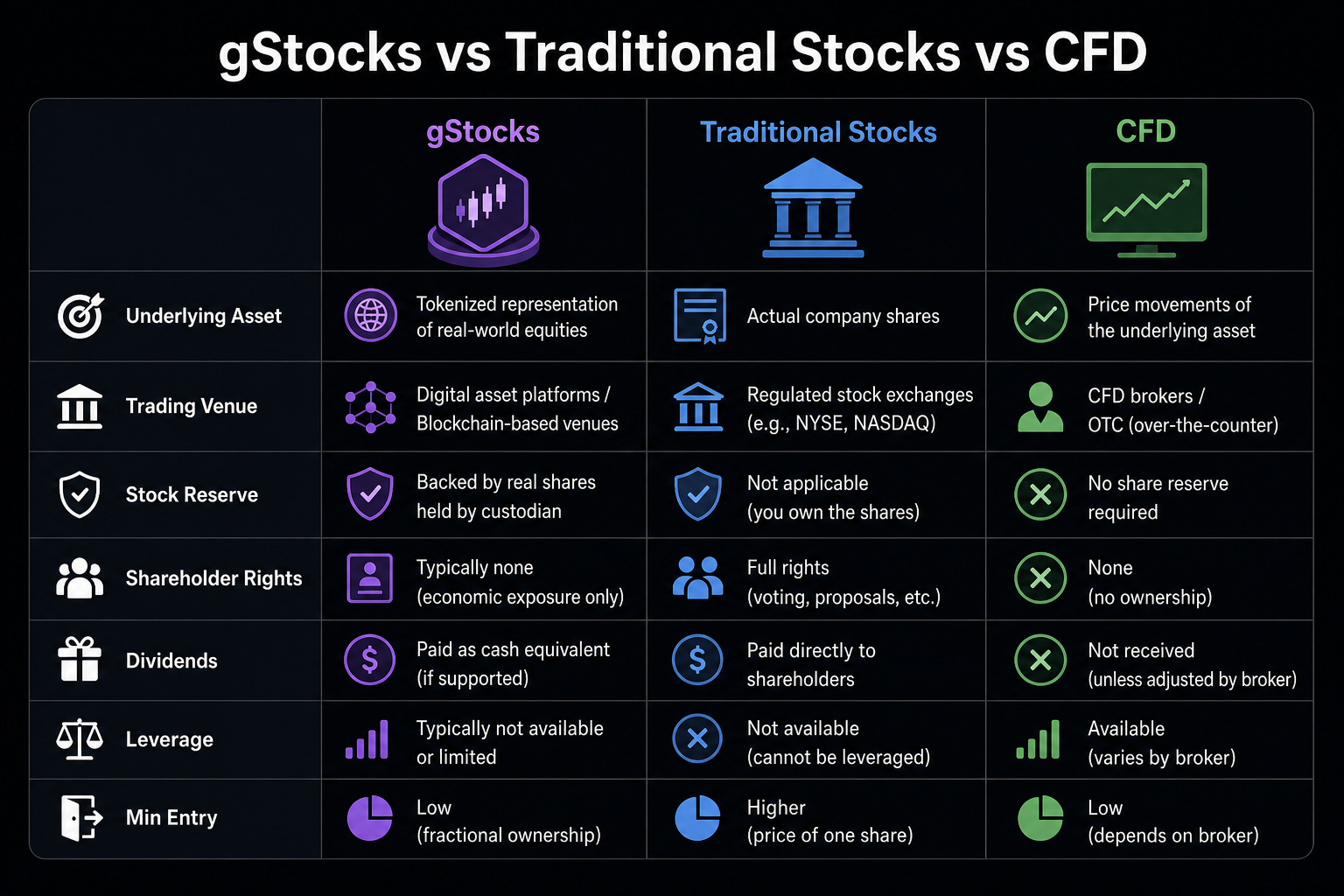
Comparison of the core differences among gStocks, traditional stocks, and CFDs.
How do trading mechanisms and cost structures differ?
gStocks use order book matching and Gate’s tokenized stock fee schedule. Funds are managed in a unified account with crypto assets, resulting in lower fund transfer costs. Traditional stocks incur commissions, stamp duties (market dependent), custody fees, and more, with settlement cycles based on market (e.g., T+1, T+2). CFDs typically involve spreads, overnight holding fees, and leverage financing costs, with no actual stock delivery.
Cost comparison should consider more than just explicit fees: liquidity depth, slippage, capital lock-up, and opportunity costs all impact the true cost of trading. gStocks can integrate with tools like Simple Earn within the Gate ecosystem, traditional stocks may be financed via brokers, and CFD leverage costs require separate calculation.
Which scenarios are suitable for each? What are the risk boundaries?
gStocks are suitable for: Users who already hold crypto assets on Gate and want to add stock exposure in a unified account; those who need fractional shares and low entry barriers; and users who prefer order book trading and digital asset operations. Risk boundaries include misperceptions of the token’s peg, liquidity differences, and regional service restrictions. See gStocks Risk and Compliance Boundaries.
Traditional stocks are suitable for: Investors seeking full shareholder rights and regulatory protection, long-term holders participating in corporate governance, and those accessing specific markets via local brokers. Risks include market volatility, individual stock fundamentals, currency fluctuations (for cross-border investments), and broker creditworthiness.
CFDs are suitable for: Investors seeking leverage or short selling to express market views, those who want extended trading hours, and those not seeking shareholder rights. Risks include amplified losses due to leverage, accumulation of overnight fees, counterparty risk, and regulatory differences.
These pathways can be combined within a single portfolio, but it is essential not to confuse the nature of holdings and associated rights. The Gate gStocks Trading Process provides step-by-step instructions for placing tokenized securities orders on Gate.
Summary
gStocks, traditional stocks, and CFDs represent three distinct frameworks: real-stock-backed tokenization, registered securities holdings, and contract-based price exposure. The key differences lie in the underlying asset, rights, trading mechanism, and risk structure. Before choosing, clarify whether you need tokenized exposure mapped to actual stocks, traditional holdings with full shareholder rights, or leveraged price contracts—these are not interchangeable and must be matched to your investment scenario.
FAQ
How are gStocks different from directly buying stocks?
gStocks are tokenized securities traded on the Gate order book, with a 1:1 real-stock reserve; traditional stocks are registered holdings purchased through brokers on the securities market. Account structures, rights, and trading rules differ—gStocks are more aligned with digital asset trading habits.
How do gStocks differ from CFDs?
gStocks are anchored to real stocks on a 1:1 basis, with the underlying asset mapped to the actual stock; CFDs are contracts for difference, generally not holding the underlying stock and not providing shareholder rights. CFDs typically include built-in leverage and short selling, while gStocks focus on real-stock mapping and unified account management.
Which option has the lowest barrier to entry?
gStocks have an entry threshold as low as about 1 USDT and support fractional shares; the minimums for traditional stocks and CFDs vary by broker, market, and contract rules. A low entry threshold does not mean low risk—volatility and rule constraints must also be considered.
Can gStocks earn dividends?
Dividends from gStocks holdings are automatically settled and distributed by the system. Traditional stocks pay dividends according to market and broker rules; CFDs typically do not pay shareholder dividends. Dividend policies are subject to each product’s terms.
Should I choose gStocks, traditional stocks, or CFDs?
It depends on your needs: choose gStocks for unified account stock exposure, traditional stocks for full shareholder rights and regulatory protection, and CFDs for leveraged short selling and expressing market views. The frameworks differ fundamentally and are not directly comparable in terms of superiority.