As modular blockchains, Layer 2 solutions, and cross-chain applications continue to evolve, chain abstraction is emerging as a key frontier in the next wave of infrastructure competition. Heima and Particle Network are two representative approaches in this space. While they share similar goals, their underlying architectures, implementation logic, and ecosystem strategies differ significantly, which is why they are often compared side by side.
What Is Heima?
Heima is positioned more as a cross-chain coordination network.
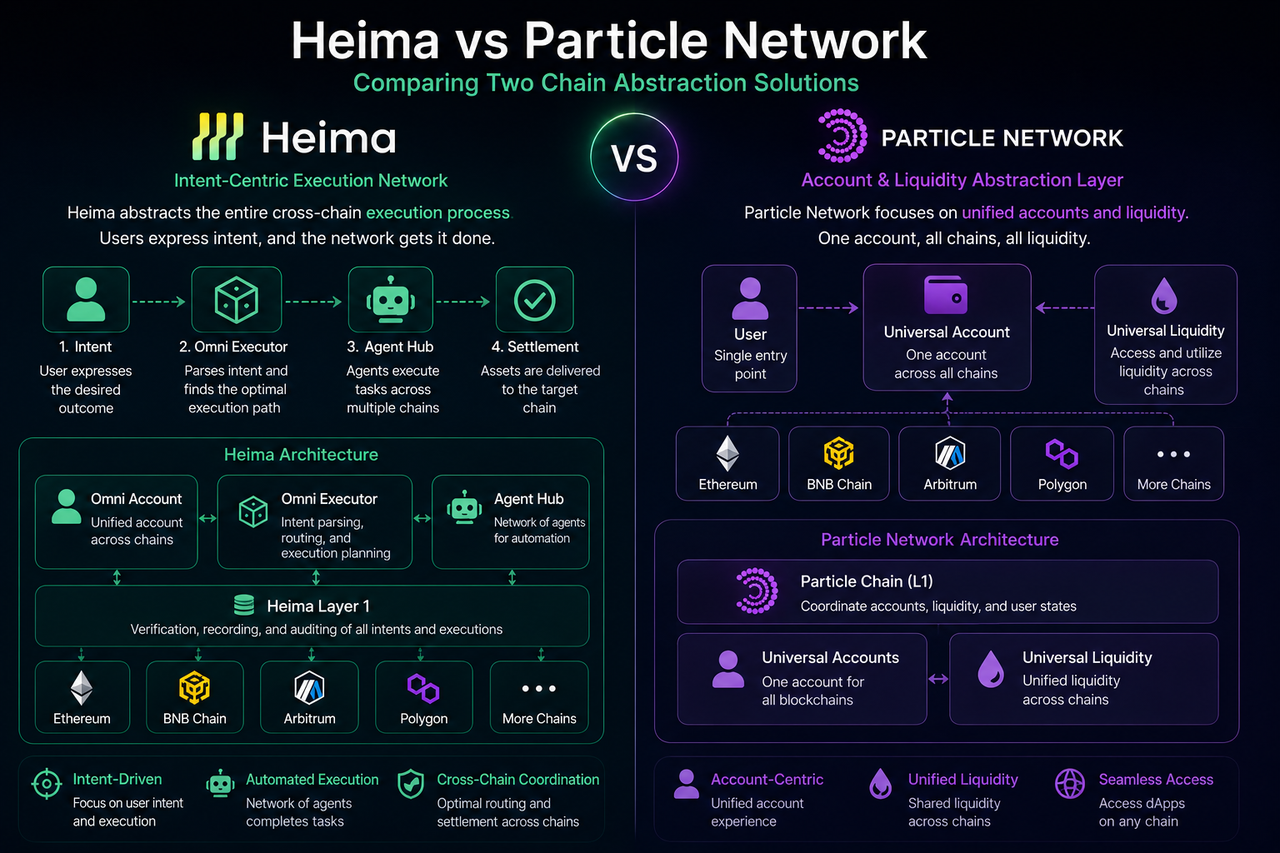
Heima aims to build a unified chain abstraction infrastructure, connecting multiple blockchains into a single execution environment through Omni Account, Omni Executor, Agent Hub, and Heima Layer 1. Users don't need to worry about which chain their assets are on or plan cross-chain steps themselves. Instead, they simply submit their end goal, and the network automatically handles execution.
In the Heima architecture, Intent is the core interaction method. Users express the outcome they want to achieve, and the underlying system automatically manages execution paths, liquidity scheduling, gas payments, and cross-chain settlement.
This design emphasizes Heima's role as an “automation execution layer” and “cross-chain coordination layer.”

What Is Particle Network?
Particle Network is positioned more as a unified account infrastructure.
Particle Network delivers a chain abstraction experience through Universal Accounts and Universal Liquidity, enabling users to use a single account and a unified set of asset balances across multiple blockchains.
In the Particle Network architecture, users can access applications on different networks without switching wallet addresses. Account status and asset management are abstracted into a unified layer, making the user experience closer to that of a traditional internet account system.
Compared to execution coordination, Particle Network focuses more on account abstraction, identity management, and liquidity unification.

What Is the Core Difference Between the Two?
The biggest difference between Heima and Particle Network lies in what they abstract.
Particle Network primarily abstracts the account and liquidity layers, focusing on solving the problem of how users manage multi-chain identities and assets.
Heima abstracts not only accounts and assets but also the execution process itself, focusing on how users complete cross-chain tasks.
In other words, Particle Network is more concerned with a unified entry point, while Heima is more concerned with unified execution.
How Do Their Account Systems Differ?
The account system is a core component of chain abstraction architecture.
Particle Network uses Universal Accounts as its foundation, mapping accounts across multiple blockchains into a unified identity. Users can access applications on different chains with a single account and enjoy a consistent interaction experience.
Heima adopts the Omni Account model. The Omni Account not only handles identity management but is also deeply integrated with the Intent system and execution network, enabling the account to directly trigger cross-chain execution tasks.
Therefore, although both provide a unified account experience, Heima's account leans more toward an execution entry point, while Particle Network's account leans more toward an identity entry point.
How Do Their Execution Mechanisms Differ?
Execution mechanism is the area where the two solutions differ most.
Particle Network's core logic allows users to access multi-chain liquidity through a unified account. Most cross-chain interactions still rely on the underlying liquidity network and account system for coordination.
Heima, on the other hand, builds an execution network around an Intent-Centric architecture. When a user submits a goal, the Omni Executor automatically breaks down the task, plans the path, and coordinates execution nodes to complete the operation.
This means Heima emphasizes task execution automation, while Particle Network emphasizes account abstraction and access unification.
Particle Network's Execution Logic
Particle Network enables asset access through Universal Liquidity.
Users can use asset balances distributed across different networks without manual cross-chain steps, but the core goal remains improving asset accessibility and liquidity efficiency.
Heima's Execution Logic
Heima converts user requests into Intents.
The Omni Executor then generates an execution path and coordinates agent nodes through the Agent Hub to complete trades, swaps, bridging, or other on-chain tasks.
Thus, Heima's abstraction layer covers a broader scope.
How Do Their Liquidity Management Approaches Differ?
Liquidity coordination is a key capability for chain abstraction systems.
Particle Network tends to build a unified liquidity layer, allowing users to share asset states across different networks. The focus is on reducing asset silos and improving capital efficiency.
Heima also integrates cross-chain liquidity, but its liquidity design primarily serves Intent execution. The system dynamically finds the best execution path based on the user's goal and coordinates liquidity from different sources to complete the task.
Therefore, Particle Network emphasizes liquidity unification, while Heima emphasizes liquidity orchestration.
How Do Their Network Architectures Differ?
Particle Network is building Particle Chain as the coordination layer for Universal Accounts and Universal Liquidity.
The main responsibility of Particle Chain is to synchronize account states, coordinate asset management, and maintain a unified user experience.
Heima, on the other hand, builds Heima Layer 1 and constructs the Omni Executor and Agent Hub network around it.
Heima Layer 1 not only handles verification but also records the Intent lifecycle, execution paths, and cross-chain settlement information. Thus, Heima Layer 1 is more like a cross-chain execution coordination hub.
How Do Their Use Cases Differ?
The two solutions have some overlap in application scenarios but with different emphases.
Particle Network is better suited for applications that need a unified account system and unified liquidity management, such as wallets, social protocols, chain abstraction entry platforms, and multi-chain DeFi applications.
Heima is better suited for scenarios that require complex cross-chain execution capabilities, such as cross-chain trade aggregation, automated strategy execution, multi-chain DeFi operations, and AI agent-driven on-chain task systems.
From an application layer perspective, Particle Network is more like account infrastructure, while Heima is more like execution infrastructure.
Heima vs. Particle Network Comparison Table
| Comparison Dimension |
Heima |
Particle Network |
| Core Positioning |
Cross-Chain Coordination Network |
Unified Account Infrastructure |
| Primary Goal |
Abstract Execution Process |
Abstract Accounts and Liquidity |
| Account System |
Omni Account |
Universal Accounts |
| Execution Model |
Intent-Driven Execution |
Account-Driven Interaction |
| Liquidity Strategy |
Dynamic Liquidity Orchestration |
Universal Liquidity |
| Execution Layer |
Omni Executor + Agent Hub |
Universal Account Layer |
| Network Layer |
Heima Layer 1 |
Particle Chain |
| Key Use Cases |
Cross-Chain Automated Execution |
Multi-Chain Unified Account Experience |
Summary
Heima and Particle Network are both key players in the chain abstraction track, but they have chosen different development directions.
Particle Network's core goal is to build a unified account experience through Universal Accounts and Universal Liquidity, making it easier for users to manage multi-chain identities and assets. Heima goes a step further by extending into the execution layer, building an automated cross-chain coordination network through Intents, Omni Executor, and Agent Hub, allowing users to directly express their goals while the system handles execution.
From a technical roadmap perspective, Particle Network focuses more on account abstraction and liquidity unification, while Heima focuses more on intent-driven execution and cross-chain automated coordination. The two solutions are not simply competitors; rather, they cover different infrastructure layers within the chain abstraction ecosystem.
FAQs
Are Heima and Particle Network Both Chain Abstraction Projects?
Yes. Both Heima and Particle Network are chain abstraction infrastructure projects with the goal of reducing complexity in multi-chain environments, but they use different technical implementation paths.
What Is the Biggest Difference Between Heima and Particle Network?
Heima primarily abstracts the cross-chain execution process, automatically completing tasks through Intents and an execution network. Particle Network primarily abstracts accounts and liquidity, providing a unified user entry point through Universal Accounts.
What Are Universal Accounts in Particle Network?
Universal Accounts are Particle Network's unified account system. Users can access multiple blockchains and applications with a single account without frequently switching wallets or managing multiple addresses.
What Is the Role of Heima's Omni Executor?
The Omni Executor is Heima's core execution engine, responsible for parsing user Intents, planning execution paths, coordinating liquidity, and completing cross-chain task execution.
Which Solution Is More Suitable for Cross-Chain Automation?
Based on architectural design, Heima emphasizes automated execution and task coordination, making it more suitable for complex cross-chain trades, automated strategies, and agent-driven application scenarios.
Can Particle Network and Heima Coexist?
Yes. Particle Network primarily solves the unified account problem, while Heima primarily solves the cross-chain execution problem. They cover different layers of the chain abstraction ecosystem and thus have the potential for synergistic development.







