As blockchain applications continue to develop, access to on-chain data has become a core need within the Web3 ecosystem. Whether an application is checking wallet balances, reading NFT data, broadcasting on-chain transactions, or updating the status of a DeFi protocol, it ultimately depends on continuous communication between the application and blockchain nodes. In the early days, developers usually had to run full nodes themselves and maintain databases, servers, and indexing systems, which increased both development costs and operational complexity.
In today’s Web3 infrastructure sector, the core value of Alchemy lies in helping developers access multiple blockchain networks through a unified API, while improving on-chain data retrieval efficiency through data indexing, caching systems, and enhanced interfaces.
What Is Alchemy API?
As a set of blockchain development interfaces provided by Alchemy, Alchemy API helps applications read on-chain data, send transactions, and monitor blockchain events.
From a technical perspective, Alchemy API is essentially a middle layer between DApps and blockchain nodes. Developers do not need to directly maintain Ethereum, Polygon, or Solana nodes. Instead, they interact with blockchains through the API endpoints provided by Alchemy.
Its main supported functions include:
-
Querying wallet balances
-
Retrieving NFT data
-
Checking transaction status
-
Broadcasting on-chain transactions
-
Monitoring on-chain events
-
Retrieving block and log data
The goal of Alchemy API is not just “node access.” It also includes structuring on-chain data so developers can build Web3 applications more easily.
What Is an RPC Request?
RPC, or Remote Procedure Call, is the core method Web3 applications use to access blockchain nodes.
When a user opens a wallet or DApp, the frontend application usually sends requests to an RPC node. For example:
Common Ethereum RPC methods include:
| RPC Method |
Function |
| eth_blockNumber |
Gets the latest block height |
| eth_getBalance |
Queries an account balance |
| eth_call |
Calls a smart contract |
| eth_sendRawTransaction |
Broadcasts a transaction |
| eth_getLogs |
Retrieves on-chain logs |
One of Alchemy’s core functions is to receive these RPC requests and forward them to the corresponding blockchain network.
How Does a User Request Enter Alchemy?
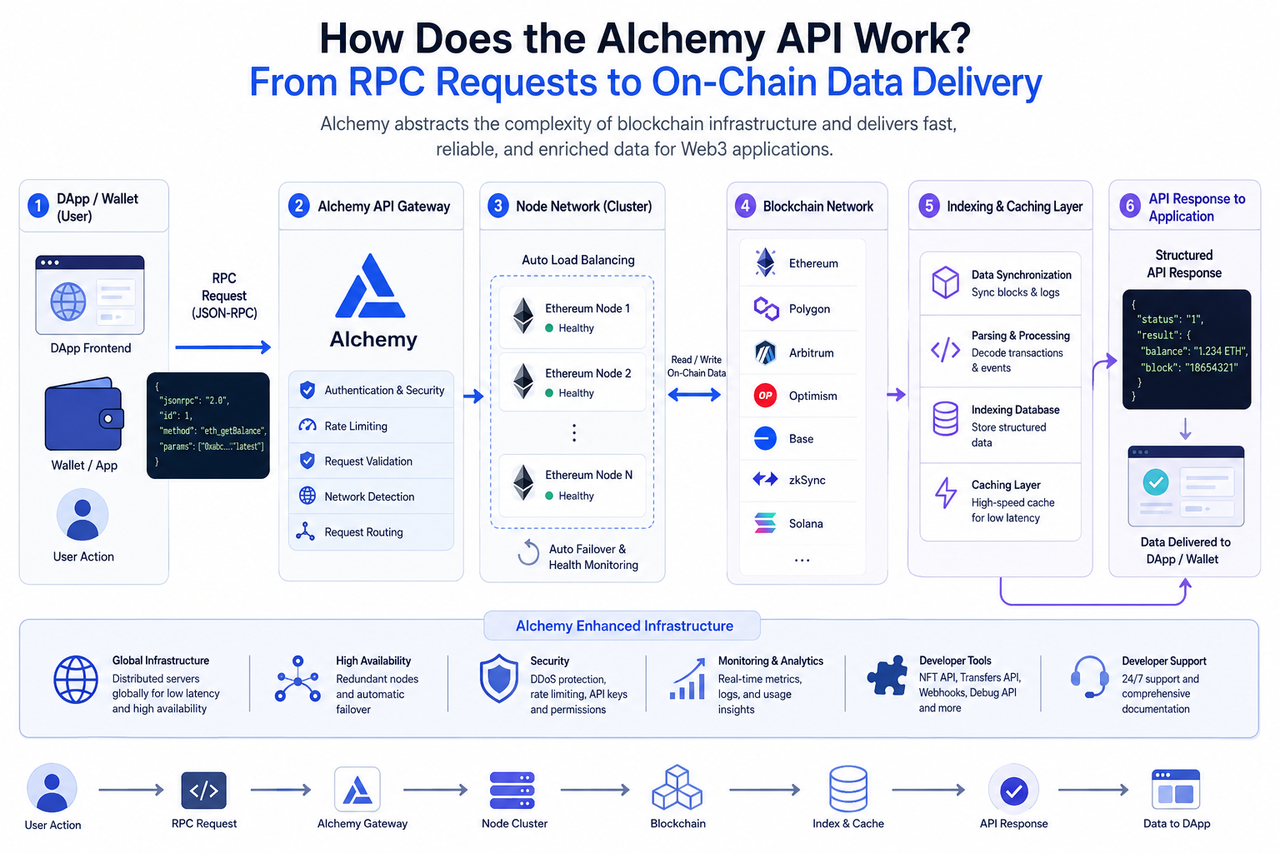
When a user opens a DApp, the request usually follows this flow:
-
The user interacts with the front-end application
-
The frontend sends an RPC request through an SDK or API
-
The request enters the Alchemy API Gateway
-
The system identifies the corresponding blockchain network
-
The request is routed to the appropriate node cluster
-
The node reads on-chain data
-
The data is returned to the application frontend
This process is essentially similar to the traditional internet model of “client → cloud server → database.”
Alchemy handles request management, node load balancing, data processing, and other work in the middle.
How Does Alchemy’s Node System Work?
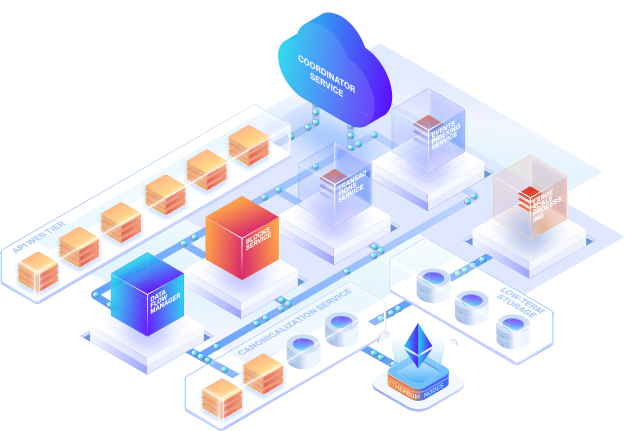
Alchemy runs a large number of distributed nodes on the backend to connect to different blockchain networks.
Unlike a developer running a single node independently, Alchemy usually uses:
This structure helps reduce the risk of node outages and improves API response speed.
For example, if an Ethereum node falls out of sync, the system can automatically switch to another available node, preventing an API service interruption.
This is also one of the key reasons why large Web3 applications often rely on professional infrastructure platforms.
How Do On-Chain Data Indexing and Caching Work?
Raw blockchain data is usually not suitable for direct querying.
For example, if an NFT marketplace had to scan NFT transfer data block by block directly from the chain, the process would be highly inefficient. For this reason, Alchemy indexes and caches on-chain data in advance.
Its core process includes:
-
Nodes synchronize on-chain data
-
The system parses blocks and logs
-
Data enters an index database
-
APIs read data from the index layer
-
Structured results are returned
This model is similar to a search engine’s webpage index.
Through data indexing, Alchemy can provide higher-level APIs, such as:
Compared with raw RPC queries, this approach is more efficient and better suited to commercial-grade Web3 applications.
How Do NFT API and Transfers API Work?
Alchemy’s enhanced APIs are one of the main features that distinguish it from traditional RPC providers.
NFT API
NFT API indexes NFT contracts and metadata in advance, allowing it to quickly return:
-
NFT images
-
NFT attributes
-
Holder addresses
-
NFT rarity
-
Collection information
Traditional nodes usually cannot directly return this kind of structured data.
Transfers API
Transfers API is used to track asset transfer records for tokens and NFTs.
For example, when a user checks wallet history, Alchemy will:
-
Scan on-chain Transfer Events
-
Parse the token type
-
Organize timeline data
-
Return structured transaction records
These APIs are widely used in wallets, block explorers, and asset management platforms.
How Do Webhooks Enable Real-Time Notifications?
Webhooks are Alchemy’s on-chain event notification system.
If a traditional application wants to monitor on-chain events, it usually needs to keep polling nodes, but this approach consumes substantial resources.
The typical workflow of Alchemy Webhooks includes:
-
The developer sets monitoring conditions
-
The system continuously monitors on-chain data
-
A specific event triggers a notification
-
Data is automatically pushed to the server
Supported monitoring scenarios include:
This mechanism helps applications deliver real-time updates.
How Is Alchemy API Different from Traditional Nodes?
Alchemy is not just a standard RPC node provider. Its core advantage lies in enhanced development infrastructure.
| Comparison Dimension |
Traditional Nodes |
Alchemy API |
| Data access |
Raw on-chain data |
Structured APIs |
| NFT support |
Limited |
Relatively complete |
| Data indexing |
Must be built by the developer |
Provided by the platform |
| Real-time notifications |
Must be developed independently |
Supported through Webhooks |
| Multichain compatibility |
Maintained manually |
Unified interface |
| Operational cost |
Relatively high |
Relatively low |
As a result, Alchemy is closer to a “Web3 development platform” than simply a node service.
Summary
As a core part of today’s Web3 infrastructure, Alchemy API mainly helps DApps, wallets, and on-chain applications access blockchain data and send transactions.
From RPC requests entering the API Gateway, to nodes reading on-chain data, and then to indexed processing and structured API responses, Alchemy completes a large amount of infrastructure work in the background. Compared with traditional node access models, it improves data retrieval efficiency and the development experience for Web3 applications through caching, indexing, and enhanced APIs.
FAQs
What Is Alchemy API?
Alchemy API is a developer interface that helps Web3 applications access blockchain data and send transactions.
What Does an RPC Request Mean?
An RPC request is a data call that an application sends to a blockchain node to read on-chain data or broadcast transactions.
Why Do DApps Need Alchemy?
Alchemy helps DApps avoid running their own nodes, reducing development and operational complexity.
Which Blockchains Does Alchemy API Support?
Alchemy supports multiple networks, including Ethereum, Polygon, Arbitrum, Optimism, Base, zkSync, and Solana.
How Is NFT API Different from Regular RPC?
NFT API indexes NFT data in advance, allowing it to return more complete and structured NFT information.
What Do Webhooks Do?
Webhooks can automatically send real-time notifications when on-chain events occur, such as NFT transfers or transaction confirmations.