One of Ethereum’s most significant breakthroughs is the integration of smart contracts into the blockchain, empowering developers to deploy automated programs without relying on centralized servers. Traditionally, internet applications have depended on corporate servers, but Ethereum leverages a global network of nodes to maintain a public computing environment, enabling anyone to verify how programs execute.
This paradigm has enabled the emergence of DeFi, NFTs, DAOs, and other innovative applications, forming the foundation of the Web3 ecosystem. Yet, as blockchain applications reach new levels of maturity, a critical question is emerging: can the fully transparent smart contract model address the increasingly complex commercial needs of the future?
At present, most Ethereum smart contract code is open-source. Users can review the rules, and developers can verify security, but this also means that a protocol’s internal logic is entirely exposed. As a result, trading strategies, business models, and innovative mechanisms are susceptible to replication by competitors.
While transparency is advantageous for simple applications, for complex financial products, enterprise solutions, and AI services, the program logic itself often constitutes the most valuable asset.
Obfuscation technology has attracted considerable attention in this context. It seeks to resolve a longstanding Ethereum dilemma: how to enable smart contracts to protect their core logic while retaining decentralized verification.
Why Ethereum Smart Contracts Require Enhanced Privacy Capabilities
Ethereum’s smart contract architecture is fundamentally rooted in openness. Any user can inspect contract code, track the movement of funds, and verify that protocols operate as intended. This transparency reduces trust costs and eliminates dependence on traditional financial institutions or centralized platforms.
However, as Ethereum applications evolve from experimental projects to sophisticated financial and business use cases, the transparent model is revealing its limitations.
For instance, a DeFi protocol might develop a unique liquidity management algorithm. If the code is fully public, other projects can quickly replicate similar mechanisms. A trading protocol may implement optimized execution strategies, but public code allows arbitrageurs to analyze and exploit these strategies in advance.
In traditional financial markets, trading models, risk management systems, and investment strategies are often core competitive advantages. The public blockchain’s requirement for full transparency creates a natural conflict with this reality.
Consequently, Ethereum’s future demands not only faster transactions and lower costs, but also more flexible privacy-preserving computation.
Obfuscation introduces a new approach: allowing smart contracts to operate on public networks without exposing all internal logic.
The Limitations of Public and Transparent Smart Contracts
Smart contract transparency is central to Ethereum’s trust model. Users can audit code, developers can perform security reviews, and the community can monitor protocol operations. This structure prevents centralized platforms from unilaterally changing the rules. However, public transparency also exposes all information to competitive threats.
For DeFi, one of the most significant consequences is strategy leakage. For example, a protocol may implement a sophisticated automated trading algorithm. Once the code is deployed on-chain, other participants can reverse-engineer the logic, seek arbitrage opportunities, or even clone the entire mechanism.
Moreover, public code increases the risk of attacks. Hackers can scrutinize smart contract structures in search of vulnerabilities. While security audits mitigate some risks, a fully open environment gives attackers equal access to information.
The challenge is even greater for enterprise users. Many traditional companies seek to leverage blockchain for transparency and efficiency, but are unwilling to disclose internal business rules. Examples include:
- Financial institutions unwilling to expose risk models;
- Supply chain enterprises seeking to conceal business processes;
- AI companies protecting proprietary model logic.
If Ethereum is to serve as a broader commercial infrastructure, it must reconcile the tension between transparency and privacy.
How Obfuscation Enables “Executable but Unreadable” Smart Contracts
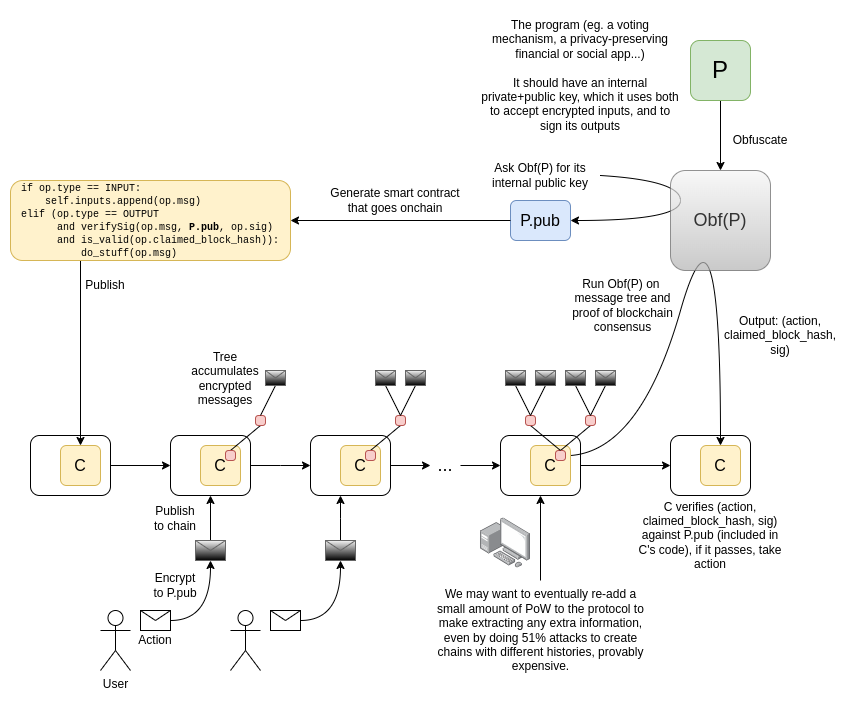
Image source: https://vitalik.eth.limo/general/2026/06/29/obfuscation1.html
Obfuscation fundamentally transforms how programs are disclosed.
Traditional smart contracts: code is public → nodes execute → users verify results. In this model, all participants can see the program logic.
The Core Value of Obfuscation
With obfuscation, smart contracts could follow a different model: obfuscated program → nodes execute → users receive results, but cannot discern the internal logic.
Essentially, the program still exists and can be invoked, but its core rules are concealed.
This is distinct from data encryption. Encryption protects information such as transaction amounts or identity data; obfuscation protects the program itself. For Ethereum, this means smart contracts could one day provide commercial protection similar to traditional software. Developers could build complex protocols without fear of their core innovations being directly copied. Importantly, this does not eliminate blockchain’s verification capabilities. Future privacy smart contracts will still require additional cryptographic tools, such as zero-knowledge proofs (ZKP), to demonstrate that execution results adhere to the rules.
As a result, a new smart contract paradigm could emerge:
- Code logic remains private;
- Execution results remain verifiable;
- The system stays decentralized.
The Impact of Private Smart Contracts on the DeFi Ecosystem
DeFi stands out as the most promising field for obfuscation. Over the past few years, DeFi’s growth has been fueled by open innovation. Anyone can audit code, provide liquidity, and develop new financial products based on public rules.
However, as the ecosystem matures, complete openness introduces competitive pressures. If obfuscation technology reaches maturity, DeFi protocols could gain greater design flexibility.
For example: trading strategies could be concealed, reducing the risk of replication; complex financial models could operate on-chain; and institutional-grade products could enter decentralized markets. This evolution could propel DeFi from simple open protocols toward more advanced financial infrastructure. Many traditional financial institutions remain cautious about blockchain, largely due to concerns over protecting trade secrets. If smart contracts can hide core logic while ensuring trustworthy execution, it could lower the barrier for enterprises to enter Web3.
Nevertheless, enhanced privacy also introduces new challenges. Blockchain’s trust model has always relied on transparency, so future systems must balance privacy, regulatory demands, and public verification.
How Obfuscation Drives Enterprise Blockchain Adoption
A major barrier to enterprise blockchain adoption is safeguarding data and business logic. While public chains provide transparency and openness, many enterprises are unwilling to fully expose core information.
- In supply chain management, companies may want to verify goods flow, but not reveal supplier pricing or business contracts;
- In finance, institutions may seek improved settlement efficiency without exposing trading strategies;
- In AI, companies may wish to enable on-chain model participation without disclosing model parameters.
Obfuscation could become a pivotal technology bridging public blockchains and enterprise requirements. It enables enterprises to benefit from blockchain’s security and decentralization while protecting their core assets. This could broaden Ethereum’s applicability, making previously unviable business scenarios possible on public chains.
Building Future Privacy Infrastructure with Obfuscation and ZK Technology
While obfuscation holds tremendous promise, it is not a substitute for other cryptographic approaches. Ethereum’s future privacy architecture will likely require a combination of technologies.
Zero-knowledge proofs are designed to prove that a computational result is correct.
Obfuscation, by contrast, protects the computational process and program logic itself. Together, they provide a more comprehensive privacy smart contract system. For example, a DeFi protocol could conceal its trading strategy while using ZK proofs to demonstrate honest execution to users.
This approach could become a cornerstone of future Web3 applications. Ethereum would no longer have to choose between transparency and privacy, but could achieve nuanced control via advanced cryptography.
How Close Are Private Smart Contracts to Reality?
Although obfuscation opens new horizons for Ethereum, there are still considerable obstacles to widespread adoption. The primary limitation is performance. Technologies like iO remain in the research phase and require significant computational resources. Direct deployment in blockchain environments may not yet meet the needs of large-scale node synchronization.
Furthermore, security models, engineering implementations, and developer tools must be further refined. In the near term, the Ethereum ecosystem is unlikely to undergo radical change due to obfuscation. For the next few years, ZK Rollups, account abstraction, and modular architectures will continue to dominate development.
In the long run, however, obfuscation could become a key pillar of Ethereum’s privacy computing roadmap. As the technology matures, smart contracts could enter a new era:
- Programs remain executable, but their logic can be concealed;
- Systems remain verifiable, while business secrets are protected;
- Blockchains remain open, while supporting more complex applications.
This is exactly why Vitalik is focused on obfuscation: it is not simply a routine technical upgrade, but an exploration of the boundaries of what the next generation of decentralized computing systems can achieve.







