Users often look into ILITY’s cross-chain identity mechanism to understand how it handles multi-chain accounts, asset proofs, on-chain behavior records, and privacy protection. For a Web3 identity protocol, the key question is not only whether verification is possible, but also whether user data is exposed during verification.
This topic usually involves several layers, including cross-chain data collection, ZK proof generation, identity mapping, on-chain reputation, and permission control. Understanding how these modules relate to one another helps clarify how ILITY builds a balance between identity verification and data privacy.
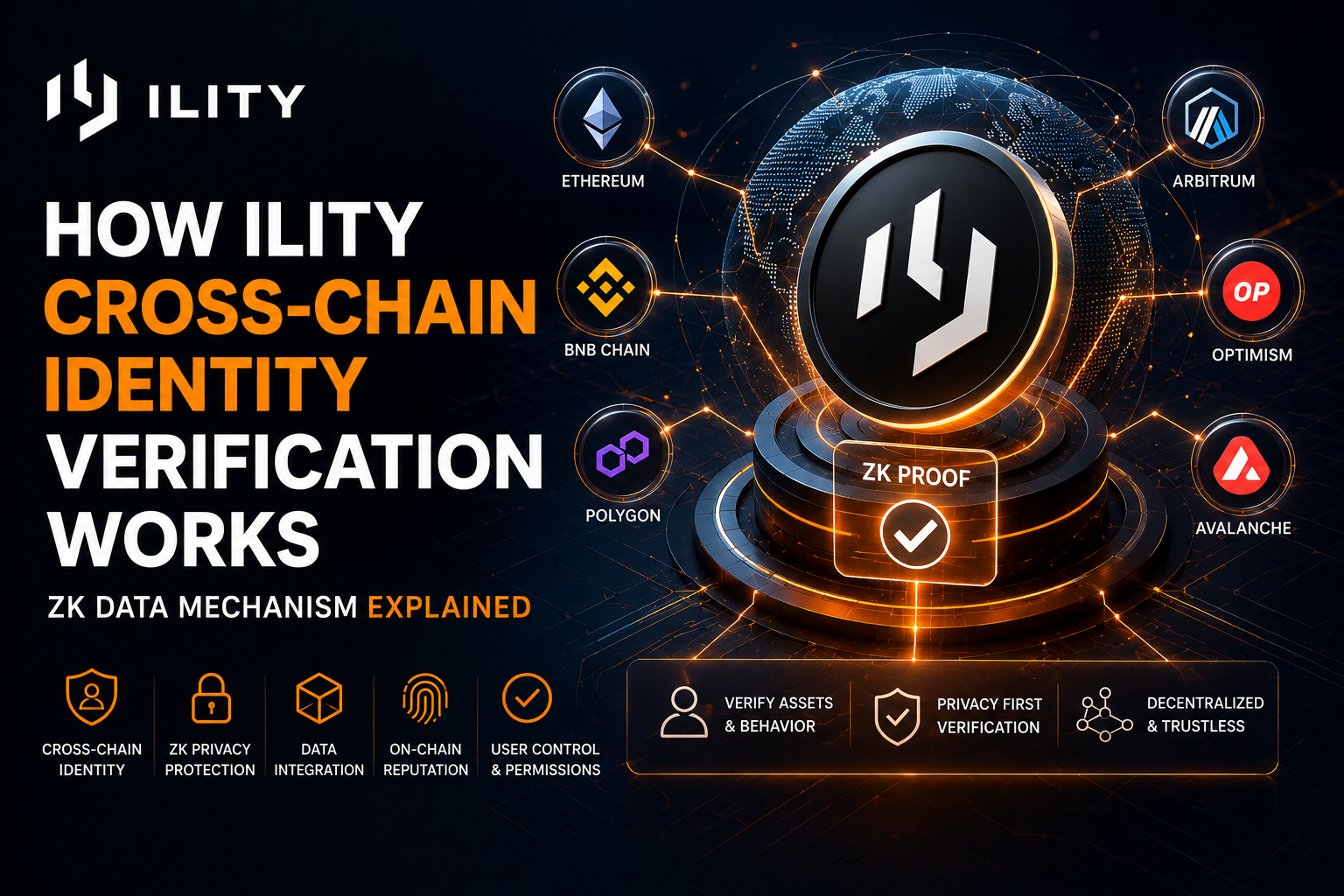
What Is ILITY’s Cross-Chain Identity System
Structurally, ILITY’s cross-chain identity system is used to integrate a user’s assets, behavior, and account status across different blockchains into a verifiable identity. It is not simply a wallet-linking tool, but an identity verification mechanism built around multi-chain data and privacy-preserving proofs.
ILITY’s cross-chain identity system can be understood as a verification layer for a user’s on-chain behavior. Users do not need to make all wallet information directly visible to applications. Instead, they can use a proof mechanism to confirm that they meet certain identity conditions, such as holding a specific asset, completing a certain type of interaction, or having a particular on-chain record.
First, the user connects the relevant wallet or submits a verification request. The system then reads or identifies assets and behavior data across different chains. Next, ILITY processes this information through its ZK data mechanism. Finally, the application receives the verification result, rather than the complete raw wallet data.
The importance of this mechanism is that it expands on-chain identity from a single address into a combination of multi-chain behaviors. For users, a cross-chain identity system can reduce repeated authentication. For applications, it can provide a more complete basis for permission checks and user recognition.
How Users Verify On-Chain Assets and Behavior
When users verify on-chain assets and behavior in ILITY, the core process is to submit verification conditions and have the system generate proof results that applications can recognize. This process emphasizes proving that a condition is true, rather than revealing the full transaction history.
In practical terms, on-chain asset verification does not require users to show every asset detail. Users only need to prove that they satisfy a specific rule, such as that an address holds an asset, has participated in an on-chain activity, or has a certain behavioral history. The system focuses on verifying the condition itself, not exposing data indiscriminately.
First, the user chooses the identity condition to be verified. The system then checks the asset or behavior records on the relevant chain. Next, the ZK proof mechanism converts the raw data into a privacy-preserving proof. Finally, the application uses the proof result to determine whether the user has access rights, identity eligibility, or the required interaction conditions.
| Verification Stage |
User Action |
System Action |
Output Result |
| Condition submission |
Selects the verification target |
Identifies the verification rules |
Defines the verification scope |
| Data reading |
Authorizes relevant accounts |
Checks on-chain records |
Obtains the original basis |
| Proof generation |
Confirms the verification request |
Generates a ZK proof |
Privacy-preserving result |
| Application judgment |
Submits the proof result |
Verifies that the condition is true |
Completes identity confirmation |
The impact of this process is that ILITY shifts on-chain verification from public data querying to privacy-preserving proof interaction. This allows asset authentication, behavior authentication, and on-chain permission management to be completed with less data exposure.
How ILITY Integrates Data from Different Blockchains
In a multi-chain environment, users’ assets and behaviors are often scattered across different networks. ILITY’s data integration mechanism is centered on mapping these distributed records into a unified identity verification framework.
An identity system that relies on multi-chain data needs to solve two issues: inconsistent data formats across chains, and the difficulty of directly confirming identity relationships between different wallet addresses. Through data recognition, identity mapping, and proof generation, ILITY turns these fragmented records into verifiable results.
First, the user provides the wallets or on-chain accounts related to identity verification. The system then identifies assets, transactions, and behavior records across different blockchains. Next, this data is incorporated into a unified verification logic. Finally, ILITY generates proof results that can be used for application access, reputation assessment, or permission authentication.
Structurally, ILITY does not display all on-chain data in one centralized view. Instead, it processes data around the verification purpose. This helps avoid excessive disclosure and reduces the need for applications to directly access a user’s complete asset history.
The importance of this mechanism is that the real identity of a multi-chain user often cannot be judged from a single address. Cross-chain data integration makes on-chain identity closer to a complete picture of user behavior, while also requiring privacy mechanisms to limit the scope of data exposure.
The core role of Zero-Knowledge Proof is to let users prove that an on-chain condition is true without revealing the complete data used to prove it. ILITY uses this mechanism to reduce exposure of wallet addresses, asset balances, and transaction histories during verification.
With ZK proofs, users can prove to an application that they meet a requirement without showing the full contents of their wallet. For example, a user can prove that they satisfy an asset holding condition without revealing their entire asset structure. They can also prove that they completed a certain type of on-chain activity without exposing their full interaction history.
First, the system obtains the necessary data within the scope authorized by the user. The ZK mechanism then generates a proof based on the verification condition. Next, the application verifies whether the proof is valid. Finally, the application receives only a result showing whether the condition is true or false, not complete wallet information.
This means ILITY’s identity verification is closer to minimized disclosure. It does not completely hide all on-chain behavior, but it reduces unnecessary information exposure during verification scenarios.
For Web3 applications, ZK privacy mechanisms can lower users’ concerns about data exposure. For users, they make asset proofs, eligibility verification, and on-chain reputation display less dependent on revealing the entire wallet history.
How On-Chain Reputation and Behavior Verification Are Established
On-chain reputation usually comes from a user’s long-term transaction history, interactions, asset holdings, and protocol participation records. ILITY’s behavior verification mechanism focuses on turning these records into verifiable identity signals.
Structurally, on-chain reputation is not a single score. It is a set of verifications made up of different types of behavior. Users may form identity characteristics through asset holdings, protocol usage, governance participation, or cross-chain interactions. ILITY can generate proofs around these behaviors to help applications assess user eligibility.
First, users generate interaction records on different chains. The system then identifies behavior data related to a particular verification target. Next, the ZK proof mechanism hides unnecessary details while preserving the verifiable result. Finally, applications can use the proof result to determine whether a user meets specific reputation or behavior conditions.
The importance of this mechanism is that Web3 identity should not rely only on the wallet address itself. An address is just an account identifier. What truly reflects a user’s characteristics is long-term behavior and cross-chain activity. Through behavior verification, ILITY provides a more privacy-friendly data foundation for on-chain reputation systems.
That said, on-chain reputation still needs careful design. Different applications evaluate behavioral value differently, and if verification conditions are too simple, they may fail to accurately reflect the quality of real users.
How ILITY Handles Data Privacy and Permission Control
ILITY’s data privacy mechanism focuses on allowing users to control which information can be verified and which information does not need to be disclosed. Permission control is then used to determine which proof results an application can access.
The key point is that a cross-chain identity system cannot simply hand over all of a user’s on-chain data to applications. Through permission settings and ZK proofs, ILITY limits the scope of data access to specific verification scenarios. What applications need is an identity conclusion, not unrestricted access to data.
First, the user confirms the verification request and authorization scope. The system then processes only the data related to the verification target. Next, the privacy proof mechanism hides irrelevant information. Finally, the application receives a restricted verification result and cannot directly view the user’s full wallet history.
In terms of impact, this permission structure helps reduce privacy risks in on-chain identity systems. Users can retain more control during identity authentication, asset proofs, and behavior verification, while applications can avoid directly handling large amounts of sensitive data.
This mechanism makes ILITY closer to a user-controlled identity protocol. It emphasizes verifiable data, but does not encourage unrestricted public disclosure.
What Are the Limitations of Cross-Chain Identity Mechanisms
The limitations of cross-chain identity mechanisms mainly come from data accuracy, privacy costs, cross-chain compatibility, and application adoption. ILITY can improve identity verification through ZK proofs and multi-chain data integration, but this type of system still faces technical and ecosystem-level challenges.
Cross-chain identity is not simply about linking several wallets together. Different chains may have different data standards, transaction structures, and account models, which increases integration difficulty. At the same time, generating and verifying ZK proofs may also bring computational costs and system complexity.
First, users need to authorize or provide a verifiable data scope. The system must then correctly identify behavior records across different chains. Next, the proof mechanism needs to balance privacy and efficiency. Finally, whether applications accept these proofs will also affect the practical value of cross-chain identity.
The impact of this mechanism is that ILITY’s long-term adoption depends not only on the protocol itself, but also on how many applications in the ecosystem are willing to use this type of identity verification result. Without enough application scenarios, the usefulness of a cross-chain identity system may be limited.
Therefore, the key challenge for cross-chain identity mechanisms is to form a stable balance among security, privacy, cost, and usability.
Conclusion
ILITY’s cross-chain identity verification mechanism centers on multi-chain data integration, ZK proofs, on-chain behavior verification, and permission control. Its core process allows users to submit verification conditions, the system to identify relevant on-chain data, and privacy-preserving proofs to generate results that applications can recognize.
The value of this mechanism is that users can prove that asset, behavior, or identity conditions are true without revealing complete wallet information. For Web3 applications, ILITY provides a more privacy-friendly identity verification path. For users, it strengthens data control and cross-chain identity usability.
FAQs
What Is ILITY’s Cross-Chain Identity Verification Mainly Used For
ILITY’s cross-chain identity verification is mainly used to prove users’ on-chain assets, behavior records, and identity conditions. It applies to permission management, reputation authentication, asset proofs, and privacy-focused identity scenarios.
Why Can ZK Proof Protect Wallet Privacy
A ZK proof can prove that a certain condition is true without disclosing complete wallet data. Applications only need to verify the proof result and do not need to view all of a user’s assets and transaction records.
How Does ILITY Verify User On-Chain Behavior
ILITY identifies relevant on-chain behavior within the scope authorized by the user and generates verification results through its proof mechanism. Applications then use those results to determine whether the user meets specific conditions.
What Is the Difference Between Cross-Chain Identity and Ordinary Wallet Login
Ordinary wallet login usually only proves that a user controls a certain address. Cross-chain identity verification can integrate assets, behavior, and reputation records across multiple chains to create a more complete identity assessment.
What Are the Limitations of ILITY’s Identity Mechanism
ILITY’s identity mechanism may be affected by multi-chain data compatibility, ZK proof costs, application adoption, and permission rule design. A cross-chain identity system needs to strike a balance among privacy, security, and usability.







