In Web3 environments, address readability directly affects payment security, user experience, and the efficiency of identity verification. Traditional blockchain interactions rely on lengthy string addresses that are hard for users to remember and prone to mistakes during transfers, approvals, or contract calls. ENS lowers the entry barrier by turning addresses into verifiable names, enabling Wallets, DApps, DAOs, NFTs, DeFi platforms, and on-chain social tools to integrate around a unified identity gateway.
Technically, ENS operates through modules such as Registry, Resolver, Namehash, reverse resolution, subdomain management, and cross-chain resolution. Recently, ENS Labs announced a major strategic shift: ENSv2 will continue to deploy on Ethereum L1, abandoning the separate Namechain plan. This decision is driven by sharply reduced Ethereum mainnet gas costs, faster scaling progress, and the superior security and ecosystem consensus of L1 as the long-term settlement layer for ENS.
Core Architecture and Operating Principles of ENS
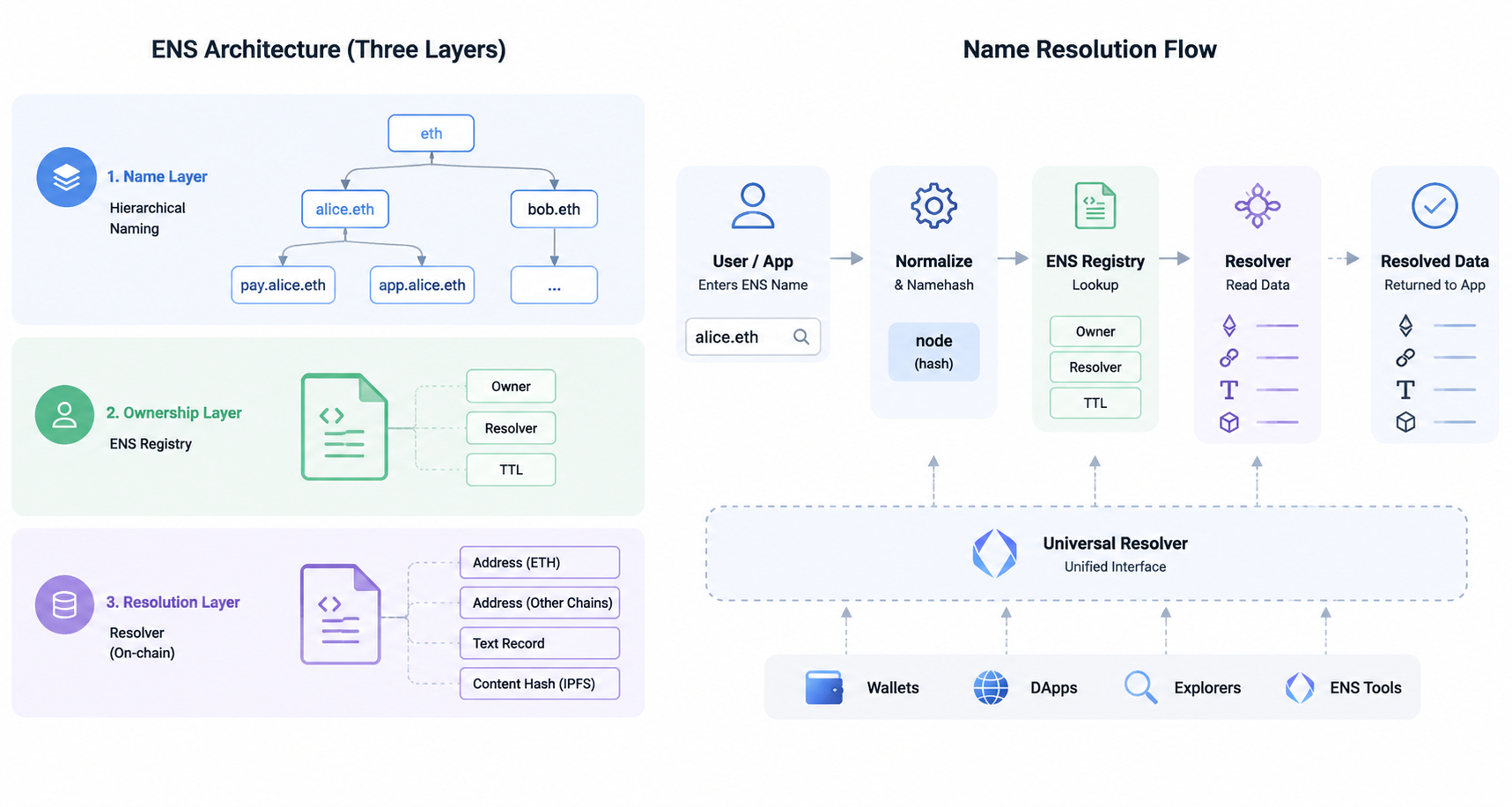
ENS’s foundational architecture consists of three layers: the naming layer, the ownership layer, and the resolution layer. The naming layer defines structures like eth, alice.eth, and pay.alice.eth; the ownership layer, managed by the ENS Registry, records who controls each name; and the resolution layer, handled by the Resolver contract, returns data such as Ethereum addresses, other blockchain addresses, text records, or content hashes.
When a user enters an ENS name, the system first normalizes it to prevent inconsistencies caused by case, special characters, or visual ambiguity. The name is then converted via the Namehash algorithm into a unique node—a hash identifier recognized by on-chain contracts. The ENS Registry does not store the full string but instead uses this node to look up the owner, Resolver address, TTL, and other details.
Resolution is typically handled automatically by Wallets, block explorers, DApps, or official ENS tools rather than by users themselves. Modern applications commonly use the Universal Resolver as a unified entry point, simplifying the Developer experience by abstracting away direct interaction with the Registry, Resolver, and cross-chain logic.
How ENS Domains Map to Wallet Addresses
Mapping ENS domains to Wallet addresses centers on the Resolver’s address records. For example, users can assign an Ethereum address to alice.eth within the ENS app. Once set, the Resolver contract stores the addr record for alice.eth.
When someone sends funds to alice.eth, the Wallet first locates the corresponding Resolver, then calls its addr method to retrieve the Ethereum address. After confirming the address, the Wallet constructs the transaction. For the user, the input is a domain name; for the blockchain, the transaction is ultimately sent to the actual address.
ENS also enables multi-coin address records, allowing a single ENS name to bind addresses from Ethereum, Bitcoin, Litecoin, Solana, and more. As a result, alice.eth can serve as a multi-chain asset deposit gateway—not just an Ethereum alias.
ENS Resolver and Registry Mechanisms Explained
The ENS Registry is the system’s core registration contract, storing three key fields: name owner, Resolver address, and TTL. The owner can be a standard Wallet address, a multisig Wallet, a Smart Contract, or a DAO. Whoever controls the name can set the Resolver, create subdomains, or transfer ownership.
The Resolver is the contract that returns data, storing address records, text records, content hashes, Avatars, Email, social accounts, website Links, and more. ENS’s official Public Resolver supports multiple standard interfaces, enabling Wallets and DApps to access data in a consistent format.
Separating Registry and Resolver is a pivotal ENS design. The Registry determines “who controls the name and which Resolver to use,” while the Resolver determines “what data is returned for the name.” This division allows ENS to support various resolution logics—pure on-chain, off-chain, cross-chain, or custom identity profiles.
ENS Integration with the Ethereum Ecosystem
ENS is deeply embedded in the Ethereum ecosystem. Leading Wallets recognize ENS names for payments, transfers, and address display; block explorers can reverse-resolve addresses to ENS names; and DeFi protocols, NFT Marketplaces, and DAO tools frequently use ENS as a user identity tag.
At the Smart Contract level, DApps can call ENS directly. For instance, an app might read a user’s reverse-resolved name for their homepage, or display Avatars, websites, or social profiles from ENS text records. This turns ENS into more than just a Wallet alias—it becomes the on-chain identity metadata layer.
ENS also leverages mechanisms like CCIP Read to support off-chain and cross-chain data retrieval. In complex scenarios, the Resolver may not store all data on Ethereum mainnet; some logic can be handled by off-chain services or other networks, with clients verifying the results. This reduces costs and lays the groundwork for multi-chain identity expansion.
How the ENS Subdomain System Works
ENS uses a hierarchical naming structure similar to DNS. eth is the top-level domain; alice.eth is a second-level name; pay.alice.eth, dao.alice.eth, and team.alice.eth are subdomains. Each name can have its own owner, Resolver, and resolution records.
Subdomain control is delegated by the parent domain owner. For example, alice.eth’s owner can create pay.alice.eth for payments, nft.alice.eth for an NFT showcase, or assign subdomains to team members, community users, or product modules.
The subdomain system gives ENS robust organizational capabilities. Individuals can allocate different functions to subdomains, projects can distribute identity names to users, and DAOs can create namespaces for members, proposals, treasuries, and working groups. A key ENSv2 upgrade is providing each name with a more flexible sub-registry and permission model, streamlining subdomain management.
Technical Differences Between ENS and DNS
DNS resolves domain names to IP addresses, coordinated by registrars, registries, root servers, and ICANN. ENS resolves names to on-chain addresses, content hashes, and identity data, with critical control managed by Ethereum Smart Contracts.
In terms of trust, DNS relies on centralized entities and account systems—domain holders manage records via registrar dashboards. ENS relies on Private Keys and Smart Contracts, with on-chain verifiable ownership, and the ability to transfer control to multisig setups, contracts, or DAOs.
Regarding resolution content, DNS is for website access (A, AAAA, CNAME, MX records, etc.); ENS is for Web3 interactions (addr, contenthash, text records, multi-chain addresses, reverse resolution). ENS can also integrate with DNS, importing DNS domains into ENS for on-chain resolution.
ENS Technical Challenges and Limitations
ENS’s first challenge is cost. While Ethereum L1 gas fees have fallen from their peak, registering, renewing, updating records, and creating subdomains can still be expensive during network congestion. ENSv2’s commitment to L1 ensures security but leaves user experience subject to mainnet fee volatility.
The second challenge is resolution complexity. ENS names require normalization, Namehashing, Registry and Resolver queries, reverse resolution, and multi-chain reads. For end users, this is invisible; for Developers, improper use of Universal Resolver or SDKs can cause incomplete resolution, chain mismatches, or compatibility issues.
The third challenge is security and misuse. ENS names are vulnerable to phishing, spoofing, and visual confusion attacks. Even trusted-looking names require users to verify addresses, DApp sources, and Signature content. For high-value names, Private Key leaks, Resolver tampering, or misconfigured permissions can result in severe losses.
Future ENS Technical Upgrades
The primary technical focus for ENS is ENSv2. According to ENS Labs’ latest roadmap, ENSv2 will remain on Ethereum L1, rather than moving to a standalone Namechain. This aligns with Ethereum’s scaling progress, lower gas fees, and security requirements, while reducing the complexity for users switching between Layer 2 and mainnet.
ENSv2 introduces a more modular, layered Registry, flexible permissions, simpler registration, improved cross-chain resolution, and new tools for users and Developers. With greater independence for each name, subdomain distribution, organizational identity management, and complex permissions become more accessible.
The Universal Resolver will continue as a key component, serving as the unified entry for ENS resolution—regardless of whether the name belongs to ENSv1, ENSv2, L1, L2, or is resolved off-chain. For Developers, this lowers integration barriers; for users, it ensures a consistent resolution experience.
Summary
ENS’s technical backbone is its Registry for ownership, Resolver for data, and supporting mechanisms like Namehash, reverse resolution, subdomains, and Universal Resolver, which together transform complex on-chain addresses into readable, verifiable, and scalable identity gateways.
As ENSv2 advances, ENS is evolving from a .eth domain service into a comprehensive Web3 naming and identity infrastructure. Its enduring value lies not only in streamlining transfers, but also in providing a unified identity resolution standard for Wallets, DApps, DAOs, multi-chain assets, and on-chain social platforms.