MiCA’s client crypto asset protection is fundamentally based on the mandatory segregation of client assets from service provider assets across custody, blockchain recordkeeping, and bankruptcy liquidation. When users deposit crypto assets into a licensed crypto asset service provider (CASP) custodial account, regulations stipulate that CASPs cannot misappropriate client holdings, and if a CASP faces financial distress, client assets should, in principle, not be included in the CASP’s bankruptcy estate.
Within the MiCA EU crypto regulatory framework, asset protection rules are codified in Title V. Article 70 applies to all CASPs that hold client crypto assets or access means, while Article 75 specifically governs the “custody and administration of crypto assets on behalf of clients” authorized service. MiCA’s impact on users covers accounts, trading, and asset management; custodial segregation directly determines whether users can recover on-chain holdings first in the event of platform bankruptcy or attack.
Core Requirements for MiCA Client Asset Protection
MiCA’s client asset protection framework consists of three layers: ownership assurance, asset segregation, and bankruptcy segregation. Ownership assurance requires CASPs to guarantee client rights are not compromised by service provider actions; asset segregation mandates that client crypto assets, access means, and fiat funds (excluding electronic money tokens) are stored separately from CASP assets; bankruptcy segregation stipulates that, if CASPs are insolvent, client assets under custody must not be subject to claims by general creditors.
| Protection Layer |
Regulatory Basis |
Core Requirement |
| Ownership assurance |
Article 70(1) |
Safeguard client ownership; prohibit proprietary misappropriation |
| Asset segregation |
Article 70(3), Article 75(7) |
Store and account for client assets separately from CASP assets |
| Bankruptcy segregation |
Article 70, Article 75 |
Legally distinguish client assets from CASP bankruptcy property |
| Information transparency |
Article 75(2), (5) |
Register of holdings, periodic statements, and asset return procedures |
| Liability for damages |
Article 75(8) |
CASP must compensate for attributable ICT incidents |
These five mechanisms are summarized in the table above. The protections only apply to CASPs within the scope of MiCA authorization and actually providing custody or safekeeping services; self-custodial wallets or unauthorized platforms are not included under this framework.
Article 70 Custody Obligations
Article 70 of the Markets in Crypto-Assets Regulation (Safekeeping of clients’ crypto-assets and funds) applies to all CASPs that hold client crypto assets, access means, or client fiat funds as required by their business model.
Article 70(1) establishes the general principle: CASPs must make adequate arrangements to protect client ownership, “especially in the event of CASP bankruptcy,” and prevent the use of client crypto assets for CASP proprietary accounts. Article 70(2) and (3) address client fiat funds: CASPs must deposit received funds into a credit institution or central bank by the end of the next business day, and ensure the account is separated from CASP’s own funds.
CASP crypto asset service provider authorized services are categorized by MiCA annexes. CASPs authorized only for “operating trading platforms” and not for “custody and administration of crypto assets” must still comply with Article 70(1) for crypto assets (if they hold client assets), but are not required to follow the full set of Article 75 custodial provisions.
Article 75 Custodial Segregation
Article 75 (Providing custody and administration of crypto-assets on behalf of clients) applies only to CASPs with the relevant authorization and sets out more detailed operational requirements.
Article 75(1)–(3) requires a custody agreement, the establishment of a register of holdings, and a custodial policy; Article 75(5)–(8) stipulates periodic statements, asset return procedures, three-layer segregation, and ICT liability.
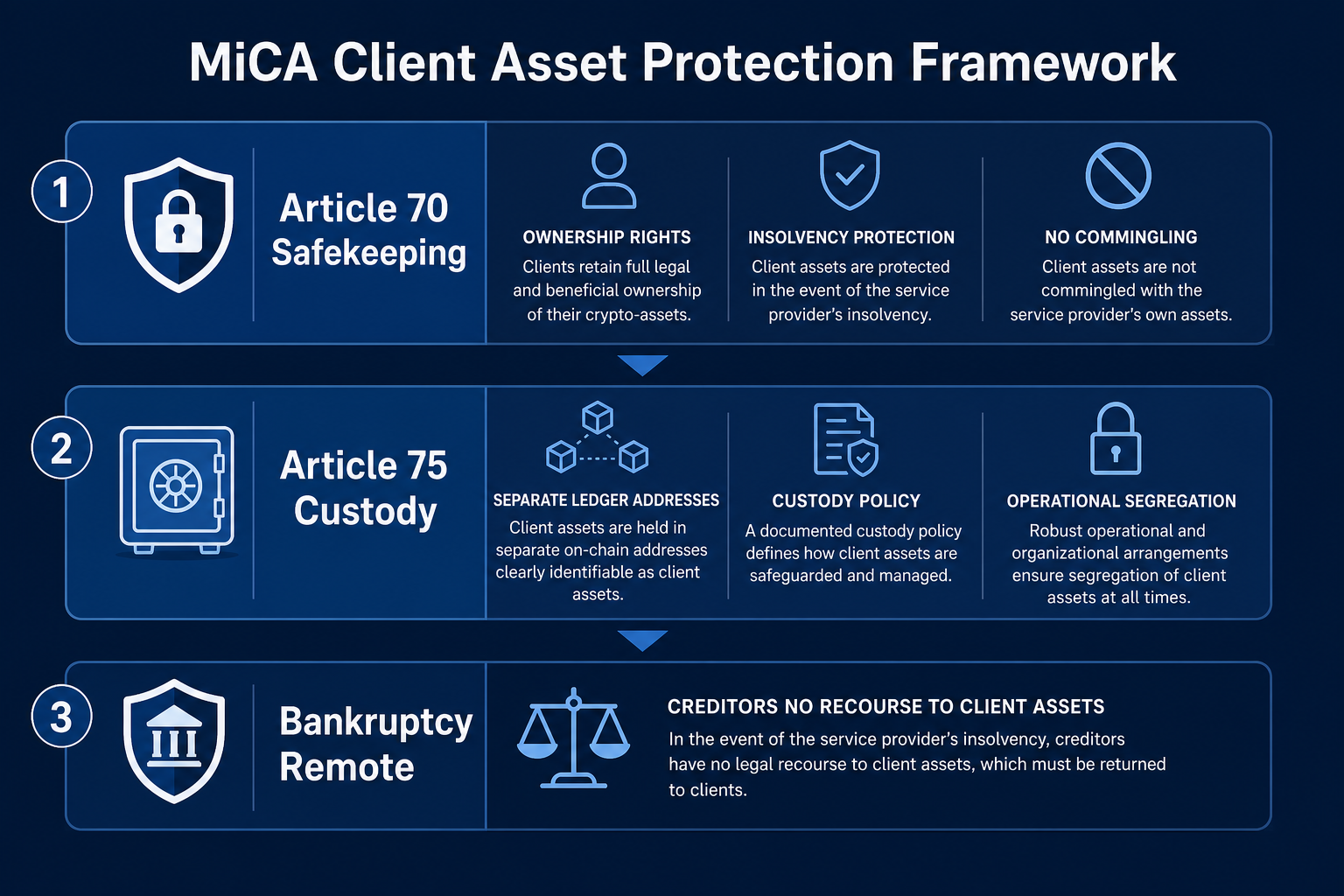
Figure 1. The three-tier structure of MiCA client asset protection: the relationship between Article 70 custody obligations, Article 75 custodial segregation, and bankruptcy isolation mechanisms.
On-Chain Segregation and Bankruptcy Segregation
MiCA’s segregation requirements cover both the distributed ledger and legal layers.
Article 75(7), first paragraph, requires CASPs to separate crypto assets held on behalf of clients from their own holdings, maintain separate accounts on the distributed ledger, and clearly identify access means. The second paragraph establishes legal segregation: custodial assets must be legally separated from CASP estate, ensuring they are independent of CASP property and creditors—especially in bankruptcy—cannot claim custodial client assets. The third paragraph requires operational segregation, ensuring that client assets and CASP assets are independent in daily operations and IT systems.
Both on-chain and legal segregation must be achieved; the effectiveness of bankruptcy segregation ultimately depends on the bankruptcy law practices of each EU member state.
Custodial vs Non-Custodial CASPs
Under MiCA, “custodial CASPs” are entities authorized to provide “custody and administration of crypto assets on behalf of clients”: CASPs that hold client crypto assets or control access means must fully comply with Article 75. In self-custody scenarios, users hold their own private keys; MiCA’s preamble clarifies that non-custodial hardware/software wallet providers are not subject to MiCA regulation.
| Dimension |
Custodial CASP |
Non-custodial / Self-custody |
| Private key control |
CASP holds or controls access means |
User holds private key |
| Applicable articles |
Article 70 + full Article 75 |
Article 75 does not apply |
| Segregation obligations |
On-chain, legal, operational segregation |
No statutory segregation requirement |
| Bankruptcy protection |
Creditors cannot claim custodial assets |
No CASP-side bankruptcy protection |
| Authorization requirement |
Must have custody and administration authorization |
Non-custodial wallets are not covered by MiCA |
The table above highlights the core differences between both scenarios. Some platforms offer both custodial accounts and on-chain withdrawal functions: platform balances are generally subject to Articles 70 and 75, while withdrawals to external wallets shift to a self-custody risk structure.
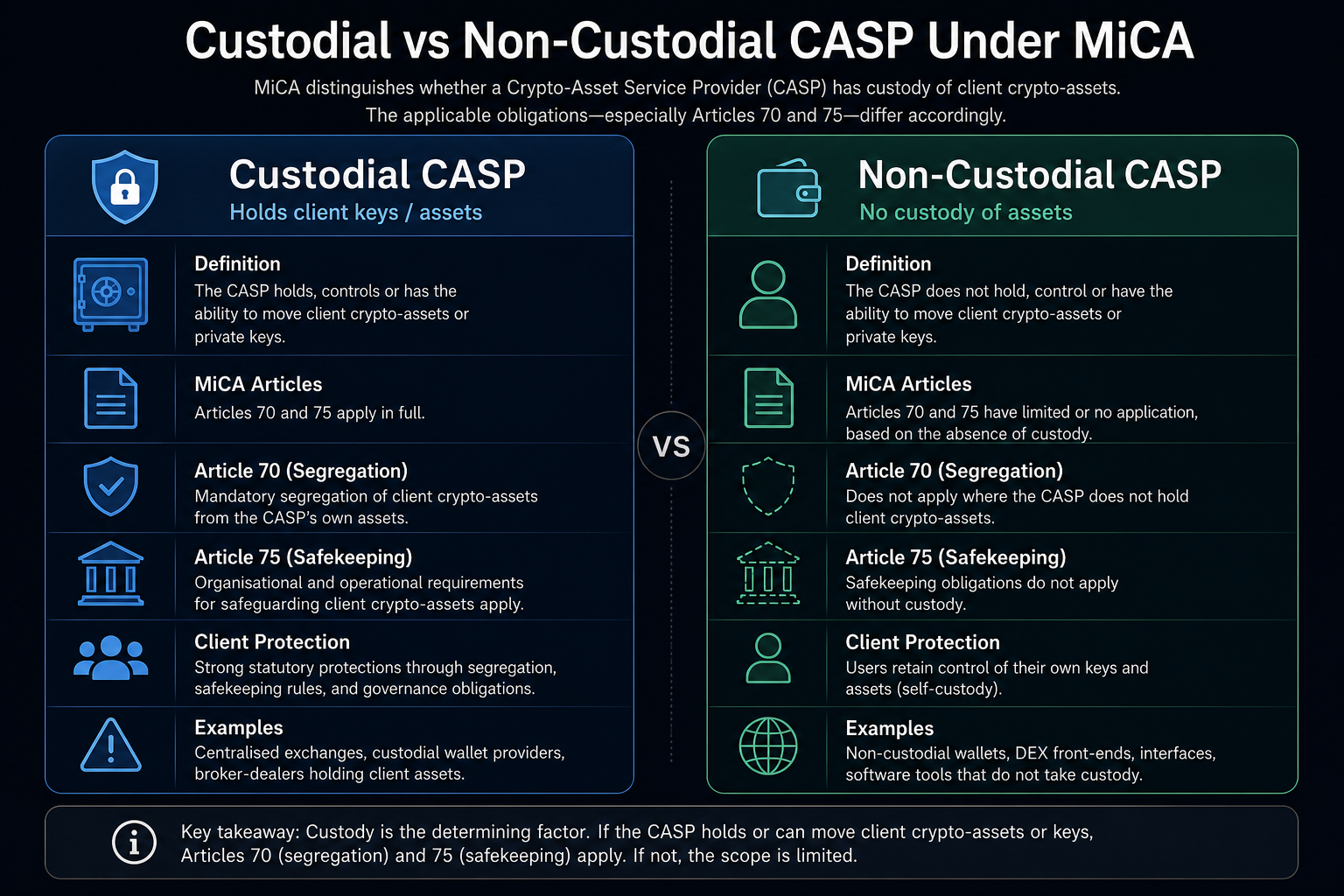
Figure 2. Comparison of custodial CASPs and self-custody scenarios under MiCA in terms of applicable articles, segregation obligations, and bankruptcy protection.
How Users Identify Licensed Custody
MiCA asset protection rules fully apply only to CASPs whose authorized service list includes “custody and administration of crypto assets.” To identify licensed custody, users should check three points: legal entity, authorized services, and passport coverage country.
First, confirm the legal entity’s name and search for it or its Legal Entity Identifier (LEI) in the ESMA MiCA register. Second, check the “authorized service list” to see if custody and administration of crypto-assets is included. Third, confirm if your country is listed in the “passport coverage member states” field.
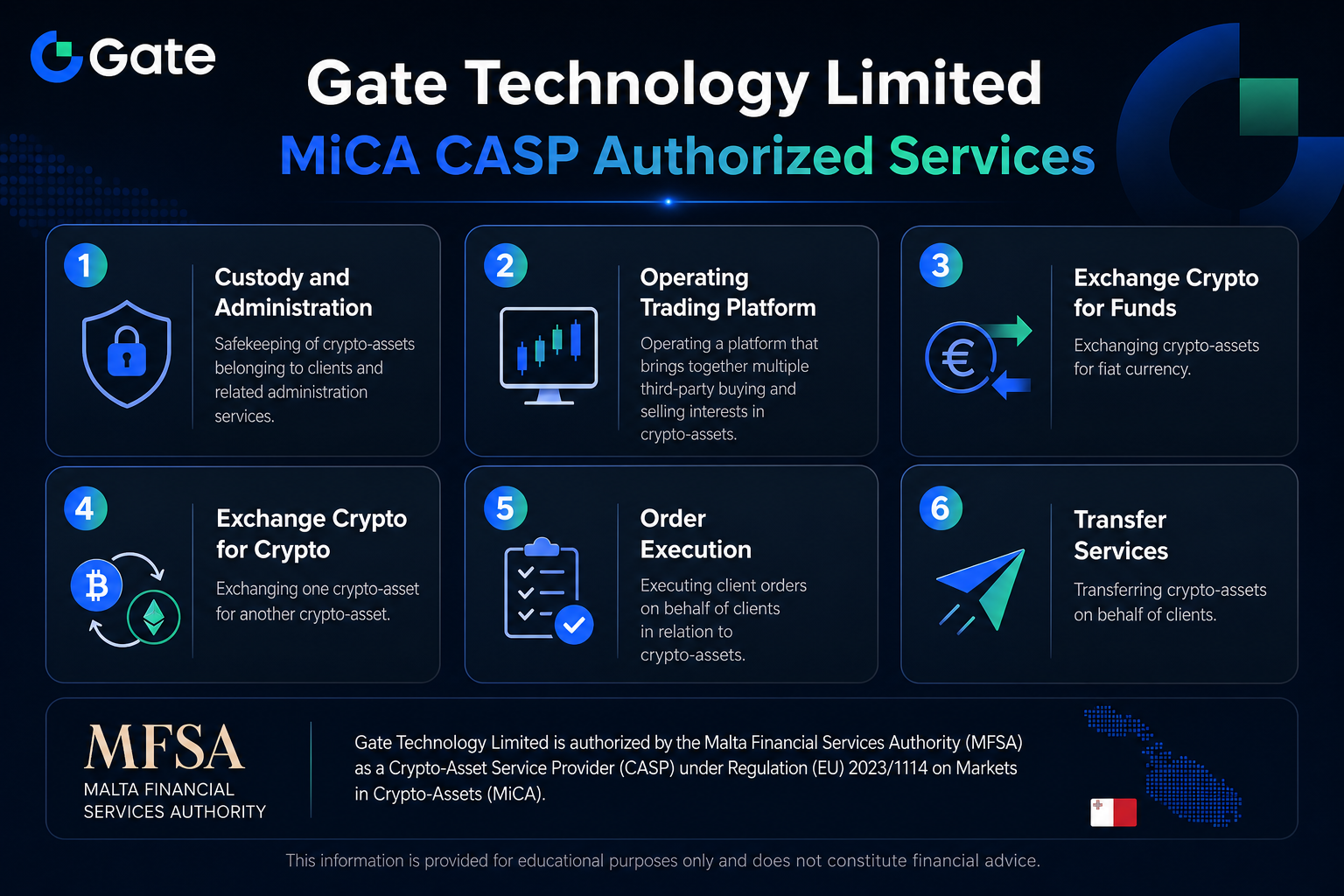
Gate MiCA Malta License explains that Gate Technology Limited is authorized by MFSA under MiCA, covering custody and administration of crypto-assets among six services. Users can verify this in the ESMA register; marketing pages are not a substitute for authorization records or custody agreements.
Risks and Limitations
MiCA’s custodial segregation rules enhance asset protection standards for licensed CASPs, but certain limitations must be acknowledged.
Protection is limited by authorization and passport coverage, and the regulatory status of regional legal entities under global brands is not automatically linked. Bankruptcy segregation depends on member state judicial practice; inherent on-chain defects and other uncontrollable events may exclude liability for damages. Unauthorized functions are not covered by the same custodial rules; after withdrawal to self-owned wallets, MiCA protection no longer applies.
Summary
MiCA establishes a client crypto asset protection framework through Articles 70 and 75: Article 70 sets ownership assurance, prohibits proprietary use, and requires independent storage of fiat; Article 75 mandates, for custodial CASPs, custody agreements, registers of holdings, custodial policies, periodic statements, return procedures, three-layer segregation (on-chain/legal/operational), and ICT liability. The central logic of bankruptcy segregation is that custodial client assets are legally independent from CASP property, and CASP creditors cannot claim them.
Users must verify legal entity, authorized services, and passport coverage country through the ESMA register. Gate Technology Limited’s MFSA authorization includes custody and administration services. MiCA protection does not eliminate all risks, and bankruptcy practices and authorization scope limitations must be considered.
FAQ
Can MiCA protect my crypto assets if the exchange goes bankrupt?
MiCA requires legal segregation of custodial assets from CASP property, so creditors cannot claim them in bankruptcy. Protection is limited to CASPs authorized and actually providing custody under MiCA, and ultimately depends on member state bankruptcy law.
What is the difference between Article 70 and Article 75?
Article 70 applies to all CASPs holding client crypto assets or fiat funds, focusing on ownership assurance, prohibition of proprietary use, and independent bank accounts for fiat. Article 75 is dedicated to custodial CASPs authorized for custody and administration, requiring custody agreements, registers of holdings, custodial policies, periodic statements, three-layer segregation, and ICT liability. Article 70 is the baseline; Article 75 is the detailed rule for custodial business.
What layers does MiCA require for custodial segregation?
Article 75(7) requires simultaneous fulfillment of on-chain segregation, legal segregation, and operational segregation: separate holdings on the ledger, legal independence from CASP bankruptcy property, and independent operational processes.
What is the difference between custodial CASPs and self-custody under MiCA?
Custodial CASPs hold client assets or access means, must comply with the full set of Article 75 rules, and benefit from bankruptcy segregation protection. Self-custody users control their own private keys; non-custodial wallets are outside MiCA’s scope. Users do not benefit from CASP-side bankruptcy protection and must manage their own key management and on-chain security risks.
How do I confirm if a platform offers MiCA-compliant custody?
Search the ESMA MiCA register by legal entity name or LEI, check if authorized services include custody and administration of crypto-assets, and confirm that your country is listed in the passport coverage. Also review the custody agreement for service details, custodial policy, and applicable law. Gate Technology Limited’s MFSA authorization includes custody and administration services, which can be verified in the ESMA register.
What are the limitations of MiCA custodial protection?
Protection is limited by authorized entity, authorized services, and passport coverage country, and does not automatically extend to global affiliates. Legal segregation depends on member state bankruptcy practice; inherent on-chain defects and other uncontrollable events may exclude liability for damages. Unauthorized functions may not be covered by custodial rules. After withdrawal to self-owned wallets, MiCA custodial protection no longer applies.