The development of artificial intelligence depends on high-quality data. Compared to internet text, images, and video, real-world environmental data allows AI systems to more accurately grasp changes in the physical world.
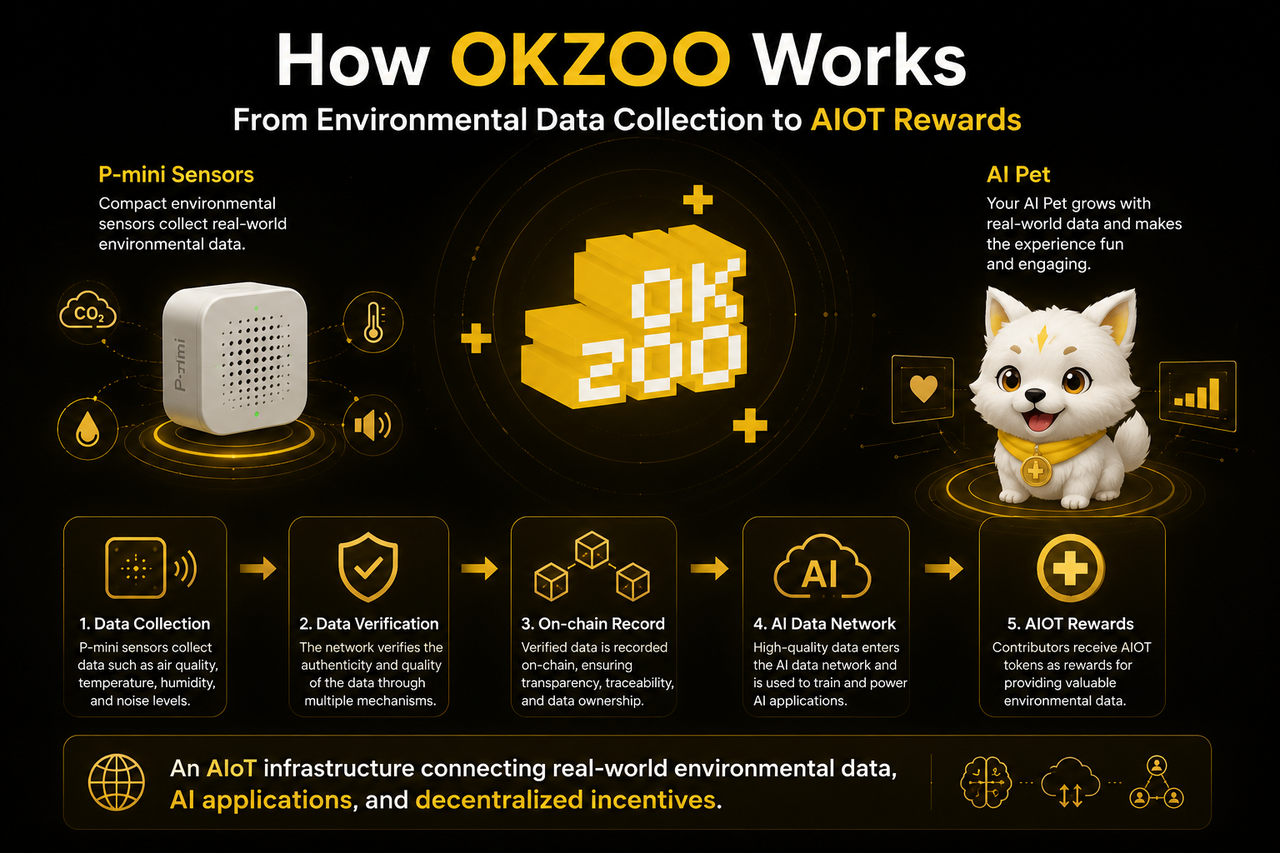
As AI agents, smart cities, and automated devices advance, environmental perception has become a vital component of AI infrastructure. Air quality, temperature, humidity, noise levels, and other environmental indicators are increasingly critical data sources. OKZOO continuously collects environmental data via community-deployed P-mini devices, leveraging the AIOT incentive mechanism to encourage user participation in network building.
Unlike traditional environmental monitoring systems, OKZOO expands data coverage through a decentralized approach. By combining on-chain records with a community participation model, the network consistently generates verifiable environmental data that serves as foundational support for future AI applications.
Why Environmental Data Is the Core Resource of the OKZOO Network
Environmental data forms the bedrock of the OKZOO network. Every incentive mechanism, AI use case, and ecosystem interaction revolves around real-world data.
Unlike DePIN projects that center on hashrate or bandwidth, OKZOO’s primary asset is continuously generated environmental information. Data quality, density, and coverage directly determine the network’s overall value.
As more devices join the network, environmental data builds a richer digital mirror of the physical world—offering AI systems a sustainable, long-term data source.
How P-mini Devices Collect Real-World Data
The P-mini is the environmental sensing terminal in the OKZOO network. Its integrated suite of sensors constantly monitors the surrounding environment.
Data collected typically includes temperature, humidity, air quality index, noise levels, and other environmental parameters. The collection process is fully automated, requiring minimal human intervention.
Because devices are deployed across different geographic locations, multiple P-mini nodes can collectively form a data network that covers a much wider area.
What Processing Steps Does Data Undergo Before Upload
Once environmental data is collected, it does not immediately enter the network. The device first formats and validates the data.
This initial stage filters out obviously anomalous values and ensures uploaded content meets standardized requirements. Standardization streamlines subsequent verification and analysis.
After preprocessing, the system generates corresponding data records, setting the stage for network validation in the next phase.
How Data Is Verified and Enters the Network
The network must confirm the data’s source and validity before it is accepted. The verification process is essential for maintaining the credibility of environmental data.
The verification mechanism typically checks device status, upload time, geographic location, and consistency with historical records. Only data that passes these rules is formally onboarded into the network.
Once verified, the records enter the OKZOO data ecosystem and become available as a resource for future AI applications.
How On-Chain Records Complete Data Rights Confirmation
On-chain recording sets OKZOO apart from traditional IoT networks. Verified data contributions are recorded on the blockchain.
These on-chain records do not necessarily store every raw data point; instead, they capture proof of contribution, timestamps, and indexing information. This approach ensures traceability while keeping storage costs low.
Through on-chain rights confirmation, the network can clearly identify data sources and contribution relationships, providing a basis for subsequent incentive distribution.
How AIOT Incentives Are Distributed
Incentive distribution is a key part of the entire workflow. The network calculates rewards based on the quantity, quality, and participation level of contributed data.
Eligible data contributors receive AIOT tokens. The core objective of this reward system is to encourage users to consistently provide authentic, stable, and high-quality data.
As the network scales, the AIOT token becomes an essential value medium connecting device operators, data contributors, and ecosystem participants.
How AI Pet Participates in the Data Feedback Process
AI Pet serves as the interactive layer in the OKZOO ecosystem. Compared to traditional DePIN projects, it adds a visual, gamified element to data contribution.
When users contribute environmental data, AI Pet displays different status changes based on that data. A dynamic link is created between the real environment and the digital pet.
This design makes the abstract process of data contribution more tangible and helps boost long-term community engagement.
What Is the Difference Between OKZOO and Traditional IoT Data Networks
Traditional IoT networks are typically built for enterprises or institutions, with centralized platforms controlling data collection, storage, and management.
OKZOO, by contrast, takes a community-driven approach. Users deploy devices, contributions are recorded on-chain, and the AIOT token provides incentives.
Furthermore, OKZOO introduces the AI Pet mechanism, giving the data network not just infrastructure value but also user interaction and ecosystem growth potential.
Summary
OKZOO’s operational flow can be broken down into six stages: data collection, preprocessing, network verification, on-chain recording, data integration, and incentive distribution. P-mini devices capture real-world environmental data, verification mechanisms ensure quality, blockchain records contributions, and AIOT handles incentives.
This model continuously converts real-world environmental information into AI-ready data resources while expanding the network through community participation. As AI’s appetite for real-world data grows, AIoT networks like OKZOO are becoming critical infrastructure that bridges the physical world and artificial intelligence.
FAQs
Where does OKZOO’s environmental data mainly come from?
OKZOO’s environmental data primarily comes from community-deployed P-mini devices. These devices continuously gather real-world information such as air quality, temperature, humidity, and noise, then upload it to the network for processing and verification.
Is data uploaded by P-mini directly written to the blockchain?
Data collected by P-mini typically undergoes preprocessing and verification before on-chain records are generated. The blockchain mainly records proof of contribution and index data—not the full raw dataset.
On what basis are AIOT rewards distributed?
AIOT rewards are generally linked to data contribution activity. Device uptime, data quality, data stability, and network participation all influence the final reward amount.
What role does AI Pet play in the data upload process?
AI Pet does not handle data collection or verification. Instead, it provides interactive feedback based on users’ data contribution activity. AI Pet is a key component connecting user experience with the data network.
What is the difference between OKZOO and traditional environmental monitoring systems?
Traditional environmental monitoring systems are typically deployed and operated centrally by institutions. OKZOO uses a community-driven model, where data contributions earn on-chain records and incentives, thus expanding data coverage.
Why is environmental data important for AI?
Environmental data helps AI systems understand the state of the physical world. Applications such as smart cities, autonomous driving, smart homes, and AI agents all need continuous access to real-world environmental data for informed decision-making.