SK Eternix (475150) is a South Korean new energy operating company listed on the stock market, with the trading code 475150. In the Gate Stocks context, users are less concerned with the traditional brokerage account opening process and more focused on how to search for the target, submit orders, confirm fees, and review positions using USDT as the funding method.
Before trading, users need to verify the corporate entity and business scope of SK Eternix (475150). The actual trading operations return to the Gate Stocks page, where users must check the name, code, market, order type, available balance, fee rules, and trade status line by line. Understanding the company and performing page operations are two separate layers and should not be combined in a single assessment.

What Do You Need to Prepare Before Buying or Trading SK Eternix on Gate Stocks?
Before trading SK Eternix with USDT, you need to confirm the account status, stock trading permissions, available USDT, product availability, and regional access conditions. Different accounts and regions may have different page rules, so the actual available features should be based on what the Gate Stocks page displays.
The goal of the preparation phase is not to place an order but to eliminate fundamental issues—such as inability to trade, unavailable funds, code confusion, and fee misinterpretation. If any preparation item is unclear, you may later encounter scenarios where you can view the market but cannot submit an order, or the order amount does not match the available balance.
| Preparation Item |
Check Content |
Common Impact |
| Account Permissions |
Whether the Stocks / Korean stock trading feature is enabled |
Affects ability to submit orders |
| USDT Funds |
Whether available USDT has been transferred to the stock account |
Affects order amount and tradable quantity |
| Product Availability |
Whether SK Eternix page shows a tradable status |
Affects order submission ability |
| Target Identification |
Whether name, code 475150, and market information are consistent |
Affects whether the correct stock is selected |
| Fee Rules |
Fees, minimum unit, settlement method |
Affects actual execution and position records |
The preparation checklist separates the ability to "see the page" from the ability to "submit an order" for independent verification. Only when the account, permissions, funds, product status, and fee rules are clear do the search and order placement steps have a workable foundation.
Step 1: How to Prepare Your USDT and Stock Trading Account?
Gate Stocks Korean stock trading typically requires completing account status verification, identity verification, stock trading permission confirmation, and preparing USDT for the stock account. The available USDT balance and the spot account balance may not be displayed on the same page. Before trading, confirm that funds are already in a state available for stock orders.
Fund preparation also requires attention to fields such as network deposits, internal transfers, available balance, and frozen amounts. If USDT is still being confirmed, the transfer is incomplete, or it is occupied by other orders, the buyable quantity shown on the page may be lower than the total account balance.
Step 2: How to Search for SK Eternix (475150) on Gate Stocks?
In the Gate Stocks Korean stock section, enter 475150. Once on the SK Eternix detail page, first verify that the name is SK Eternix, the code is 475150, and the page displays Korean stock trading rules. Code verification should take priority over abbreviation recognition, because companies with similar names may exist within the same group or industry.
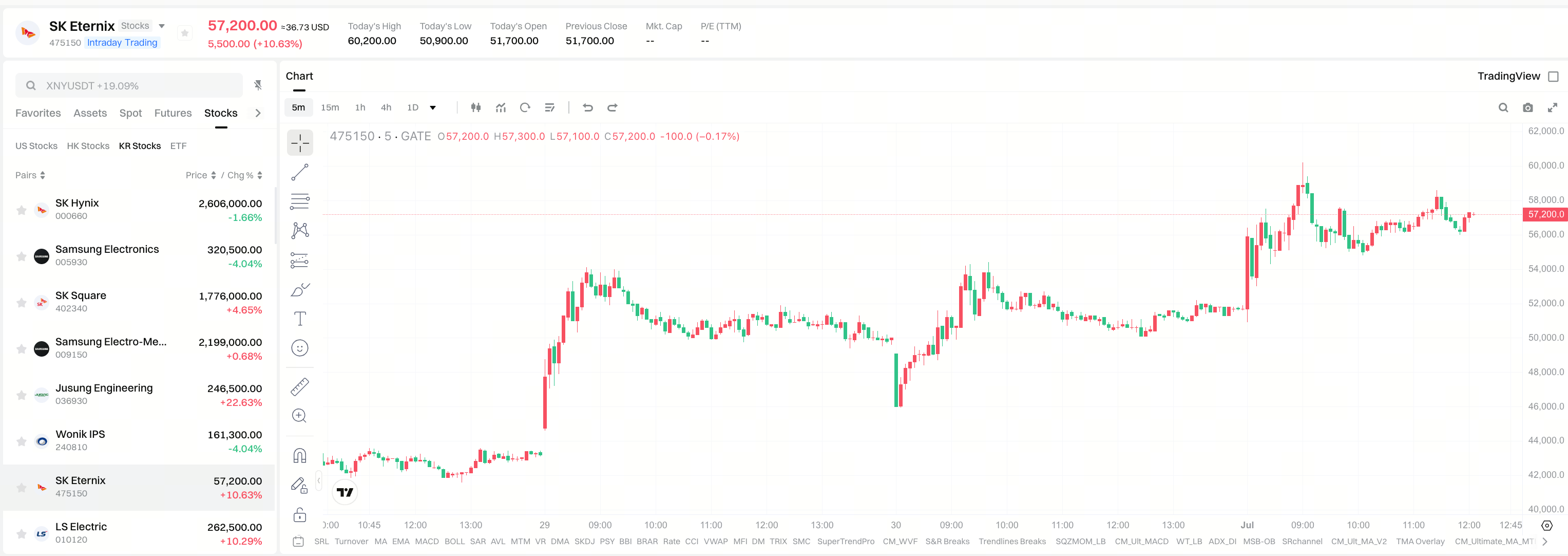
If names are similar or English abbreviations are confusing, using the code for retrieval is generally more reliable. SK Eternix should not be confused with other SK Group companies, energy subsidiaries, or stocks with similar names. If the page only displays an abbreviation or local language name, verify using the code, full company name, and trading market information together.
The trading page typically displays market data, buy/sell panel, order types, available balance, fee information, and position entry points simultaneously. Since SK Eternix is a South Korean stock, the market data display method and account settlement method may differ. Page fields should be read one by one; do not judge order submission ability based solely on the price area.
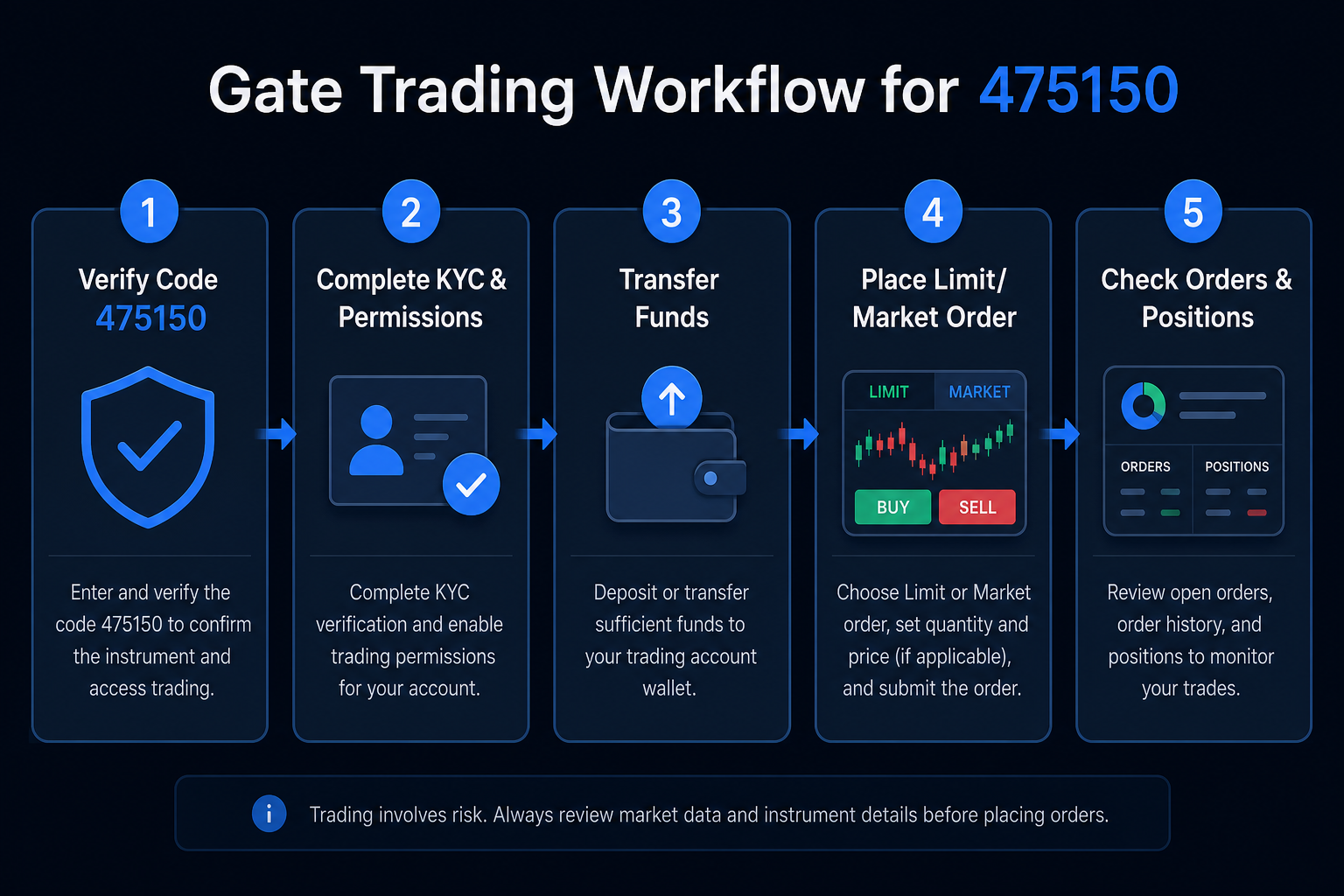 Figure 1. Gate trading workflow for 475150: verify code, complete permissions, transfer funds, place an order, and review positions.
Step 3: How to Place an Order to Buy or Trade SK Eternix?
After entering the SK Eternix trading page, you need to confirm in order: order direction, order type, quantity or amount, estimated execution amount, fees, and available account balance. Before submitting the order, recheck the stock name and code to avoid carrying incorrect target identification into the trade history.
Common order types include limit orders and market orders. Limit orders prioritize a user-defined price condition, while market orders prioritize execution at the market's available price. Neither order type is inherently superior; the differences lie in execution logic, execution speed, and price control method.
| Order Type |
Key Check Points |
Possible Scenarios |
| Limit Order |
Price, quantity, validity status |
May not execute if the price is not triggered |
| Market Order |
Available balance, market liquidity |
Execution price may differ from the estimate |
| Partial Fill |
Executed quantity, remaining order |
Positions and available balance change simultaneously |
The table explains the differences between order types and order statuses. Before submitting the order, use the confirmation box, fee prompt, and order direction on the page as final checkpoints.
What Fees and Order Rules Need to Be Confirmed When Trading SK Eternix?
The stock trading page typically displays fees, spreads, order execution price, minimum trading unit, trading hours restrictions, and related prompts. Different products and regions may have different rules, so fee and order rules should be based on what the page shows.
In addition to fees, pay attention to order execution costs. Market orders may incur price differences due to market liquidity, while limit orders may remain unfilled for a long time if the price condition is not met. Fee rules, execution methods, and order status need to be considered together.
| Check Item |
Meaning |
Why It Matters |
| Fee |
Transaction fee incurred upon execution |
Affects the amount shown on the order confirmation page |
| Spread |
Difference between bid and ask prices |
Affects actual execution cost |
| Minimum Unit |
Smallest tradable quantity allowed by the page |
Affects whether the order can be submitted |
| Trading Hours |
Time window during which the target is tradable |
Affects whether the order can be executed |
The table breaks down fee and order rules into four check items. If the content displayed on the order page differs from your estimate, first recheck the quantity, price, fee, and trade status before deciding whether to proceed with submission.
Step 4: How to Review Positions and Historical Orders After Execution?
Do not leave the page immediately after placing an order. First, check the order status under [Open Orders / Order History], then go to the [Positions] area to see if the executed quantity, cost, and related records have been updated. The order status and position changes need to be reviewed together; looking at only one item may not tell you whether the order was fully executed.
If the order remains unfilled, first check whether the cause is an untriggered price, time restrictions, or insufficient liquidity. Then handle it according to the platform's order rules.
The key point of execution review is to confirm that the "order status" and "position change" are consistent. If the order shows a partial fill, both the position quantity and available balance may change. If the order is still active, the position may not have been updated. Reviewing records helps distinguish between unfilled, partially filled, and fully filled orders.
What Risks Should You Understand Before Buying or Trading SK Eternix?
Trading process risks and company fundamental risks need to be understood separately. Trading process risks include code misselection, order type misinterpretation, unclear fee rules, trading hours restrictions, and liquidity changes. Company fundamental risks stem from policy rules, project progress, financing costs, operational efficiency, and exchange rate conversion.
For a new energy operating company, business risk does not only come from price fluctuations but also from whether projects can be commissioned as planned, whether power generation assets can settle stably, and whether capital costs affect long-term holding capacity. Before placing an order, you can cross-check information with the SK Eternix Investment Risk Checklist.
Common operational errors include only looking at the name without verifying the code, confusing available balance with buyable quantity, ignoring trading hours, not distinguishing between limit and market orders, and failing to review after execution. The trading process can be read alongside the Build-to-Own Business Model: the former focuses on codes, orders, and positions; the latter focuses on asset quality, operational capability, and risk sources.
Summary
Trading SK Eternix (475150) with USDT via Gate Stocks is essentially a standardized process execution: prepare your account and USDT, search code 475150, verify the stock detail page, select an order type, confirm fee rules, and review positions after execution. The trading page resolves operational issues, while the company business and risk checklists resolve target understanding issues—these two should be checked separately.
FAQ
What if I can't find SK Eternix?
First, search using the code 475150 and make sure you are on the Korean stock section page.
What is the difference between trading SK Eternix on Gate Stocks and using a traditional broker?
Gate Stocks presents the trading process using platform accounts and USDT as the funding method, while traditional brokers typically rely on local securities accounts and local currency fund systems. Specific product rules, fees, and rights arrangements should be based on page descriptions.
How do I confirm the minimum purchase requirement?
The minimum quantity, minimum amount, and submittable unit should be based on the order box prompts on the SK Eternix trading page; different stocks and account statuses may vary.
What industry does SK Eternix belong to?
SK Eternix is a South Korean new energy listed company, with business covering solar, wind power, fuel cells, ESS, and power trading.
Why didn't my order execute immediately?
Possible reasons: the trigger price was not reached, insufficient liquidity, or the stock is outside tradable hours. Whether you can sell, cancel the order, or continue waiting should be based on the page order status and trading rules.
How do I confirm dividend or corporate action rules?
Stock-related dividends, splits, mergers, or other corporate action arrangements should be based on Gate Stocks page descriptions and platform notifications, not solely on experience with traditional brokers.