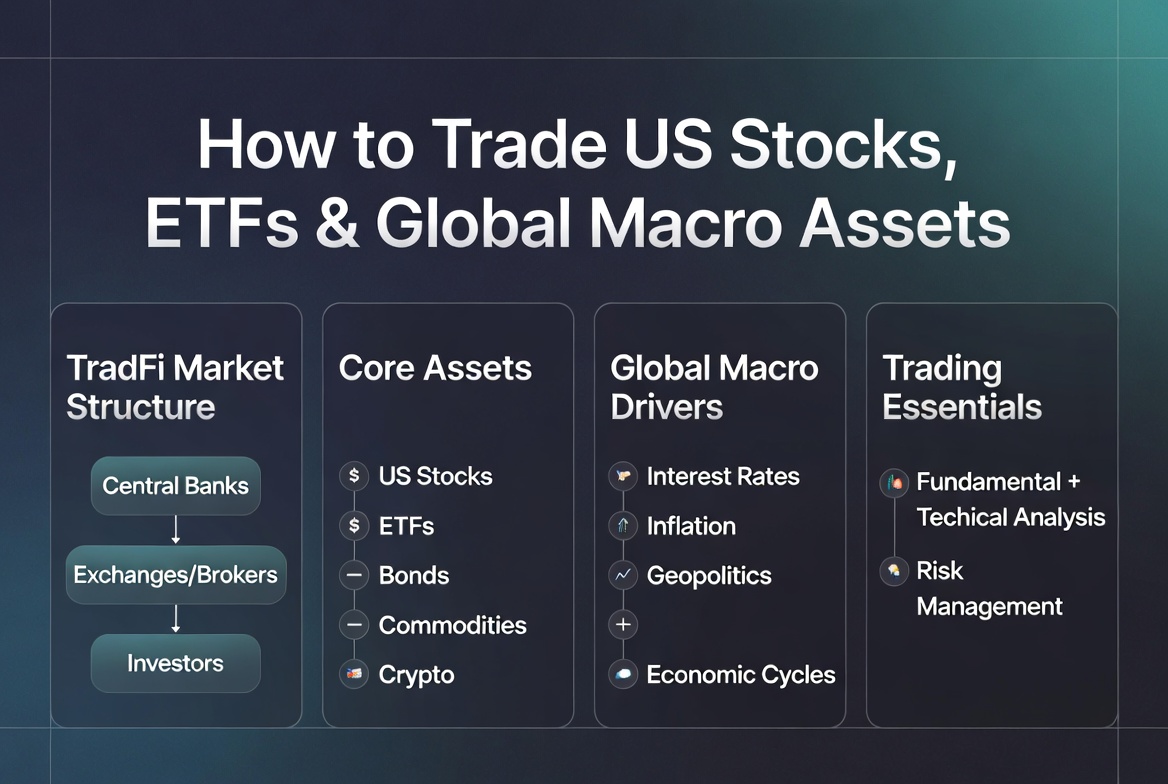
Global financial markets have developed a highly interconnected structure. Changes in Federal Reserve interest rates, the U.S. dollar's trajectory, the AI technology cycle, energy price volatility, and geopolitical risks all shape capital flows across different asset classes.
Unlike traditional single-stock investing, modern TradFi markets place a stronger emphasis on industry themes, index allocation, and global macro linkages. ETFs, index derivatives, and thematic assets have consequently become some of the most vital trading tools in global markets.
What Are TradFi Assets in Global Financial Markets?
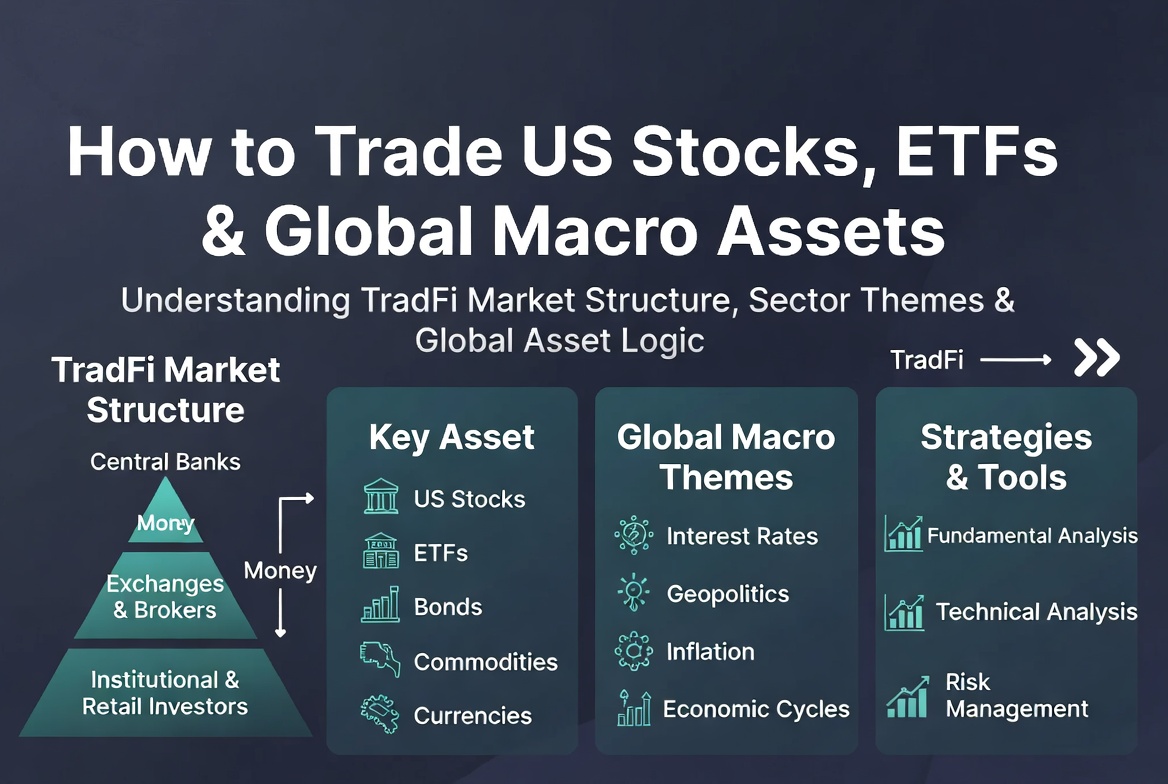
TradFi assets typically refer to mainstream trading instruments within the traditional financial system, including stocks, ETFs, bonds, indices, commodities, foreign exchange, and their related derivatives. In contrast to crypto assets, which rely on on-chain ecosystems and decentralized structures, TradFi markets have long been shaped by stock exchanges, banking systems, asset managers, and global regulatory frameworks.
The U.S. stock market is TradFi's core, as the world's largest tech companies, financial institutions, and consumer brands are primarily listed on U.S. exchanges. Meanwhile, the rapid growth of ETFs has expanded TradFi from individual stock trading to industry themes, indices, and portfolio trading.
Beyond stocks, derivatives like CFDs (Contracts for Difference) have become a key way for market participants to follow TradFi assets. CFDs track price movements of stocks, ETFs, indices, commodities, or forex without requiring asset ownership, making their structure distinctly different from traditional securities accounts.
Some digital asset platforms are now offering TradFi-related products. For instance, Gate CFD and other products cover select U.S. stocks, ETFs, indices, and global macro assets, allowing users to track price changes in both digital and traditional assets on a single platform.
| Asset Class |
Representative Markets |
| Stocks |
U.S. stocks, Hong Kong stocks, European stocks |
| ETFs |
Sector ETFs, Index ETFs, Commodity ETFs |
| Indices |
NAS100, SPX500, GER40, HK50 |
| Commodities |
Gold, Silver, Crude Oil |
| Forex |
USD, EUR, JPY, etc. |
| Derivatives |
CFDs, Futures, Options |
The key difference between TradFi and crypto markets lies in TradFi's long-standing exposure to global regulation, institutional capital, and macroeconomic policy. As a result, interest rate cycles, inflation, employment data, and central bank decisions directly impact TradFi asset volatility.
Why the U.S. Stock Market Is the Core of Global Risk Assets
The U.S. stock market has become the global pricing center for risk assets because the world's largest tech companies, AI firms, and financial institutions are predominantly listed there.
NASDAQ and NYSE are more than stock exchanges; they represent a key direction for global capital allocation. Many global ETFs, pension funds, and institutional investors prioritize U.S. assets.
AI's growth has further boosted the U.S. stock market's global influence. Companies in GPUs, cloud computing, HBM memory, and data centers are now among the most important growth themes in global capital markets.
Volatility in U.S. stocks often ripples across other markets. For example, a sharp rise in the NAS100 typically lifts Asian and European tech stocks.
This global linkage means the U.S. stock market isn't just domestic—it's a core pricing center for global macro assets.
How ETFs Reshaped Global Investment Markets
ETFs (Exchange-Traded Funds) have transformed global investing by allowing investors to access an entire industry, index, or asset class with a single product.
Traditional stock investing requires picking individual companies, but ETFs cover entire market sectors. For instance, SOXX covers semiconductors, URA (Global X Uranium ETF) covers uranium mining, and HYG tracks the high-yield bond market.
ETFs have also fueled the expansion of thematic investing. AI, semiconductors, renewable energy, nuclear energy, and gold all have their own ETF ecosystems.
The core benefits of ETFs include:
- Industry diversification
- High liquidity
- Relatively low trading costs
- Easier global asset allocation
The growth of ETFs has accelerated global capital flows. When a sector becomes a market hotspot, capital tends to flow into its ETFs first.
How Leveraged and Inverse ETFs Work
Leveraged and inverse ETFs are high-volatility derivative ETFs designed to amplify market moves.
For example, SQQQ is a triple inverse Nasdaq ETF, and SOXS is a triple inverse semiconductor ETF. These products use swap contracts, futures, and other derivatives to amplify daily returns.
The key feature of leveraged ETFs is daily rebalancing. They target amplified single-day returns, not cumulative long-term gains.
So, during periods of sustained high volatility, leveraged ETFs can experience significant decay.
| ETF Type |
Core Logic |
| Regular ETF |
Tracks an index |
| Leveraged ETF |
Amplifies index moves |
| Inverse ETF |
Shorts the index |
| Leveraged Inverse ETF |
Amplifies short moves |
Leveraged ETFs are mainly used for short-term trading and hedging, not long-term asset allocation.
The rise of thematic ETFs reflects a shift from broad-based indices to sector cycles.
AI, semiconductors, renewable energy, nuclear power, and energy infrastructure have become the core global market themes in recent years. These sectors have strong long-term trends, making them ideal for concentrated ETF allocations.
For example:
Sector ETFs have broadened investment logic from company analysis to industry chain analysis.
This shift has made macro trends and industry themes the primary drivers of global capital flows.
How Semiconductors, AI, and Data Centers Are Reshaping Tech Asset Valuations
AI has fundamentally altered the valuation of the global tech industry. GPUs, HBM memory, AI servers, and data center power demands are redefining growth logic for tech assets.
Companies like NVIDIA, AMD, Micron (MU), and Monolithic Power Systems (MPWR) are essential pieces of AI infrastructure.
Training AI models requires massive computing power, which in turn requires:
- GPUs
- HBM memory
- Power management chips
- Data centers
- Power infrastructure
This industry chain linkage has driven rapid growth in semiconductor and AI-themed ETFs.
Market focus on AI is not just about software—it's about a global infrastructure upgrade cycle.
Why Energy, Nuclear, and Commodity Assets Are Back in Focus
The global energy market has re-entered a high-volatility phase, bringing energy ETFs and resource assets back into the spotlight.
Crude oil, natural gas, gold, silver, and uranium are not just commodities—they're increasingly vital to global macro asset allocation.
The revival of nuclear energy has increased attention on uranium ETFs like URA. Meanwhile, energy infrastructure companies such as GE Vernova and Southern Company (SO) have become key players in the energy transition narrative.
Energy market changes are typically driven by:
- Geopolitics
- Inflation
- U.S. dollar movements
- Global economic cycles
- Energy security concerns
Thus, energy assets are both commodity plays and important risk indicators in the global macro market.
The Role of Gold, Silver, and Crude Oil in the Global Asset System
Gold, silver, and crude oil are among the most important commodities in the global financial system.
Gold is widely seen as a safe-haven asset, while silver has dual properties as both a precious and industrial metal. Crude oil is a fundamental input for the global industrial economy and energy consumption.
XAU, XAG, XTI, and Brent crude are all influenced by the U.S. dollar, interest rates, and the global economic cycle.
When market risk appetite falls, gold typically attracts capital inflows. When the global economy expands, crude oil demand rises.
This macro linkage has strengthened the correlation between commodity and stock markets.
Why Global Utilities and Energy Infrastructure Matter Again
As AI data centers, electrification, and renewable energy accelerate, global markets are refocusing on the importance of power infrastructure.
AI servers and large data centers need continuous, stable electricity, making power grids, utilities, and energy infrastructure more critical than ever.
Companies like DTE Energy, Southern Company (SO), and GE Vernova (GEV) are key players in the energy transition and power upgrade narrative.
Market attention on these companies stems not only from traditional utility revenue but also from:
- AI-driven electricity demand
- Grid modernization
- Renewable energy integration
- Nuclear energy expansion
- Infrastructure investment
Energy infrastructure has thus re-emerged as a major theme in global capital markets.
How Consumer, Airline, and Food Supply Chains Reflect the U.S. Economy
Consumer goods, airlines, and food supply chains are key lenses for observing the U.S. economy.
Companies like General Mills (GIS), Sysco (SYY), and Alaska Airlines (ALK) represent consumer brands, food supply chains, and air travel.
Consumer sectors tend to be defensive, while airlines are more sensitive to economic cycles and energy prices.
Food supply chain companies connect agriculture, logistics, and food service, so they reflect changes in U.S. consumer activity.
While not as high-growth as AI or semiconductors, these sectors remain essential to the U.S. economic ecosystem.
How Digital Banking in Latin America and the Global Fintech Ecosystem Are Evolving
The global fintech market is expanding rapidly, with Latin American digital banking among the fastest-growing segments.
Companies like CIB (Grupo Cibest) and BAP (Credicorp) represent the region's digital banking and fintech development.
Digital banking's core value lies in using mobile payments, super apps, and low-cost financial services to reach underserved populations.
Compared to traditional banks, digital banking emphasizes:
- User ecosystems
- Digital payments
- App-based platforms
- Integrated financial services
This trend has made fintech an increasingly important theme in global capital markets.
The Role of European and Asian Indices in Global Capital Markets
GER40 and HK50 represent key European and Asian stock indices.
GER40 reflects German industry and European manufacturing, while HK50 connects Chinese assets with global capital markets.
Unlike NAS100, which is tech-focused, GER40 is more tied to industry and exports, and HK50 is more influenced by China's economy and international capital flows.
Global indices are highly interconnected. The U.S. dollar, interest rates, energy prices, and economic cycles all affect different regional markets.
Therefore, index trading is not just regional—it's a component of global macro asset allocation.
How CFDs and Derivatives Connect Global Asset Markets
CFDs (Contracts for Difference) are important derivatives in the global TradFi market. They allow traders to participate in price movements without holding the underlying asset.
Through CFDs, traders can access:
- Stocks
- ETFs
- Indices
- Gold
- Crude oil
- Forex
CFDs typically use leverage, amplifying market volatility.
Platforms like Gate TradFi are expanding coverage of global stock indices, commodities, and ETFs, creating deeper ties between TradFi and crypto trading.
Key Differences Between U.S. Stock Indices, ETFs, and Crypto Markets
While U.S. stock indices, ETFs, and crypto markets are all global trading assets, their underlying structures differ significantly.
U.S. stock indices rely on corporate earnings and the macroeconomy. ETFs are portfolio tools. Crypto markets are driven by on-chain liquidity, sentiment, and tokenomics.
Crypto has higher volatility but operates 24/7, unlike TradFi.
Recent years have seen growing linkages:
- BTC ETFs have brought institutional capital into crypto
- AI themes affect both tech stocks and crypto AI tokens
- Fed rates impact both asset classes
The boundary between TradFi and crypto is gradually blurring.
Conclusion
Global TradFi markets have evolved from traditional stock trading into a comprehensive system centered around ETFs, indices, industry themes, and macro assets. Linkages among U.S. stocks, energy, commodities, bonds, and global indices are strengthening, while AI, semiconductors, nuclear energy, power infrastructure, and digital finance have become the most enduring long-term themes.
Meanwhile, ETFs, leveraged products, and derivatives enable faster capital flows across markets and sectors. Trading logic is no longer limited to single-company fundamentals—it's increasingly shaped by industry cycles, macroeconomic policy, interest rates, and global risk appetite.
FAQ
What is the TradFi market?
TradFi refers to traditional financial markets, including stocks, ETFs, bonds, indices, commodities, and derivatives.
What is the difference between an ETF and a stock?
A stock represents ownership in a single company; an ETF holds a basket of assets covering multiple companies or sectors.
Why do global markets focus on NAS100?
The NAS100 includes many major global tech companies, making it a key indicator of risk in the tech sector.
Why are leveraged ETFs riskier?
They amplify daily market moves, so in high-volatility environments, they can experience significant return decay.
Why is gold considered a safe-haven asset?
Gold typically attracts capital when market risk rises or the dollar weakens, making it a traditional safe-haven asset.
What is the difference between a CFD and an ETF?
An ETF is a fund that holds real assets; a CFD is a derivative that tracks price movements without requiring asset ownership.