In today’s AI Infra sector, most systems still focus primarily on model inference and computing power, while long-term memory and multi-agent collaboration remain at an early stage.
Unibase seeks to build the underlying environment AI Agents need to operate continuously through a decentralized Memory Layer, open agent protocols, and a data availability architecture. Its goal is to allow AI Agent systems to accumulate experience, share knowledge, and participate in open networks like persistent digital agents.
What Is Unibase’s Overall Architecture?
Unibase’s overall structure is mainly composed of three parts: Membase, AIP Protocol, and Unibase DA.
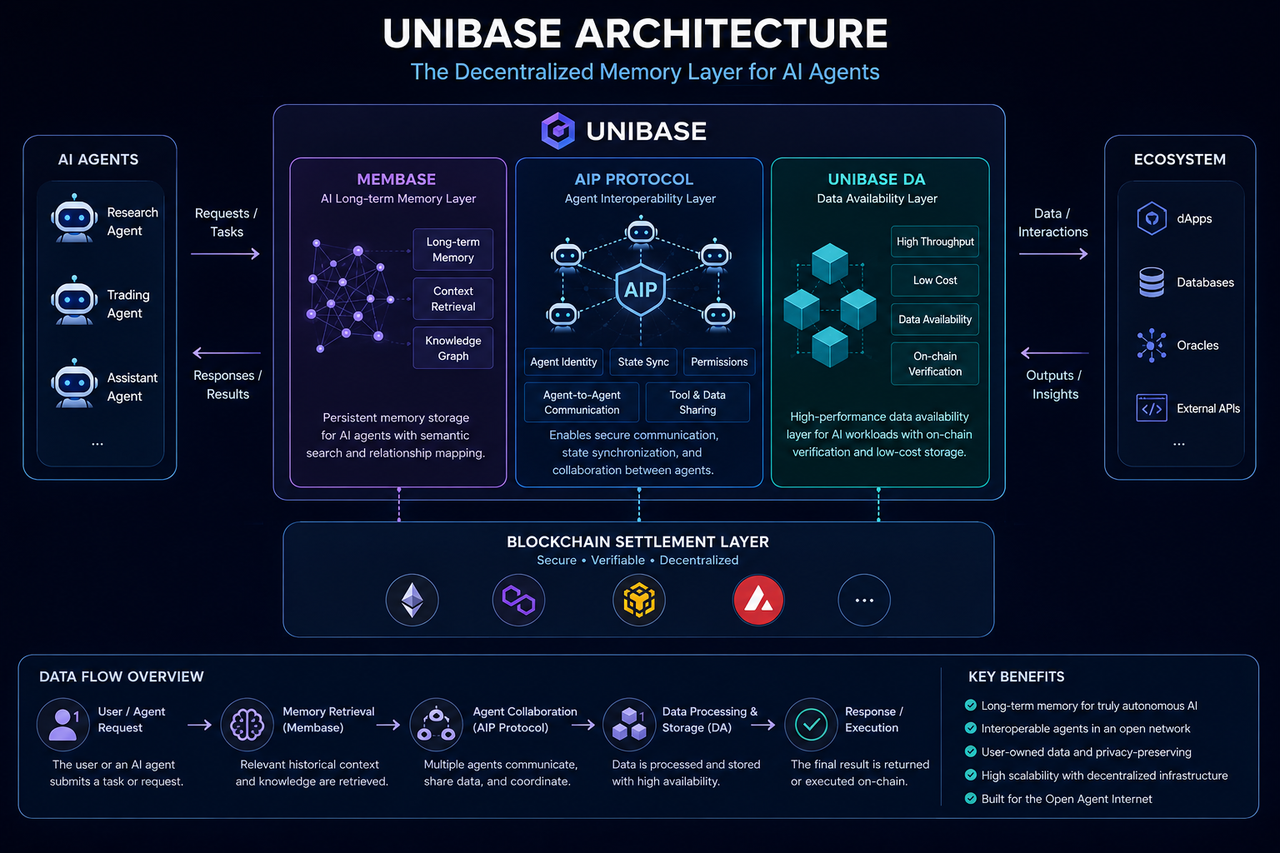
Membase is responsible for long-term memory management for AI Agents. It stores historical context, task states, and knowledge data. AIP Protocol, short for Agent Interoperability Protocol, establishes communication standards between agents, allowing different AI systems to exchange states and collaborate on tasks. Unibase DA, or Data Availability, supports the storage, synchronization, and accessibility of high-frequency AI data.
Traditional AI systems usually rely on centralized databases and short-term context windows. Unibase, by contrast, places more emphasis on long-term state synchronization and open agent networks. Its goal is not simply to improve model capabilities, but to provide the infrastructure AI Agents need to persist over time and collaborate with others.
| Module |
Core Role |
Main Function |
| Membase |
AI long-term memory layer |
Stores context, historical states, and knowledge data |
| AIP Protocol |
Agent communication protocol |
Identity management, state synchronization, and multi-agent collaboration |
| Unibase DA |
Data availability layer |
AI data storage, synchronization, and on-chain verification |
How Do AI Agents Generate and Store Memory?
In traditional large language models, conversational context is usually limited in length. Once a session ends, most of the state is not preserved over the long term. This makes it difficult for AI to accumulate experience continuously or remember user preferences and past tasks over time.
Unibase’s Membase module is designed to solve this problem.
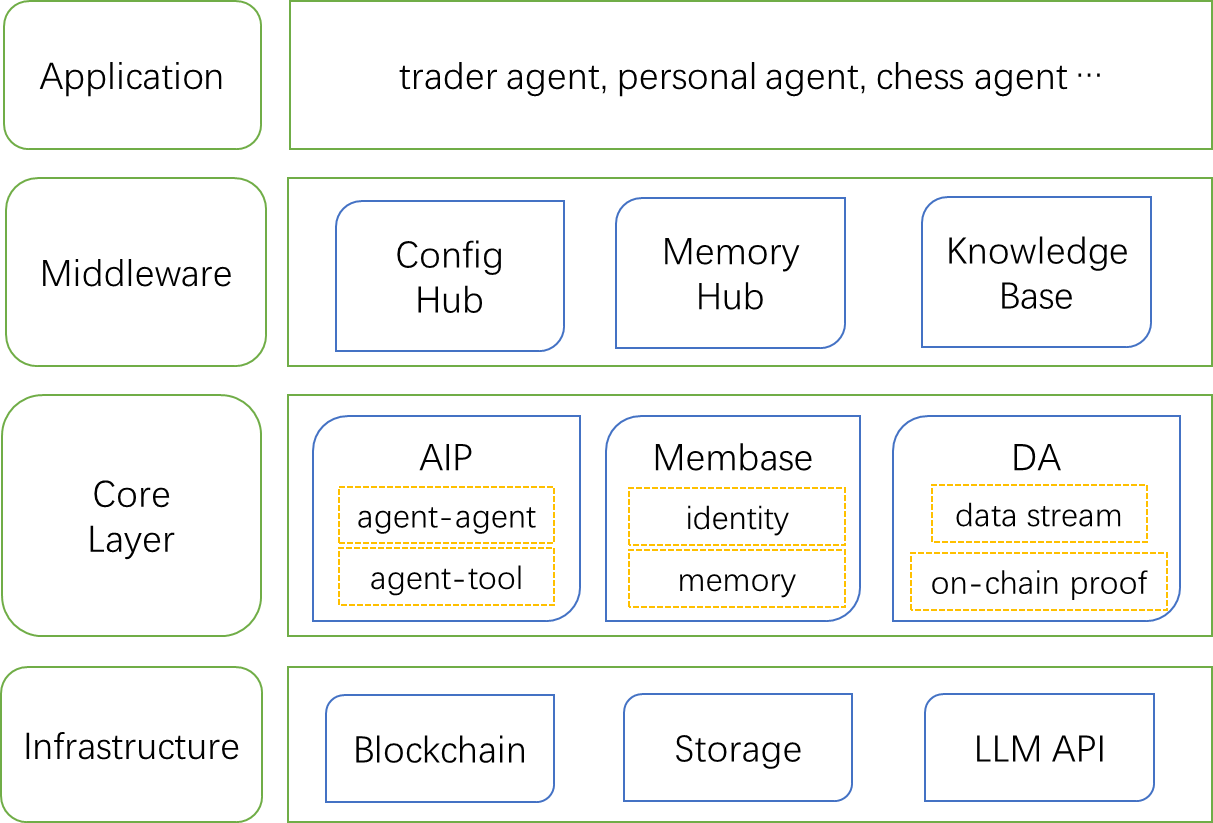
When an AI Agent interacts with a user, performs a task, or calls a tool, the relevant state is converted into structured memory data. This data may include past conversations, task results, environmental information, or knowledge fragments. Membase then writes this content into the long-term memory system and creates a searchable index.
In later tasks, the AI Agent can read these historical states again, enabling continuous learning and contextual continuity. This structure makes AI feel closer to a persistent digital entity rather than a one-time question-and-answer system.
| AI Memory Type |
Features |
Limitations |
| Short-term context window |
Fast response speed |
Cannot preserve state over the long term |
| Centralized database Memory |
Can store data over the long term |
Data remains dependent on platform control |
| Unibase Membase |
Decentralized long-term memory |
Supports multi-agent collaboration and state sharing |
How Does Membase Manage Long-Term Context?
The core logic of Membase is not simply to “store data.” It is designed to help AI continuously retrieve and manage historical states.
During actual operation, an AI Agent filters, updates, and retrieves long-term memory based on the needs of a task. For example, when a user makes another request, the agent can first retrieve relevant historical information, then combine it with the current context to generate a new response.
Compared with traditional databases, Membase focuses more on semantic-level memory management. This means AI is not just reading text. It can understand user relationships, task goals, and environmental changes based on historical states.
In multi-agent collaboration scenarios, different agents can also share certain memory states. For example, an agent responsible for research can synchronize its results with an execution agent, which then continues the next steps in the process.
This structure means long-term memory no longer belongs to a single model. Instead, it becomes shared infrastructure within an open agent network.
How Does AIP Protocol Enable Agent Communication?
AIP Protocol is Unibase’s agent interoperability protocol. Its role is similar to a communication standard for the world of AI Agents.
In the Open Agent Internet, different agents may come from different models, platforms, or applications. Without a unified protocol, it would be difficult for agents to exchange states and work together.
The core functions of AIP Protocol include identity management, state synchronization, permission control, and agent-to-agent communication. For example, one agent can request data analysis results from another agent or delegate a specific task to it.
This structure shares some similarities with the way smart contracts interact in Web3. Through a unified standard, different AI Agents can form collaborative relationships within an open network, instead of being limited to a single platform.
| Function |
Role of AIP Protocol |
| Agent Identity |
Manages agent identity and permissions |
| State Sync |
Synchronizes agent states |
| Communication |
Establishes agent-to-agent communication |
| Task Coordination |
Supports multi-agent collaboration tasks |
| Tool Invocation |
Enables cross-platform agent tool calls |
How Does Unibase DA Support AI Data Operations?
AI Agents generate large amounts of high-frequency data while operating continuously, including memory updates, task states, tool call records, and collaboration information.
Traditional blockchains usually struggle to process this kind of high-throughput AI data directly, so Unibase introduces a dedicated Data Availability Layer.
The core role of Unibase DA is to improve AI data throughput, reduce long-term storage costs, ensure state accessibility, and support on-chain verification and synchronization.
For AI Agent networks, the data availability layer acts as the underlying infrastructure for long-term memory and state synchronization. Without stable data availability support, AI Agents would struggle to operate continuously and share states.
| Data Type |
Role in Unibase DA |
| Conversation state |
Stores the agent’s current context |
| Memory Updates |
Synchronizes long-term memory updates |
| Tool Records |
Stores tool call results |
| Agent Collaboration Data |
Records multi-agent collaboration states |
| Verification Data |
Supports on-chain verification and traceability |
How Is an AI Agent Collaboration Workflow Completed?
In Unibase’s architecture, a typical multi-agent collaboration workflow usually includes several stages.
First, a user submits a task request to an AI Agent, such as data research, market analysis, or automated execution. The agent then calls Membase to retrieve long-term historical states, including user preferences, past tasks, and relevant knowledge data.
When a task involves multiple agents, AIP Protocol establishes the communication connection between them. For example, a research agent may be responsible for collecting information, while an execution agent handles subsequent processing.
As the task runs, all state changes and data updates are synchronized to Unibase DA to ensure data accessibility and state consistency. Once the task is complete, the newly generated data is written back into Membase and becomes a long-term context for future tasks.
| Stage |
System Module |
Main Role |
| User request |
AI Agent |
Receives the task |
| Memory retrieval |
Membase |
Calls historical context |
| Agent collaboration |
AIP Protocol |
Establishes communication and state synchronization |
| Data synchronization |
Unibase DA |
Stores operating state |
| Memory update |
Membase |
Writes long-term memory |
How Is Unibase Different From Traditional AI Systems?
Traditional AI systems usually use centralized architectures, with memory and state mostly stored inside platform databases. Users have limited control over their data and cannot easily enable cross-platform agent collaboration.
By contrast, Unibase places greater emphasis on long-term memory systems, open agent communication protocols, decentralized data structures, and multi-agent collaboration capabilities.
Traditional AI is more like a one-time model call, while Unibase focuses more on the long-term autonomy and persistence of AI Agents.
| Comparison Dimension |
Traditional AI Systems |
Unibase |
| Memory |
Short-term context |
Long-term memory system |
| Data structure |
Centralized databases |
Decentralized storage |
| Agent collaboration |
Limited |
Supports open network collaboration |
| State synchronization |
Internal to the platform |
Cross-platform agent synchronization |
| Data ownership |
Platform controlled |
Places greater emphasis on openness and verifiability |
Why Does the Open Agent Internet Need a Memory Layer?
The core goal of the Open Agent Internet is to allow AI Agents to exist over the long term, interact continuously, and form collaborative networks, much like users on the internet.
If AI Agents cannot preserve long-term states, each task must rebuild its context from scratch, which would clearly limit collaboration efficiency. In essence, the Memory Layer exists to give AI Agents a “persistent identity” and “long-term experience.”
Under this structure, AI is no longer just a model that temporarily generates content. It becomes more like a digital agent that can grow over time.
For this reason, long-term memory systems are considered one of the key infrastructure layers of the Open Agent Internet, and Unibase is a representative project in this direction.
Conclusion
Unibase’s core operating logic revolves around long-term memory, open protocols, and data availability.
Through Membase, AIP Protocol, and Unibase DA, AI Agents can preserve long-term context, collaborate across platforms, and continuously synchronize states within an open network. This structure means AI Agents are no longer just short-term tools, but are closer to autonomous digital entities that can persist over time.
FAQs
What Is the Role of Membase?
Membase is used to store the long-term context, historical tasks, and knowledge data of AI Agents, allowing AI to keep learning and retrieve historical information over time.
How Does AIP Protocol Work?
AIP Protocol is an agent communication protocol used to support agent identity management, state synchronization, and multi-agent collaboration.
What Is Unibase DA?
Unibase DA is a data availability layer used to support high-frequency data storage, synchronization, and accessibility for AI Agents.
Why Do AI Agents Need Long-Term Memory?
Long-term memory helps AI preserve historical states, continuously accumulate experience, and improve collaboration on complex tasks.
What Is the Open Agent Internet?
The Open Agent Internet is an open network where AI Agents can connect and interact with one another, allowing multiple AI Agents to collaborate under a unified protocol.







