Meta AI is a generative AI ecosystem developed by Meta. Its core design principle is embedding large language model (LLM) capabilities into social platforms, advertising systems, and content delivery networks, transforming AI into an infrastructure layer that drives product efficiency and business conversion optimization. At the same time, it extends its developer ecosystem influence outward through the open-source Llama model.
As generative AI accelerates the restructuring of digital content production and interaction logic, AI is evolving from a single tool into a system-level infrastructure. It is not only reshaping how information is distributed but also redefining the value chains of advertising, social relationships, and content creation. This shift has transformed Meta from a traditional social media company into an application-driven AI infrastructure platform.
By examining Meta AI’s technical architecture, the Llama model ecosystem, its integration across applications, and its competitive dynamics with companies like Google, OpenAI, and Anthropic, we can better understand its strategic position and evolution path within the global AI industry.
Meta AI is the generative AI platform built by Meta. By nature, it is an intelligent capability layer spanning social media, advertising, and content ecosystems, rather than a standalone product.
Its primary goal is to enhance the efficiency of existing products through LLM capabilities—including content understanding, generation, recommendation optimization, and intelligent ad targeting—making AI the underlying engine for Facebook, Instagram, and WhatsApp.
Structurally, Meta AI adopts a dual-track strategy: “internal application-driven + external open-source diffusion.” Internally, it boosts business efficiency; externally, it expands the developer ecosystem via the Llama model, creating scalable influence.
Why Do Developers Care About the Llama Open-Source Model?
Llama is Meta’s open-source LLM family and the most ecologically influential component of its AI strategy.
Developers are drawn to Llama for three key reasons:
- High openness: Unlike closed models, Llama supports flexible local deployment and fine-tuning, lowering the barrier to AI application development.
- Continuous performance upgrades: Newer Llama versions show steady gains in reasoning, context length, and multimodal capabilities, gradually catching up to commercial closed-source models.
- Rapidly expanding ecosystem: A rich ecosystem of toolchains, inference frameworks, and community optimization solutions has grown around Llama, further improving its usability.
This open-source approach gives Meta a “technology diffusion influence” in AI—meaning it doesn’t rely solely on its own product commercialization but also leverages the developer ecosystem to amplify long-term impact.
Meta AI’s core advantage lies in its deep embedding across products, rather than existing as a separate app.
- On Facebook, AI optimizes news feed ranking, ad matching, and content understanding, increasing user engagement and ad conversion rates.
- On Instagram, AI enhances image generation, short-video recommendations, and creative tools, making content production more automated and personalized.
- On WhatsApp, AI acts as a conversational assistant, powering multilingual translation, automated customer service, and information processing to improve communication efficiency.
This full-product integration turns AI into the central engine of Meta’s ecosystem, not just an add-on feature.
What Are Reality Labs and AI Smart Hardware Plans?
Reality Labs is Meta’s core division for AR/VR and spatial computing, serving as the main vehicle for AI hardware deployment. Meta is now driving the convergence of AI with smart glasses, VR headsets, and wearables, moving AI from screen-based interactions to environmental sensing and real-time engagement. For example, visual recognition, speech understanding, and live translation create more natural human-computer interactions.
The strategic significance is to extend AI from software into the physical world, positioning Meta for the next generation of computing platforms and securing long-term ecosystem control.
Meta is evolving from “content-generating AI” to “task-executing AI agents,” enabling AI not just to answer questions but to autonomously perform complex operations.
In advertising, AI agents can automatically optimize bidding strategies, generate ad creatives, and perform user segmentation analysis, boosting overall business efficiency.
At the same time, Meta is building enterprise-grade AI services based on Llama, offering APIs and model deployment to developers and businesses, gradually establishing an infrastructure layer.
This direction puts Meta in competition with Microsoft’s cloud AI services, but Meta’s focus remains on “application-driven efficiency improvements” rather than pure cloud platform output.
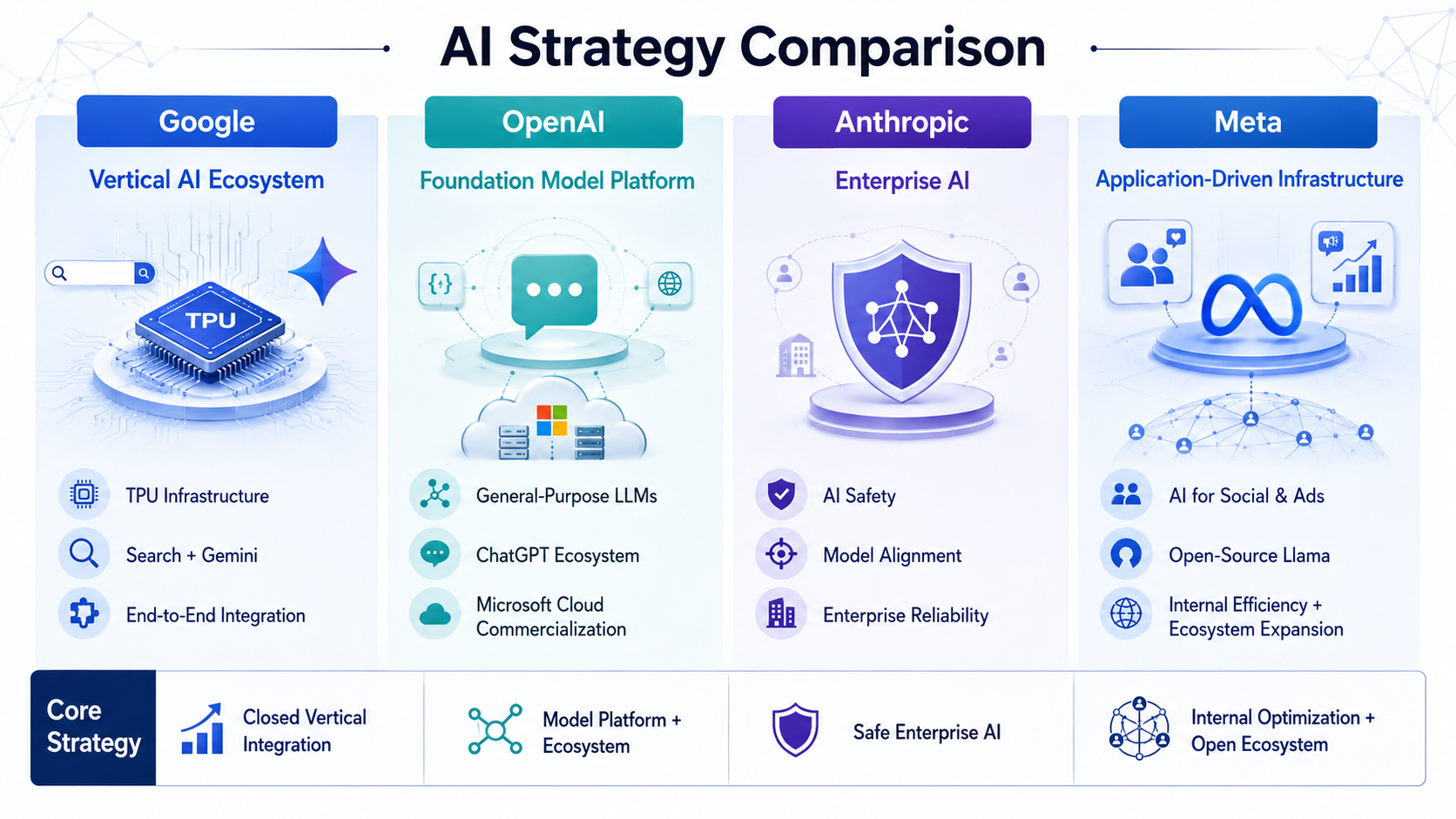
In the AI landscape, each company follows a distinct path:
- Google builds a vertically integrated closed loop with TPUs, Search, and Gemini, tightly coupling technology and products.
- OpenAI focuses on general-purpose LLMs and the ChatGPT ecosystem, commercializing through Microsoft’s cloud infrastructure.
- Anthropic prioritizes model safety and enterprise-grade alignment.
By contrast, Meta’s strategy is application-driven infrastructure: AI first serves its own social and advertising systems, while the open-source Llama model extends ecosystem influence externally. The result is a hybrid model of “internal efficiency maximization + external ecosystem diffusion.”
Meta AI faces three main challenges:
- Model capability pressure: OpenAI and Google still lead in general LLM performance and multimodal capabilities.
- Hashrate cost issues: Large-scale training and inference demand massive infrastructure investment.
- Commercialization balance: Meta must carefully balance ad efficiency improvements with user experience.
Additionally, while the open-source strategy boosts ecosystem influence, it may also lower technical barriers, making long-term differentiation harder to sustain.
Meta AI is expected to follow three major directions:
- Stronger multimodal capabilities: Unified understanding and generation of text, images, video, and voice.
- AI agents evolve from assistants to autonomous executors: Handling complex tasks end-to-end.
- Expansion of hardware entry points: AR glasses and spatial computing devices power the next interaction platform.
As the Llama ecosystem matures, Meta is poised to form a “social + AI + hardware” trinity, evolving from an application company into an infrastructure platform.
Summary
Meta AI’s core logic isn’t about a single technological breakthrough. Instead, it is building a generative AI ecosystem driven by applications—centered on the open-source Llama model, deep integration with social products, and strategic hardware entry points. In competing with Google, OpenAI, Microsoft, and others, Meta has chosen a differentiated path: optimizing its own product efficiency as the core and using open-source expansion as a growth lever, forming a dual growth model of “internal optimization + external diffusion.”
As AI agents and multimodal capabilities mature, Meta AI will evolve from a feature enhancement layer into the core infrastructure connecting social media, advertising, and digital interaction.