As Provas de Conhecimento Zero (ZKPs) foram inicialmente criadas para proteger a privacidade, mas, com o aumento das exigências de escalabilidade da blockchain, a tecnologia zk tornou-se um pilar essencial nas soluções Layer2 e nas arquiteturas modulares. Recentemente, inovações como zkRollup, zkVM e computação verificável ampliaram de forma acelerada o alcance da tecnologia zk, indo além da privacidade das transações para abranger computação de alto desempenho, inferência de IA e finanças on-chain.
No universo zk, a zkSync e a Nexus seguem caminhos distintos. A zkSync dedica-se à escalabilidade do Ethereum e ao apoio ao ecossistema compatível com EVM, enquanto a Nexus aposta na computação verificável e em redes de provas, visando permitir cenários de computação on-chain mais sofisticados com zkVM e arquitetura modular. Distinguir claramente estes dois projetos permite compreender melhor o futuro da tecnologia zk.
Visão geral da Nexus e da zkSync
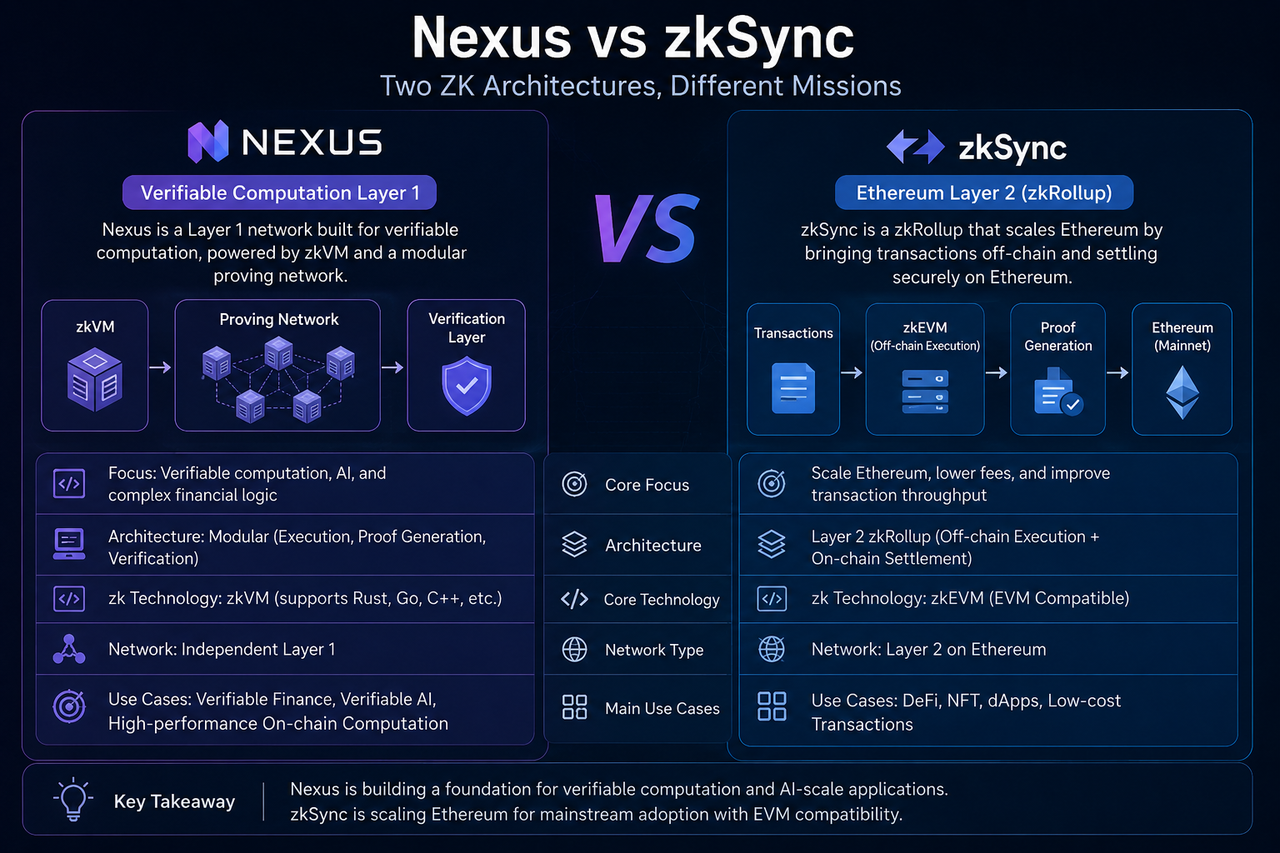
A Nexus é uma rede Layer1 desenvolvida especificamente para computação verificável, destinada a possibilitar computação verificável em grande escala através de zkVM, uma rede de provas modular e uma arquitetura de verificação distribuída.
Enquanto as cadeias públicas tradicionais privilegiam o throughput de transações, a Nexus dá prioridade ao “modo de verificação de computação complexa”. A arquitetura assenta em zkVM, geração de provas e rede de provas, orientando-se para Finanças verificáveis, IA verificável e computação on-chain de alta frequência.
Por contraste, a zkSync é uma rede zkRollup construída sobre o Ethereum, desenhada para aumentar o throughput de transações do Ethereum e reduzir custos de Gas.
Em que diferem Nexus e zkSync no posicionamento central?
Embora tanto a Nexus como a zkSync recorram a provas zk, cada uma responde a desafios diferentes.
O objetivo principal da zkSync é “escalar o Ethereum”, enfrentando os custos elevados de Gas e a limitação de velocidade de transação no Ethereum. A sua abordagem é, essencialmente, uma agregação Rollup Layer2.
Já a Nexus está centrada na “verificação de computação complexa”. O projeto propõe-se permitir verificação de baixo custo para inferência de IA, automação e lógica financeira avançada.
Resumidamente, a zkSync é uma infraestrutura de escalabilidade para transações, e a Nexus é uma infraestrutura de computação verificável. Esta diferença fundamental define a arquitetura, as prioridades de desenvolvimento e o posicionamento no ecossistema de cada uma.
Que diferenças de arquitetura existem entre a Nexus e a zkSync?
A zkSync adota uma arquitetura zkRollup tradicional: as transações são executadas numa rede Layer2, com as atualizações de estado a serem submetidas ao Ethereum através de provas zk.
Assim, herda-se a segurança do Ethereum e aumenta-se consideravelmente o throughput.
Por sua vez, a Nexus aplica um design modular. A rede separa execução, prova e verificação em camadas independentes, recorrendo a uma rede de provas para a geração de provas.
Em síntese:
- A zkSync atua como “camada de escalabilidade do Ethereum”
- A Nexus funciona como uma “Layer1 centrada num sistema de provas”
Ambas dependem de provas zk, mas os objetivos de design dos seus sistemas são distintos.
Como difere a Nexus zkVM da zkSync zkEVM?
A zkEVM é uma tecnologia-chave para a zkSync, visando compatibilidade com o ecossistema Ethereum Virtual Machine. Os programadores podem continuar a utilizar Solidity e as ferramentas EVM já estabelecidas.
A Nexus zkVM privilegia a computação de uso geral. Suporta Rust, Go, C++ e outras linguagens de programação amplamente adotadas, com especial enfoque na verificação de programas complexos.
A zkEVM concentra-se na compatibilidade, ao passo que a zkVM é orientada para a computação verificável.
Esta distinção implica que:
- A zkEVM é indicada para migração de aplicações DeFi e EVM tradicionais
- A zkVM é ideal para IA, lógica financeira avançada e automação
Com a crescente procura de computação on-chain, a zkVM é cada vez mais identificada como base para ambientes de computação fidedigna de nova geração.
Quais são os cenários de aplicação distintos para a Nexus e a zkSync?
Os principais usos da zkSync são DeFi, NFT, escalabilidade de dApp Ethereum, transações de baixo custo e migração do ecossistema EVM. A sua missão central é reduzir custos operacionais das aplicações Ethereum.
Já a Nexus foca-se em Finanças verificáveis, IA verificável, redes de provas, computação on-chain de alto desempenho e verificação de inferência de IA. Assim, a Nexus é preferível em cenários que exigem computação complexa e geração de provas, não apenas escalabilidade transacional.
Como se comparam Nexus e zkSync em desempenho e escalabilidade?
A estratégia de escalabilidade da zkSync assenta no throughput de transações e na otimização de custos de Gas, com ganhos de performance sobretudo através da agregação Rollup.
A Nexus aposta na eficiência da geração de provas e na verificação paralela. A rede de provas distribuída permite atribuir tarefas de prova a diferentes nodo, ampliando a capacidade de processamento para computações complexas.
A lógica de escalabilidade pode ser resumida assim:
| Dimensão de comparação |
Nexus |
zkSync |
| Posicionamento central |
Computação verificável |
Ethereum Layer2 |
| Tipo de rede |
Layer1 |
zkRollup |
| Tecnologia central |
zkVM + Rede de provas |
zkEVM |
| Objetivo principal |
Verificar computação complexa |
Aumentar throughput de transações |
| Linguagens de programação |
Rust / Go / C++ |
Solidity |
| Suporte a IA |
Robusto |
Limitado |
| Dependência do Ethereum |
Relativamente independente |
Altamente dependente |
No longo prazo, estes projetos não são concorrentes diretos, mas representam ramos distintos do desenvolvimento da tecnologia zk.
Que desafios enfrentam a Nexus e a zkSync?
Apesar do rápido progresso da tecnologia zk, ambos os projetos enfrentam desafios próprios.
A zkSync tem de gerir continuamente a compatibilidade com zkEVM, os custos da agregação Rollup e a forte dependência do Ethereum.
A Nexus encara custos elevados de geração de provas, um ecossistema de desenvolvimento ainda em fase inicial e um mercado de IA verificável embrionário.
O setor zk é altamente competitivo, incluindo projetos como Starknet, Scroll, Polygon zkEVM e várias iniciativas modulares que exploram rotas técnicas alternativas.
Em última análise, a adoção em larga escala de uma arquitetura zk dependerá da maturidade do ecossistema de programadores, da capacidade do hardware e da procura do mercado real.
Resumo
Apesar de ambas assentarem em provas de conhecimento zero, Nexus e zkSync têm objetivos centrais distintos.
A zkSync prioriza a escalabilidade Layer2 do Ethereum, recorrendo a agregação Rollup e zkEVM para aumentar a eficiência das transações e reduzir custos de Gas. A Nexus, por sua vez, aposta na computação verificável, com suporte a IA, Finanças verificáveis e verificação de lógica complexa on-chain através de zkVM e redes de provas.
A longo prazo, a tecnologia zk está a evoluir de uma solução exclusiva de escalabilidade para servir de base à infraestrutura de computação fiável. zkSync e Nexus representam caminhos diferentes nesta evolução.
Perguntas frequentes
Qual é a principal diferença entre a Nexus e a zkSync?
A zkSync é sobretudo uma solução de escalabilidade agregação Rollup para Ethereum, enquanto a Nexus está centrada em computação verificável e infraestrutura de provas.
Porque é que a Nexus utiliza zkVM?
A Nexus recorre à zkVM para gerar provas zk, permitindo verificar resultados de computações complexas sem que cada nodo reexecute o programa.
Qual a diferença entre zkEVM e zkVM?
A zkEVM foca-se na compatibilidade com o ecossistema Ethereum, enquanto a zkVM destina-se a computação verificável de uso geral.
Para que serve, principalmente, a zkSync?
A zkSync é utilizada para escalar o Ethereum, reduzir custos de Gas e facilitar transações on-chain de baixo custo.
São a Nexus e a zkSync concorrentes?
Ambas integram o setor zk, mas resolvem desafios distintos e representam direções técnicas diferentes.