Unlike traditional token projects that hinge on a single DApp or purely speculative narratives, Palladium Network represents a systematic integration of on-chain settlement, off-chain execution, and treasury strategies. Real estate rental income and appreciation, standard and triangular arbitrage, staking tiers, an internal Swap, and programmatic buyback and burn form a multi-module closed loop — not a case of "decentralization" used as a marketing label.
From an industry evolution standpoint, Palladium Network embodies the convergence of RWA tokenization, DeFi automated strategies, and deflationary token design on the Ethereum mainnet during 2025–2026. In 2025, it completed its TGE, five rounds of open market buybacks, and launched staking and Swap. 2026 is the expansion year, advancing real estate RWA NFTs and income distribution, and completing the PLLDv2-to-PLLDv3 contract migration in May 2026. The following sections cover core technology layers, infrastructure construction, collaboration and data transmission, comparison with centralized alternatives, security and privacy, application scenarios, track challenges, and future directions, providing a systematic understanding of how the network works.
Core Technical Architecture of Palladium Network
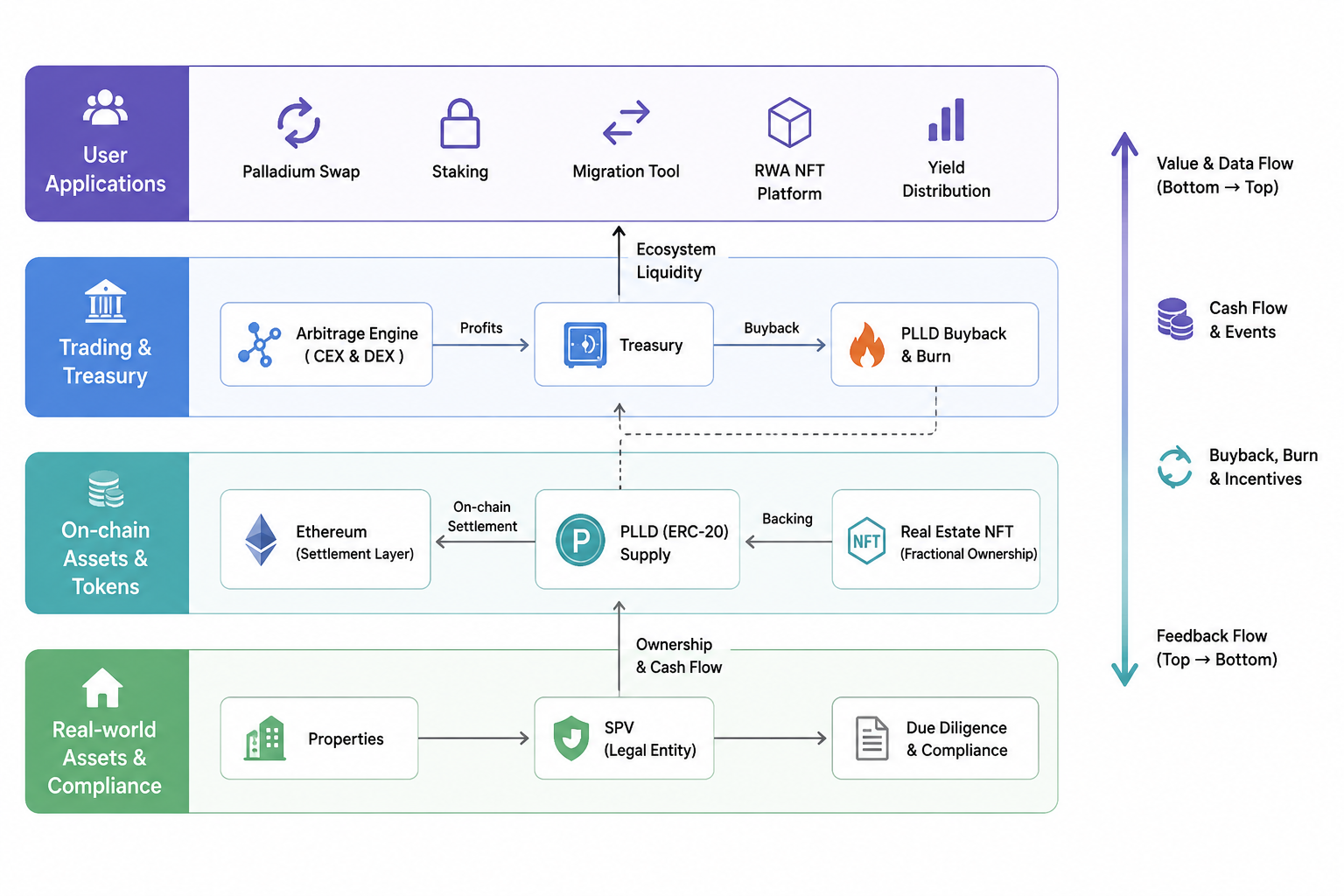
Palladium Network's tech stack can be broken down into four layers: Asset and Compliance, On-Chain Representation and Token, Trading and Treasury, and User Application. These layers are coupled through defined interfaces and fund flows, forming a closed loop of value anchoring, profit generation, supply management, and user reach.
The Asset and Compliance layer handles tokenization of offline real estate. After legal, environmental, and financial due diligence, an SPV holds the property title and isolates liabilities. On-chain Real Estate NFTs represent proportional shares, giving holders exposure to rental income and appreciation via NFT metadata and supporting legal documents — rather than direct ownership of a single title on the land registry.
The On-Chain Representation and Token layer uses Ethereum as the primary settlement environment. The native token PLLD is an ERC-20 asset. In May 2026, the official PLLDv2→PLLDv3 migration was completed; the current contract must be verified against the official website address (v2 is obsolete, and users should watch for counterfeit tokens on DEXs). Fractional shares are released via on-chain streaming vesting through Sablier, making unlock schedules publicly auditable. Burns send tokens to the Ethereum Null address, and cumulative burn amounts and effective circulating supply can be checked on-chain.
The Trading and Treasury layer is the ecosystem's cash flow engine. The automated system connects to 15+ centralized and decentralized exchanges, executing standard arbitrage (capturing short-term price gaps) and triangular arbitrage (exploiting small deviations among paths like ETH, BTC, USDT). Profits flow into the treasury, which performs PLLD open market buybacks at randomized intervals, paired with periodic burns — mapping off-chain strategy gains to on-chain supply discipline. This layer typically runs on low-latency servers and real-time market data feeds, representing a hybrid of off-chain computation and on-chain settlement.
The User Application layer includes the live Palladium Swap (asset swapping on Ethereum), staking platform, official migration tool, and roadmap items such as RWA NFT pre-sale, on-chain issuance, and income distribution interfaces. Each module shares the same token and treasury narrative but has clear technical boundaries: Swap and staking use smart contract interactions; property income distribution depends on a combination of SPV governance and on-chain NFT logic.
Overall, Palladium Network is not a single consensus chain but an ecosystem-type decentralized financial network, with the Ethereum mainnet as the root of trust and multi-module collaboration as its edges. Decentralization is reflected in the verifiability of asset ownership certificates, supply changes, and fund flows; operational centralization is partly seen in the off-chain execution of the trading engine and property management.
Using a simplified topology: offline properties and SPVs sit at the bottom; above them are on-chain rights and supply layers represented by NFTs and PLLD; then the arbitrage engine and treasury, which convert market behavior into token-layer discipline; the outermost layer consists of user interfaces like Swap, staking, migration, and NFT platforms. Value and data flow upward, converging into cash flows and on-chain events, and flow downward as buybacks, burns, and incentive parameters to token holders and NFT holders. This topology helps distinguish which states are immutable on-chain and which processes still rely on operator honesty and competence — avoiding the mistake of viewing a Web3 ecosystem as fully autonomous on-chain.
How Decentralized Network Infrastructure Is Built
Building such an ecosystem requires coordination across four areas: public chain selection, contract systems, off-chain services, and governance transparency.
Public Chain and Standards: The project chooses Ethereum as its current main arena, leveraging its mature ERC-20/ERC-721 (or compatible NFT standards) ecosystem, wallet infrastructure, and block explorer audit capabilities. PLLD transfers, approvals, burns, and vesting streams are all traceable on-chain, reducing reliance on a "black box ledger."
Smart Contracts and Upgrades: The 2026 PLLDv3 upgrade aims to optimize the contract structure for RWA and staking compatibility. Users should only use the official migration portal to convert v2, avoiding approval of phishing contracts. Whether contract permissions (mint, pause, admin, etc.) are minimized and whether multi-sig or timelock is in place are key technical indicators for assessing the degree of decentralization. Researchers should directly read verified contracts and official migration announcements rather than relying on brand claims alone.
Off-Chain Infrastructure: The trading engine depends on high-performance nodes, exchange APIs, risk control, and fund scheduling systems. The real estate process relies on SPVs, custody, valuation, and rental management. These components form the network's execution plane, usually maintained by the operating entity, but they are linked to the on-chain plane through quarterly buyback disclosures, on-chain burn reports, Sablier unlock links, etc., creating a verifiable dual-ledger structure.
Liquidity Infrastructure: Palladium Swap provides an in-ecosystem exchange gateway, improving PLLD accessibility. External CEX listings (e.g., TradeOgre) expand price discovery. The randomized design of treasury buybacks aims to reduce predictable front-running, acting as a mechanism-level buffer against MEV and speculative behavior — not a complete elimination of market games.
Supply Infrastructure: Genesis supply is 100 million PLLD. After structured burns, effective circulating supply is approximately 52.64 million (per Litepaper v1.2), with a long-term cap of 30 million. The supply curve is shaped by burns, buybacks, and vesting, forming the hard constraint parameters of the network's economic layer. In 2025, the project announced multiple rounds of open market buybacks, with official news mentioning cumulative burns exceeding 47 million PLLD. This makes effective circulation significantly lower than genesis design, directly affecting the relative weights of staking yields, Swap depth, and unlock selling pressure.
Monitoring and Observability: A mature ecosystem typically includes block explorer labels, holder distribution statistics, Sablier unlock calendars, and burn address inflow monitoring. Participants can compare on-chain metrics (daily burn volume, treasury outflows, large staking changes) with official quarterly buyback disclosures to build their own network health dashboard. This is part of the decentralized infrastructure accessible to users in practice.
In summary, Palladium Network's decentralized infrastructure = Ethereum trust layer + auditable contracts and vesting + transparent treasury strategy + off-chain high-performance execution. Its goal is to reuse public chain security and DeFi legos in a modular way without building its own L1.
Data Transmission and Network Collaboration Mechanisms
Data and value flows within the ecosystem can be summarized into three main paths: market data and instruction flow, on-chain state flow, and off-chain compliance and income flow.
Market Data and Instruction Flow: The trading engine subscribes to order book and trade data from multiple exchanges, identifies price gaps and plans paths in memory, generates buy/sell instructions, and sends them via API. This path is latency-sensitive, with data mostly staying in an off-chain closed loop. It interacts with smart contracts or treasury wallets only when profits, positions, or risk parameters need to be on-chained. This is typical off-chain computation, on-chain settlement — different from the full transparency of on-chain AMMs, but partially verifiable through post-hoc audits (trade records, buyback hashes).
On-Chain State Flow: Users trigger operations like Swap, staking, migration, NFT minting, or claiming via wallet signatures. Nodes broadcast transactions, and contracts update balances, staking shares, or NFT ownership. PLLD burns, buyback transfers, and Sablier releases generate indexable events for analytics platforms and community monitoring. During the 2026 PLLDv3 migration, the on-chain state flow also includes a batch state migration of old contract balance → migration contract → new tokens, placing higher demands on wallet UI and approval management.
Off-Chain Compliance and Income Flow: Real estate rental income, property maintenance costs, SPV dividend decisions, etc., happen within the legal and accounting system, then reach NFT holders through on-chain distributions (or declared distributions). This path is a common bottleneck for RWA projects: consistency between on-chain credentials and off-chain cash flows depends on disclosure quality and custodial structure, not just consensus algorithms.
Module Collaboration: Arbitrage profits → Treasury → Buyback/Burn → Reduced circulating PLLD → Changes in staking and Swap depth → User behavior feeds back to trading and NFT demand. Real estate NFT income → Enhances "tangible anchor" narrative → Affects holding and staking willingness → Indirectly supports token layer stability. Modules are not simply parallel; they form feedback loops through the treasury and token supply.
Understanding how the network collaborates requires seeing both sides: on-chain modules speak through transactions and events; off-chain modules speak through profits and property cash flows. They converge at the PLLD economy and treasury policy.
From an engineering perspective, two more collaboration interfaces are worth noting: APIs and indexers push off-chain engine states and buyback plan summaries to front-ends and community dashboards; event subscriptions allow on-chain actions (staking, burns, large transfers) to trigger alerts or automated reports. Wallets serve as the unified user-side entry point, handling address management, signing, and network switching. After the 2026 PLLDv3 migration, users must clearly distinguish whether old v2 balances have been exchanged within the same wallet, avoiding duplicate approvals or accidental transfers to abandoned contracts. The overall collaboration rhythm can be summarized as: off-chain prioritizes throughput and strategy iteration speed; on-chain prioritizes state finality and immutability; treasury policy acts as a confluence valve between them.
How Palladium Network Differs from Traditional Centralized Solutions
Compared to traditional centralized finance or purely on-chain protocols, Palladium Network differs in trust source, module boundaries, and value anchoring.
| Dimension |
Traditional Centralized Solution (e.g., Broker + REIT Portal) |
Palladium Network |
| Root of Trust |
Institutional license, custodian bank, internal ledger |
Ethereum contract state + public burn/vesting + disclosed buybacks |
| Asset Representation |
Account shares, PDF contracts |
PLLD, Real Estate NFTs, composable on-chain positions |
| Income Source |
Management fees, rental share |
Rental income/appreciation + cross-exchange arbitrage + impact of buyback/burn on supply |
| Liquidity |
Trading days, redemption thresholds |
24/7 on-chain Swap/secondary market, NFT shares transferable (subject to liquidity) |
| Transparency |
Quarterly reports, regulatory filings |
On-chain hash verifiable + official burn/buyback reports (requires on-chain reconciliation) |
Compared to pure on-chain DeFi (e.g., only AMM + lending), Palladium introduces off-chain SPVs and a trading engine in exchange for RWA exposure and stable arbitrage cash flows, but sacrifices some execution transparency. Users must accept the trade-off of key strategies being off-chain.
Compared to pure RWA protocols (e.g., institutional credit or fund tokenization), Palladium places greater emphasis on its own arbitrage engine plus PLLD deflationary economy as an internal cycle. User entry points are closer to holding, staking, and Swap, rather than solely as an on-chain credit channel.
Compared to pure market-making or arbitrage DAOs, its differentiation lies in using real estate cash flows to reduce sensitivity to a single crypto cycle, forming a dual-track structure of off-chain productivity + on-chain token discipline. Whether this structure is sustainable depends on the synchronization of three elements: verifiable property income, transaction profits covering buybacks, and clearly controllable contract permissions.
Network Security and Privacy Protection Mechanisms
Security architecture needs to be discussed in terms of on-chain, off-chain, and user-side.
On-Chain Security: Relies on Ethereum consensus and contract audit quality. Users should verify contract addresses, reject unauthorized approvals, use hardware wallets or mature browser wallets. During migration, beware of counterfeit PLLD and phishing sites (the official team warned about counterfeit token risks in March 2026). Burns to the Null address are irreversible, suitable as a transparent means of supply contraction, but have no recovery mechanism for mistaken transfers.
Off-Chain Security: The trading engine faces risks such as API key leaks, exchange counterparty risk, withdrawal limits, and strategy failure. SPVs face legal, occupancy rate, interest rate, and cross-border compliance risks. Operators need to isolate hot wallets and cold storage, implement multi-sig and permission minimization — specific practices should be based on official security disclosures. Investors should assume off-chain components carry single-point operational risk.
Privacy: On-chain addresses are pseudo-anonymous; holdings and burns can be analyzed on-chain. Off-chain KYC (if required for NFTs or fiat channels) may collect identity data, contrasting with the permissionless nature of pure DeFi. Sensitive business data such as real estate location and tenant information should generally not be fully on-chain, often using hashes or off-chain disclosures to balance transparency and privacy.
Mechanism Security: Randomized buyback intervals reduce predictability. Sablier linear release reduces dump shocks. Two-tier liquidation mechanisms are common in stablecoin protocols, while Palladium focuses more on arbitrage and buybacks rather than CDP liquidation. Users need to distinguish between price support mechanisms and principal protection — the latter generally does not apply to crypto assets.
Objectively, Palladium Network's security model is a combination of public key cryptography + contract governance + operational risk control + user self-protection, rather than relying on a single "decentralization" slogan to eliminate all counterparty risks.
Application Scenarios of Palladium Network
PLLD Holding and Circulation: Serves as a governance and incentive vehicle for the ecosystem, used for Swap, secondary market trading, and long-term holding. Buybacks and burns allow holders to indirectly share in the results of arbitrage and treasury strategies (not a fixed income promise).
Staking: Lock PLLD to earn rewards, strengthening long-term participants and ecosystem stability. v2 stakers need to follow the official process to migrate to v3 before participating in new contract logic.
Palladium Swap: Exchange PLLD and supported assets on Ethereum, lowering the entry barrier and serving daily liquidity needs.
Real Estate RWA NFTs: The 2026 roadmap includes pre-sale, on-chain issuance, and distribution of property income to holders. Suitable for high-net-worth or institutional participants comfortable with on-chain settlement cycles and SPV structures. May also attract users seeking a combined crypto + real estate exposure.
Indirect Asset Allocation: Users who prefer not to hold NFTs directly can use PLLD and the buyback/burn mechanism to express a comprehensive view on the trading engine + treasury discipline + RWA narrative.
Growth and Referrals: The official program includes referral commission designs, which may touch on marketing or securities regulations in different jurisdictions. Participants must assess compliance boundaries on their own.
The core logic of application scenarios is: use on-chain tools to reduce participation friction, and use off-chain assets and strategies to provide cash flow and narrative anchoring. Whether it constitutes a suitable investment depends on individual risk tolerance and information disclosure adequacy, not the technical architecture itself.
For institutions or researchers, Palladium Network can also be viewed as a sample for observing RWA on-chain representation + CeFi/DeFi hybrid liquidity + programmatic supply management. Its Swap and staking modules verify the availability of public chain DeFi legos; real estate NFTs verify the integration cost of SPVs and smart contracts; buyback/burn verifies whether off-chain profits can be stably converted into on-chain verifiable supply changes. The three types of verification need not succeed simultaneously, but long-term failure of any link will weaken the overall narrative consistency of the network.
Challenges Facing This Technology Track
The track in which Palladium Network operates — RWA + on-chain token economy + off-chain quantitative strategies — faces common challenges:
RWA Implementation: Legal structures, cross-border taxation, securities classification, property liquidity, and valuation lags can delay NFT income distribution and alignment with holder expectations.
Off-Chain Transparency: If arbitrage engine profit margins, exchange distribution, maximum drawdown, etc., are insufficiently disclosed, on-chain buybacks, while verifiable, cannot easily reverse-engineer strategy health, leading to a "black box Alpha" controversy.
Market Cycles: The crypto market in early 2026 experienced significant volatility; even high-market-cap tokens can undergo major corrections. Burns and buybacks cannot fully hedge against macro liquidity contraction.
Contracts and Migration: Version upgrades, counterfeit tokens, and erroneous approvals are high-frequency user-side risks. Team and treasury shares are released via vesting, requiring ongoing tracking of the selling pressure timeline.
Regulation: Real estate tokenization, stable yield promotion, and referral commissions are subject to different rules in the US, EU (MiCA), Singapore (MAS), etc. Global ecosystem operations face regulatory fragmentation.
Namesake Confusion: There are different projects in the market such as Palladium Labs (PUSD stablecoin protocol on Bitcoin L2 Botanix). Researchers must distinguish by contract and official domain name to avoid misreading the architecture.
These challenges do not negate the value of modular architecture, but indicate that "decentralized networks" in RWA scenarios remain a matter of progressive trust, not instantaneous trustlessness. Additionally, ecosystem external communication must continuously clarify differences from same-name projects like Palladium Labs (PUSD / Botanix) to prevent users from misjudging the tech stack and risk profile due to overlapping search keywords.
Future Development Directions of Palladium Network Technology
Combining the official Litepaper and the 2026 roadmap, technological evolution may proceed in the following directions:
RWA Scale-Up: Continuously acquire and tokenize properties, expand NFT categories and income distribution automation, improve on-chain queryable distribution records and holder dashboard experience.
Contracts and Interoperability: If contract optimization after PLLDv3 is completed, it may further unify account views for staking, NFTs, and Swap. In the medium to long term, the official has mentioned exploring a proprietary chain or cross-chain bridge. If implemented, this would change the current trust model centered on Ethereum but also introduce new cross-chain bridge security issues.
Trading Engine Evolution: Expand from standard and triangular arbitrage to more strategies and risk control modules, with tighter integration with treasury APIs to achieve a semi-automated profit-to-buyback pipeline.
Disclosure and Auditing: Standardization of quarterly buyback reports, on-chain burn summaries, and strategy overviews is the lowest-cost engineering path to enhance decentralized credibility. If third-party audits and security bounty programs are introduced, they will reduce contract and operational risk premiums.
Liquidity Layer: Swap functionality is already live. The future may deepen routing, aggregator integration, and deeper CEX/DEX liquidity to reduce the impact of large trade slippage on the ecosystem.
The key to technological development lies not in the slogan of "full decentralization," but in whether the on-chain verifiable portion can be continuously expanded, and whether off-chain key risks can be measured, disclosed, and constrained.
Summary
Palladium Network's technical architecture is a multi-layer Web3 ecosystem with Ethereum as the root of trust, PLLD as the economic hub, SPV real estate NFTs as the value anchor, and cross-exchange arbitrage engines and treasury buyback/burns as the supply discipline. Its "decentralized network" operation is essentially a hybrid model of publicly auditable on-chain states + efficient off-chain execution of strategies and assets + inter-module collaboration through the treasury and token economy.
For developers and researchers, evaluating this architecture should focus on: contract permissions and migration security, on-chain data on burns and vesting, reconciliation of buyback and arbitrage disclosures, RWA legal structure and income arrival path, and the effectiveness of supply management under macro liquidity. For ordinary participants, it is necessary to understand that PLLD is not an equity certificate; the rights boundary is jointly defined by smart contracts, NFT metadata, and offline legal documents.
In the ongoing convergence of RWA and DeFi automation, Palladium Network represents an engineering path that stitches together tangible assets, algorithmic trading, and deflationary token design. Its long-term value will depend on whether operational transparency, module rollout pace, and risk disclosure can evolve in sync with the technical narrative. Independent due diligence and cross-verification with official on-chain data remain necessary steps before participation. Technical readers need only remember one point: the network's "operation" does not equal full node consensus but rather public chain settlement + multi-module economic feedback. Understanding this is essential to accurately assess its strengths, boundaries, and residual centralization risks.







