Chip stocks and crypto compute are often discussed under the same topic, but the mobile system-on-chip (SoC) represented by Qualcomm (QCOM), proof-of-work (PoW) mining application-specific integrated circuits (ASICs), and graphics processing units (GPUs) from NVIDIA and AMD differ in hardware goals, revenue structure, and crypto relevance. When researching listed chip stocks such as QCOM, the business framework in the QCOM stock overview should be established first, then all three silicon categories placed in one comparison table to understand where their roles diverge.
When the crypto industry discusses "compute," the conversation often starts from PoW block production, AI training, or on-chain inference—making it easy to conflate hardware at different layers. For QCOM stock, the key question is not whether Qualcomm "participates in crypto," but which silicon category mobile Web3, edge AI, and PoW mining compute each map to. Only by separating hardware roles from commercial logic can QCOM avoid being misread as a mining or GPU peer.
Why Compare Qualcomm, Mining ASICs, and GPUs?
Qualcomm, mining ASICs, and GPUs belong in the same comparison framework not because they share a product category, but because the word "compute" is often generalized in crypto discussions. PoW networks emphasize hash throughput; AI and off-chain inference emphasize parallel compute; mobile wallets and DApps emphasize low power and security isolation—three distinct demands pointing to different silicon architectures.
The value of comparison is boundary-setting: Qualcomm does not belong in the same "crypto compute stock" basket, yet Snapdragon remains infrastructure for mobile digital-asset experiences; a horizontal view distinguishes terminal-side, PoW-dedicated, and general-parallel compute supplier roles. Mobile SoC maps directly to QCOM's QCT/QTL core; mining ASICs have virtually no revenue overlap with QCOM; GPUs enter the picture only indirectly through AI-at-the-edge narratives.
What Problem Does Each Chip Type Solve? (Mobile SoC / Mining ASIC / GPU)
Qualcomm Snapdragon and other mobile SoCs integrate communications, AI inference, and key protection within tight power budgets; mining ASICs are built almost exclusively for a single PoW hash function; NVIDIA and AMD GPUs target general parallelism and AI training/inference, and were historically used for some PoW workloads—though mobile SoC use cases differ sharply.
| Chip type |
Typical examples |
Design priority |
Primary workloads |
| Mobile SoC |
Qualcomm Snapdragon |
Integration, connectivity, power efficiency |
Operating systems, apps, edge AI, secure keys |
| Mining ASIC |
Network-specific chips (e.g., Bitcoin miners) |
Fixed algorithm, hash efficiency |
SHA-256 and other PoW hashes |
| Discrete GPU |
NVIDIA, AMD data-center and consumer GPUs |
General parallelism, memory bandwidth |
AI training, inference, rendering, historical PoW |
Qualcomm differs from NVIDIA and AMD in that the former delivers a mobile compute platform with connectivity, while the latter two provide scalable parallel compute engines; ASICs serve only algorithm-locked PoW networks. The three should not be force-compared on the same financial or capacity metrics.
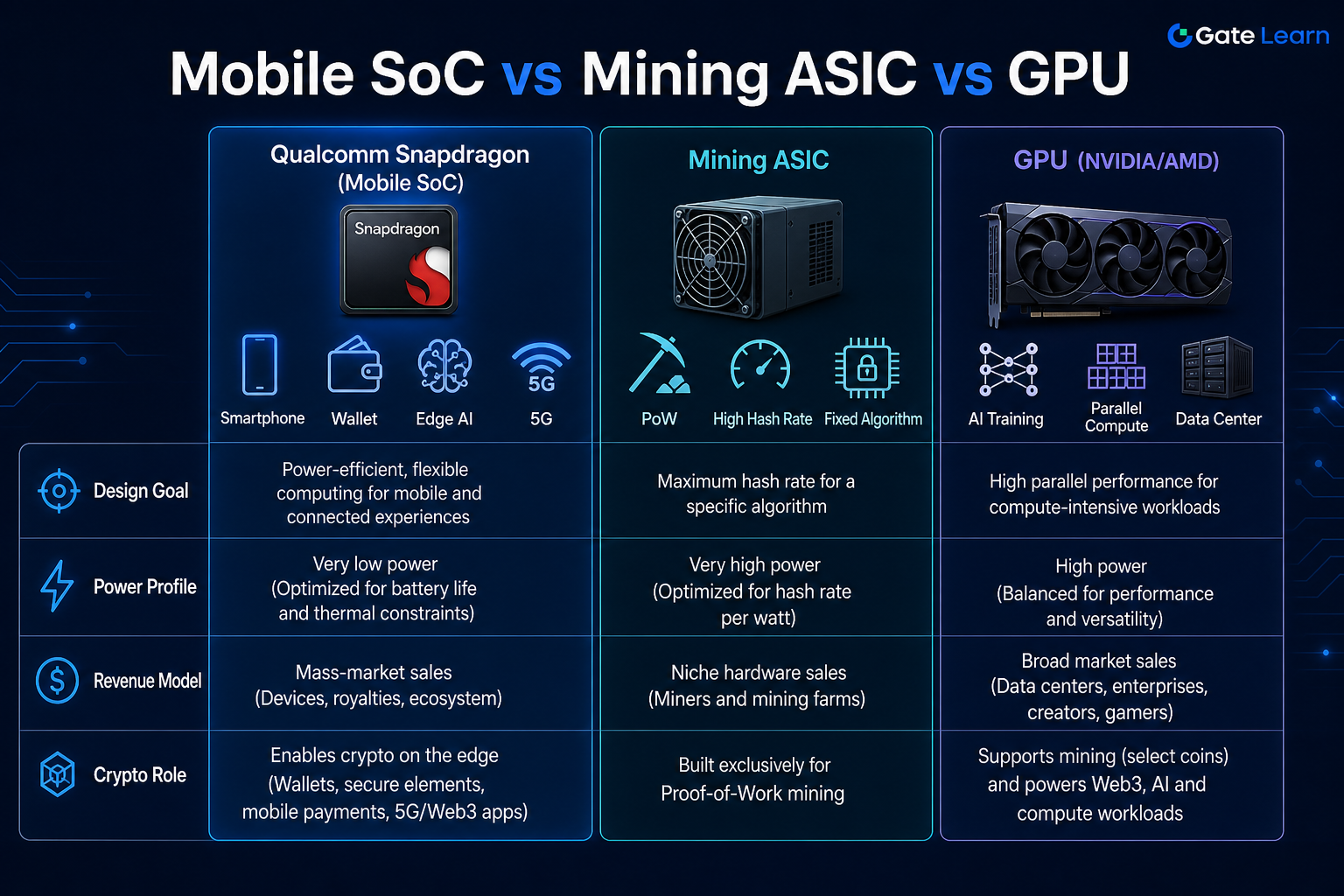 Figure 1. A four-axis comparison of mobile SoC, mining ASIC, and GPU across compute goals, power characteristics, revenue models, and crypto roles.
How Do Business Models and Revenue Logic Differ?
Qualcomm relies mainly on QCT chip sales and QTL patent licensing, tied to smartphone and partial automotive and IoT shipments; mining ASIC revenue fluctuates with PoW network difficulty and mining-farm capex; GPU leaders connect to data-center AI and consumer graphics cycles.
| Business model element |
Qualcomm (QCOM) |
Mining ASIC ecosystem |
GPU leaders |
| Revenue stability |
QTL licensing provides a higher-margin buffer |
Fluctuates with PoW networks and mining investment |
AI demand and product cycles stack volatility |
| Customer base |
Global OEMs, carriers, automakers |
Mining farms, miner brands, hosting providers |
Cloud providers, enterprise IT, consumers |
| R&D focus |
Connectivity standards, SoC integration, edge AI |
Algorithm hardening, energy efficiency |
Parallel architecture, software stack, data-center solutions |
| Stock research entry point |
Earnings QCT/QTL, patent litigation |
Mostly private or non-pure-ASIC listed entities |
Data-center GPU mix, AI order visibility |
QCOM stock is read through QCT/QTL segment reporting; GPU leaders through data-center share; ASIC narratives require separating network hash power from whether the listed company is the ASIC entity itself.
How Does Each Relate to Crypto Scenarios? (Wallet/Edge vs PoW vs AI/Historical Mining)
Qualcomm's main crypto intersection sits at the terminal layer: mobile wallet signing, hardware key storage, DApp interaction, light-node sync, and edge-AI-assisted risk controls all depend on SoC security modules, connectivity, and low-power AI units. Qualcomm does not issue tokens and does not participate in PoW block production; its role is as the mobile infrastructure supplier that crypto user experiences rely on.
Mining ASICs bind directly to PoW block production; GPU ties to crypto are more scattered—the current main line is off-chain AI and auxiliary tooling, while some PoW networks historically suited GPUs, though ASIC specialization has removed GPU competition from most networks.
| Crypto relevance |
Mobile SoC |
Mining ASIC |
GPU |
| Wallets and edge |
Direct |
None |
Indirect (not the primary mobile path) |
| PoW block production |
Not applicable |
Core |
Some historical use |
| AI and off-chain compute |
Edge inference |
Largely none |
Core |
Therefore, whether "Qualcomm counts as a compute stock" depends on the question level: for PoW hash compute, the answer is no; for terminal compute underpinning mobile Web3 and edge AI, Snapdragon sits in the infrastructure layer—yet that layer must still be read separately from QCOM stock pricing drivers (phone cycles, licensing, competition).
What Common Narrative Misconceptions Appear When Researching Chip Stocks?
Common mistakes include grouping QCOM with NVIDIA and AMD in the same AI compute lane; explaining QCOM volatility through PoW cycles; treating it as a "crypto concept stock" because of Web3 narratives while ignoring the QCT/QTL core; comparing only hash rate, TOPS, or CUDA core counts without regard to workload; and mapping DePIN or similar protocol narratives directly onto QCOM revenue. A comparison framework helps flag these conflation paths early.
QCOM stock research works best in three parallel layers that do not substitute for one another: Layer one is the business core—QCT chip shipments, QTL licensing rates, gross margins, and competitive landscape; layer two is compute narrative mapping—assigning mobile Web3, edge AI, and PoW/GPU compute explicitly to different hardware categories to avoid mixed baskets; layer three is platform verification—confirming the instrument on Gate Stocks under ticker QCOM, and completing pre-trade checks per the conditions and order fields listed in trade QCOM with USDT. The three layers are independent—crypto compute heat neither automatically converts into QCOM chip demand nor replaces earnings and risk checklists.
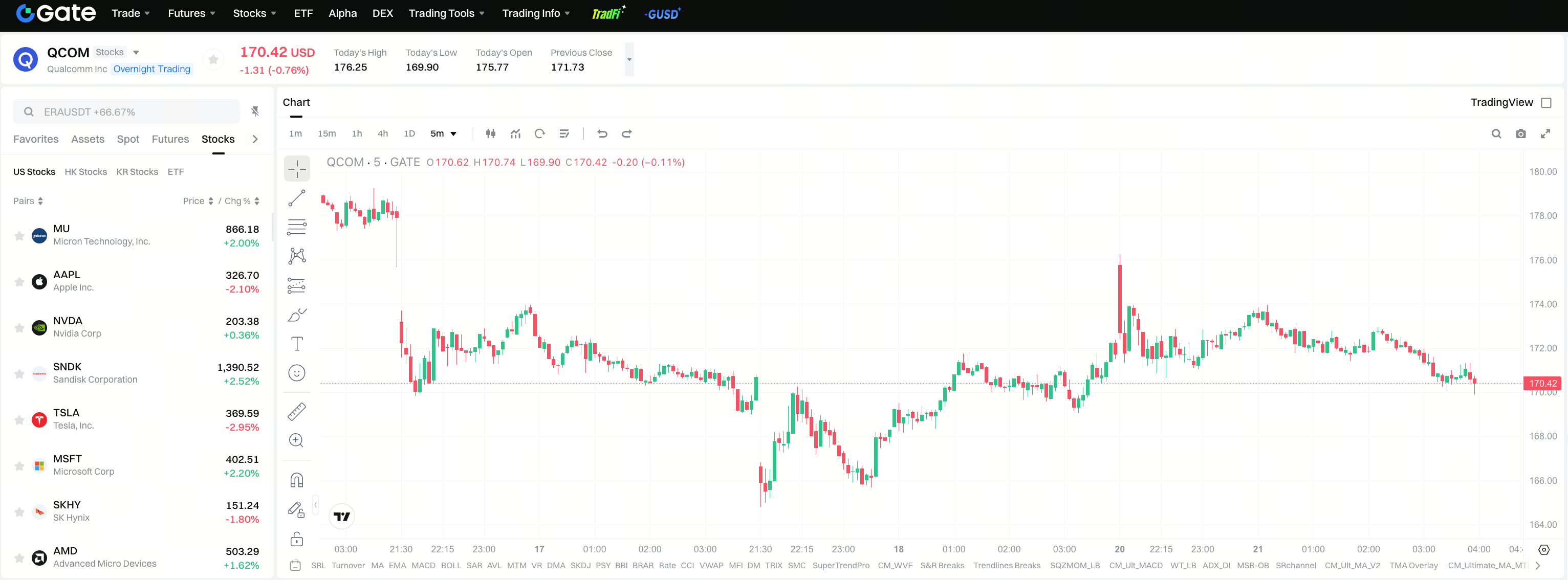
When reading side by side, first confirm whether the discussion concerns terminal-side, PoW-side, or data-center AI compute, and whether that narrative maps to QCOM's QCT/QTL metrics.
Summary
Qualcomm mobile SoC, mining ASIC, and GPU each serve integrated terminal compute, PoW-dedicated hashing, and general parallel compute—differing in hardware goals, business models, and crypto relevance. QCOM stock research should focus on QCT/QTL and patent competition, treating mobile Web3 and edge AI as terminal infrastructure narratives rather than substitutes for PoW or data-center GPU metrics. Building boundaries with a comparison table, then returning to earnings and risk checklists, is a sounder path when chip stocks and crypto compute intersect.
FAQ
What's the difference between Qualcomm and NVIDIA/AMD?
Qualcomm focuses on Snapdragon mobile SoC and wireless connectivity platforms, with revenue from chip sales and patent licensing, emphasizing low-power terminals and edge inference. NVIDIA and AMD GPUs target general parallel compute and data-center AI, with different customer structures and capex logic. Both may appear in "AI compute" discussions, but hardware form, workload types, and financial reporting should not be conflated.
Can Qualcomm chips be used for mining?
Qualcomm Snapdragon and other mobile SoCs are not designed for PoW hash operations and are unsuitable as mining hardware for networks such as Bitcoin. PoW mining typically uses ASICs optimized for specific algorithms, or historically GPUs. Mobile chip priorities—power efficiency, integration, and security—oppose the maximum hash-efficiency goal of mining silicon.
How do mobile chips differ from cryptocurrency mining chips?
Mobile SoC must run operating systems, communication protocols, applications, and secure key modules, with compute constrained by power and thermal limits. Mining ASIC dedicates circuitry almost entirely to a single PoW algorithm, targeting maximum hash rate per unit of energy, without general compute or mobile connectivity. The two differ in architecture, buyers, and revenue drivers with no direct comparability.
How does Qualcomm relate to AI and edge computing?
Qualcomm integrates NPU/DSP and other AI acceleration units in the Snapdragon platform for edge inference in phones, automotive, and IoT, emphasizing low power and local processing. Edge AI and data-center GPU training/inference sit at different layers: the former close to terminals and user devices, the latter aimed at cloud and large-scale clusters. QCOM stock AI narratives belong in a mobile and edge context.
Common risks include smartphone demand cycles, competition from MediaTek and Apple in-house silicon, QTL patent licensing rates and litigation progress, and whether valuation and growth expectations align. Compute or Web3 narratives that do not map to actual QCT/QTL revenue and shipments should not replace the above fundamental risk review order.