Semiconductors form the critical backbone of the modern digital economy. From smartphones and PCs to AI, large-scale model training, and data centers, virtually every modern technology sector depends on advanced chips for computing and storage. As demand for AI hashrate surges, the global semiconductor industry's importance is rising, and South Korea has emerged as an indispensable core force within this value chain.
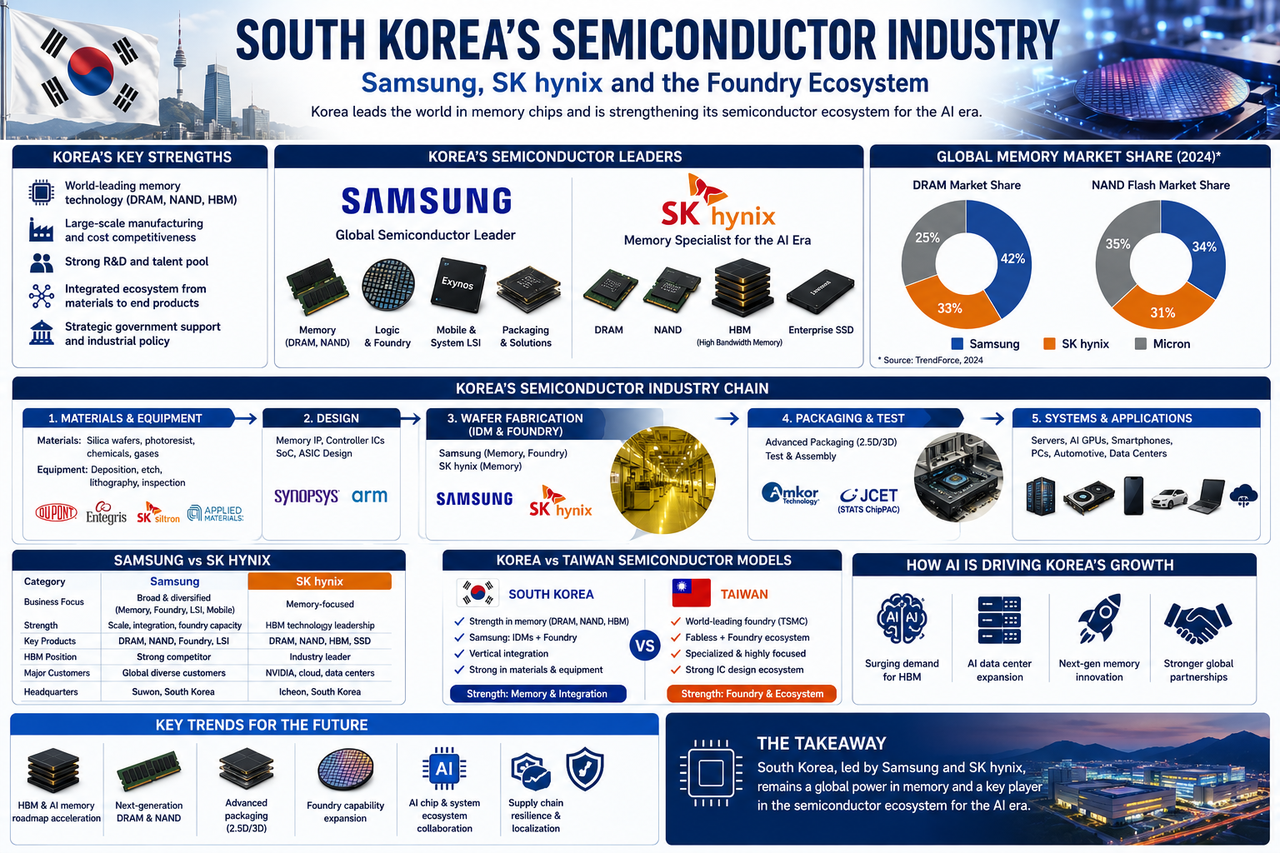
In the global semiconductor landscape, South Korea has built a formidable industrial advantage through two titans: Samsung Electronics and SK Hynix. Particularly in memory chip segments like DRAM, NAND Flash, and HBM, South Korean firms have long dominated the global stage. With AI infrastructure expanding relentlessly, the strategic importance of South Korea's semiconductor industry continues to intensify.
How Did South Korea Become a Global Semiconductor Powerhouse?
South Korea's semiconductor ascent began in the 1980s. The government actively promoted high-tech development, nurturing domestic chip companies through funding, talent cultivation, and supportive policies.
At the same time, South Korea developed a growth model centered on large conglomerates (chaebols). The Samsung Group and SK Group have consistently poured resources into semiconductor R&D and manufacturing, enabling the country to build a complete industrial ecosystem.
Over decades, South Korea has become one of the world's largest memory chip production bases, wielding significant influence in the DRAM and NAND Flash markets.
Key Advantages of South Korea's Semiconductor Industry
| Advantage Area |
Specific Details |
| Memory Chips |
World-leading DRAM and NAND manufacturing capabilities |
| Advanced Manufacturing |
Extensive experience in mass production and yield management |
| AI Storage |
Global leadership in HBM technology |
| Industrial Synergy |
Well-established ecosystem across materials, equipment, and manufacturing |
| Policy Support |
Long-term backing as a national strategic industry |
What Are the Components of South Korea's Semiconductor Supply Chain?
South Korea's semiconductor ecosystem extends beyond chip manufacturers, covering materials, equipment, design, packaging, and testing.
The upstream includes suppliers of silicon wafers, photoresists, chemicals, and semiconductor equipment. The midstream encompasses chip design and wafer fabrication. The downstream involves packaging/testing, server makers, consumer electronics firms, and data center operators.
Structure of the South Korea Semiconductor Supply Chain
| Segment |
Key Components |
| Upstream |
Materials, equipment, wafer supply |
| Midstream |
Chip design, memory manufacturing, wafer foundry |
| Downstream |
Packaging/testing, end products, data centers |
| Application Layer |
AI, cloud computing, smartphones, automotive electronics |
This comprehensive industrial structure helps South Korea maintain a strong competitive edge in the global chip race.
What Role Does Samsung Electronics Play in South Korea's Semiconductor Industry?
Samsung Electronics is one of the world's largest semiconductor companies and a cornerstone of South Korea's chip industry.
Unlike most chipmakers, Samsung's operations span memory chips, logic chips, wafer foundry, consumer electronics, and smartphones—covering the entire semiconductor value chain.
In memory, Samsung has long held the top spot in global DRAM and NAND. In wafer foundry, it is one of the few companies capable of competing with TSMC in advanced process nodes.
As such, Samsung is not only the face of South Korea's semiconductor industry but also a key global chip player.
Why Is SK Hynix So Important?
SK Hynix is a world-leading memory chip manufacturer and another pillar of South Korea's semiconductor sector.
Its core businesses include DRAM, NAND Flash, enterprise SSDs, and HBM. With the rapid rise of AI, HBM has become one of the company's most closely watched products.
Compared to Samsung, SK Hynix is more focused on memory, giving it a distinct edge in memory technology R&D and mass production expertise.
Samsung vs. SK Hynix: A Comparison
| Dimension |
Samsung Electronics |
SK Hynix |
| Headquarters |
South Korea |
South Korea |
| Core Business |
Comprehensive semiconductor group |
Memory chip leader |
| DRAM Market |
Global leader |
Global leader |
| NAND Market |
Global leader |
Key player |
| HBM Strategy |
Expanding aggressively |
Industry leading |
| Wafer Foundry |
Yes |
No |
Together, these two companies form the core of South Korea's memory chip competitiveness.
Why Does South Korea Lead the World in Memory Chips?
Memory chips are characterized by strong economies of scale, high technical barriers, and massive capital requirements.
South Korean companies have sustained heavy investment and R&D, building advantages in process technology, yield control, and supply chain management. At the same time, consolidation in the global memory market has increased concentration.
Today, the global DRAM market is dominated by Samsung, SK Hynix, and Micron Technology, with South Korean companies holding a commanding share.
How Is South Korea's Wafer Foundry Ecosystem Developing?
While South Korea excels in memory, wafer foundry is not its strongest suit.
The global advanced foundry market has long been led by TSMC. Samsung is one of the few players capable of competing on advanced nodes and continues to scale its foundry business.
In recent years, the South Korean government has actively promoted the domestic foundry ecosystem, aiming to boost logic and AI chip manufacturing and reduce dependence on overseas supply chains.
Semiconductor Model Comparison: South Korea vs. Taiwan, China
| Aspect |
South Korea |
Taiwan, China |
| Core Strength |
Memory chips |
Wafer foundry |
| Leading Companies |
Samsung, SK Hynix |
TSMC |
| AI Advantage |
HBM, DRAM |
AI chip manufacturing |
| Industry Structure |
Strong IDM model |
Foundry-dominated |
| Global Position |
Memory hub |
Manufacturing hub |
The rise of generative AI has fueled explosive demand for high-performance memory.
Modern AI GPUs require HBM to function—a technology where South Korean companies excel. As data center buildouts and large model training expand, HBM has become one of the fastest-growing semiconductor segments.
This has opened new growth avenues for Samsung and SK Hynix, further cementing South Korea's role in the global AI infrastructure supply chain.
What Challenges Does South Korea's Semiconductor Industry Face?
Despite its advantages, South Korea's semiconductor sector faces several challenges.
First, the memory industry is highly cyclical, with market fluctuations impacting profitability. Second, intensifying global tech competition puts supply chain security and technological self-sufficiency front and center.
Additionally, the U.S., China, Japan, and Europe are all ramping up semiconductor investments, promising fiercer competition ahead.
For South Korea, maintaining technological leadership while expanding into logic chips and foundry will be critical for future growth.
Future Trends in South Korea's Semiconductor Industry
In the coming years, the industry's focus may center on:
-
Upgrading HBM and AI memory technologies
-
R&D for next-generation DRAM and NAND
-
Advanced packaging capabilities
-
Enhancing wafer foundry competitiveness
-
AI chip ecosystem partnerships
-
Localizing the semiconductor supply chain
With sustained AI infrastructure investment, South Korean companies are well-positioned to retain their dominance in the global memory market.
Summary
South Korea is one of the world's premier semiconductor hubs, with a clear edge in memory chips. Samsung Electronics and SK Hynix jointly dominate DRAM, NAND Flash, and HBM markets, making South Korea a vital source of AI memory infrastructure.
In the AI era, high-performance memory is a critical component of computing power, and South Korean companies occupy this key niche. While TSMC remains the foundry leader, Samsung is steadily expanding its presence, and South Korea is building a more comprehensive semiconductor ecosystem.
FAQs
Why is South Korea a semiconductor powerhouse?
South Korea has invested heavily in semiconductor R&D and manufacturing for decades, building an industry anchored by Samsung Electronics and SK Hynix. It holds global leadership in DRAM, NAND Flash, and HBM.
Who is the largest semiconductor company in South Korea?
Samsung Electronics is the largest semiconductor firm in South Korea and one of the world's top memory chip makers. SK Hynix is another major global memory manufacturer.
What are South Korea's main advantages in semiconductors?
South Korea's biggest strength is memory chips—DRAM, NAND Flash, and HBM. In the AI era, HBM has become a pivotal competitive advantage.
What is the relationship between SK Hynix and Samsung Electronics?
Both are part of major South Korean conglomerates but operate independently. They are both partners and fierce competitors in the global memory market.
Does South Korea have its own wafer foundry industry?
Yes. Samsung Electronics is a major global foundry player, though its market share trails TSMC. South Korea is actively developing its foundry ecosystem to strengthen logic chip manufacturing.