From a technical standpoint, USWR operates at the intersection of "resource narrative, data modeling, and on-chain settlement." Rather than following the traditional path of asset securitization, it constructs a dynamic framework for expressing resource value, centered on the relationship between AI data centers, water consumption, and energy systems. In this model, the expansion of AI hashrate is the primary driver of changes in water demand.
Within the broader blockchain and digital asset ecosystem, USWR embodies a classic "infrastructure narrative asset." It anchors value to macro resources—water, energy, and hashrate—and uses AI-driven dynamic pricing in an on-chain experiment. This approach pushes the boundaries of RWA (Real World Assets) by expressing resource value through data and models rather than a single physical peg.
What Is USWR (United States Water Reserve)? Project Background and Timeline
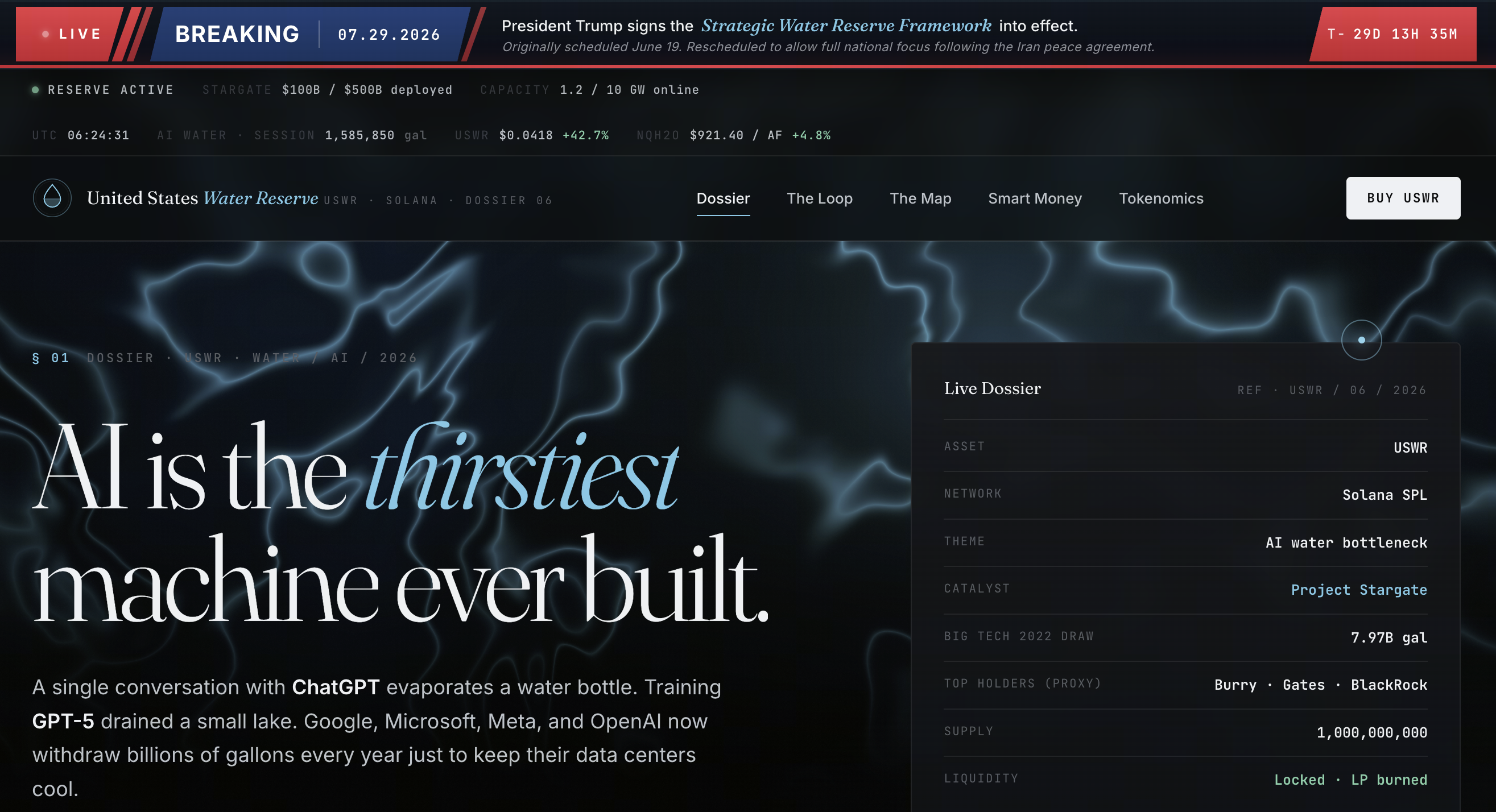
According to its official website, USWR is an on-chain system built around the "AI water bottleneck." The core thesis: as AI expands, data centers require significantly more cooling, and water is emerging as one of the most critical constraints.
From a narrative perspective, USWR is not a traditional DeFi protocol or payment token. It is a data-driven asset model designed around macro resource themes. The website explores the relationships among AI data centers, cooling cycles, industrial water use, and infrastructure expansion, aiming to abstractly represent this complex system on-chain.
The project's development path blends "narrative-driven and market experimentation," rather than following a typical fundraising protocol or application product. By mapping real-world water issues into on-chain asset concepts, it allows users to gain exposure to this macro theme within the crypto market.
USWR Tokenomics and Market Narrative
USWR's token model is built on a "fixed supply + liquidity market-driven" foundation. Its defining characteristic is positioning the token as a "resource narrative vehicle" rather than a yield distribution tool. The market narrative centers on three pillars:
- Resource pressure from AI infrastructure expansion, especially rising data center cooling demand.
- Water as an irreplaceable underlying resource in industrial and energy systems.
- Growing market demand for "resource financialization" narratives.
In this framework, USWR functions as a form of "resource indexation." The token price reflects market expectations of water scarcity rather than being tied to returns from any physical asset.
Why the AI Era Creates a "Water Resource" Investment Theme
AI technology is reshaping the resource consumption profile of infrastructure. Large model training and inference require massive data center support, and these facilities depend heavily on cooling systems. While energy has traditionally been seen as the key constraint for AI infrastructure, water is now becoming a second-order bottleneck as hashrate scales. This shift transforms water from a "natural resource" into a "digital infrastructure input variable."
USWR emerges precisely in this context, converting the resource consumption challenges of AI infrastructure expansion into an asset logic that can be expressed and traded on-chain. This narrative reinforces water's strategic importance in the future digital economy.
How USWR Builds the Water × AI Crypto Narrative
USWR's narrative structure hinges on the fusion of Water × AI × Infrastructure.
According to the official description, AI drives water consumption growth, while water becomes an inescapable constraint on AI expansion. Through this dynamic, USWR creates an on-chain model that translates real-world resource pressure into a digital asset price feedback mechanism.
This logic can be understood in three layers:
- Growth in AI computing demand.
- Data center cooling and water consumption.
- On-chain asset price mapping of this structure.
This model does not rely on traditional asset collateral but on macro narratives and data modeling, making it closer to a "predictive resource market."
USWR's Core Mechanism and Token Issuance Model
Based on public information, USWR uses the Solana SPL token standard, featuring a fixed supply and on-chain liquidity trading.
Its mechanism can be broken down into three components:
- On-chain token layer: USWR circulates on the Solana network as the basic trading unit.
- Narrative mapping layer: Water and AI infrastructure serve as the value interpretation framework.
- Market trading layer: Price discovery occurs through decentralized trading markets.
The core of this structure is not complex protocol design but attracting market attention through narratives and macro themes to generate liquidity and price consensus.
How USWR Differs from RWA and Resource-Based Tokens
The key difference between USWR and traditional RWA projects is the presence of a clear asset anchor. RWA projects are typically backed by verifiable assets like treasury bonds, real estate, or commodities. USWR, by contrast, leans toward "resource narrative mapping." Its value derives from macro trends and market expectations, not asset cash flows. Compared to energy or hashrate tokens, USWR is more abstract. It does not directly bind water usage rights but expresses water as a key variable in the AI economic system through financialization.
Thus, it is better characterized as a "narrative resource asset" than a standard asset tokenization product.
Risks to Consider When Investing in USWR
The main risks of USWR fall into three categories:
- Unclear asset anchoring: The website emphasizes the resource concept, but there is no standardized asset mapping mechanism.
- Narrative-driven risk: Price relies heavily on market sentiment and hype cycles.
- Liquidity and volatility risk: Like early-stage concept tokens, price fluctuations tend to be large.
Additionally, the AI and water narrative is a macro theme susceptible to sentiment cycles, making it inherently unstable.
USWR's Future Development Direction and Market Potential
USWR's potential development path may take three directions:
First, evolving into an AI × resource data modeling platform.
Second, entering the broader RWA narrative system as a resource indexation tool.
Third, continuing as a macro narrative asset participating in crypto market cycle rotations.
If water's importance in AI infrastructure continues to grow, this type of narrative asset may attract sustained attention. However, long-term value still depends on whether it can transition from "narrative-driven" to "data and mechanism-driven."
Summary
USWR (United States Water Reserve) is fundamentally an on-chain narrative asset built around AI infrastructure and water scarcity. Its core value lies not in the asset itself but in the financialized expression of the "Water × AI Economic Structure."
In the current crypto market, such projects represent attempts to assetize macro themes. Their significance lies in expanding the boundaries of RWA and resource narratives—but they come with high uncertainty.
FAQs
-
Q1: Does USWR represent real water assets?
No, it does not directly represent water ownership. It leans toward narrative and data modeling expression.
-
Q2: What is the core value source of USWR?
Primarily the AI water narrative and market expectations of resource scarcity.
-
Q3: Is USWR an RWA project?
Not exactly. It is more of a resource narrative token than a standard asset-anchored RWA.
-
Q4: Is USWR related to government or official water systems?
The website describes it as an on-chain model, not an official water authority.
-
Q5: What are the main risks of USWR?
Narrative-driven volatility, unclear asset anchoring, and market liquidity risks.







