Zero-Knowledge Proofs (ZK Proof) are becoming essential infrastructure for blockchain scaling, off-chain computation, and verifiable AI execution. As zkVM technology matures, developers no longer need to handcraft complex circuits—they can generate a verifiable Proof directly using general-purpose programming languages, lowering the barrier to ZK app development.
Two projects frequently compared in today's zkVM landscape are Succinct and RISC Zero. Both support zero-knowledge proofs for general computation, but they differ in technical approach and product positioning. Succinct emphasizes a decentralized Prover Network and a universal verification layer, aiming to turn proof generation into a market. RISC Zero focuses on a verifiable execution environment, leveraging the RISC-V architecture to offer a more integratable developer experience.
What Is Succinct?
As a zkVM and proof infrastructure for general verifiable computation, Succinct's core components include the SP1 zkVM and a decentralized Prover Network. Developers can write programs in languages like Rust, then have the zkVM automatically generate zero-knowledge proofs—no need to design complex circuits.
Succinct's core focus is building an open proof marketplace. Prover nodes in the network generate proofs and compete for computational tasks via market mechanisms. This design not only improves scalability but also shifts proof generation from a single service toward a decentralized hash power network.
What Is RISC Zero?
RISC Zero is a zkVM based on the RISC-V instruction set that lets developers generate zero-knowledge proofs directly in their familiar software environments. Rather than requiring specialized circuits like traditional ZK development, RISC Zero champions the idea of "building ZK apps just like regular software."
Developers can build programs in Rust, execute them through the zkVM, and generate verifiable proofs. The workflow closely mirrors traditional software engineering, making it more developer-friendly.
RISC Zero's core strengths are ease of use and flexible integration. It's ideal for quickly building off-chain verification logic, smart contract helper computations, and prototype apps—especially for small teams and independent developers who want to quickly enter ZK development.
How Do the Architectural Designs of Succinct and RISC Zero Differ?
One of the biggest differences between Succinct and RISC Zero is how they view "proof infrastructure."
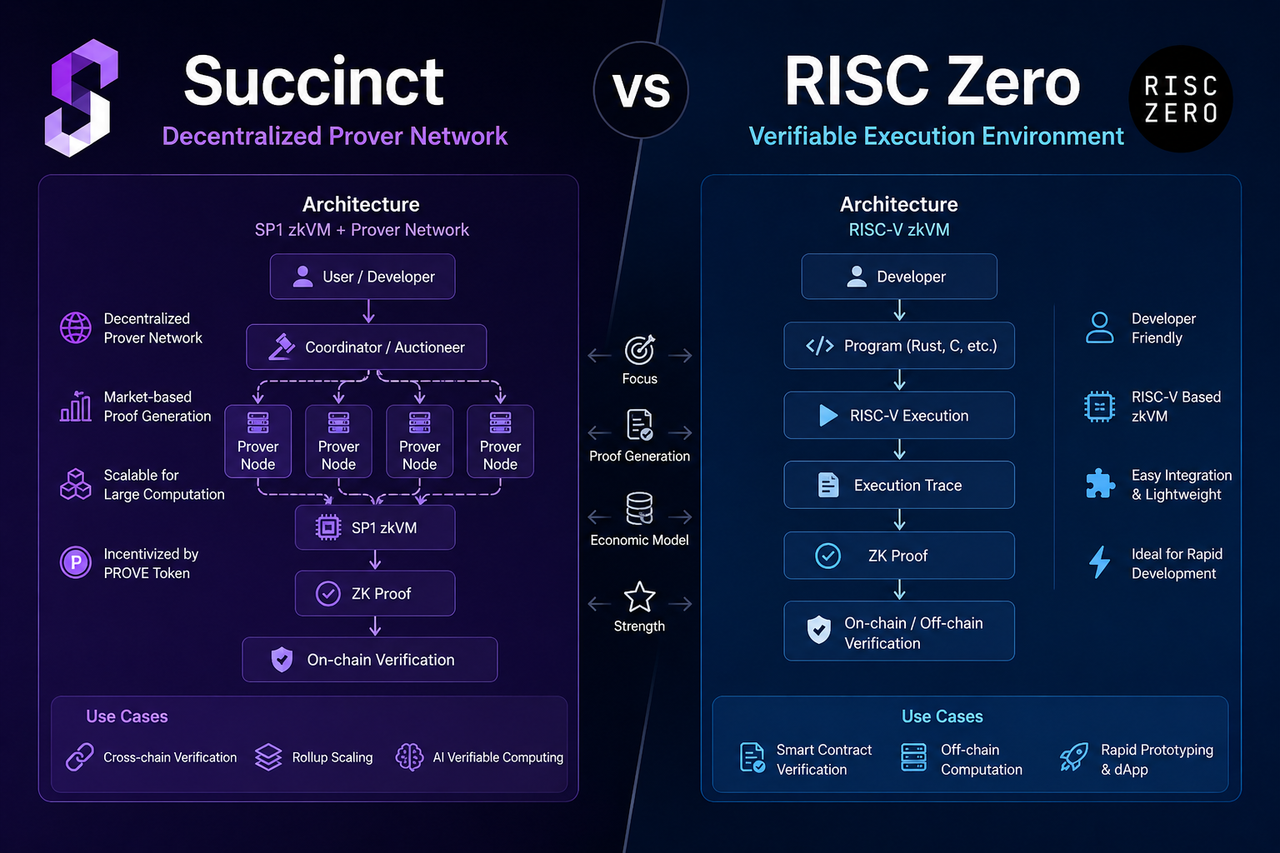
Succinct doesn't just provide a zkVM; it also builds a complete decentralized Prover Network. After a developer submits a proof request, the system coordinates nodes across the network to generate the proof and then completes verification and settlement. The goal is to create an infrastructure layer akin to a "proof cloud computing market."
RISC Zero focuses primarily on the zkVM itself. It's more like a verifiable execution environment, centered on letting developers quickly generate and verify proofs rather than building a decentralized hash power market. As a result, its architecture is relatively lightweight and easier to drop into existing application stacks.
This means Succinct is better suited for large, cross-ecosystem applications, while RISC Zero is a better fit for rapid integration and local deployment.
How Do the Proof Generation Processes of Succinct and RISC Zero Differ?
Succinct's proof process leans toward network-based collaboration.
Developers first submit a proof request; then the network's coordination layer assigns tasks, Prover nodes execute the zkVM computation and generate the proof, and the final result is submitted on-chain or to a verification layer for validation. The entire process involves task distribution, hash power competition, and incentive mechanisms, making it suitable for large-scale proof needs.
RISC Zero's process is more straightforward. After the program runs, the zkVM generates an execution Trace, which is then used to produce a zero-knowledge proof. Verification can happen either on-chain or off-chain.
The core difference: Succinct emphasizes a proof generation network, while RISC Zero prioritizes a single execution environment.
How Do the Developer Experience and Integration Methods of Succinct and RISC Zero Differ?
RISC Zero is generally considered better for rapid development.
Because its approach is close to traditional software engineering, developers can leverage existing Rust toolchains and the RISC-V environment to build applications, resulting in a lower learning curve. For prototype verification, small off-chain computation tasks, and smart contract auxiliary verification, RISC Zero can often be deployed faster.
Succinct also supports general-purpose languages, but since it involves a Prover Network, proof request scheduling, and decentralized settlement mechanisms, the overall system is more complex. Developers need to understand not just the zkVM, but also the network layer and proof coordination.
However, that complexity brings greater scalability. When a project needs to handle a large volume of cross-chain verifications or large-scale verifiable computation, Succinct's networked structure has the edge.
How Do the Application Scenarios of Succinct and RISC Zero Differ?
Succinct is better suited for scenarios requiring large-scale verification.
For example, bridges need to frequently verify states on other chains, Rollups need to continuously submit state proofs, and AI apps need to validate complex model outputs—all of which require massive proof generation. In these cases, Succinct's decentralized Prover Network can more easily achieve scalability.
RISC Zero is better for lightweight verifiable execution.
Off-chain order matching verification, smart contract helper computations, game state validation, and rapid prototype development all prioritize dev efficiency and fast deployment over massive proof marketplaces.
In simple terms, Succinct is more like underlying infrastructure, while RISC Zero is more of a developer tool.
How Do the Economic Mechanisms and Ecosystem Positioning of Succinct and RISC Zero Differ?
Succinct introduces a clearer network economic model.
Its PROVE token is used for paying proof services, node staking, and reward distribution. This design creates a market mechanism for proof generation and provides economic incentives for network security.
RISC Zero has no obvious decentralized economic layer; its ecosystem relies more on development tools and application integration. It functions more like a software platform than a fully decentralized protocol network.
Succinct vs. RISC Zero Comparison Table
| Dimension |
Succinct |
RISC Zero |
| Core Positioning |
Decentralized Proof Layer |
Verifiable Execution Environment |
| zkVM Architecture |
SP1 zkVM + Prover Network |
RISC-V-based zkVM |
| Key Focus |
Proof marketplace & universal verification |
Developer experience & rapid integration |
| Proof Process |
Networked generation & settlement |
Local execution-based generation |
| Scalability |
Better for large-scale proof demand |
Better for lightweight scenarios |
| Typical Applications |
Rollups, cross-chain, AI verification |
Off-chain computation, prototyping |
| Economic Mechanism |
PROVE incentivizes network nodes |
No independent incentive layer |
| Development Barrier |
Relatively high |
Relatively low |
Summary
Succinct and RISC Zero are both next-generation zkVM infrastructures, but they solve different problems.
Succinct emphasizes a decentralized proof network and universal verification layer, aiming to support complex demands like cross-chain verification, Rollups, and verifiable AI computation via an open hash power market. RISC Zero focuses on developer experience, lowering the barrier to ZK app development through a lightweight zkVM.
For projects requiring large-scale proof capabilities and cross-ecosystem collaboration, Succinct offers greater scalability potential. For teams pursuing rapid development, lightweight deployment, and prototype validation, RISC Zero is often easier to get started with.
FAQs
What are the main differences between Succinct and RISC Zero?
Succinct emphasizes a decentralized Prover Network and universal verification layer, while RISC Zero focuses more on a verifiable execution environment and developer experience.
Which solution is better for cross-chain verification?
Succinct is better for cross-chain verification because its networked proof structure can support larger-scale verification needs.
Which solution is better for rapid prototype development?
RISC Zero's development process is closer to traditional software engineering, making it better suited for rapid development and testing.
Does RISC Zero support off-chain verification?
Yes. RISC Zero can generate and verify proofs off-chain and can also be used with on-chain smart contracts.
Can Succinct and RISC Zero be used together?
In some cases, yes. For example, developers could use RISC Zero for fast local verification first, then use the Succinct network for larger-scale decentralized proof generation and settlement.