As blockchain technology matures, Web3 applications have expanded beyond cryptocurrency trading and DeFi to increasingly diverse scenarios such as artificial intelligence (AI), enterprise services, digital identity, and data collaboration. However, as more applications involving sensitive information are deployed on-chain, balancing data privacy, computational efficiency, and decentralization has become a key challenge for the industry.
Confidential Computing has emerged as a focal point in this landscape. As a blockchain infrastructure dedicated to confidential computing, Arcium aims to empower developers to perform computations without exposing data content, thereby broadening the horizons for Web3 applications.
Why Does Web3 Need Confidential Computing?
Web3 is fundamentally built on decentralization, transparency, and verifiability. These attributes reduce reliance on centralized institutions and make transactions and data records more easily auditable. Yet, not every application is suited to full transparency. For example, enterprises may need to safeguard business strategies and operational data; financial services handle customer transaction details; AI models process large volumes of private data; and the healthcare sector must comply with strict data protection regulations.
In these scenarios, exposing all information directly on-chain would constrain blockchain’s use across industries. Thus, the next phase of Web3 isn’t just about faster transactions or lower costs—it’s about building new infrastructure that balances transparency with privacy. Arcium’s confidential computing capabilities are designed precisely for this, enabling encrypted data processing and unlocking new possibilities for real-world business use.
What Is Arcium’s Role in Web3 Infrastructure?
 (Source: Arcium)
The Web3 ecosystem can be viewed as a layered technology stack. The blockchain records transactions and asset states; smart contracts provide programmable logic; and decentralized applications (dApp) serve end users. On top of these layers, more projects are offering specialized infrastructure, including data indexing, cross-chain communication, decentralized storage, and privacy computing.
Arcium operates at the Confidential Computing Layer. It’s neither a new public chain nor a DeFi protocol, but a foundational service enabling developers to securely process sensitive data. When applications require both privacy and on-chain verifiability, Arcium provides the necessary functions without forcing teams to design complex cryptography themselves. As a result, Arcium functions as a core computational service, adding value by supporting other Web3 applications rather than directly targeting end users.
Why Does AI Development Require Confidential Computing?
AI’s rapid advancement has made data security and privacy protection paramount, as AI systems heavily rely on sensitive data. When enterprises deploy AI, they often process internal documents, customer information, financial records, or business models. Handing this data to external services can increase the risk of leaks, prompting organizations to seek ways to perform AI computations without exposing raw data.
Arcium’s confidential computing architecture is tailored for this purpose. The official Arcium Blackthorn initiative focuses on Confidential AI applications, enabling AI inference while maintaining data protection, privacy, security, and verifiability. As AI Agents, autonomous decision systems, and enterprise AI platforms evolve, confidential computing is positioned to become a core component of AI infrastructure.
How Does Confidential Computing Expand DeFi Use Cases?
While DeFi has long prioritized transparency and openness, certain financial services require robust privacy. Institutional portfolio allocations, corporate financials, credit scoring models, and large-scale trading strategies all involve sensitive information. Full transparency could undermine market fairness and discourage institutional adoption. With confidential computing, developers can execute specific financial calculations without exposing raw data, allowing DeFi to support a broader range of privacy-sensitive financial applications. This approach doesn’t sacrifice transparency; instead, it enables tailored data protection strategies, balancing auditability and privacy. For the Web3 ecosystem, especially those aiming to attract institutional players, this capability could become a key competitive edge.
How Does ZINC Showcase the Commercial Value of Confidential Computing?
 (Source: zinc_cash)
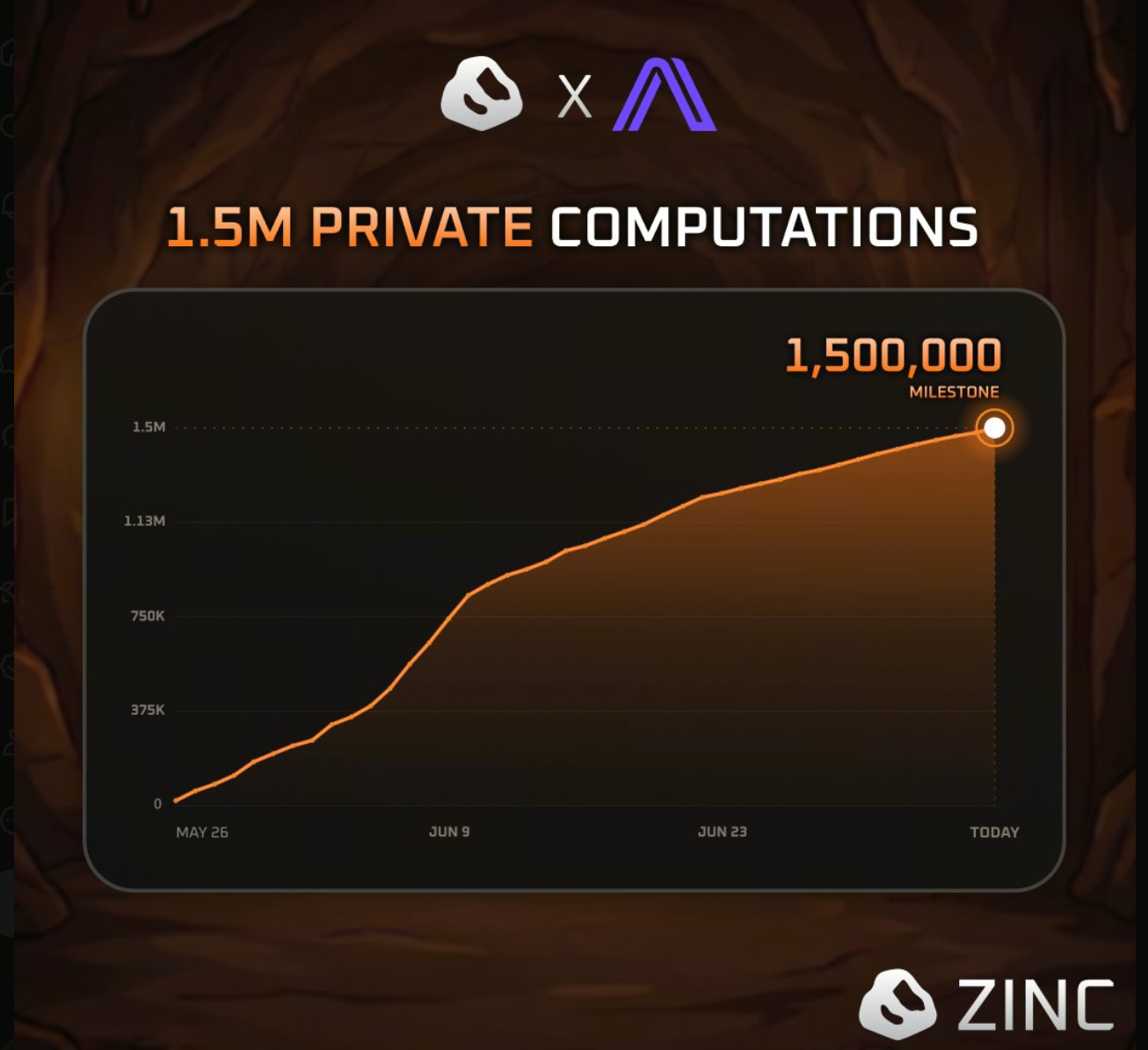
Market value is proven not just by theory but by real-world use. ZINC, built on Arcium’s confidential computing infrastructure, stands as a landmark case for the commercialization of Confidential Computing. According to official reports, ZINC rapidly accumulated deployed capital after launch and secured a leading spot on the Solana ecosystem income leaderboard—demonstrating that users are willing to pay for privacy-enabled applications. This case highlights not just a single project’s success but a broader shift: developers are now building commercially viable applications atop Arcium, moving beyond proof-of-concept and signaling that confidential computing is evolving from research to a practical foundation for real products.
How Is the Arcium Ecosystem Growing?
The long-term value of infrastructure depends on ecosystem growth. In recent years, Arcium has attracted developers across AI, financial services, data collaboration, and other privacy-centric scenarios. As more projects join, confidential computing is becoming a robust application network, not just a single product. Beyond the increasing number of applications, Arcium’s team is advancing development tools, ecosystem partnerships, and research to lower the barrier for Confidential Computing adoption. For developers, leveraging mature confidential computing infrastructure means more resources for product innovation and less time spent on building complex cryptographic systems—underscoring the platform’s value.
How Will Confidential Computing Influence Enterprise Adoption of Web3?
Enterprises are increasingly evaluating blockchain, but large-scale implementation remains limited—often due to data privacy and regulatory demands. Companies must comply with regional data protection laws while safeguarding customer data, trade secrets, and internal systems. If blockchain cannot deliver robust privacy, many use cases remain out of reach.
Arcium’s confidential computing model offers a new path. When enterprises can maintain data confidentiality while benefiting from blockchain’s verifiability and decentralization, Web3 can extend further into enterprise-grade services. In the future, the core of enterprise Web3 adoption will shift from whether to use blockchain to how best to integrate various infrastructure components to build digital services that address real-world needs.
How Does Arcium Reflect Web3 Infrastructure Trends?
Web3 infrastructure is moving toward specialization—from data storage and cross-chain messaging to AI and confidential computing. Projects increasingly address specific challenges and interoperate modularly, rather than relying on a single blockchain for all functions. Arcium’s focus on Confidential Computing exemplifies this trend, complementing rather than replacing existing blockchains and enhancing Web3’s privacy computing capabilities. This enables more AI, DeFi, and enterprise services to be securely deployed in decentralized environments. As demand grows for solutions that deliver efficiency, transparency, and data protection, confidential computing is set to join smart contracts, zero-knowledge proofs (ZKP), and decentralized identity (DID) as pillars of next-generation Web3 infrastructure.
Summary
Arcium’s evolution signals that Web3 infrastructure is moving beyond basic trading and asset management to embrace AI, enterprise services, and privacy computing. By leveraging confidential computing, the platform delivers computation that balances data protection, decentralization, and verifiability—expanding blockchain’s potential for financial, healthcare, AI, and enterprise-grade applications. As projects like ZINC highlight the commercial promise of confidential computing and AI continues to merge with Web3, Confidential Computing is poised to become a cornerstone of next-generation blockchain infrastructure. For the industry, Arcium is more than just a privacy computing project—it represents Web3’s shift toward maturity, completeness, and real-world business alignment.
FAQ
Q1: What Role Does Arcium Play in the Web3 Ecosystem?
A: Arcium delivers Confidential Computing infrastructure, enabling developers to securely process sensitive data on blockchain. Its use cases span AI, DeFi, enterprise services, and other decentralized applications where privacy is essential.
Q2: Why Do AI and DeFi Require Confidential Computing?
A: AI and DeFi often involve sensitive data, financial models, or personal information. Confidential Computing enables encrypted data processing, balancing privacy, security, and verifiability—helping expand these application domains.
Q3: What Is the Relationship Between ZINC and Arcium?
A: ZINC is an application built on Arcium’s Confidential Computing infrastructure. Its performance in the Solana ecosystem demonstrates that confidential computing is maturing from a technical concept into a commercially valuable pillar of Web3 infrastructure.







