As DeFi, Layer 2, cross-chain protocols, and AI Agent Web3 applications advance rapidly, the security of smart contracts has become increasingly critical. Alongside professional security audits, bug bounty programs are now a fundamental mechanism for blockchain projects to continually uncover security vulnerabilities. In public bug bounty programs, researchers must not only possess technical expertise, but their ability to access information quickly also directly impacts their research outcomes and reward opportunities. BountyHunt.xyz is a real-time monitoring platform purpose-built for these needs, empowering security researchers to swiftly track code updates and new project developments.
Why Is Bug Bounty Gaining Importance in Web3?
With blockchain technology maturing and smart contracts managing ever-larger asset volumes, any code vulnerability can result in financial losses, protocol disruptions, or diminished user trust. As a result, Web3 projects increasingly treat security as a core element of product development. Beyond pre-launch security audits, many teams now maintain ongoing bug bounty programs to invite global security researchers to continuously review code and proactively identify risks. This approach not only brings more external security scrutiny but also fosters a collaborative security ecosystem among development teams, security platforms, and researchers. In recent years, DeFi protocols, Layer 2 networks, cross-chain bridges, wallets, infrastructure, and AI applications have launched their own bug bounty programs, making bug bounty a central pillar of Web3 security governance.
Why Does Speed Matter in Bug Bounty?
Many believe bug bounty competition is simply about who finds vulnerabilities first. However, on most platforms, another critical factor is who submits a valid report first. Many platforms use a "First Valid Report" system, meaning that if a vulnerability is reported by another researcher before you, subsequent reports may not receive full rewards. This makes bug bounty research a race not only of technical skill but also of information speed.
For security researchers, the period immediately after code updates is often the most valuable for analysis. New features, modules, or fixes may introduce new attack surfaces, so starting research early increases the likelihood of discovering vulnerabilities before others. Thus, "timely awareness of project updates" has become an essential step in the bug bounty research workflow.
Bug bounty programs in Web3 aren’t centralized on a single platform. Projects may use Immunefi, Sherlock, Cantina, HackerOne, HackenProof, or their own bug bounty websites to manage research initiatives. Each project may have unique GitHub repositories, documentation, and announcement channels. Researchers tracking multiple projects must monitor several websites and repositories, increasing organizational costs and risking missed updates and opportunities. As Web3 project numbers grow, manual tracking becomes less efficient, underscoring the need for information integration and real-time monitoring tools.
 (Source: BountyHuntApp)
BountyHunt.xyz isn’t a vulnerability analysis tool; it’s designed to streamline information flow for researchers. The platform aggregates multiple bug bounty sources into a unified interface and continuously monitors each project’s GitHub repository. When the system detects a Commit, Pull Request, Release, or new bug bounty program, it instantly updates information and sends notifications.
Compared to manually checking GitHub or waiting for Grupo to share updates, BountyHunt.xyz automates previously manual processes, enabling users to quickly identify new research-worthy content. The platform doesn’t alter vulnerability analysis methods, but it improves the research starting point, allowing security researchers to dedicate more time to code analysis rather than information gathering.
In modern Web3 security research, vulnerability analysis goes far beyond simply reading code. Researchers must continuously track numerous projects, analyze version updates, review Pull Requests, compare Commit differences, and combine static analysis, testing, and manual verification.
 (Source: bountyhunt.xyz)
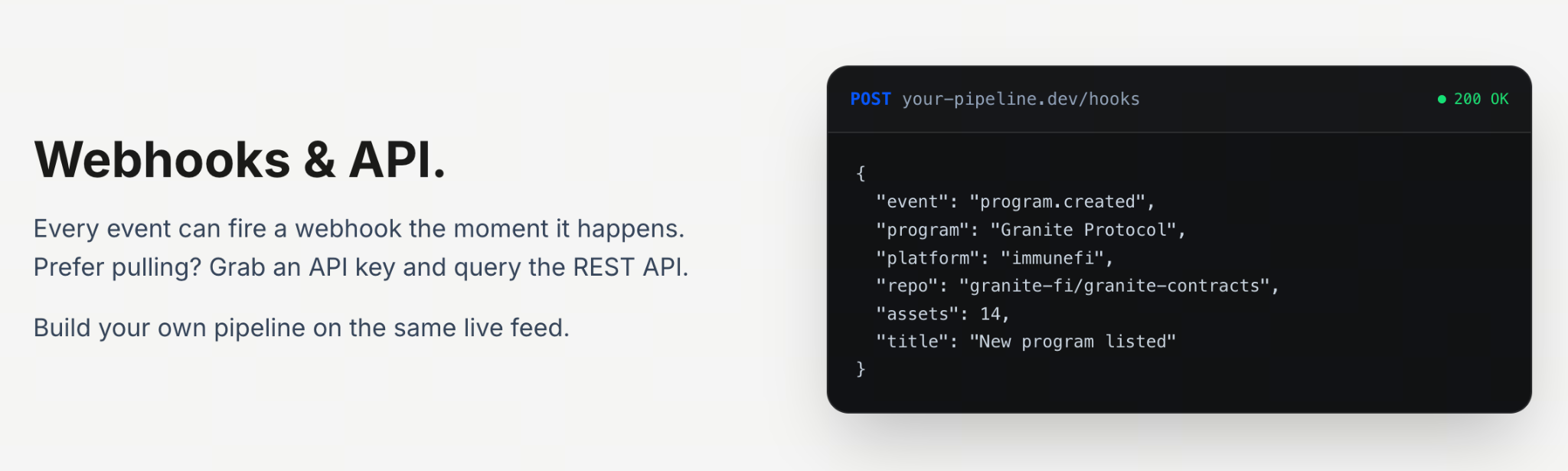
Within this workflow, real-time monitoring tools handle information acquisition at the front end. For example, when GitHub publishes a new version, the system immediately notifies researchers, who then decide whether to conduct deeper analysis based on update details. For more robust workflows, MCP Server, Webhook, or REST API can connect update information to other tools or AI-driven processes. While real-time monitoring tools don’t directly discover vulnerabilities, they serve as a crucial starting point for the entire research process.
How Do Real-Time Notifications Boost Research Efficiency?
The speed of information updates directly impacts research scheduling. If researchers must manually check dozens of GitHub repositories daily, it’s time-consuming and easy to miss critical updates. As project scales grow, manual tracking becomes less efficient. By integrating GitHub updates with Telegram notifications, BountyHunt.xyz eliminates the need for repeated page refreshes. Whenever a tracked project changes, the system instantly notifies users. The platform also offers filtering tools, enabling users to set monitoring criteria by bug bounty platform, programming language, or reward amount, reducing irrelevant information and further enhancing efficiency.
With the rapid proliferation of smart contracts, manual tracking alone is no longer sufficient for security research. In recent years, Web3 security tools have evolved from single vulnerability analysis to include information management, automated notifications, and workflow integration. BountyHunt.xyz exemplifies this new tool category. It does not replace security audits or serve as a smart contract analysis tool, but provides efficient information flow management within the bug bounty ecosystem.
When more researchers can promptly discover code updates and begin analysis, it shortens vulnerability discovery times and strengthens the overall security of the Web3 ecosystem. From this perspective, real-time monitoring tools not only enhance individual research efficiency, but are becoming foundational infrastructure for the security research ecosystem.
BountyHunt.xyz’s Role in the Web3 Security Ecosystem
Viewed holistically, BountyHunt.xyz isn’t a security audit platform or vulnerability scanner; it’s an information bridge connecting bug bounty platforms, GitHub, and security researchers. The platform centralizes bug bounty information, monitors GitHub repositories in real time, and offers integration with Telegram, MCP, Webhook, and REST API, helping researchers build more efficient workflows. As AI, automated analysis, and smart contract security tools continue to advance, information management will only grow in importance—and BountyHunt.xyz’s real-time monitoring capabilities are now a vital part of modern Web3 security research.
Conclusion
Bug bounty programs are now a core part of the Web3 security ecosystem, and information acquisition speed is a key factor in research efficiency. BountyHunt.xyz doesn’t directly help researchers find vulnerabilities, but through real-time GitHub monitoring, multi-platform integration, and notification features, it enables researchers to quickly access new code and bug bounty programs for analysis. As the Web3 ecosystem expands and smart contract numbers rise, real-time monitoring, automated notifications, and information integration tools will become increasingly crucial—serving as essential infrastructure connecting development teams, security platforms, and researchers, and advancing blockchain applications toward greater security and maturity.
FAQ
Q1: What is BountyHunt.xyz’s role in the Web3 security ecosystem?
BountyHunt.xyz is a Web3 bug bounty information monitoring platform. By aggregating multiple bug bounty sources, monitoring GitHub updates, and providing real-time notifications, it helps security researchers quickly access new vulnerability research opportunities.
Because many bug bounty programs use a first-valid-report mechanism, the sooner researchers learn about code updates, the sooner they can begin analysis and submit vulnerability reports. Real-time monitoring significantly improves research efficiency.
Q3: Does BountyHunt.xyz automatically analyze smart contract vulnerabilities?
No. BountyHunt.xyz’s main function is to monitor bug bounty programs and GitHub repository updates, provide real-time notifications, and integrate information. Actual vulnerability analysis must be performed by security researchers themselves.







