Stablecoin 1:1 pegging relies on the issuer strictly synchronizing reserves with on-chain supply. If minting precedes reserve confirmation, or if redemption isn't promptly burned, the circulating supply will decouple from actual reserves. USDG programmatically binds these two operations through programmatic minting and on-chain burning, minimizing the risk of supply-reserve mismatches.
From the perspective of the Global Dollar Network (GDN) ecosystem, authorized Mint partners deposit USD into Paxos reserves and receive on-chain USDG, while Accept and Hold partners take on adoption in the circulation stage. Understanding the full mint and redeem lifecycle is essential for evaluating how USDG is distributed and maintains credibility within the GDN network.
What Do You Need to Prepare Before Minting USDG? USD Deposit and Reserve Confirmation
The first step in minting USDG is not an on-chain operation—it's an off-chain USD deposit and reserve verification. Institutions authorized by GDN or that have submitted a direct application to Paxos must transfer an equivalent amount of USD into a segregated reserve account designated by Paxos. Reserve assets consist of cash and cash equivalents, held by major banking partners such as DBS, and are kept separate from user and Paxos proprietary assets.
Paxos Digital Singapore Pte. Ltd. handles USDG issuance and reserve management under Singapore's MAS Major Payment Institution (MPI) license. The system only allows the next phase of programmatic minting after confirming that the corresponding USD has been credited to the segregated reserve account and the deposit source has passed compliance review. Mint requests that don't satisfy reserve preconditions will not be processed.
| Mint Prerequisite |
Description |
| USD Deposit |
Transfer equivalent USD to Paxos segregated reserve account |
| Compliance Review |
Deposit source must pass KYC/AML screening |
| Reserve Confirmation |
System verifies that the reserve account balance has been updated |
| Authorized Entity |
Mint partner approved by GDN or qualified institution |
The table above summarizes the four key conditions before USDG minting. Once all four are met, Paxos' backend system triggers the on-chain mint instruction, ensuring every newly minted USDG is backed by a corresponding USD reserve.
How Is USDG Minted? On-Chain Minting After Reserves Are In Place
After reserve confirmation, Paxos mints an equivalent amount of USDG on the blockchain through a programmatic mint interface. This process is executed by the Paxos issuance system and an audited smart contract working in tandem: the backend verifies that the reserve increase matches the mint request quantity, then sends a mint instruction to the USDG contract, distributing new tokens to the designated wallet address.
The key feature of programmatic minting is "reserve-driven supply"—the increase in on-chain circulating supply strictly lags behind the off-chain reserve increase, rather than being self-issued by users or partners on-chain. Paxos developer documentation provides a mint API for authorized GDN Mint partners to integrate; regular users cannot bypass reserve verification to call the mint function directly.
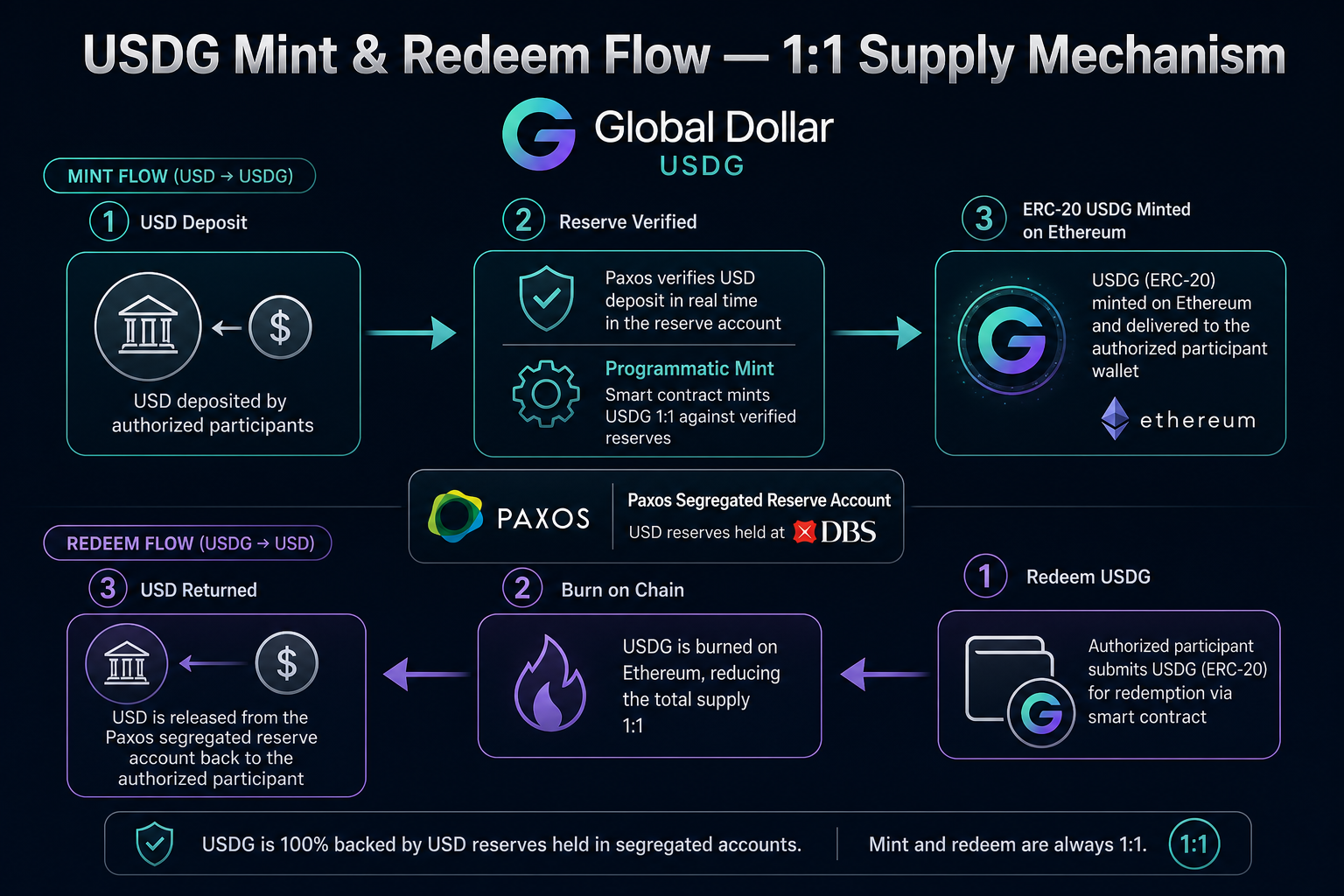 Figure 1. USDG mint and redeem process: USD deposit triggers programmatic minting; the redeem path burns ERC-20 tokens and returns USD.
The diagram above shows the two-way flow of USDG: the mint path goes from USD deposit → reserve confirmation → on-chain minting; the redeem path goes from submitting USDG → on-chain burn → USD return. Both paths share the same 1:1 supply constraint, ensuring symmetrical increases and decreases.
How Does USDG Circulate On-Chain? ERC-20 and Multi-Chain Composability
Newly minted USDG circulates as an ERC-20 token on Ethereum and other blockchains approved by Paxos. The ERC-20 interface allows USDG to integrate directly into DeFi protocols, wallets, cross-chain bridges, and payment gateways without requiring additional adaptation layers. After receiving minted USDG, partners or institutions can transfer, custody, or inject it into liquidity pools on-chain.
The USDG smart contract has undergone an independent third-party audit, covering core functions such as mint, burn, and permission management. The total on-chain supply can be publicly queried via block explorers and cross-referenced with Paxos' periodic reserve reports and attestations. When using USDG, users must confirm that the contract on the target chain is the official Paxos deployed version to avoid interacting with counterfeit contracts.
| On-Chain Element |
Description |
| Token Standard |
ERC-20 |
| Supported Networks |
Ethereum and other Paxos-approved chains |
| Core Operations |
mint (issue), burn (destroy), transfer |
| Contract Security |
Independent third-party smart contract audit |
The table above summarizes the technical parameters of USDG on-chain. The ERC-20 standard and multi-chain deployment provide a unified value representation across GDN ecosystem participants while preserving verifiable on-chain supply transparency.
How Is USDG Redeemed? Burn and USD Return Process
Redeeming USDG is the reverse of minting. A holder or authorized institution submits a redemption request to Paxos, transferring the on-chain USDG to a designated address or calling the redeem interface. After confirming receipt of the USDG, Paxos executes a burn through the smart contract, permanently destroying the corresponding number of on-chain tokens, then returns an equivalent amount of USD from the segregated reserve account to the requester.
The burn mechanism is central to maintaining the 1:1 peg: each time a USDG is burned, the circulating supply decreases by one, and the corresponding USD in the reserve is released and returned to the redeemer. If a refund is made without completing the burn, or if the burn quantity doesn't match the refund amount, the supply and reserves become misaligned. The Paxos issuance system binds burn confirmation with USD withdrawal in the same business process.
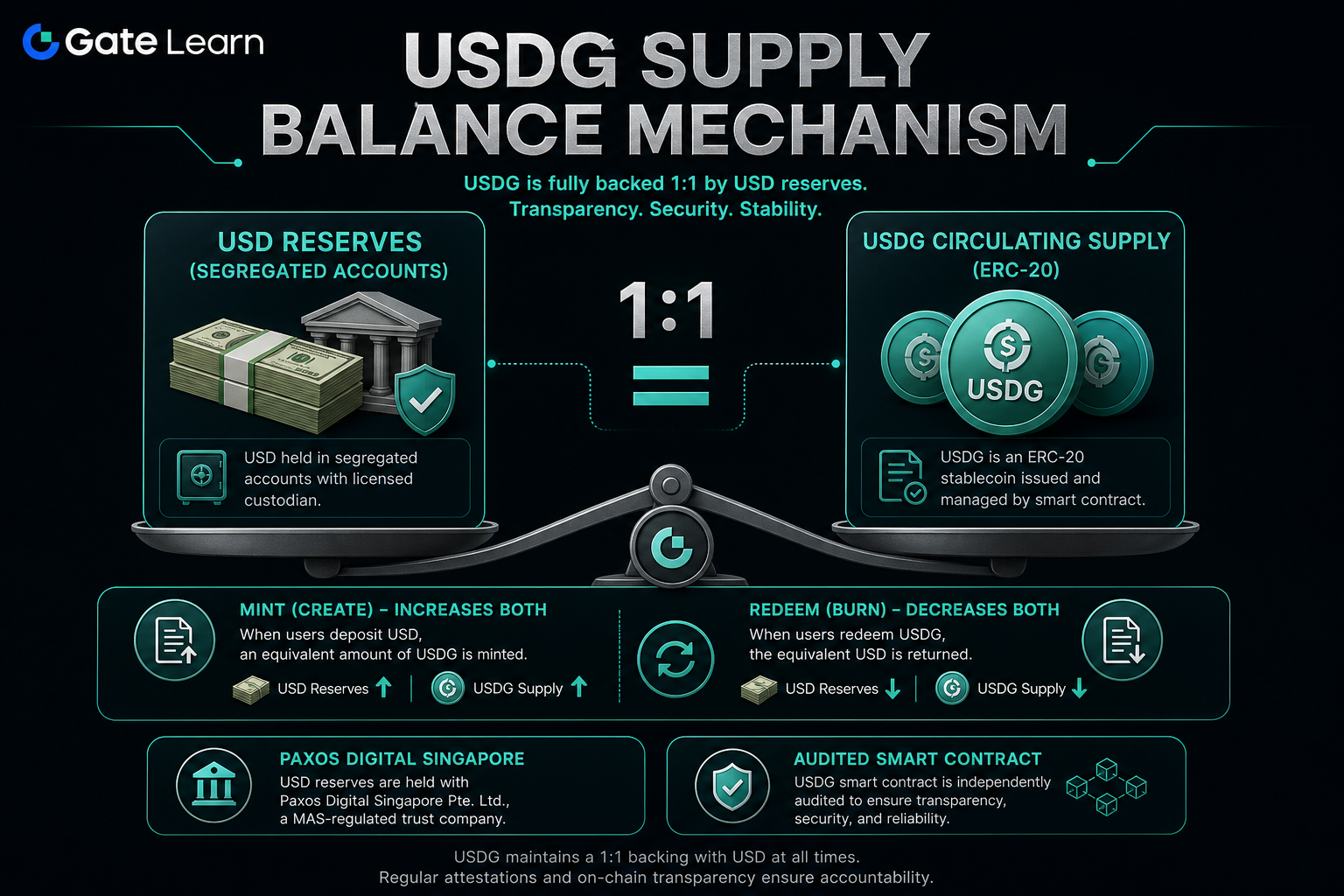 Figure 2. USDG 1:1 supply balance: segregated USD reserves correspond to ERC-20 circulating supply; mint and burn mechanics keep both sides synchronized.
The diagram above illustrates the USDG supply mechanism in a balanced structure: on the left side are the USD reserves in the segregated account, on the right side is the on-chain ERC-20 circulating supply. Minting increases both sides simultaneously, and redeeming (burning) decreases both sides simultaneously, maintaining the 1:1 relationship.
How Long Does It Take to Receive USD After Redeeming USDG? Banking Hours and Liquidity Constraints
The final stage of redeeming USDG involves off-chain bank transfers, so it's subject to banking hours, clearing cycles, and cross-border remittance rules. The USD in Paxos' segregated reserve account must be transferred out through custodian banks such as DBS, and large or cross-border redemptions may require additional processing time. On-chain burns can be completed instantly after blockchain network confirmation, but the time for USD to arrive depends on bank processing efficiency.
Institutional Mint partners typically handle bulk minting and redemption via APIs and need to maintain sufficient on-chain USDG balances or USD liquidity to handle redemption spikes. The redemption path for ordinary token holders is similar to that of institutions, but processing priority and delivery times may vary based on account type and amount. Reserves are 100% cash and cash equivalents, with no high-risk assets, helping to maintain liquidity when redemption demand rises.
How Do Mint Partners Drive USDG Circulation Growth?
Within the Global Dollar Network (GDN), Mint partners are the primary drivers of incremental USDG circulation. Mint partners approved by GDN deposit USD into Paxos reserves, trigger programmatic minting, and inject USDG into exchanges, payment platforms, or treasury accounts. Hold partners hold already-circulating USDG to participate in yield distribution, and Accept partners accept USDG as a means of payment. Neither holder nor acceptor directly triggers minting, but they absorb the circulating supply injected by Mint partners.
GDN network rules link Mint partners' circulation contribution to their share of reserve yield, creating a cycle of "minting drives adoption, adoption shares yield." Paxos, as the issuer, handles reserve custody and on-chain burn/mint execution, while GDN defines partner onboarding and yield distribution frameworks. This division of labor couples USDG supply expansion with network adoption.
Summary
USDG minting and redemption follow the principle of "reserves first, on-chain synchronization": Paxos programmatically mints ERC-20 USDG only after confirming that USD has been credited to the segregated reserve account, and when redeeming, it first burns the on-chain tokens before returning the equivalent USD. Paxos Digital Singapore operates under the MAS MPI framework for issuance. The smart contract has been independently audited, and the circulating supply always maintains a 1:1 correspondence with reserves. GDN Mint partners use this process to inject incremental supply into the ecosystem, while Hold and Accept partners take on on-chain circulation and use cases.
FAQ
When is USDG minted?
USDG is minted on-chain only after Paxos confirms that an equivalent amount of USD has been credited to its segregated reserve account and that the deposit has passed compliance review. Mint requests that don't meet the reserve precondition are not processed, ensuring every new USDG has a corresponding USD reserve.
What happens on-chain when USDG is redeemed?
When redeeming, the requester submits USDG through Paxos' designated process, and the smart contract executes a burn, permanently destroying the corresponding number of on-chain tokens. After burn confirmation, Paxos returns an equivalent amount of USD from the segregated reserve account to the requester.
How does Paxos ensure the 1:1 correspondence between USDG supply and reserves?
Paxos uses a two-way constraint: "reserves first, then mint; burn first, then refund." Minting strictly lags behind reserve confirmation, and redemption is strictly linked to burn and USD disbursement. Monthly reserve reports and independent attestations are available for public verification of total on-chain supply against reserve balances.
Is the USDG smart contract secure?
The USDG smart contract follows the ERC-20 standard, covers core functions such as mint, burn, and permission management, and has been audited by an independent third party. Before use, users must confirm that the contract on the target chain is the official Paxos deployed version.
Can ordinary users mint USDG directly?
USDG minting is available to GDN-authorized Mint partners or institutions that submit a qualified application to Paxos. Ordinary on-chain users typically obtain the token through secondary markets or platforms that support USDG, rather than calling the mint interface directly.
How long does it take to receive USD after redeeming USDG?
The on-chain burn is completed after blockchain network confirmation, but the time for USD to arrive depends on banking hours, clearing cycles, and the remittance path. Large or cross-border redemptions may require additional processing time, subject to Paxos' procedures and bank efficiency.