AI data centers require more than just basic power—they demand uninterrupted, schedulable, contractually secured electricity with minimized carbon intensity. Any power interruption, delayed capacity expansion, or grid approval setback can directly impact rack deployments and Hashrate ramp-up, making electricity supply a critical factor in understanding VST’s business logic.
Vistra (VST) stands out in the power industry with its combination of nuclear baseload, natural gas peaking, battery storage, and a robust retail network. Its three-tiered business model—generation, market, and retail—aligns with the top priorities of data center operators: stability, flexibility, and contractability. Unlike pure nuclear firms or regulated utilities, Vistra’s exposure to competitive power markets is notably greater.
Why Is Stable Power Essential for Data Centers?
AI data centers rely on GPU clusters, networking gear, and cooling systems, all requiring nearly continuous electricity. Unlike residential power, data center load profiles are steady, but their tolerance for outages is extremely low—brief interruptions can halt training, cause data loss, or damage equipment.
Beyond reliability, large data centers also focus on schedulability and carbon intensity. Nuclear power delivers 24/7 baseload, natural gas ramps up quickly to meet surges, and storage and solar smooth out demand peaks. Corporate clients increasingly demand zero or low-carbon power contracts to meet ESG goals and regulatory requirements.
| Demand Dimension |
Data Center Focus |
Generator Implications |
| Continuity |
24/7 uninterrupted supply, minimal outage tolerance |
Baseload unit reliability, redundant design |
| Schedulability |
Rapid capacity increase during load spikes |
Natural gas peaking, storage response |
| Contractability |
Locked-in volume, term, and pricing |
Long-term PPA structure and execution |
| Low Carbon |
Zero or low-carbon sources |
Nuclear, solar, Vistra Zero portfolio |
These four dimensions define the core power needs of data centers. A generator’s ability to deliver continuous, flexible, contractable, and low-carbon power determines its suitability for long-term hyperscale Hashrate contracts.
Which Vistra Assets Support 24/7 Power?
Vistra’s portfolio spans nuclear, natural gas, coal, solar, and battery storage, with nuclear and natural gas forming the backbone of 24/7 supply. Nuclear units, with high capacity factors, deliver round-the-clock zero-carbon baseload; natural gas units provide rapid dispatch during peaks or nuclear maintenance.
Vistra operates multiple nuclear plants in the US and integrates solar and storage through Vistra Zero. Public disclosures indicate Vistra has signed nuclear PPAs with major corporate clients for up to 20 years, totaling more than 2,600 MW, covering both current output and planned upgrades.
| Asset Type |
Supply Role |
24/7 Suitability |
Key Limitations |
| Nuclear |
Baseload, zero-carbon |
High |
Slow ramp-up, lengthy expansion, regulatory hurdles |
| Natural Gas |
Peaking, flexible |
Medium-high |
Fuel price volatility, emission regulations |
| Solar |
Daytime generation |
Medium (with pairing) |
Intermittency, needs storage/gas backup |
| Battery |
Short-term balancing, arbitrage |
Medium (auxiliary) |
Limited capacity, cannot replace baseload |
Nuclear is Vistra’s core 24/7 baseload, natural gas adds dispatch flexibility, and storage plus solar enhance the zero-carbon mix. This complementary structure lets Vistra offer bundled solutions: nuclear as primary, natural gas as secondary, and storage as supplement.
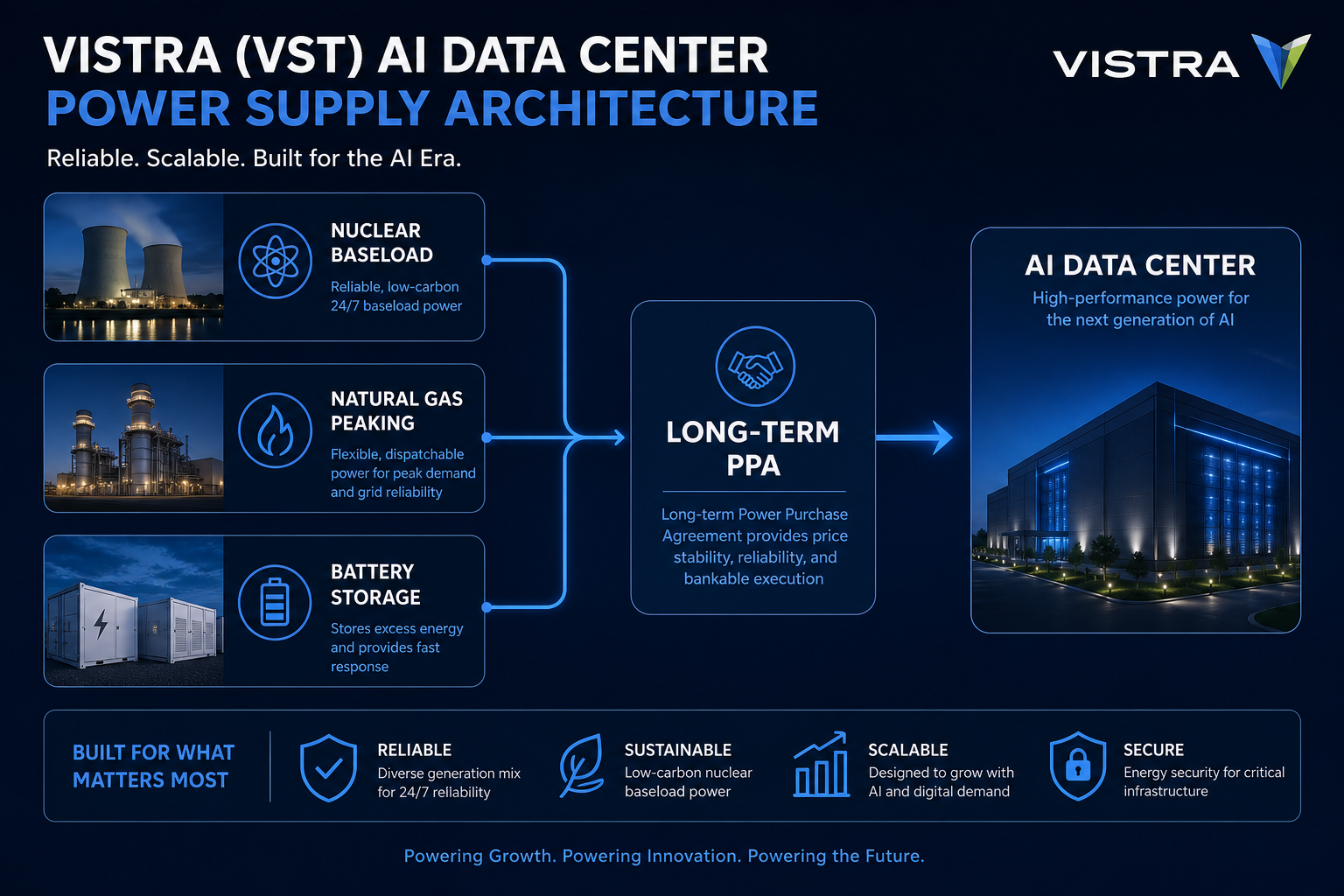
Figure 1. Vistra’s AI data center power architecture: nuclear delivers 24/7 baseload, natural gas handles peaking, storage and solar add flexibility, and long-term PPAs secure contractual relationships.
What’s the Role of Long-Term PPAs in the Business Model?
Long-term Power Purchase Agreements (PPAs) are contracts that lock in volume, term, and pricing between generators and consumers, typically spanning years or decades. For Vistra, PPAs serve three key purposes: anchoring demand for part of its output, providing revenue visibility for nuclear upgrades, and enabling direct supply to large enterprise clients.
PPAs typically specify contract duration, locked volume, pricing mechanism, delivery location, and zero-carbon attributes. Corporate clients gain predictable power costs; generators secure long-term revenue. Grid connection approval, transmission capacity, and nuclear upgrade licensing all affect contract execution, with signing and delivery often separated by several years.
How Do ERCOT and PJM Regional Differences Impact Supply?
Vistra’s main markets are ERCOT and PJM, with structural differences in pricing, dispatch rules, and grid approvals that directly affect supply routes and contract terms.
ERCOT operates an energy-only market, making prices highly sensitive to supply-demand balance. Vistra owns major natural gas and nuclear assets in ERCOT and serves Texas retail customers via TXU Energy. PJM uses a dual-track energy and capacity market, where generators earn both sales and capacity payments; Vistra operates nuclear and retail business in PJM via Energy Harbor.
| Dimension |
ERCOT |
PJM |
| Market Model |
Energy-only |
Energy + capacity |
| Price Drivers |
Supply-demand, weather, fuel costs |
Energy price + capacity payments |
| Vistra Key Assets |
Natural gas, nuclear, TXU Energy |
Nuclear, Energy Harbor |
| Data Center Hotspots |
Texas (Dallas, San Antonio, etc.) |
Virginia, Ohio, etc. |
| Grid Challenges |
Long queue times, transmission limits |
Nuclear upgrade approvals, regional transmission planning |
This comparison highlights ERCOT and PJM’s key differences. Reference VST vs CEG vs NextEra vs Duke for asset and regulatory exposure. Understanding these regional nuances is crucial for assessing Vistra’s PPA negotiation leverage and revenue structure.
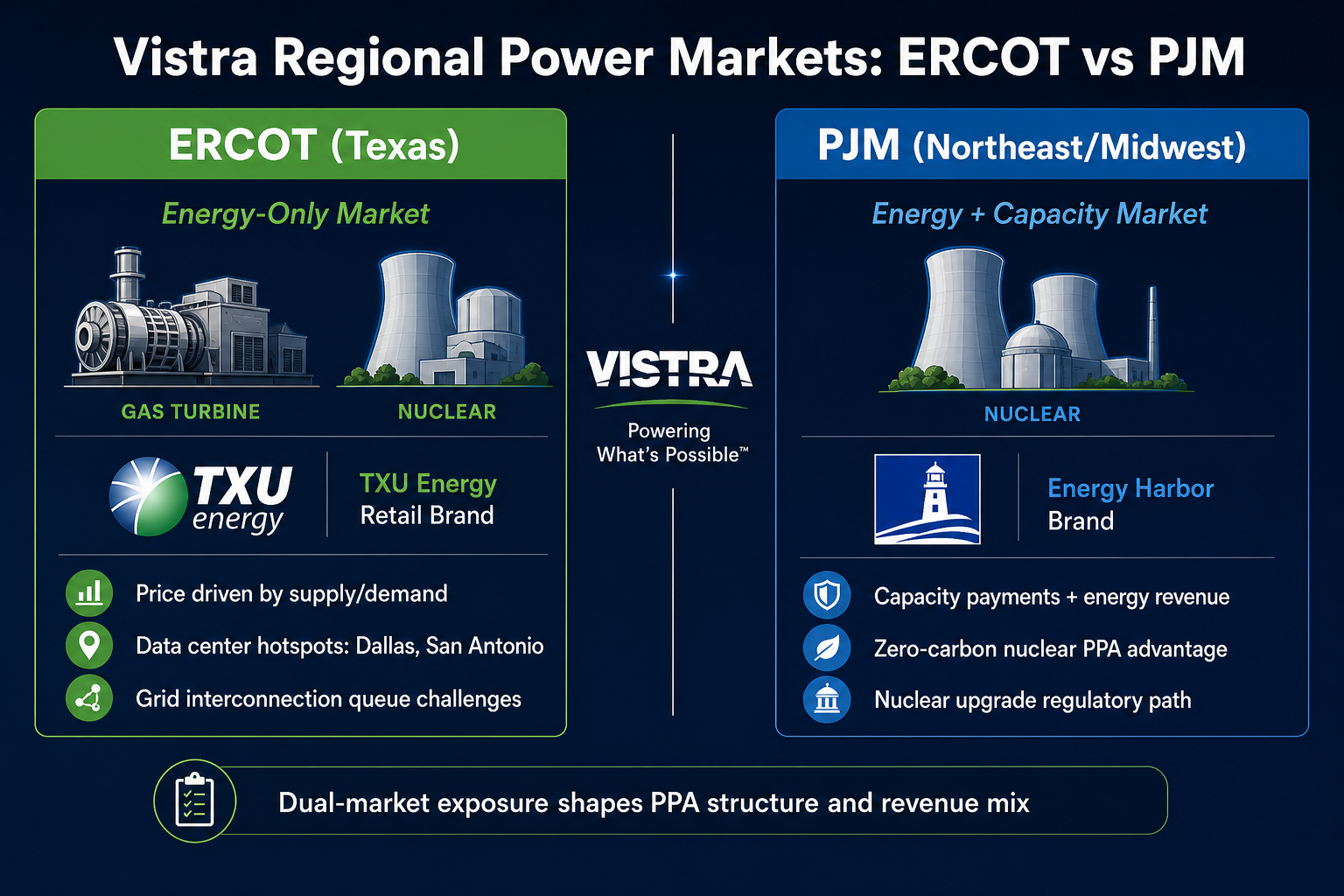
Figure 2. Vistra’s supply layout in ERCOT and PJM: ERCOT focuses on TXU Energy with natural gas/nuclear, PJM centers on Energy Harbor nuclear and the capacity market.
What Are the Advantages and Limitations?
Vistra’s strengths in AI data center power supply come from its diversified asset base and long-term PPA expertise. Nuclear delivers 24/7 zero-carbon baseload, natural gas supplements dispatch flexibility, and retail brands like TXU Energy and Energy Harbor connect end customers, forming a complete chain from generation to contract delivery.
However, limitations must be considered: nuclear upgrades require lengthy approvals, natural gas faces fuel price and emission regulation risks, and ERCOT’s energy-only market increases revenue sensitivity to price swings. Data center power demand is an industry variable—not a guaranteed growth driver for VST stock. The VST risk indicator checklist separates nuclear operation, market exposure, and trading risks for independent review alongside PPA mechanisms.
Both strengths and weaknesses exist; VST stock analysis should avoid oversimplifying with “AI power” or “nuclear” labels.
Summary
Vistra (VST) delivers continuous, contractually secured power solutions for AI data centers through nuclear baseload, natural gas peaking, and long-term PPAs. Nuclear provides 24/7 zero-carbon baseload, natural gas adds dispatch flexibility, and PPAs lock in volume and duration. ERCOT and PJM differ in pricing and capacity markets, affecting supply routes. A comprehensive understanding requires attention to asset mix, regional rules, PPA structure, and execution timing—not just a single storyline.
FAQ
Why do data centers need stable power?
AI data center GPU clusters and cooling systems require nearly continuous power; brief outages can disrupt training or damage hardware. Large facilities also prioritize schedulability, contractually locked pricing, and low carbon intensity for ESG compliance.
Which Vistra assets are suitable for 24/7 power supply?
Nuclear—with high capacity factors—delivers round-the-clock zero-carbon baseload and is central to 24/7 supply. Natural gas units ramp up quickly, supplementing flexibility during peaks or nuclear maintenance. Storage and solar provide auxiliary balancing but cannot independently replace baseload.
What does a long-term PPA mean for Vistra?
Long-term PPAs lock in volume, term, and pricing, anchor demand for part of Vistra’s output, and provide revenue visibility for nuclear upgrades. Signing and delivery may be separated by years; grid approval and unit licensing affect execution timing.
How do ERCOT and PJM impact Vistra’s supply capabilities?
ERCOT operates an energy-only market, with Vistra focusing on natural gas, nuclear, and TXU Energy retail, making prices highly sensitive to supply-demand. PJM features dual-track energy and capacity markets, with Vistra’s nuclear operations via Energy Harbor, capacity payments, and PPA negotiation leverage differing, along with distinct grid connection rules.
What are the limitations of AI data center power analysis?
Nuclear upgrade approval cycles, natural gas fuel price volatility, ERCOT price sensitivity, grid queueing, transmission constraints, and the gap between PPA signing and delivery are structural factors requiring independent review. Data center power demand is an industry variable, not a guaranteed growth driver.