However, Ethereum co-founder Vitalik Buterin believes that a fundamental limitation remains in blockchain technology: most cryptographic solutions focus primarily on protecting data, not program logic.
In June 2026, Vitalik published "Obfuscation: building the final boss of cryptography (Part I)," offering an in-depth analysis of Indistinguishability Obfuscation (iO). He argues that Obfuscation could become a foundational technology for building complex trustless systems. The reason: it aims to achieve what was once thought impossible—allowing programs to be used without exposing their internal logic.
If this technology matures, Ethereum could move beyond public verification to support advanced privacy-preserving computation, enterprise solutions, and AI-powered on-chain services.
Why Is Vitalik Refocusing on Obfuscation Technology
Ethereum's core philosophy has always been openness and transparency. Anyone can inspect smart contract code, verify protocol rules, and confirm that computations are executed as intended. While this transparency is fundamental to blockchain’s trustless model, it also introduces new challenges.
In the real world, many high-value applications are unwilling to reveal their core logic. Financial institutions won’t disclose risk models, quantitative trading teams keep strategies secret, and AI companies guard model parameters. If these businesses migrate directly to public blockchains, they gain decentralization but face major obstacles in protecting trade secrets.
Historically, cryptography has focused on "how to protect information." Encryption hides communication, zero-knowledge proofs let you prove correctness without revealing data. But these techniques don’t address a critical issue: how to hide the program itself.
Obfuscation directly addresses this. It enables a program to remain operational while concealing its internal algorithms and logic. For blockchain, this means smart contracts may no longer have to choose between "fully public" and "fully centralized"—they could achieve both verifiability and privacy.
What Is Obfuscation? Understanding Program Hiding in Cryptography
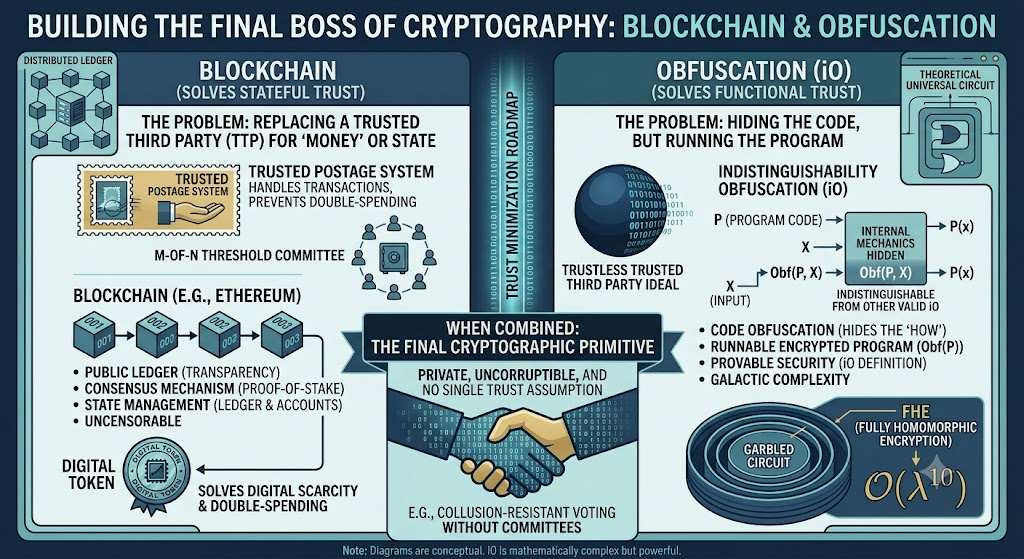
Obfuscation isn’t new in software engineering. Developers have long used code restructuring, variable renaming, and added complexity to hinder reverse engineering. But these are engineering defenses, not true cryptographic security.
Cryptographic Obfuscation pursues a much higher bar. It seeks to produce a specially transformed program that others can run and interact with—without ever learning the underlying logic.
Take a DeFi protocol with a complex trading algorithm. On Ethereum, this logic is typically public so users and developers can verify the code’s behavior. But public code means competitors can copy strategies, attackers can hunt for vulnerabilities, and arbitrageurs can analyze trading patterns.
If Obfuscation matures, protocol developers could conceal core algorithms while allowing users to access the protocol as usual. This could fundamentally reshape how smart contracts evolve, letting blockchain applications protect business logic much like traditional software.
Vitalik highlights Indistinguishability Obfuscation (iO) as a leading direction in the field. If two programs perform the same function, iO ensures that after obfuscation, it’s impossible to distinguish between them. This makes the program itself a cryptographically protected asset.
From Encryption and ZK to Obfuscation: The Evolution of Blockchain Privacy Technologies
Understanding Obfuscation’s significance requires context in cryptographic history.
Early encryption addressed data confidentiality. Users could encrypt information, but encrypted data typically couldn’t be used in computation, so decryption was needed before processing.
Zero-knowledge proofs (ZK) later became a breakthrough for blockchain. ZK lets users prove statements are true without revealing underlying data. Many Ethereum rollups and privacy protocols depend on ZK.
However, ZK mainly answers "how to prove correctness," while Obfuscation addresses "how to hide computation logic." They’re not competing—they solve different problems.
Future privacy-preserving computation will likely require a suite of cryptographic tools. Zero-knowledge proofs handle verification, fully homomorphic encryption (FHE) enables computation on encrypted data, and Obfuscation secures program logic.
Together, these technologies could form the backbone of next-generation blockchain privacy infrastructure.
Why Obfuscation Is So Important for Ethereum
Ethereum’s current model is built on public computation. Smart contract code is open for anyone to audit and verify. This ensures transparency and fairness but limits the complexity of applications that can live on-chain.
A financial firm may want to manage assets on-chain but not reveal its risk models; an AI project may want to participate in on-chain tasks but keep its algorithms secret; a DeFi protocol may have unique trading strategies it can’t risk being copied.
These challenges show that blockchains must address not just scalability, but also "how to protect complex application logic."
Obfuscation’s potential lies here. It could help Ethereum evolve from a public smart contract platform into a global, privacy-preserving open computing network.
In this paradigm, users verify system correctness, while developers protect core innovation. This could broaden blockchain’s application scope and draw more traditional business scenarios into the decentralized ecosystem.
DeFi stands to be one of the most impacted sectors.
Transparency in DeFi is a double-edged sword: public code builds trust, but all transaction logic and mechanisms are visible on-chain. This makes strategies easy to copy and amplifies MEV (Maximal Extractable Value) issues.
With Obfuscation, DeFi protocols could gain far greater design flexibility.
Developers could create more sophisticated financial products while safeguarding core algorithms. Trading strategies could remain secret, automated financial models would be harder to clone, and enterprise-grade finance could run securely on-chain.
This doesn’t mean blockchain loses transparency—it means cryptography enables a new balance: system outcomes remain verifiable, but critical logic isn’t fully exposed.
For DeFi, this could mark a shift from simple open protocols to more advanced on-chain financial infrastructure.
Obfuscation and AI Agents: The New Foundation for Next-Generation On-Chain Applications
Beyond DeFi, AI Agents could be a major driver for Obfuscation adoption.
As AI advances, intelligent agents are increasingly involved in on-chain operations—automated asset management, business execution, DAO governance, and complex trading.
Yet AI Agents’ models and strategies are valuable assets. Full disclosure risks copying, full centralization undermines Web3’s decentralization.
Obfuscation could offer a solution: AI Agents can operate on-chain while keeping internal models and logic confidential.
In the future, AI Agents could interact with blockchains and complete public tasks without exposing core decision-making. This could drive deeper AI-Web3 integration and unlock greater commercial value for on-chain intelligence.
Why Obfuscation Remains Distant from Large-Scale Adoption
Despite its promise, Obfuscation remains far from real-world deployment.
The biggest barrier is performance. Current iO research relies on advanced cryptographic schemes like lattice-based cryptography and homomorphic encryption. While progress is ongoing, computational costs remain high.
Blockchains require strict performance—Ethereum nodes must collectively process computations, so high-cost solutions are impractical for scale.
As a result, Obfuscation is still a long-term research area, not a production-ready technology.
But cryptographic history shows that many now-mainstream technologies faced similar hurdles. Zero-knowledge proofs also struggled with performance and engineering challenges early on, but with algorithmic and infrastructure advances, they became practical.
Will Obfuscation Become the Next Phase of Ethereum Infrastructure?
In the short term, the Ethereum ecosystem will continue focusing on scaling, ZK Rollups, account abstraction, and modular architectures. Obfuscation isn’t yet ready for mainstream user adoption.
Long-term, however, it could resolve blockchain’s enduring dilemma: how to protect privacy while maintaining decentralization and public verifiability.
If Obfuscation matures, Ethereum could become more than a platform for public smart contracts—it could support private computation, complex business logic, and collaborative AI on a global scale.
Vitalik’s exploration of Obfuscation isn’t a prediction of immediate transformation, but a vision for cryptography’s next frontier. Blockchain’s progress—from digital signatures to smart contracts to zero-knowledge proofs—has always depended on foundational breakthroughs.
Obfuscation could be the next cryptographic milestone to watch.
FAQs
What is Obfuscation?
Obfuscation is a cryptographic technique designed to hide a program’s internal logic while still allowing others to use it. Unlike basic code obfuscation, cryptographic Obfuscation aims for much stronger security.
Why is Vitalik interested in Obfuscation?
Vitalik believes blockchain has solved transparency and verification, but not program logic protection. Obfuscation could make smart contracts "operable but unreadable," enabling more private and sophisticated on-chain applications.
What’s the difference between Obfuscation and ZK Proof?
ZK Proofs (zero-knowledge proofs) focus on hiding data and proving correctness, while Obfuscation hides program logic. They solve different problems and may be used together in the future.
How could Obfuscation impact Ethereum?
If it matures, Obfuscation could enable private smart contracts, privacy-preserving DeFi, on-chain AI Agents, and other innovations—combining transparent verification with logic protection.
Is Obfuscation ready for large-scale use?
Not yet. High computational costs mean Obfuscation is still in the research phase. More optimization and infrastructure development are needed for real-world adoption.
Why is Obfuscation called cryptography’s "final boss"?
Because it tackles a longstanding challenge: making programs usable while concealing their inner workings. This is even harder than hiding data, making it one of cryptography’s most formidable frontiers.







