As global cross-border payments continue to surge, traditional financial systems are facing increasingly significant challenges in settlement efficiency, cost, and process complexity. To explore more efficient payment models, the Bank for International Settlements (BIS) has joined forces with multiple central banks and financial institutions to launch Project Agorá, aiming to build next-generation wholesale cross-border payment infrastructure leveraging tokenization and blockchain technology.
What Is Project Agorá?
 (Source: Project Agorá)
Project Agorá, jointly initiated by the Bank for International Settlements (BIS) and the Institute of International Finance, is an experimental research project focused on wholesale cross-border payment systems. The initiative brings together seven central banks and more than 40 regulated financial institutions worldwide to test whether a tokenized financial framework can address persistent issues in international payments—namely, low efficiency, high costs, and complex settlement processes.
According to BIS’s latest report, the prototype platform can settle wholesale cross-border payments within seconds once liquidity is locked.
Why Does the Global Payment System Need an Upgrade?
Currently, large cross-border transactions are hindered by varying business hours, intermediary bank processes, and compliance review mechanisms across countries, resulting in prolonged fund transfers.
FXC Intelligence data cited in the report shows that global cross-border payment volume reached $195 trillion in 2024 and is projected to grow to $320 trillion by 2032. As transaction volumes rise, the market is increasingly focused on more efficient financial infrastructure. Project Agorá aims to redesign cross-border payment processes using blockchain and tokenization technologies.
How Does Project Agorá Work?
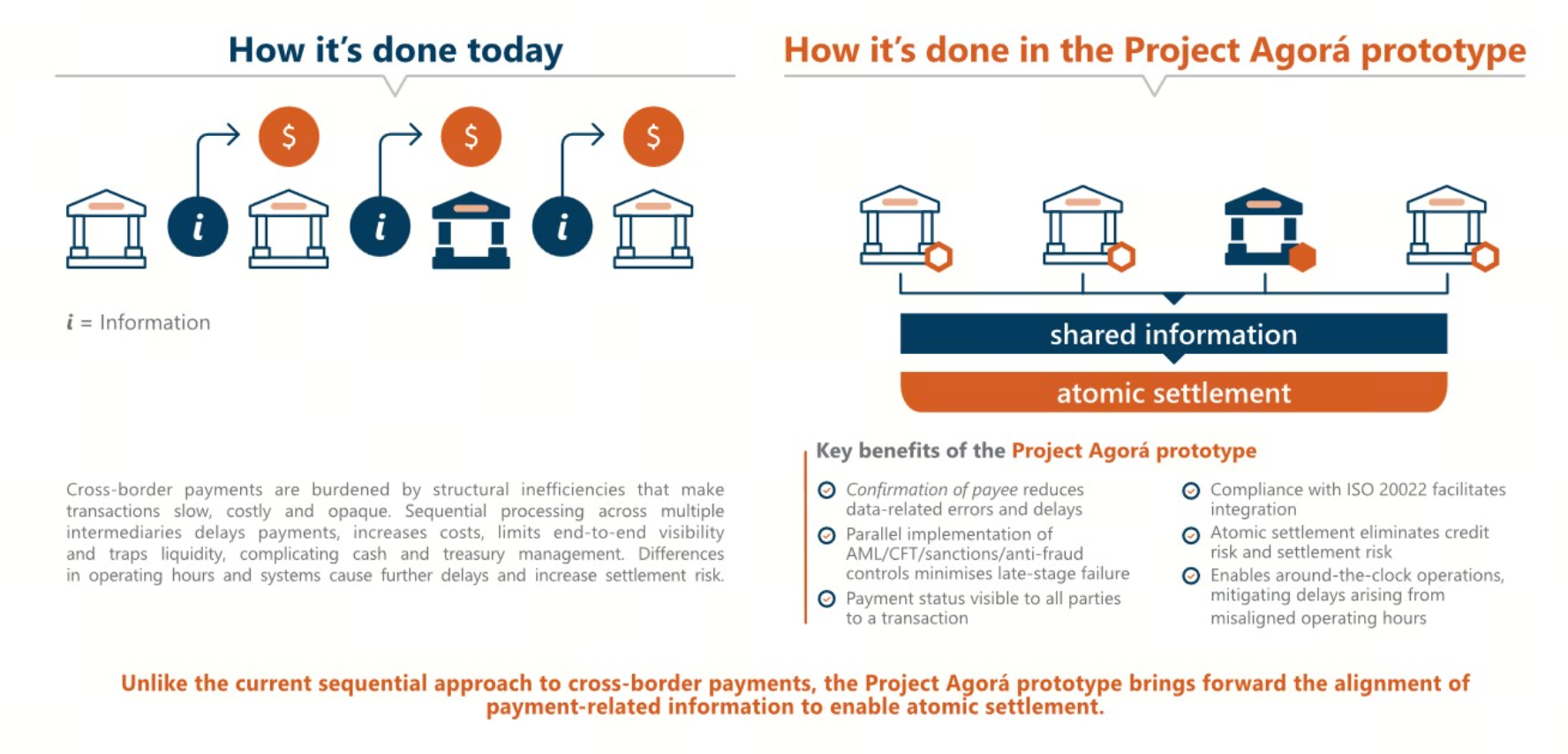
Project Agorá utilizes a dual-layer blockchain architecture, with central bank reserves tokenized and maintained on ledgers within each jurisdiction, while commercial bank deposits are managed on a shared unified ledger. This combination enables atomic settlement, meaning all account balances in a transaction are updated simultaneously—or the transaction fails. BIS believes this approach reduces credit and settlement risks inherent in traditional cross-border payments. The architecture preserves the existing two-tier banking system and maintains the singleness of money, which distinguishes BIS’s model from certain stablecoin frameworks.
What Improvements Does Tokenized Payment Offer?
Beyond shortening settlement times, Project Agorá seeks to optimize compliance processes in cross-border payments. BIS notes that the platform enables anti-money laundering, sanctions screening, and fraud checks to occur simultaneously, rather than sequentially as in traditional systems. This could significantly reduce the high rate of false positives prevalent in current cross-border payment systems.
Transparency is another key benefit. Transaction participants can view payment status in real time, while privacy for non-participants is preserved. BIS also suggests that this visibility could eventually extend to end users, including payers and recipients.
Project Agorá’s Next Step: Real-Value Testing
 (Source: BIS)
Project Agorá has now moved into the real-value testing phase, involving select currencies and authentic transaction scenarios.
However, BIS has yet to announce a specific timeline for full deployment.
The report highlights several critical areas requiring ongoing development:
-
Liquidity-saving mechanisms
-
Network security capabilities
-
Governance structure
-
Settlement finality
-
Data governance
-
Risk management mechanisms
The platform also supports 24/7 operations, aiming to mitigate delays caused by differences in time zones and business hours across countries.
Which Central Banks Are Participating in Project Agorá?
Participating central banks include:
Notably, the Bank of England has recently proposed extending the operating hours of its RTGS and CHAPS systems to move toward near-continuous settlement.
Sarah Breeden, Deputy Governor of the Bank of England, has noted that shared ledgers and tokenization technology could make payment and settlement processes faster and more cost-effective, while reducing intermediary involvement.
Summary
Project Agorá represents one of the largest tokenized payment collaborations among global central banks and major financial institutions. Although still in testing and validation, BIS’s latest report demonstrates the real-world potential of tokenized payment frameworks for wholesale cross-border financial transactions. As global payment volumes grow, balancing efficiency, security, and financial stability will be a central focus in the evolution of financial infrastructure.
FAQ
Q1: What is Project Agorá?
Project Agorá is a cross-border payment research project jointly led by the Bank for International Settlements (BIS) and the Institute of International Finance (IIF), aiming to improve international payment and settlement efficiency through tokenization and blockchain technologies.
Q2: What problems does Project Agorá address?
Project Agorá targets slow speeds, high costs, complex processes, and inefficient settlement in traditional cross-border payments, enabling faster, safer, and more transparent fund flows.
Q3: What stage is Project Agorá at now?
Project Agorá has entered its real-value testing phase, validating the feasibility of tokenized payments in real-world transaction scenarios. However, the official launch timeline has not yet been announced.







