Digital identity has always been a cornerstone of the internet. From logging into traditional websites to undergoing identity verification at financial institutions and managing social media accounts, authentication determines how users access services and build trust. But in the Web3 landscape, users are often forced to repeatedly authenticate across different platforms, resulting in fragmented data and redundant verification processes that have persisted for years.
As digital identity, DAO governance, real-world assets (RWA), and the AI Agent ecosystem evolve, a unified identity layer is becoming a key piece of blockchain infrastructure. BNB Passport was introduced as an identity solution precisely to address this need.
What Is BNB Passport?
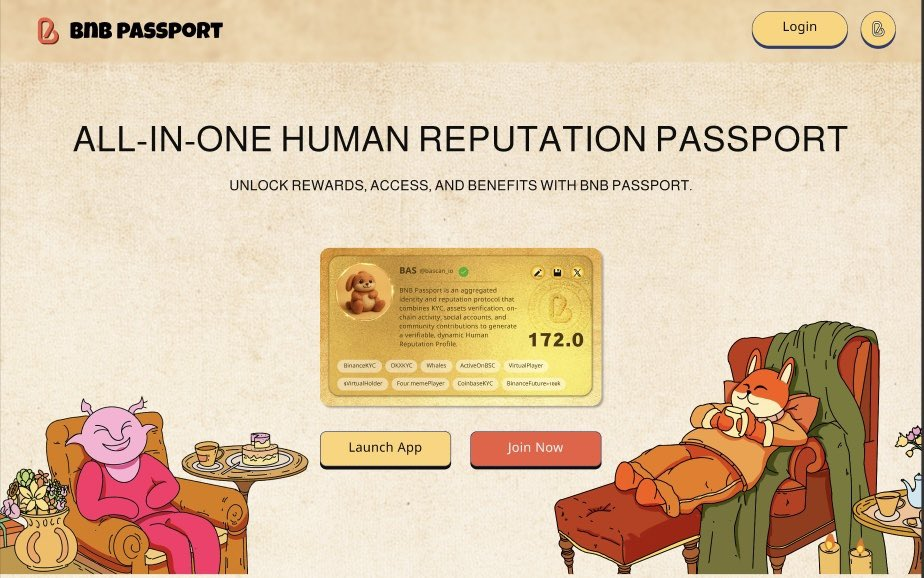
BNB Passport is a digital identity system built on BNB Attestation Service (BAS) that aggregates and manages various identity credentials for users.
In the traditional internet, identity information is typically siloed across platforms. Users have to register and verify themselves repeatedly on e-commerce sites, social media, and financial institutions, with no interoperability between those records.
BNB Passport aims to change that. By turning verified identity information into Attestations, it brings together credentials from different sources into a unified identity framework, creating a digital identity profile that stays up to date.
BAS is the underlying attestation infrastructure, while BNB Passport is the identity application layer built on top of it.
BAS handles creating, storing, and verifying Attestations, while BNB Passport uses those proofs to build the user identity system. Think of BAS as the digital proof network and BNB Passport as the application that leverages those proofs to construct an identity profile.
When users complete identity verification, obtain DAO membership, or pass an enterprise audit, the results are recorded as Attestations on BAS. BNB Passport then aggregates these proofs into a structured, verifiable identity profile.
In short, BAS provides the trust infrastructure, and BNB Passport delivers identity management capabilities.
BNB Passport is not a single identity verification tool—it's an identity framework that can aggregate multiple credential types.
In practice, BNB Passport can integrate KYC results, linked social accounts, on-chain activity history, DAO memberships, and enterprise certifications. As users engage with more applications, new Attestations can be added to their identity profile over time.
This dynamic update mechanism lets the identity system grow with the user, forming a more complete digital identity picture.
Unlike traditional account systems, BNB Passport focuses on identity continuity and verifiability, not just serving as a login credential.
How Does BNB Passport Build Identity Using Attestation?
Attestation is the core building block of BNB Passport.
When a user completes a certification, the issuing authority signs a corresponding Attestation through BAS. For example, users get an identity verification Attestation after KYC, a membership Attestation after joining a DAO, and potentially a contribution record Attestation after participating in governance.
These proofs are recorded on the BAS network and linked to the user's address. BNB Passport aggregates these individual proofs into a structured identity profile.
Since every piece of information has a verifiable source, third-party applications can quickly validate the user's identity without running through complex review processes again.
What Is the Difference Between BNB Passport and DID?
DID (Decentralized Identity) is an identity standard, while BNB Passport is more of a concrete identity product.
DID defines identity identifiers and control rights, emphasizing user sovereignty over identity data. BNB Passport, on the other hand, uses BAS's attestation mechanism to bring together identity information from different sources into a unified framework.
They're not competitors—they're highly complementary.
DID answers "who owns the identity," while BNB Passport tackles "how to prove identity" and "how to reuse identity."
Future digital identity systems will likely need to rely on both DID and Attestation infrastructure.
What Are the Application Scenarios for BNB Passport?
DeFi and Compliant Finance
As regulatory requirements tighten, some DeFi protocols need to verify user identity or regional eligibility. BNB Passport lets users verify their identity while protecting privacy and cuts down on repeated KYC processes.
DAO Governance
DAOs need to identify members and track contributions. With BNB Passport, governance participation history and community contributions can be stored and verified over the long term, improving governance efficiency.
RWA Ecosystem
Real-world assets depend on extensive off-chain data. BNB Passport can integrate investor identity, asset holding eligibility, and compliance certifications, providing a trusted identity foundation for RWA applications.
Web3 Social Networks
Social platforms can use BNB Passport to build a more trustworthy user system, reducing the impact of bots and fake identities on the community.
AI Agent Networks
As AI Agents become key players in the blockchain ecosystem, identity verification needs are growing. BNB Passport's identity framework helps Agents establish reputation records and enables cross-platform collaboration.
What Challenges Does BNB Passport Face?
Building a digital identity system comes with hurdles.
First, the credibility of identity proofs depends on the quality of the Attester. If the issuing institution lacks trustworthiness, the value of the proof is undermined.
Second, different regions have different regulations around digital identity and privacy. Striking the right balance between identity verification and privacy protection remains a major challenge for the entire industry.
Third, identity standards aren't fully unified yet. With more blockchain networks and identity protocols emerging, cross-chain identity interoperability will be a key focus going forward.
Summary
BNB Passport is a digital identity system built on BAS. It uses the Attestation mechanism to integrate identity verification, activity records, and qualification credentials, helping users create verifiable and reusable Web3 identity profiles. Compared to the fragmented identity systems of the traditional internet, BNB Passport emphasizes interoperability, verifiability, and user control over identity data.
FAQs
What Is the Difference Between BNB Passport and BAS?
BAS is the underlying Attestation infrastructure that creates and verifies proofs. BNB Passport uses those proofs to build user identity profiles. Think of it as the infrastructure layer versus the application layer.
Does BNB Passport Require KYC?
BNB Passport can incorporate KYC results but is not a KYC system itself. Whether users need to complete KYC depends on the specific application and service requirements.
Are BNB Passport and DID the Same Concept?
No. DID is a decentralized identity standard, while BNB Passport is a specific product that builds an identity system using Attestations. They focus on different aspects.
Can a User Have Multiple Identity Proofs?
Yes. BNB Passport supports aggregating multiple identity credentials, including KYC certifications, DAO memberships, on-chain activity records, and enterprise qualifications.